Semantica: A Knowledge Graph for AI Agents

Semantica is a graph-native context and provenance layer for AI agents, with deterministic reasoning and W3C PROV-O audit trails. What it is, who needs it.
Table of Contents
A knowledge graph for AI agents solves a problem embeddings can't touch: months later, when someone asks why the system decided what it decided, you need an answer that survives scrutiny. A vector store can tell you which chunks were near the query. It cannot tell you which facts were used, where they came from, or what would have changed the outcome.
Semantica is built for that gap: a knowledge graph for AI agents where the audit trail is the point. It calls itself "the open source Palantir for AI agents," which is a bold way to describe a Python package, and the substance underneath is a deterministic layer: knowledge graph construction, reasoning and provenance, none of which require an LLM to run.
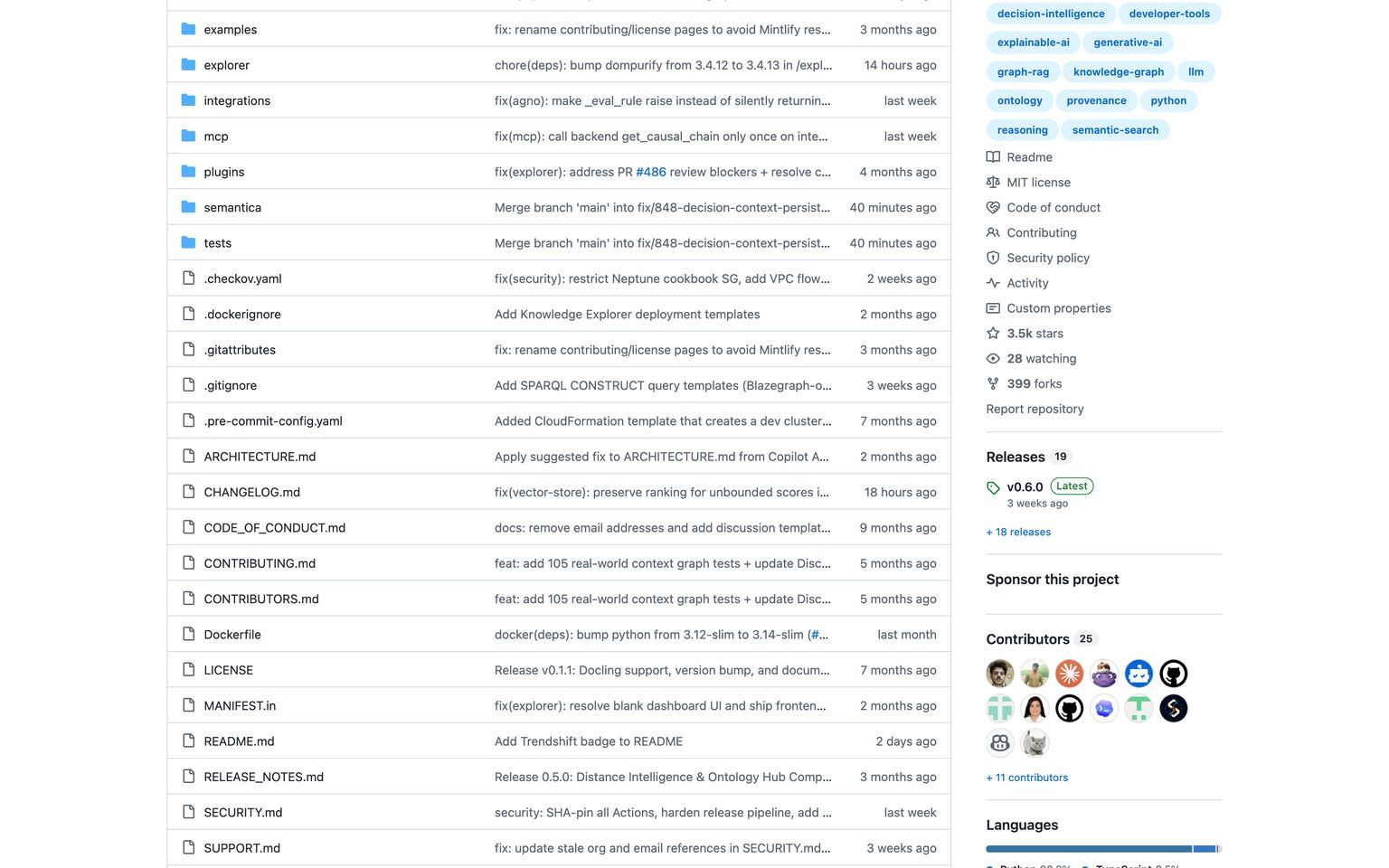
semantica-agi/semantica started on June 25, 2025 and reached 3,435 stars by August 10, 2026. MIT licensed, pip install semantica, with v0.6.0 shipping on July 21.
Key Takeaways:
- The reasoning and graph layers are deterministic. Forward chaining, a Rete network, Datalog and SPARQL, with no model in the loop and explainable paths out.
- Provenance follows the W3C PROV-O standard, attached per fact, exportable to JSON, CSV or RDF for an audit.
- Storage is swappable: RDF backends (embedded Oxigraph, Blazegraph, Apache Jena, RDF4J) and labeled property graphs (Neo4j, FalkorDB, Apache AGE, AWS Neptune), plus vector stores, without code changes.
- Conflicting facts get flagged rather than silently overwritten, which is the behaviour that separates a knowledge base from a cache.
- Databricks and Snowflake connectors turn tables already in Unity Catalog or a warehouse into graph nodes, with lineage, and without exporting to someone else's SaaS.
What Semantica is
An infrastructure layer that sits underneath your LLM, your vector store and your agent framework rather than replacing any of them.
The pitch is aimed at regulated work, and the example the README leads with is lending: an underwriting agent approves an application, and months later a regulator asks why. "The embedding was close" isn't an answer anyone accepts. What Semantica stores instead is the decision as a first-class object, linked to the facts behind it, each fact carrying provenance back to its source, with the reasoning path reproducible.
Six audiences get named explicitly, and the list is unusually specific for a README: platform teams shipping consequential agents, data teams on Databricks or Snowflake, compliance and audit functions, regulated enterprises in finance and healthcare and government, infra engineers who want the stack self-hosted, and knowledge engineers building graphs from messy multi-source data.
Notice what's missing from that list: hobbyists, side projects, anyone doing this for fun. This is enterprise plumbing published under an open licence, and the shape of the feature set follows from that.
Graph-native context versus vector memory
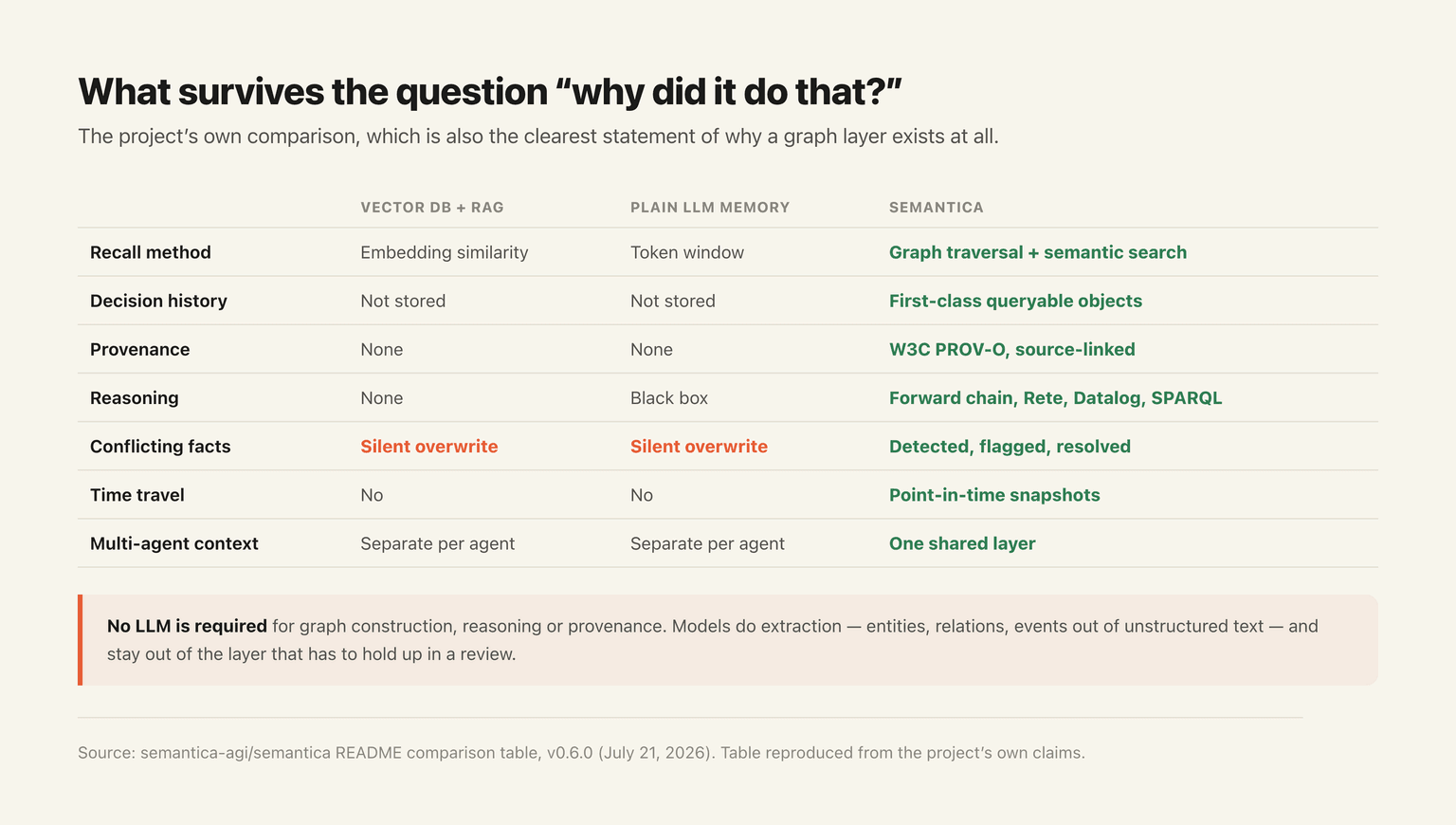
The comparison table in the README is the clearest statement of the argument, so here's the substance of it.
Vector RAG recalls by embedding similarity; a plain model recalls by whatever fits in the token window; Semantica recalls by graph traversal combined with semantic search. Decision history isn't stored in either of the first two. Provenance is absent from both. Reasoning is either non-existent or a black box.
Then the differences that matter operationally. Conflicting facts in a vector store overwrite each other silently, because a store of chunks has no notion that two chunks contradict. A graph with constraints detects the conflict and flags it. Point-in-time snapshots let you ask what the system knew on a given date, which no embedding index supports. Entity resolution merges duplicates through blocking and semantic deduplication instead of letting the same customer exist four times.
And multi-agent context stops being per-agent. Where each agent normally keeps its own memory, a shared graph is one intelligence layer several agents read and write, which is a structural answer to a coordination problem people usually solve with prompt discipline.
We've covered the general distinction in agent memory versus chat history; this is what the industrial version of that argument looks like when the auditors are involved.
How provenance and reasoning actually work
Two claims here deserve separating, because one is a standards decision and the other is an architectural one.
Provenance uses PROV-O, the W3C vocabulary for describing how data came to be. Every fact carries it, source-linked, and audit trails export to JSON, CSV or RDF. The value of picking a standard over inventing a format is that a regulator's tooling, or a partner's, can read it without you writing an adapter.
Reasoning runs on classical engines: forward chaining, a Rete network for efficient rule matching, Datalog for recursive queries, SPARQL for graph queries. All deterministic, all with explainable paths. Governance sits alongside as SHACL constraints, OWL generation and SKOS vocabulary management, with a visual editor.
The consequence people miss: no LLM is required for graph construction, reasoning or provenance. Run the same rules on the same graph twice and get the same answer, which is exactly what a model cannot promise. Language models still have a place in the pipeline for extraction, pulling entities, relations and events out of unstructured text, but they stay out of the part that has to be defensible.
That separation is the design decision worth stealing whether or not you ever install this. Put the model where fuzziness is acceptable and keep it out of the layer that has to hold up in a review, an argument that runs parallel to what governance tooling like Cambium is doing for LLM-maintained knowledge corpora.
Building accountable AI systems with knowledge graphs
Accountability, in practice, is four questions asked after the fact: what did the system know, where did it get it, what rule fired, and would a different input have changed the outcome.
Ordinary agent stacks answer none of them. The context was assembled at runtime from a retrieval call nobody logged, the model reasoned in a way nobody can reconstruct, and the only artefact is a chat transcript. That's tolerable when an agent drafts a marketing email and unacceptable when it declines a mortgage.
A knowledge graph for AI agents changes the artefact. The decision is a stored object rather than a message. The facts behind it are nodes with sources. The rule that fired is inspectable, and because it's deterministic, re-running it produces the same result rather than a paraphrase.
Where this gets hard is upkeep. Ontologies drift, extraction misses things, and a graph nobody maintains becomes confidently wrong in a way a vector index never quite manages. Semantica's answer is conflict detection and provenance-preserving merges, which helps, and does not eliminate the ongoing cost of curating a model of your domain. Budget for that before you budget for the infrastructure, and think of it as an extension of the same problem set as context engineering, just with a compliance department attached.
What it takes to run
pip install semantica, and then a set of choices that will occupy an afternoon.
Storage is the first: an embedded Oxigraph gets you moving with nothing to deploy, while Neo4j, FalkorDB, Apache AGE, AWS Neptune, Blazegraph, Jena or RDF4J are all supported if you already run one. The swappability claim is the strongest reason to look at this over a hosted graph product, since the alternative is committing your ontology to somebody's proprietary backend.
Integration surface is broad: an MCP server, native Agno support, a REST API, a CLI, and editor plugins. The MCP server is the shortest path if you already run agents that speak it, since the graph becomes another tool rather than a rewrite.
Enterprise connectors are the differentiated part. Databricks support covers Unity Catalog and Delta Lake with PAT or OAuth machine-to-machine auth and catalog, schema, table and lineage introspection; Snowflake covers warehouse, database and schema with key-pair or OAuth. Tables you already have become graph nodes carrying provenance, skipping the export-and-reimport step that usually kills these projects at the pilot stage.
Watch the version number, though. v0.6.0 in July 2026, after thirteen months of development, is not a stable API, and the feature list is wide enough that some corners of it will be thinner than others. Test the specific path you need.
The "open source Palantir" claim, weighed
Positioning yourself against Palantir is a choice, and it invites the obvious question of whether the comparison survives contact.
What holds up: the problem framing is genuinely the same. Fragmented enterprise data, an ontology over it, decisions that need to be explainable to somebody with subpoena power, and buyers in defence, government, finance and healthcare who cannot ship a black box. The feature list maps onto that framing rather than onto developer convenience, and a knowledge graph for AI agents built for auditors looks very different from one built for chatbots.
What doesn't: Palantir sells forward-deployed engineers as much as software, and the hard part of these deployments has always been the six months of someone sitting with your data teams working out what your entities actually are. A pip install does not replace that, and no open-source project can. You are buying the machinery, not the modelling.
The honest read is that this is infrastructure for teams who already know they need an ontology and don't want to buy one. If your organisation hasn't reached that conclusion yet, the tool won't get you there.
Also worth noting: 3,435 stars for something this enterprise-shaped is a lot, and star count in this category measures curiosity, not deployments.
FAQ
Is Semantica open source?
Yes, MIT licensed and self-hostable, installable with pip install semantica. The positioning line about being an open-source alternative to closed decision-intelligence platforms is the project's own, and the practical version of it is that nothing forces you onto a particular graph backend or a vendor's cloud.
What is graph-native context for AI agents?
Context stored as entities and relationships in a graph rather than as text chunks in a vector index. Retrieval becomes traversal, so an agent can follow relationships instead of hoping similar-sounding text is nearby, and every fact can carry a source. It's the difference between remembering what a document said and knowing what is true and why you believe it.
Does Semantica need an LLM?
Not for the parts that matter to an auditor. Graph construction, reasoning and provenance are deterministic and run without a model. Language models are useful for extracting entities, relations and events from unstructured text, but they sit outside the reasoning and provenance layers by design.
Which graph databases does it support?
RDF stores through SPARQL, including embedded Oxigraph, Blazegraph, Apache Jena and Eclipse RDF4J, and labeled property graphs through Cypher, including Neo4j, FalkorDB, Apache AGE and AWS Neptune. Vector stores plug in alongside. The point of the polyglot design is that swapping backends doesn't mean rewriting your code.
How does it compare with a vector database?
They answer different questions and the project positions them as complementary. A vector store finds text that resembles your query; Semantica records what was decided, which facts supported it, where those facts came from, and which rule fired. It adds decision records, causal reasoning, provenance, conflict detection and audit trails on top of a stack you keep.
Continue Reading
More Research
MiroFish: Open-Source Swarm Prediction Engine

Cambium: A Governance Standard for LLM Corpora

SwarmForge: Uncle Bob's Agent Orchestration

TradingAgents: A Multi-Agent LLM Trading Desk

Harvey LAB: An Open Legal Agent Benchmark

Prime Agent: Prime Intellect's Open RLM Agent
The MoClaw editorial team writes about workflow automation, AI agents, and the tools we build. Default byline for industry overviews, listicles, and collaborative pieces.
Turn insights into action.
MoClaw automates the recurring work your analysis points to. No engineering required.
References: semantica-agi/semantica on GitHub · semantica on PyPI · W3C PROV-O provenance ontology · W3C SHACL shapes constraint language · Oxigraph · Databricks Unity Catalog · Model Context Protocol