Claude Code Deep Research With Hyperresearch
Hyperresearch runs a 16-step audited pipeline for Claude Code deep research. What its leaderboard claim actually says, and what a run costs you in hours.
Table of Contents
Most attempts at Claude Code deep research end the same way: a long session, a plausible report, and no way to tell which of its citations actually say what the sentence claims. Hyperresearch is a Python package that installs a skill into Claude Code and replaces that single long session with sixteen discrete steps, each one loaded into context only when it runs. It went up on GitHub on 9 April 2026, has 2,658 stars as of 12 September, is MIT-licensed, and shipped three releases on 11 September after seven quiet weeks.
Key Takeaways:
- Sixteen numbered steps, routed into three tiers: a light path runs five of them in 30 to 40 minutes, the default full path runs all sixteen in roughly 1.5 to 2.5 hours, and an opt-in dissertation tier runs 4 to 8 hours across 300 to 450 sources
- Four adversarial critics attack every draft in parallel, and the component that applies their findings is tool-locked to Read and Edit, so it physically cannot rewrite the report
- A separate cite-check step verifies that each citation actually supports the sentence carrying it
- The leaderboard claim in the README is not a measured result: the chart's own footnote calls it a forward-looking projection from a stratified pilot, with third-party validation pending
- Install is
pip install hyperresearch && hyperresearch install, then/hyperresearchinside Claude Code; Python 3.11 to 3.13, not 3.14
What the sixteen steps actually do
The entry skill is a router. It fixes the canonical research query, then calls one step skill per phase through Claude Code's own Skill tool, which is the design decision that makes the length survivable — each step's procedure enters context when that step starts rather than sitting in the window from minute one.
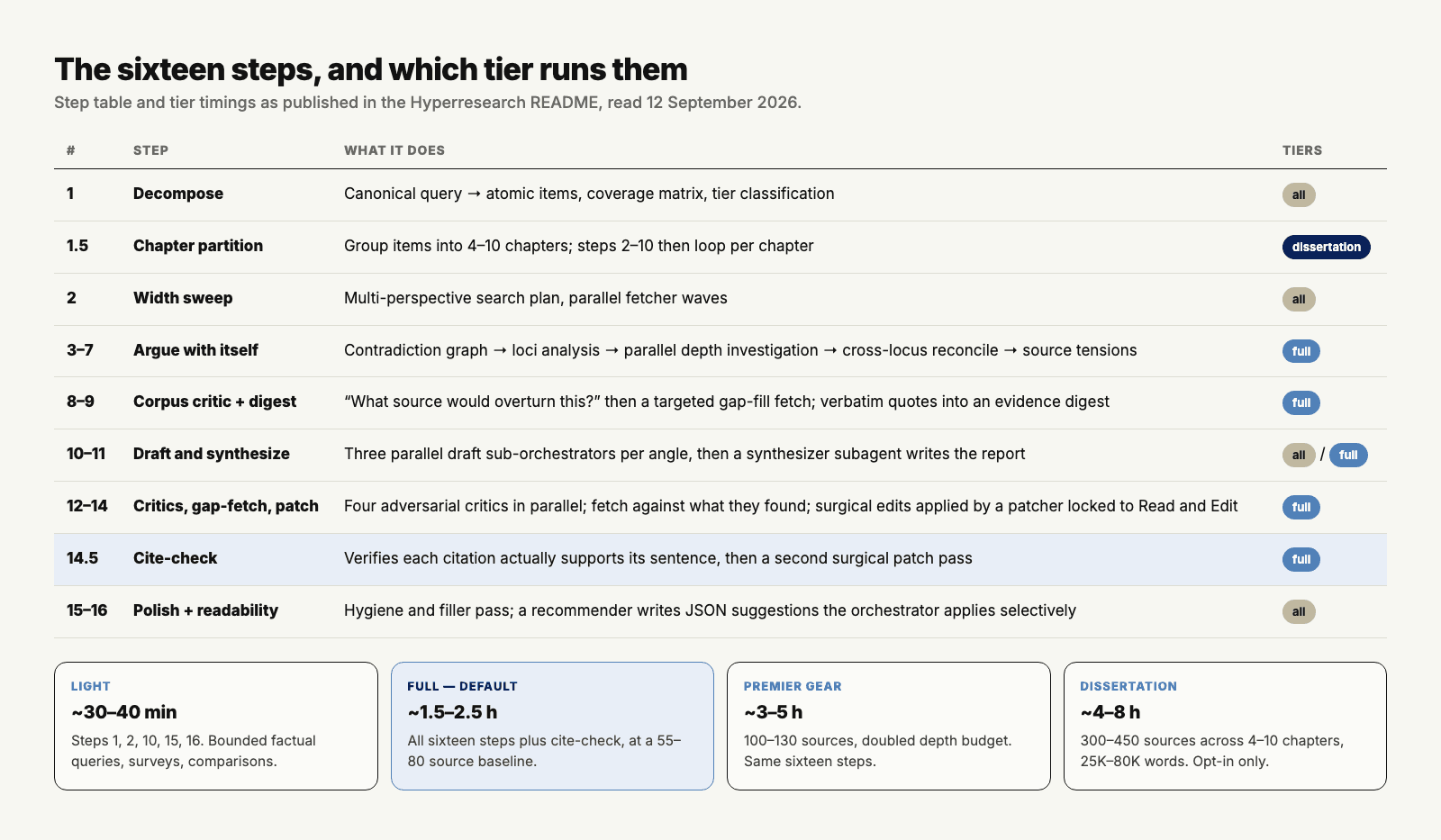
Step 1 decomposes the query into atomic items and a coverage matrix, and classifies the tier. Step 2 runs a multi-perspective width sweep with parallel fetcher waves. Steps 3 through 9 are the part that distinguishes this from a search-and-summarise loop: a contradiction graph pairs conflicts across the corpus into ranked clusters, parallel depth investigators write interim notes with committed positions, a reconcile step forces those positions to argue with each other, and a corpus critic asks "what source would overturn this?" and fires a targeted gap-fill fetch against its own answer.
Drafting is three parallel sub-orchestrators, one per angle. Then step 12 sets four adversarial critics on the result at once, step 13 fetches against the gaps they found, and step 14 applies surgical edit hunks through a patcher locked to two tools.
What a Claude Code deep research run costs in wall-clock time
Nothing about this is fast, and the project doesn't pretend otherwise. The light tier exists precisely because most questions don't need sixteen steps: bounded factual queries, surveys and straight comparisons route to a five-step path that finishes in half an hour or so. The default full tier is where the adversarial machinery lives, and it takes ninety minutes to two and a half hours before it hands anything back.
That gap between tiers is the practical design of the thing. A tool that always ran the full pipeline would be unusable for the sort of question you ask six times a day, and one that never ran it would be another summariser. Step 1 makes the routing call for you and you can override it from the prompt.
Where the citations get checked
Step 14.5 is the one worth the install on its own. It verifies citation-sentence bindings — not that the URL resolves, but that the source supports the specific claim attached to it — runs a skeptical spot-check, then applies a second surgical patch pass. The README describes hallucinated quotes and unacknowledged retractions as hard blocks at the gate.
Two more audits sit alongside it. An independence audit clusters derivative copies so that five reprints of one press release carry the weight of one source rather than five, which is the failure mode that makes automated research feel authoritative and be wrong. And for paywalled material, rather than citing a 1,500-character abstract as though the paper had been read, Hyperresearch asks Unpaywall, Europe PMC and CORE for a legal open-access copy and stores the full text, disclosing every substitution in the note, the frontmatter and the CLI output.
None of these audits is glamorous and all three attack the same weakness: a report that reads well because nothing in it was ever contradicted. Scholarly coverage runs through hpr scholar search, which queries OpenAlex, Crossref, CORE, DOAB, ClinicalTrials.gov, SEC EDGAR and FRED behind one client layer and returns a single list deduplicated by DOI and title, with books, trials and filings tagged so the pipeline knows what each one is.
The benchmark claim needs reading twice
The README's opening sentence says Hyperresearch turns Claude Code into a deep research agent that "currently leads the DeepResearch-Bench RACE leaderboard (benchmarked internally)". Underneath the chart showing it ahead of Gemini Deep Research and OpenAI Deep Research sits a caption in smaller type, and that caption says something materially weaker: a forward-looking projection from a stratified pilot against a leaderboard snapshot, with third-party validation pending.
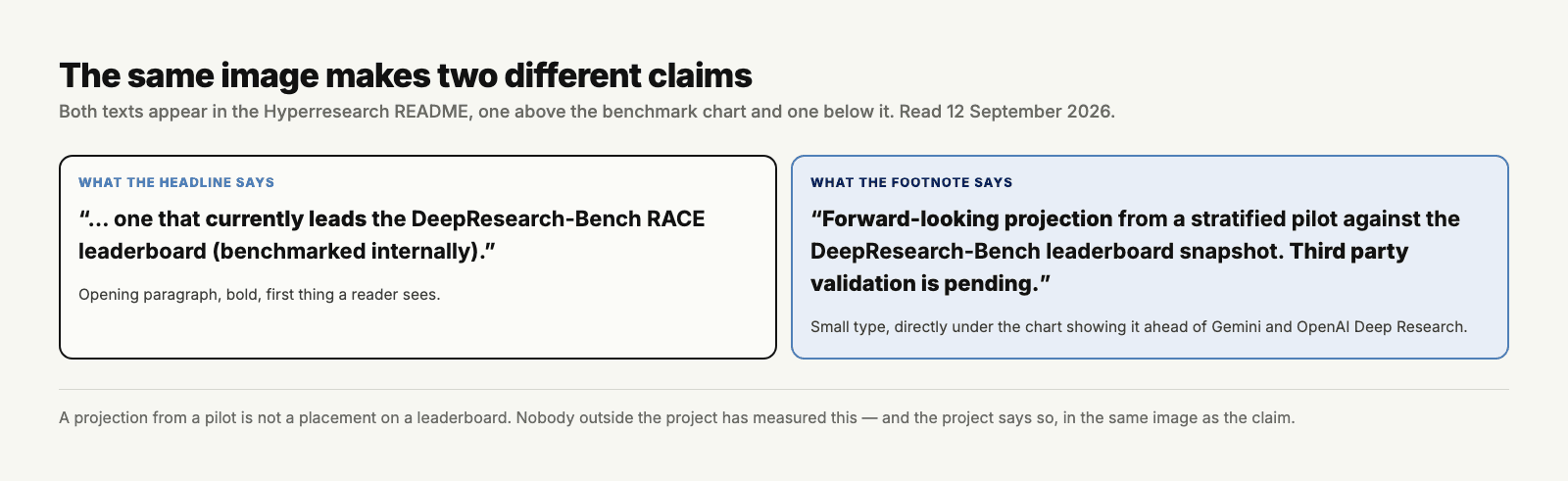
So the honest summary is that nobody outside the project has measured this, and the project says so, in the same image as the claim. That's more disclosure than most projects manage and it is still a self-reported number. Treat the ranking as a hypothesis the author is publishing, not as a result, and weigh the pipeline on its design instead — which is the part you can inspect.
Tiers, gears and the thing that actually costs you
Two separate levers control scale. Tiers route per query and are chosen automatically at step 1, except dissertation, which you have to ask for. Gears set the size of the standard pipeline: source targets, depth budgets, word targets. The default gear works from a 55 to 80 source baseline; hyperresearch profile use premier moves that to 100 to 130 sources with a doubled depth budget and pushes a run to roughly three to five hours. Gear choice persists per project and survives reinstalls, and custom gears go in .hyperresearch/config.toml, down to per-agent model selection.
Runs that die keep a manifest, and run resume restarts at the exact step where it failed rather than from the top, which on a five-hour job is the difference between an annoyance and a lost afternoon. Everything fetched lands in a searchable vault backed by markdown and SQLite, which the next session checks before it fetches anything new — so the second question you ask about a topic costs less than the first.
Now look at those durations again. A dissertation run is four to eight hours. A premier run is three to five. That is not a workload for the machine you carry between rooms, and everyone who has tried it has the same story about a laptop lid and a half-finished corpus. Zentor is a hosted cloud AI computer, so the run lives in an environment that stays awake instead of on the hardware in your bag; you start it, close the laptop, and the pipeline keeps working through step 14 without you. It runs alongside a local install rather than replacing it.
Where it sits next to other harnesses
Calling this a harness is accurate in the sense we've used the word before: it's the scaffolding that decides what the model does and in what order, not the model itself. What makes Hyperresearch a narrow one is that every step is domain-specific — contradiction graphs and loci analysis do not generalise to writing code.
That narrowness is the argument for it, and it's why comparing Hyperresearch to a general coding harness misses the point. General harnesses give you a good agent that will research when asked. This gives you sixteen steps that only make sense for research and are consequently much more opinionated about what a finished report owes its reader. If you're comparing approaches to automating research work, the distinction to hold onto is whether the tool audits its own output or merely produces it.
The resume-from-manifest behaviour matters more here than it would elsewhere, incidentally, because the failure profile of a four-hour pipeline is completely different from that of a four-minute one.
What to check before you rely on it
Python 3.14 is not supported yet, and the README says so plainly with three suggested ways to pin 3.13. The global install makes /hyperresearch reachable from any Claude Code session at the cost of about fifteen lines in every session's system reminder, which is a real tax if you use Claude Code for anything else; per-project install keeps unrelated sessions clean.
Anyone evaluating this as their Claude Code deep research setup should also weigh the install shape. Version numbers are still in the zeros, and the seven-week silence between 25 July and 11 September followed by three releases in one day is worth noticing either way you read it. All of the above is accurate as of September 2026 and some of it will not be by the next point release.
FAQ
Is Hyperresearch free?
Yes, MIT-licensed and installable from PyPI. What isn't free is the model usage: a full run reads 55 to 80 sources by default and a dissertation run reaches 300 to 450, and you pay for every token of that through whatever Claude Code is billing against.
Does it require Claude Code?
Yes. It installs as a Claude Code skill and you invoke it with /hyperresearch. The orchestration depends on Claude Code's Skill tool to load each step's procedure on demand, so there's no standalone runner.
What is DeepResearch-Bench RACE?
A public leaderboard for deep research systems. Hyperresearch's README says it leads that leaderboard on an internal benchmark, and the chart's own footnote describes the figure as a forward-looking projection from a stratified pilot, with third-party validation still pending. No independent party has confirmed the placement.
Is this better than a Claude Code deep research prompt I write myself?
For a one-off question, probably not, and the light tier exists to concede that. What a hand-written prompt cannot easily give you is the audit layer: four critics in parallel, a citation binding check, an independence audit that collapses syndicated copies, and a patcher that is structurally prevented from rewriting the draft. Those are the parts that are tedious to rebuild by hand every time.
How long does a run take?
Between about 30 minutes and eight hours, depending on tier. Light handles bounded factual queries in 30 to 40 minutes; the full default lands at 1.5 to 2.5 hours; premier gear stretches that to three to five; dissertation runs four to eight.
The pipeline is the product, not the ranking
Strip out the leaderboard graphic and what remains is the more interesting thing: a research harness that budgets its own attention, argues with its own conclusions, and checks whether its citations say what it claimed they say. Those are unglamorous properties, and they're the ones that decide whether anyone can act on the output. The ranking may or may not survive third-party review, and honestly it matters less than the README thinks it does. Step 14.5 will still be there afterwards, quietly refusing to let a sentence keep a citation that doesn't back it.
Continue Reading
More Research
MoneyPrinterTurbo: Workflow Lessons for AI Agents
AI Agent Evaluation: The 56% Pass Ceiling

Sakana Fugu and the End of Model Lock-In
TradingAgents: A Multi-Agent LLM Trading Desk

alphaXiv OpenResearch: Local-First Agent Lab

Claude Red Team Skills: Inside Claude-Red
The Zentor editorial team writes about workflow automation, AI agents, and the tools we build. Default byline for industry overviews, listicles, and collaborative pieces.
Turn insights into action.
MoClaw automates the recurring work your analysis points to. No engineering required.
References: https://github.com/jordan-gibbs/hyperresearch · https://pypi.org/project/hyperresearch/ · https://github.com/jordan-gibbs/hyperresearch/releases · https://docs.openalex.org/ · https://unpaywall.org/