GLM-5.3 Found 2,436 Real Vulnerabilities

GLM-5.3 cybersecurity results: 2,436 vulnerabilities across 269 projects, real CVEs in Linux and WebKit, and why Z.ai is holding the weights back.
Table of Contents
GLM-5.3 cybersecurity capability is the reason Z.ai is holding the model's weights for two weeks after launch. Working with security teams in China, Z.ai says the model identified 2,436 vulnerabilities across 269 open source projects, and it published a live ledger of them rather than just a number in a blog post.
Key Takeaways:
- 2,436 findings, 1,097 of them critical or high severity, across 269 open source projects
- Only 53 are publicly disclosed so far; 2,383 remain under embargo
- The oldest flaw dates to 1981, and the average vulnerability had survived 26.6 years before discovery
- Real CVEs are already published against Linux, WebKit, FreeBSD, GStreamer, Suricata and Joomla
- Z.ai calls the capability emergent: it added vulnerability data expecting incremental gains and got a jump
Z.ai's own framing is unusually restrained for a launch post. It describes the security capability as developing "faster than we expected" during post-training scaling, and it is candid that the closed frontier remains ahead where exploitation gets deepest. The ledger at cvd.z.ai is the part worth your attention, because it turns a marketing claim into something you can check line by line.
What Z.ai claims, and how it measured it
The capability arrived as a side effect. Z.ai added vulnerability discovery data and environments to the post-training mix expecting the model to get better at spotting isolated flaws, and what it got instead was a model reasoning across multiple stages of exploitation and forming plans for complete chains.
Three benchmarks, covering different depths of the same problem:
| Benchmark | What it tests | GLM-5.2 | GLM-5.3 |
|---|---|---|---|
| CyberGym | Identify and validate vulnerabilities from white-box source | 77.2% | 84.5% |
| ExploitBench | Reason about real vulnerabilities and their exploitation | 24.4% | 54.4% |
| ExploitGym (2h / 6h) | Exploitation tasks completed under time budgets | 29 / 39 | 105 / 130 |
On CyberGym that 84.5% is the best published result, ahead of Mythos 5 at 83.8% and GPT-5.6 Sol at 83.6%. The pattern across all three is consistent and Z.ai spells it out: the further up the exploitation chain a benchmark sits, the bigger the jump from GLM-5.2, and the wider the remaining gap to closed models. Capability is growing fastest exactly where Z.ai is furthest behind.
One methodological detail deserves credit. ExploitGym results are time-normalised using per-model throughput from Artificial Analysis, so a faster model does not simply win by getting more attempts inside a fixed wall clock. Z.ai rescaled its own results by 115 tokens per second against Kimi K3's 40 and Qwen3.8 Max's 47, which cuts against its own numbers rather than flattering them.
Where GLM-5.3 still loses, by Z.ai's own table
Skipping this part would be dishonest, and Z.ai did not skip it. On ExploitBench, GLM-5.3's 54.4% sits well behind Mythos 5 at 78.0% and GPT-5.6 Sol at 76.5%. On ExploitGym, GLM-5.3 completes 105 tasks in two hours against Mythos 5's 181, and 130 in six hours against 247.
So the headline is not that an open-weights model just took the security crown. It is that an open-weights model got roughly half as good as the closed frontier at exploitation, in one post-training cycle, on unchanged base weights. The trajectory is the story; the absolute position is not.
The disclosure ledger is real, and you can read it
Most vendors would have stopped at the number. Z.ai built a public ledger that tracks each finding through the disclosure process, distinguishing what is already public from what is still under embargo, and recording the affected project, severity, CVE where one exists, and how long the flaw sat in the codebase.
As of 14 August 2026 it reports:
| Metric | Count |
|---|---|
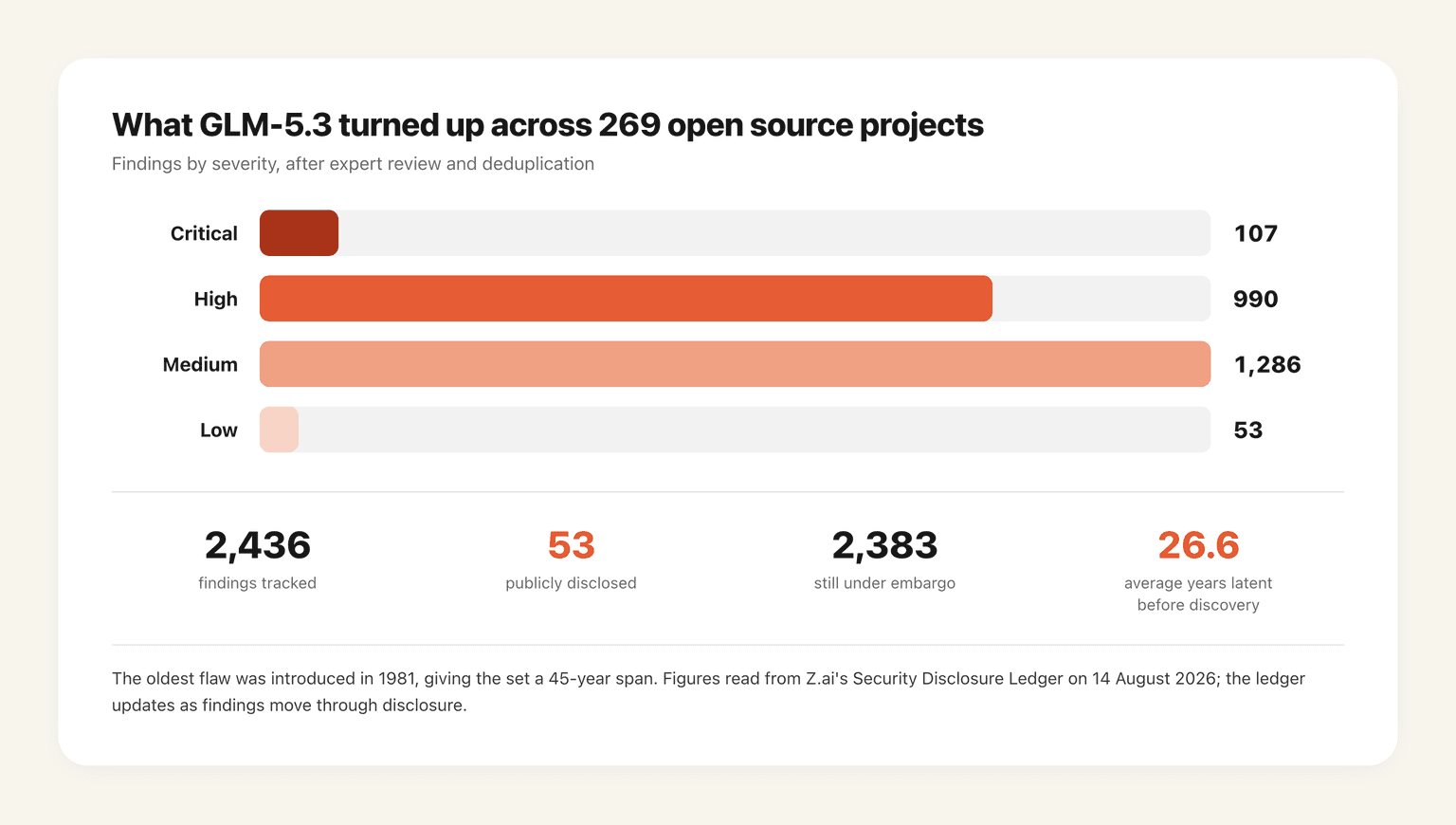
| Findings tracked | 2,436 |
| Publicly disclosed | 53 |
| Under embargo | 2,383 |
| Critical and high | 1,097 |
| Open source projects covered | 269 |
The severity split underneath breaks down as 107 critical, 990 high, 1,286 medium and 53 low. Those numbers come after expert review, screening and deduplication by the security teams Z.ai worked with, which matters: raw model output on a task like this is mostly false positives, and the review step is where the claim earns or loses its credibility.
Six CVEs that show what it actually found
Abstract counts are easy to wave away, so here are named entries from the ledger's recent additions, each carrying a published CVE:
| Project | Issue | CVE |
|---|---|---|
| Linux kernel | Use-after-free on an error path in 6lowpan NHC entries, latent 11 years | CVE-2026-64452 |
| Apple Safari (WebKit) | Memory handling flaw, crafted web content causes process crash | CVE-2026-43663 |
| FreeBSD | ptrace PT_SC_REMOTE missing argument validation, memmove underflow plus out-of-bounds sysent call |
CVE-2026-45253 |
| GStreamer | rfb_decoder_fill_rectangle() write granularity error causing heap out-of-bounds write |
CVE-2026-59691 |
| Suricata | SMTP MIME parser state not reset, allowing detection bypass | CVE-2026-57229 |
| Joomla | Stored XSS in com_installer update list via unescaped fields |
CVE-2026-48952 |
These are not toy targets. The Linux kernel, WebKit and FreeBSD are among the most heavily audited codebases in existence, reviewed continuously by people who are extremely good at this, and a model found live memory-safety bugs in all three.
The number that should actually worry you is 26.6
Not the 2,436. The average vulnerability in this set had been sitting in its codebase for 26.6 years before anyone noticed, and the oldest traces back to 1981, giving a 45-year span between the earliest flaw introduced and today.
Think about what that implies for the asymmetry. Decades of human review, fuzzing campaigns and static analysis passed over these bugs. One post-training cycle on a mid-size open model surfaced them in bulk. The backlog of undiscovered flaws in software everyone depends on is evidently much larger than the industry's discovery rate has ever suggested, and the tool that changes that discovery rate is about to be free to download.
Which cuts both ways, and I would resist the reflex to call this bad news. Defenders get the same capability, applied to their own code, before an attacker gets to it. That race just started, and the side with the source tree has a real head start.
Why the weights are two weeks late
Z.ai's commitment reads: the weights ship two weeks after launch, "once safety evaluation and hardening are complete." A promise with a condition attached rather than a date, and the security results above are the plain explanation for it.
The delay checks out against the source. On 14 August 2026 the zai-org organisation on Hugging Face had GLM-5.2, uploaded 2 July 2026, as its newest model, and the launch post's own HuggingFace button is a dead anchor labelled "Coming Soon". Nothing about GLM-5.3 is downloadable, whatever you may have seen advertised this week. We laid out all three access routes in what you can actually reach on launch day.
Two weeks is not long to harden anything, and Z.ai has not said what hardening means here or what would count as complete. Treat the date as intent.
What to do before an exploit-capable open model ships
If you maintain anything in a memory-unsafe language, the useful move is to run this class of tooling against your own code before someone else does, and the window to prepare is roughly two weeks. Prioritise the parsers: five of the six CVEs above sit in code that reads untrusted input, which is where this model's discovery pattern concentrates.
There is also a practical question about where you run the thing. An open-weights model tuned for vulnerability discovery, driven by an agent with shell access, is not software you want evaluating a codebase on the same laptop that holds your production credentials and an open email client. The general argument for that separation is in agent sandboxing explained, and it gets sharper when the model is specifically good at exploitation chains.
What GLM-5.3's security results change for open weights
The comfortable assumption until now was that frontier offensive capability stayed expensive, gated behind APIs with abuse monitoring on top. GLM-5.3 puts a serious fraction of it into a file you can download, and Z.ai is being about as responsible as a vendor can be on the way: staged release, safety evaluation first, a public ledger, findings routed through coordinated disclosure with 2,383 still held back.
That is a better model of behaviour than the industry norm, and it does not change the destination. Two weeks from now the weights exist outside Z.ai's control permanently, and the 26.6-year figure says the supply of findable bugs is nowhere near exhausted. The interesting question stopped being whether AI can find real vulnerabilities; it can, and there are CVE numbers attached. The question now is who runs it against your dependencies first.
MoClaw is built for the operational half of that: a hosted cloud AI computer that keeps running through a long scan and stays separate from the machine you work on, next to the tools you already use. The free trial runs three days on 1,000 credits, and a $20 subscription carries 1,000 credits a month.
FAQ
How many vulnerabilities did GLM-5.3 find?
Z.ai reports 2,436 vulnerabilities across 269 open source projects, after expert review, screening and deduplication with security teams in China. Of those, 1,097 are rated critical or high severity, split as 107 critical and 990 high. As of 14 August 2026, 53 were publicly disclosed and 2,383 remained under embargo.
Is GLM-5.3 better than other models at cybersecurity?
At vulnerability discovery, yes by Z.ai's measurements: 84.5% on CyberGym against Mythos 5's 83.8% and GPT-5.6 Sol's 83.6%. At exploitation it is clearly behind, scoring 54.4% on ExploitBench where Mythos 5 reaches 78.0%, and completing 105 ExploitGym tasks in two hours against Mythos 5's 181.
Where can I see the vulnerabilities GLM-5.3 found?
Z.ai publishes them at cvd.z.ai, its Security Disclosure Ledger. Entries record the affected project, severity, CVE identifier where assigned, and how long the flaw had been latent. Published examples include CVE-2026-64452 in the Linux kernel and CVE-2026-43663 in WebKit.
Why is Z.ai delaying the GLM-5.3 weights?
Z.ai says the weights ship two weeks after launch, once safety evaluation and hardening are complete. The model's jump in exploitation capability is the evident reason, though Z.ai has not defined what hardening involves or published a firm date.
What was the oldest vulnerability GLM-5.3 found?
One introduced in 1981, giving the set a 45-year span. Across all 2,436 findings the average flaw had been present for 26.6 years before discovery.
Can GLM-5.3 write exploits?
Z.ai's own benchmarks show it reasoning across multi-stage exploitation chains, scoring 54.4% on ExploitBench and completing 130 ExploitGym tasks within a six-hour budget. It is markedly weaker than closed frontier models at this, and Z.ai is holding the weights pending safety work partly for that reason.
Vulnerability counts, severity splits, benchmark figures and CVE identifiers in this article were read off Z.ai's GLM-5.3 launch post and its Security Disclosure Ledger at cvd.z.ai on 14 August 2026. The ledger updates continuously as findings move through disclosure, so current counts will have moved past the figures quoted here.
Continue Reading
More Research
MiroFish: Open-Source Swarm Prediction Engine

Cambium: A Governance Standard for LLM Corpora

SwarmForge: Uncle Bob's Agent Orchestration

Semantica: A Knowledge Graph for AI Agents

TradingAgents: A Multi-Agent LLM Trading Desk

Harvey LAB: An Open Legal Agent Benchmark
The MoClaw editorial team writes about workflow automation, AI agents, and the tools we build. Default byline for industry overviews, listicles, and collaborative pieces.
Turn insights into action.
MoClaw automates the recurring work your analysis points to. No engineering required.
References: Z.ai Security Disclosure Ledger · GLM-5.3: Frontier Coding with Emergent Cyber Capabilities (Z.ai) · GLM-5.3 model overview, Z.ai developer documentation · zai-org on Hugging Face · slime, Z.ai's open-source RL post-training framework