GLM-5.3 Is Live. The API Isn't Yet.

GLM-5.3 launched 14 Aug 2026, but the GLM 5.3 API is still coming soon and the weights are two weeks out. What you can actually access today.
Table of Contents
GLM-5.3 shipped on 14 August 2026, and the only way to use it today is a GLM Coding Plan subscription inside a coding agent. Z.ai's own documentation lists the GLM-5.3 API as coming soon and the open weights as two weeks away, so the three routes to this model arrive on three different dates.
Key Takeaways:
- Available now: GLM Coding Plan and ZCode, usable from Claude Code, OpenCode and other agents
- Not available now: the public API. Z.ai's docs say "The GLM-5.3 API is coming soon"
- Not available now: the weights. Z.ai says two weeks after launch, once safety hardening finishes
- The base model is unchanged from GLM-5.2. Every gain came from post-training
- GLM Coding Plan moved to a points quota with peak-hour pricing, which is a separate change landing the same day
The headline number is a token efficiency claim, not just a score. On Z.ai Code Bench at high reasoning effort, Z.ai reports GLM-5.3 reaching 31.4% at around 50,000 output tokens per task, against Claude Opus 4.8 at 29.5% for roughly 120,000. Same neighbourhood of quality, a bit over 40% of the output tokens. That is the sentence doing the rounds today, and it is worth reading alongside the availability picture, because a model you cannot call from your own code is a model you cannot benchmark yourself yet.
What you can actually access on launch day
Three delivery routes, three states. This is the table nobody put in the launch coverage:
| Route | Status on 14 Aug 2026 | What it means for you |
|---|---|---|
| GLM Coding Plan | Live, rolled out to all subscribers | Works inside Claude Code, OpenCode, ZCode and similar agents |
| ZCode | Live | Z.ai's own agent, with a cache-rate and quota promotion attached |
| Public API | "Coming soon" per Z.ai docs | You cannot point your own application at glm-5.3 yet |
| Open weights | Promised in two weeks | No local serving, no fine-tuning, nothing on Hugging Face |
The GLM-5.3 model page carries the coming-soon line at the very top, directly above a banner announcing availability to Coding Plan users. Both statements are true at once, and reading only one of them is how people end up filing bug reports against an endpoint that has not opened.
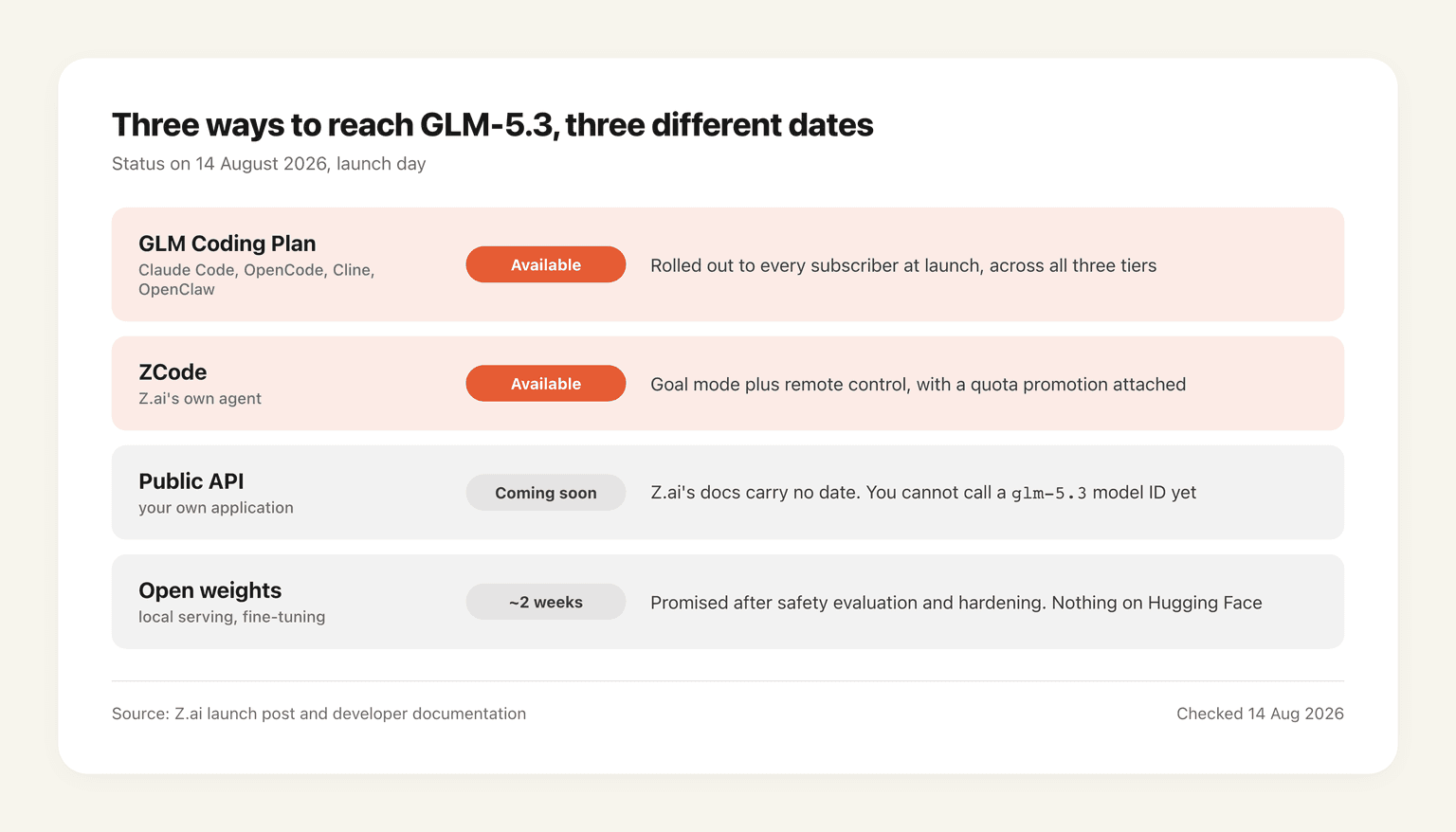
The practical read: if you write code inside an agent, you can try GLM-5.3 this afternoon. If you ship a product that calls a model, you are waiting, and you do not have a published date to wait for.
The weights are staged, and Hugging Face confirms it
Z.ai's phrasing is specific: "We will release the weights in two weeks after launch, once safety evaluation and hardening are complete." That is a promise with a condition attached, not a release date.
It also checks out against the source. On 14 August 2026 the zai-org organisation on Hugging Face had GLM-5.2 as its most recent model upload, dated 2 July 2026, with GLM-5.2 and its FP8 variant together sitting on several million downloads. There is no GLM-5.3 repository, public or gated. If you have seen a GLM-5.3 GGUF advertised somewhere this week, it is not coming from Z.ai.
The reason for the delay is the part of the announcement most summaries skipped, and it is covered further down: this model got substantially better at finding and exploiting software vulnerabilities, and Z.ai is holding the weights while it works through that.
Why the API delay is unusual for this launch pattern
Model launches normally open the API first, because the API is the cheapest surface to ship and the easiest to meter. Weights come later or never, and subscription products come last because they need quota accounting.
GLM-5.3 inverted that. The subscription surface went live on day one and the API did not, which tells you the rollout is being paced by capacity rather than by readiness. Z.ai gets to serve a known population of Coding Plan subscribers on a metered quota before it exposes an endpoint that anyone with a credit card can point a load generator at.
For anyone planning around it, that ordering has a consequence worth internalising. Your evaluation of GLM-5.3 over the next two weeks will happen through someone else's agent, on someone else's quota policy, which is a different measurement than the one your production traffic would produce.
The GLM Coding Plan quota changed on the same day
Buried in the launch post is a pricing mechanic change that will affect subscribers more than the benchmark will. The GLM Coding Plan now runs on a points-based quota, with points counted separately for input, cached input and output tokens. Calls made outside peak hours consume half the standard points, and peak is defined as 14:00 to 18:00 UTC+8, Monday to Friday. Everything else, weekends included, bills at the off-peak rate.
Read the timezone before you plan around the discount. UTC+8 peak hours are 02:00 to 06:00 US Eastern, which means a US-based developer is off-peak during their entire working day and a China-based one is paying double through their afternoon.
Rate limits on this plan were already the loudest complaint about it. Search the plan by name and the second organic result is a Reddit thread arguing against buying it, and further down the same page sits a public post from a subscriber saying they pay $65 a month and get throttled too heavily to work. A points system with time-of-day multipliers is a real answer to that, but it is an answer that rewards moving work to hours you are asleep for.
Reading the benchmark table without getting caught out
The launch post carries a nine-column comparison table, and I would not quote numbers out of it. The prose and the table disagree in at least one place: the CyberGym paragraph names Mythos 5 at 83.8% as the model GLM-5.3 edges past, while the table column carrying 83.8 is headed Opus 4.8. One of those labels is wrong, and from outside you cannot tell which.
The prose figures are safer, and they're strong enough without help: Terminal-Bench 3.0 went from 4.6 to 28.3, DeepSWE v1.1 from 46.2 to 66.9, and Agents' Last Exam from 23.8 to 28.5, all of it squeezed out of post-training on the same base weights that GLM-5.2 already used. That last part is the genuinely interesting engineering claim, and it's the one nobody put in a headline.
There is a second contradiction worth knowing about, this one between Z.ai's two own pages. The developer docs say GLM-5.3's programming and agent capabilities are "on par with Claude Fable 5". The launch blog says it "remains behind Claude Fable 5, which reaches 39.5% at Max effort" against GLM-5.3's 34.5%. The blog is the more conservative claim and it is the one with a number attached, so that is the one to carry.
What Z.ai actually trained it to do, and where that runs
The capability story is not that GLM-5.3 writes better functions. It is that Z.ai scaled post-training on environments that look like whole units of expert work. The post describes tasks where the model gets the same working environment as an engineer, with compute clusters, storage, internal docs, codebases and experiment results, and has to diagnose a bottleneck, implement optimisations, run experiments and deliver a measurable speedup. Some individual tasks, in their words, represent several days of work for an experienced engineer.
That is a specific bet: the model should take ownership of a long job instead of waiting to be handed decomposed steps. Z.ai's own product framing follows it, with ZCode advertising a mode that plans, codes, tests and verifies until a target is met, plus remote control from your phone so you can steer a run you are not sitting in front of.
Notice what that last feature admits. If the useful unit of work is several days long, the interesting failure is no longer a bad diff, it is the run ending because the machine underneath it went away. We wrote about that gap separately in what an always-on AI agent actually requires, and how to evaluate agents on long-horizon work covers why short benchmarks miss it.
The security capability is why the weights are late
Z.ai flagged this as emergent, meaning they added vulnerability discovery data expecting incremental gains and got something steeper. GLM-5.3 scores 84.5% on CyberGym, up from GLM-5.2's 77.2%. On ExploitBench it more than doubled, 24.4% to 54.4%. On ExploitGym it completed 105 tasks inside a two hour budget where GLM-5.2 managed 29.
Then it left the benchmarks. Working with security teams in China, Z.ai says the model identified 2,436 vulnerabilities across 269 open source projects after expert review and deduplication, 1,097 of them medium-to-high severity. The oldest flaw dated to 1981, and the average vulnerability had survived 26.6 years before this model found it. Fifty-three are publicly disclosed so far, with the rest under embargo, tracked in a public disclosure ledger.
That is the honest explanation for the two week hold, and it is also a reason to think about where you run this thing once the weights do land. Z.ai is straightforward that closed frontier models remain ahead on the deepest exploitation benchmarks, so the news is not that GLM-5.3 is uniquely dangerous. It is that a capable open-weights security model is about to be downloadable by everyone, and testing one is a job for a machine you are willing to lose, not the laptop with your production credentials on it. Our write-up of agent sandboxing goes into what that separation buys.
GLM-5.3 access: what to do in each of the next two weeks
If you want to form a view before everyone else does, the sequence is straightforward. This week, evaluate through the Coding Plan inside an agent you already use, and run it off-peak so the points last. Treat anything you measure as indicative rather than final, because you are measuring through a quota policy as much as through a model.
In two weeks, when the weights land, that is the real evaluation: your own harness, your own tasks, no quota in the middle. That is also when the local-versus-hosted question stops being theoretical, because a 1M context model at this size is not something most people are serving from a workstation.
The thing not to do is wait for the API without a fallback plan. Z.ai has published no date for it, and the two week promise attached to the weights carries a condition that could move. Build against GLM-5.2, which is on Hugging Face today, and swap the model ID when the endpoint opens.
MoClaw sits on the other side of that decision. It is a hosted cloud AI computer that stays running whether or not your laptop is open, which is the missing half of a model trained on jobs that take days. The free trial runs three days on 1,000 credits, and a $20 subscription carries 1,000 credits a month.
FAQ
Is the GLM-5.3 API available?
Not as of 14 August 2026. Z.ai's developer documentation for GLM-5.3 states that the API is coming soon, with no published date. The model is available to GLM Coding Plan subscribers and inside ZCode, but you cannot point your own application at a glm-5.3 model ID yet.
When will GLM-5.3 open weights be released?
Z.ai says two weeks after launch, which puts it around 28 August 2026, conditional on safety evaluation and hardening completing first. Nothing has appeared on Hugging Face yet, where the newest zai-org model upload is still GLM-5.2 from 2 July 2026.
Is GLM-5.3 better than Claude Opus 4.8?
On Z.ai's in-house Code Bench at high reasoning effort, Z.ai reports GLM-5.3 at 31.4% against Opus 4.8 at 29.5%, using roughly 50,000 output tokens per task versus 120,000. That is a vendor-run private benchmark, so treat it as a claim rather than a result until the weights are public and third parties can reproduce it. Z.ai also states GLM-5.3 remains behind Claude Fable 5.
What changed in the GLM-5.3 API parameters?
Thinking can no longer be disabled. thinking.type: "disabled" is not supported, so applications using it must switch to enabled with reasoning_effort set to low before moving to the new model ID, otherwise requests fail. The three effort levels are low, high and max, with max the default and the recommended setting for coding.
Do I need a new subscription to use GLM-5.3?
No. Z.ai rolled GLM-5.3 out to all existing GLM Coding Plan users at launch. The plan itself moved to a points-based quota at the same time, with off-peak calls consuming half the points of peak ones.
Can I run GLM-5.3 locally right now?
No. The weights are not published, so there is no local serving path, no quantised build and no fine-tuning. GLM-5.2 is the newest Z.ai model you can download today.
Availability, benchmark figures, quota terms and Hugging Face upload dates in this article were checked against Z.ai's launch post, its developer documentation and the zai-org organisation page on 14 August 2026. GLM-5.3 is one day old and its access routes are changing, so verify anything load-bearing before you build on it.
Continue Reading
More Guide
What Is GLM-5.3? Specs, Speed, Access

GLM Coding Plan: Why You Hit Rate Limits

MoClaw Pricing: Is $20 a Month Worth It?

What to Use Instead of Manus in 2026

Is DeepSeek Harness Enough for Always-On?

DeepSeek Harness for Non-Developers
The MoClaw editorial team writes about workflow automation, AI agents, and the tools we build. Default byline for industry overviews, listicles, and collaborative pieces.
Ready to put this into practice?
MoClaw runs browser tasks, research, and schedules automatically. Try it free.
References: GLM-5.3: Frontier Coding with Emergent Cyber Capabilities (Z.ai launch post) · GLM-5.3 model overview, Z.ai developer documentation · Z.ai DevPack overview (coding agent integrations) · zai-org organisation on Hugging Face · Don't get Z.ai GLM Coding Plan (r/ClaudeCode) · zai-org/GLM-5.2 on Hugging Face