Is DeepSeek Harness Enough for Always-On?

DeepSeek Harness schedules are session-local reminders tied to a live root agent. What that means if you wanted a brief waiting on Monday morning.
Table of Contents
A DeepSeek Harness persistent agent uses runtime features — session state, scheduling, jobs, sandboxed execution — to continue work beyond a single prompt. Those primitives are real. The question is whether they are enough for an always-on assistant, or whether you still need an operator and a host behind them.
Key Takeaways:
- A runtime can preserve session state without guaranteeing that compute is available
- Harness schedules are session-local reminders tied to a live root agent, not an external notification service
- Scheduled work needs an owner for billing, credentials, monitoring, updates, and recovery
- If nobody owns day-to-day runtime care, a managed service is the safer operational choice
I learned this testing a Monday market-brief workflow. The task looked simple: collect five approved sources, draft a short brief, save it before 8 AM.
The first run worked. The second failed because one source page changed layout. The third produced a brief but skipped the source table. By the fourth run the question was no longer "can the agent write?" It was "who checks whether the scheduled run actually completed, used the right sources, and left enough evidence to trust the draft?"
Popularity does not answer that. Checked on 14 August 2026, the DeepSeek Harness repository showed 85,821 stars and 7,601 forks roughly a day after it went public — an enormous amount of attention, and zero assigned operators.
A Runtime Is Not the Whole Service
DeepSeek Harness provides components that can support long-running agent workflows. It does not provide hosting, uptime, billing recovery, or business accountability by itself.
That distinction protects buyers from a common mistake. "Persistent" can mean the conversation survives, a process stays alive, a server is reachable, or a named person owns the task. Those are four different promises, and vendors rarely say which one they mean.
Define the Task Before You Judge Persistence
One-off work
One-off work needs continuity, not always-on hosting. If an agent reads files, drafts a report, and you return tomorrow to revise it, session persistence and replay matter more than 24-hour compute.
Scheduled work
Scheduled work needs a clock and a delivery rule. DeepSeek's schedule package is explicit about the shape of that: reminders whose durable state lives in the original session log, with a process-local owner that waits only while that session has a live root agent. Cold sessions resume overdue work when they become live again, and the package deliberately implies no external notification channel.
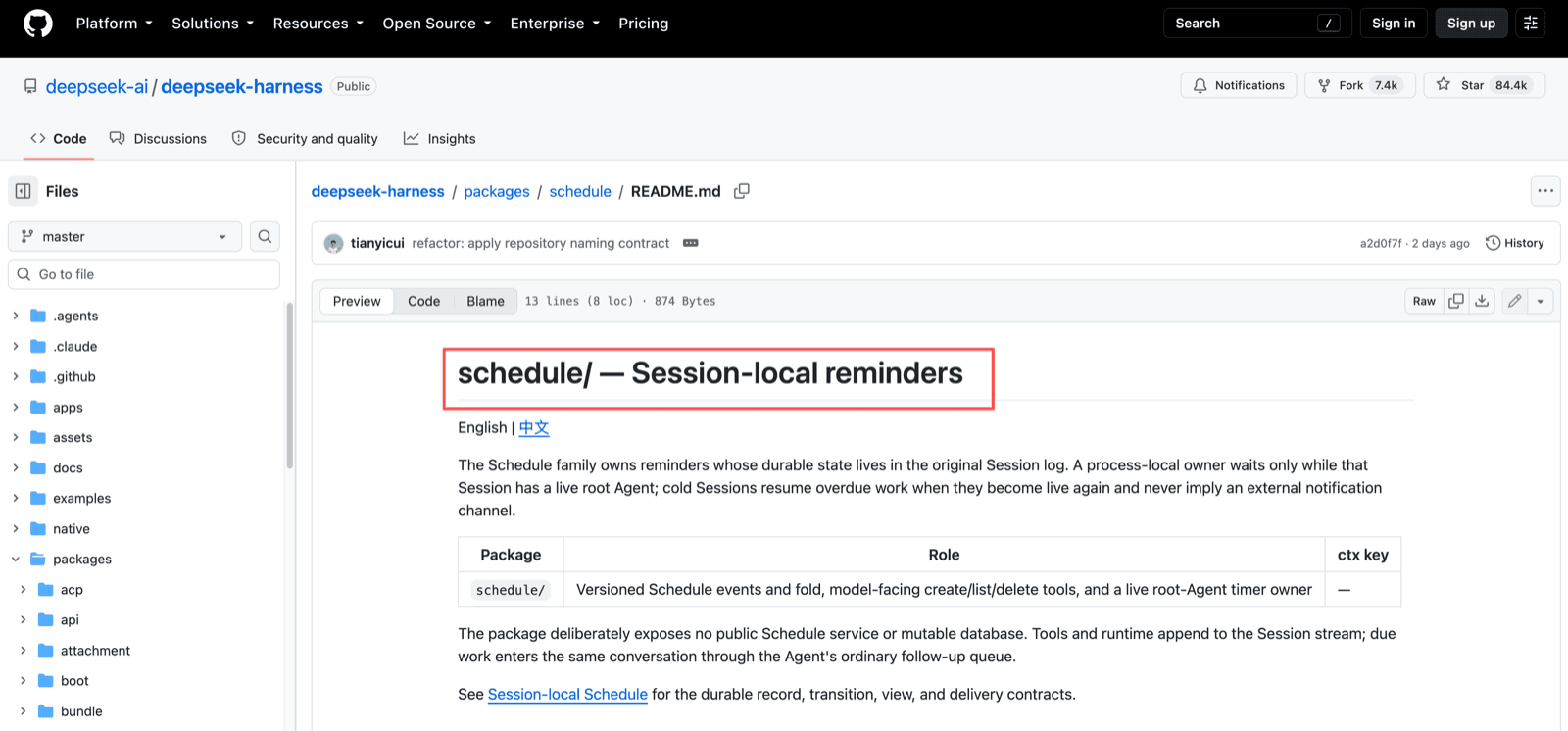
Read that twice if you were planning to rely on it for a Monday morning delivery. The reminder is durable; the delivery depends on something being awake.
In my own four-week recurring test, two runs completed cleanly, one needed a source-layout fix, and one produced a draft without enough evidence to review. That was enough to change my rule: a scheduled agent is not dependable just because it can run on a clock. It needs logs, source checks, failure messages, and a named person to review exceptions.
Work that must survive a closed laptop
Work that must survive a closed laptop needs a host outside the laptop. A runtime can support the behavior, but deployment still depends on an available execution environment — a machine, server, container, or managed service.
What DeepSeek Harness Genuinely Preserves
These are real capabilities, and they are better than most launch-stage projects ship.
Session events and resumable context
The architecture documentation treats the session log as the source of the context the model sees, with durable events for turns, steps, messages, and tools. The session package adds persistence backends, a checkpoint policy, projections, and telemetry — with JSONL and SQLite backends shipped separately from the service definition.
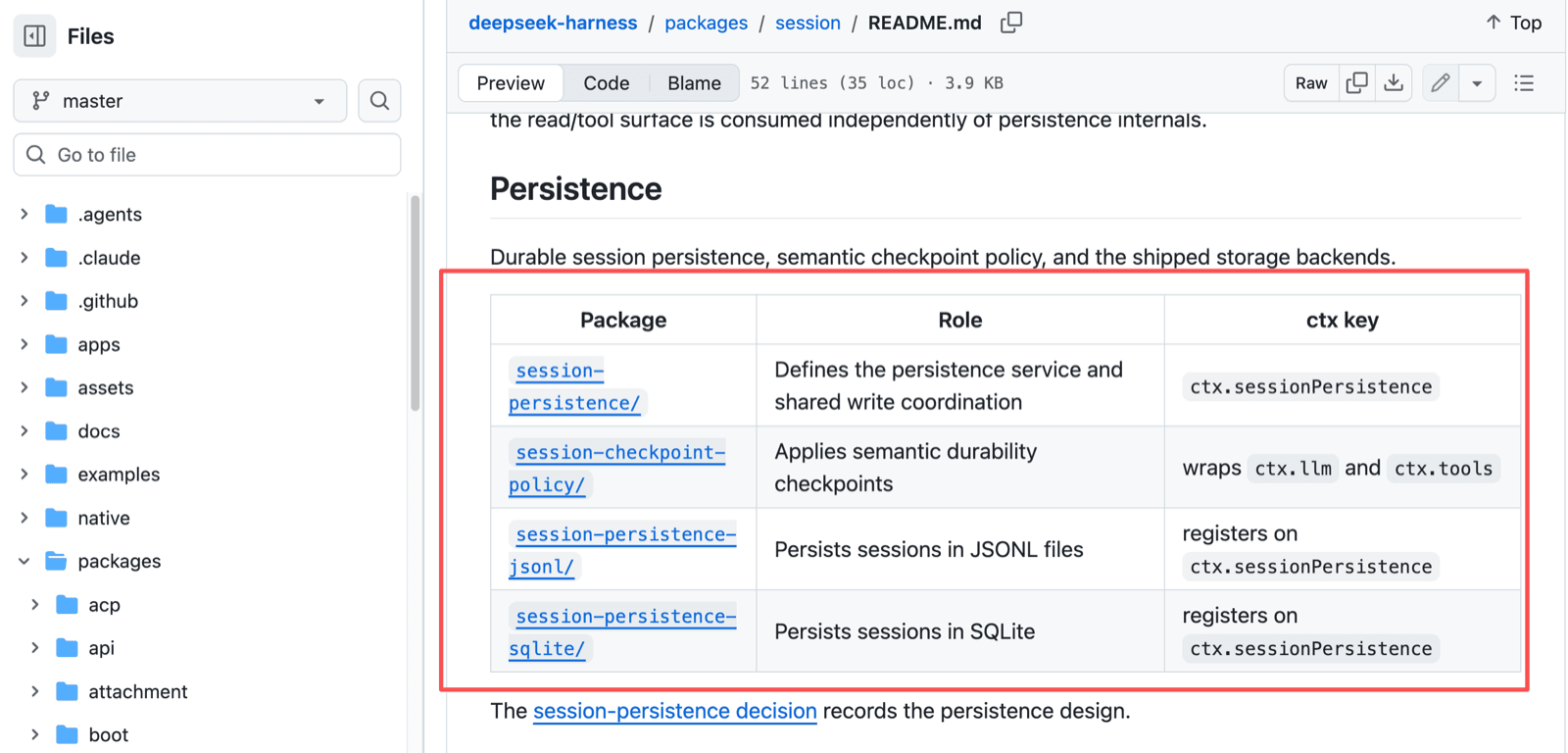
In buyer language: a session can resume, fork, replay, and rebuild context. That is the foundation you would want.
Background jobs inside a running environment
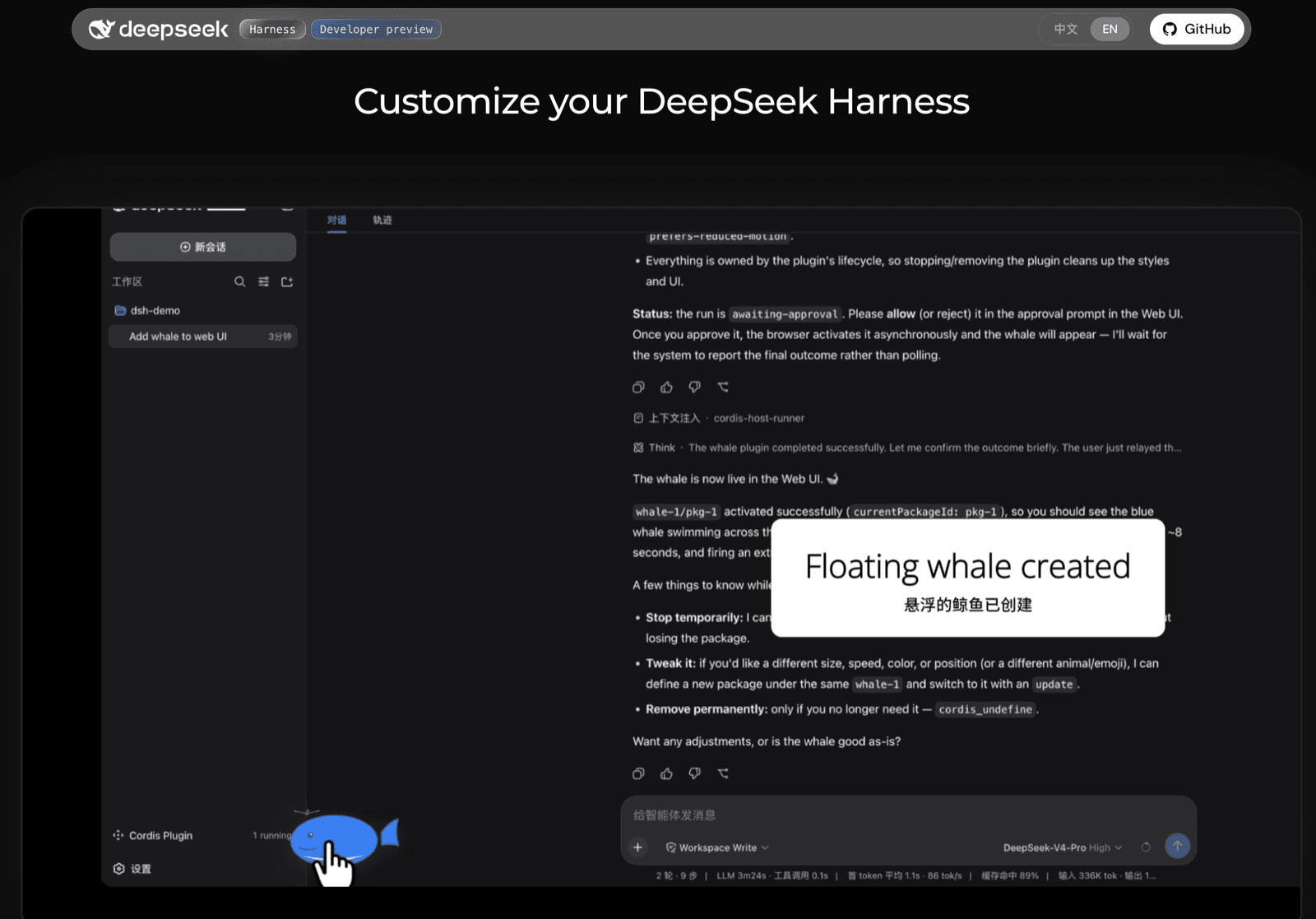
The jobs package supports long-running tools with an owner-isolated background-job protocol for observation, cancellation, waiting, and completion notices. That helps inside a running environment. It does not prove your host will be awake, funded, patched, and watched.
Five Responsibilities That Still Need an Owner
None of these are criticisms of Harness. They are the operating responsibilities around any long-running agent.
Keeping compute available. Someone must keep the host up — a server, container, VM, workstation, or managed workspace. If the agent depends on a laptop, the laptop is part of the reliability plan.
Handling secrets and access. API keys, browser sessions, client accounts, and repository access need rotation, scope limits, and removal when a teammate leaves.
Watching for failures. Logs, alerts, missed schedules, retry loops, and partial outputs need a review path. Silent failure is worse than a visible stop.
Updating the runtime. Developer-preview software requires compatibility checks, and updates should be tested before client-critical scheduled tasks depend on them.
Recovering work. Recovery means knowing the last completed step, whether retry is safe, and what evidence proves the output is complete.
For the broader version of this checklist, our always-on AI agent guide covers hosting, memory, observability, cost, and escalation across platform types.
Decide Whether Your Team Can Own It
This decision is about people, not features.
Name one operator for daily care. That person must know where the runtime runs, where logs live, how credentials are stored, and how to stop a risky task.
Set one escalation path for failures. A missed report, failed payment, expired provider key, or repeated browser error should reach a named person through a channel they actually monitor.
Keep runtime claims separate from service claims while you verify. Check session events, persistence, schedule state, background jobs, and sandbox policy in DeepSeek's materials — the sandbox package applies a per-session confinement policy for process execution, which is useful for risk control but is not operational monitoring. Then verify hosting, support, uptime, billing, export, and recovery with whoever hosts the work. A runtime page and a managed service page answer different questions.
FAQ
Who owns a recurring task when its creator leaves?
Transfer it to the team or client account before they go. Keep the schedule, prompt, credentials, output folder, approval rule, and billing owner in a shared record. A departing contractor should not remain the only person who can edit the task.
Should recurring agents have separate spending limits?
Yes, because repeats multiply errors. Set a per-task or per-client cap and stop the workflow when it crosses the limit. The approval owner should review spend before raising the cap.
What happens to scheduled work during a billing failure?
That depends on the hosting or managed provider, not the runtime. Document whether tasks pause, retry, downgrade, or fail closed. Client-facing work should not depend on an unpaid account without a fallback owner.
How long should completed task records be retained?
Match retention to the business purpose and client agreement. For consulting work, keep enough to prove the task ran, what inputs were used, and who approved the output. Delete unnecessary private data after the period ends.
What evidence should a client receive after work finishes?
The output plus a short work record: completion time, source or file list, material assumptions, skipped items, and any human approvals. For scheduled monitoring, include what changed since the previous run.
Persistence Is a Runtime Feature. Always-On Is an Operating Commitment.
A DeepSeek Harness persistent agent can use genuine primitives for sessions, schedules, jobs, sandboxing, and recovery-friendly logs. That is enough for a technically supported team to build serious long-running workflows. It is not enough to remove ownership. If nobody can keep compute available, guard credentials, watch failures, update the runtime, and recover work, the missing piece is not a feature — it is an operator or a managed service.
Source note: runtime facts verified against DeepSeek's public GitHub repository and package documentation on 14 August 2026, with star and fork counts read from the GitHub API the same day. DeepSeek Harness is in developer preview, so recheck the live repository and any provider commitments before production use.
Continue Reading
More Guide
MoClaw Pricing: Is $20 a Month Worth It?

What to Use Instead of Manus in 2026

DeepSeek Harness for Non-Developers

Personal AI Agents Explained for Real Work

What Is DeepSeek Harness (DSH)?

Orca ADE: Parallel AI Agent Fleet Explained
The MoClaw editorial team writes about workflow automation, AI agents, and the tools we build. Default byline for industry overviews, listicles, and collaborative pieces.
Ready to put this into practice?
MoClaw runs browser tasks, research, and schedules automatically. Try it free.
References: DeepSeek Harness schedule package README · DeepSeek Harness session package README · DeepSeek Harness jobs package README · DeepSeek Harness sandbox package README