What Is GLM-5.3? Specs, Speed, Access

GLM-5.3 is Z.ai's flagship coding model, same base weights as GLM-5.2 with post-training gains. Specs, benchmarks, token costs and what it can't do.
Table of Contents
GLM-5.3 is Z.ai's flagship coding and agent model, released on 14 August 2026, built on exactly the same base weights as GLM-5.2 with every improvement coming from post-training. It carries a 1M token context window, tops out at 128K output tokens, and cannot have its thinking mode turned off.
Key Takeaways:
- Same base model as GLM-5.2; the gains are post-training only, which is unusual to say out loud
- 1M context, 128K max output, text in and text out, with function calling, MCP and context caching
- Three reasoning levels, low, high and max, and no option to disable thinking
- Z.ai claims open-source SOTA on Terminal-Bench 3.0 and Agents' Last Exam
- The interesting number isn't the score, it's the tokens spent reaching it
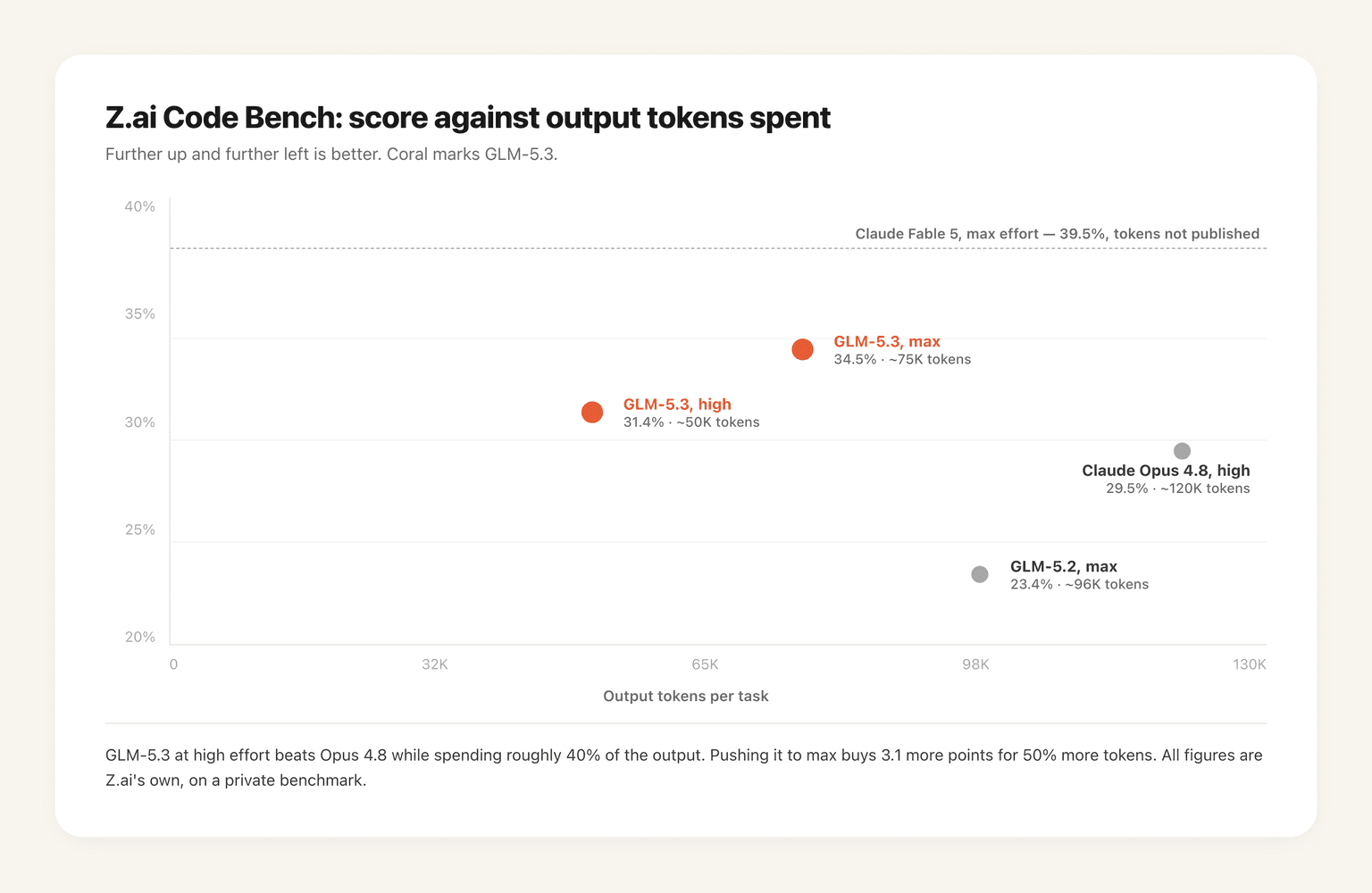
The claim Z.ai leads with is a 50% improvement over GLM-5.2 on its in-house Code Bench, and the one worth reading twice sits a paragraph below it: at high reasoning effort GLM-5.3 reaches 31.4% using around 50,000 output tokens per task, where Claude Opus 4.8 gets 29.5% for roughly 120,000. Slightly ahead on quality, at a bit over 40% of the output. Whether that reproduces outside a vendor's private benchmark is the open question, and nobody can check until the weights land.
What is GLM-5.3?
Z.ai, the company formerly trading as Zhipu, calls GLM-5.3 a flagship foundation model aimed at complex software engineering and agent work. Text in, text out; no vision or audio in this release. The model page lists the capability set as thinking modes, streaming, function calling, context caching, structured output and MCP.
It arrived roughly six weeks after GLM-5.2, which Z.ai uploaded to Hugging Face on 2 July 2026, and it slots into the GLM Coding Plan alongside GLM-5-Turbo and GLM-4.7. GLM-5.2, oddly, isn't on that plan's model list.
The naming suggests a point release. The benchmark movement doesn't: Terminal-Bench 3.0 went from 4.6 to 28.3, which is not the shape of a routine increment.
Same base model, and why that matters more than the score
Here's the part that got lost under the benchmark chart. Z.ai states plainly that GLM-5.3 "uses the same base model as GLM-5.2, every gain comes from post-training." No new pretraining run, no larger base, no fresh corpus.
Labs rarely volunteer this, because a shared base makes the improvement sound cheaper than it was. What it actually demonstrates is that a chunk of capability people assume is locked into pretraining can still be recovered afterwards, from reinforcement learning against better environments. Terminal-Bench 3.0 moving 4.6 to 28.3 on unchanged base weights is a claim about method, not about scale.
Z.ai credits three pieces of stack it built for GLM-5.2 and kept scaling: IndexShare for long-context processing, SAO for reinforcement learning on long-horizon tasks, and slime, its open-source post-training framework running Megatron for training and SGLang for rollout. System work on that stack, including local storage used as a caching layer and workload-aware scheduling, raised end-to-end RL throughput on long-horizon coding tasks by more than 2.3x.
The specs, and the one that will break your code
| Property | GLM-5.3 |
|---|---|
| Context length | 1M tokens |
| Max output | 128K tokens |
| Modalities | Text in, text out |
| Reasoning levels | low, high, max (default max) |
| Thinking disabled | No longer supported |
| Tooling | Function calling, MCP, structured output, context caching, streaming |
That fifth row is a breaking change rather than a feature note. thinking.type: "disabled" worked on GLM-5.2 and does not work here; a request carrying it fails outright. Anything you migrate has to move to enabled with reasoning_effort set to low before the model ID changes, which we go through in detail in picking a GLM-5.3 reasoning effort level.
A 1M context paired with a 128K output ceiling is a deliberate shape: read an entire repository, write a bounded change. It's the profile of a model meant to work inside a codebase rather than generate documents.
Token efficiency is the actual headline
Most launch coverage quoted the 50% figure and moved on, which buries the more useful comparison. On Z.ai Code Bench:
| Configuration | Score | Output tokens per task |
|---|---|---|
| GLM-5.3, max effort | 34.5% | ~75K |
| GLM-5.3, high effort | 31.4% | ~50K |
| GLM-5.2, max effort | 23.4% | ~96K |
| Claude Opus 4.8, high effort | 29.5% | ~120K |
| Claude Fable 5, max effort | 39.5% | not published |
Read down the GLM column: 5.3 beats its predecessor by eleven points while spending fewer tokens getting there. That's the direction of travel worth caring about, since output tokens are what you pay for and what you wait on.
Then read the Fable 5 row, because Z.ai printed it themselves. GLM-5.3 does not lead the frontier; it closes distance to it at a fraction of the token cost. Z.ai's own developer docs muddy this by saying capabilities are "on par with Claude Fable 5" while the launch post says GLM-5.3 "remains behind" it. Take the version with the number attached.
How Z.ai got there: environments, not exercises
The training story is about what the model practised on. Instead of isolated programming problems, Z.ai built environments covering the full arc of a job: identify the problem, analyse it, implement, verify, deliver. Some individual tasks represent several days of work for an experienced engineer, run against real compute clusters, storage, internal documentation and prior experiment results.
Scaling that hits an obvious wall, since hand-building thousands of realistic environments isn't feasible. So Z.ai automated the pipeline: research agents turn observed work patterns into runnable long-horizon environments with multi-step dependencies and hidden state, a judge agent attempts each one to confirm it's solvable, and verifiers get synthesised without sight of the reference solution. Solver trajectories then get mined for reward shortcuts so those can be closed. A verifier surviving oracle, no-op and unsolved-state checks yields a binary reward trustworthy enough to train against directly.
Z.ai admits this still needs meaningful human involvement and calls making it autonomous a next step. That candour is worth more than the benchmark table.
What GLM-5.3 can't do yet
Three limits, all of them temporary or bounded. The public API hasn't opened; Z.ai's docs said "coming soon" on launch day with no date, so the model is reachable only through the GLM Coding Plan and ZCode for now. The weights aren't out either, promised two weeks after launch pending safety hardening, which we unpack in what you can actually access on GLM-5.3 launch day.
And it's text-only. If your workflow needs image understanding you're on a different Z.ai model, though the Coding Plan bundles vision, web search and web reading as MCP tools regardless of what the core model handles.
Who GLM-5.3 is actually for
If you work inside a large repository and care about cost per task, this is the most interesting open-weights release of the month, and it'll be genuinely interesting in two weeks when you can run it yourself. If you need the strongest available model regardless of price, Z.ai's own numbers point you elsewhere.
The category it's really competing in isn't "best model" anyway. It's whether a long-horizon agent can own a job end to end, which is what Z.ai trained for and what ZCode's goal mode advertises: plan, code, test and verify until the target is met, with remote control from your phone for runs you're not watching. We looked at how to measure that kind of work in evaluating agents on long-horizon tasks.
Where GLM-5.3 leaves the open-weights race
Post-training alone moved a model from 4.6 to 28.3 on Terminal-Bench 3.0. If that holds up under independent testing once the weights ship, the lesson isn't that GLM-5.3 is fast or cheap; it's that the gap between open and closed models is partly a gap in training environments rather than in parameters, and environments are reproducible in a way that compute budgets aren't.
The catch is that none of it is verifiable yet. Z.ai Code Bench is private, which Z.ai defends on contamination grounds and which also means the headline number can't be audited. Two weeks from now that changes.
MoClaw is a hosted cloud AI computer built for the part of this the model can't solve: a machine that stays on while a multi-day job runs, working with the agents you already use. The free trial runs three days on 1,000 credits, and a $20 subscription carries 1,000 credits a month.
FAQ
What is GLM-5.3?
Z.ai's flagship text model for coding and agent tasks, released 14 August 2026. It has a 1M token context window, a 128K output ceiling, and uses the same base weights as GLM-5.2 with all improvements coming from post-training.
Is GLM-5.3 open source?
Not yet. Z.ai committed to publishing the weights two weeks after launch, once safety evaluation and hardening finish. As of 14 August 2026 the newest Z.ai model on Hugging Face is still GLM-5.2, uploaded 2 July 2026.
How is GLM-5.3 different from GLM-5.2?
Same base model, different post-training. Z.ai reports a 50% improvement on its in-house Code Bench, Terminal-Bench 3.0 rising from 4.6 to 28.3, DeepSWE v1.1 from 46.2 to 66.9, and Agents' Last Exam from 23.8 to 28.5, while spending fewer output tokens per task. Thinking also can no longer be disabled.
What is GLM-5.3's context window?
1M tokens, with a maximum output of 128K tokens per response.
Is GLM-5.3 better than Claude?
Z.ai's private benchmark puts it slightly ahead of Claude Opus 4.8 at high effort, 31.4% against 29.5%, using well under half the output tokens. The same benchmark puts it behind Claude Fable 5 at 34.5% against 39.5%. Both figures come from the vendor, so treat them as claims until third parties can reproduce them.
Can I use GLM-5.3 for free?
No. Access currently requires a GLM Coding Plan subscription, which starts at $18 a month list price, or ZCode. There's no free tier and no public API yet.
Specifications, benchmark figures and release commitments in this article were taken from Z.ai's GLM-5.3 launch post and developer documentation, and checked against the zai-org organisation on Hugging Face, on 14 August 2026. The model is one day old, so verify anything load-bearing before building on it.
Continue Reading
More Guide
GLM-5.3 Is Live. The API Isn't Yet.

GLM Coding Plan: Why You Hit Rate Limits

MoClaw Pricing: Is $20 a Month Worth It?

What to Use Instead of Manus in 2026

Is DeepSeek Harness Enough for Always-On?

DeepSeek Harness for Non-Developers
The MoClaw editorial team writes about workflow automation, AI agents, and the tools we build. Default byline for industry overviews, listicles, and collaborative pieces.
Ready to put this into practice?
MoClaw runs browser tasks, research, and schedules automatically. Try it free.
References: GLM-5.3: Frontier Coding with Emergent Cyber Capabilities (Z.ai) · GLM-5.3 model overview, Z.ai developer documentation · zai-org on Hugging Face · zai-org/GLM-5.2 on Hugging Face · slime, Z.ai's RL post-training framework · GLM Coding Plan FAQ, Z.ai developer documentation