Humans and AI Agents, Working in Parallel
In one week, OpenWorker, Buzz, and ego-lite all shipped the same idea: humans and AI agents working in parallel. What the pattern means and where it goes next.
Table of Contents
In a single week of late July 2026, three separate open-source projects shipped the same idea: humans and AI agents working in parallel, side by side, in the same space. OpenWorker, Buzz, and ego-lite look unrelated at first, a desktop app, a team workspace, and a browser, but they are all betting that the AI coworker is no longer a chat window you visit. It is a teammate that works next to you while you keep working too.
The timing is hard to write off as coincidence. Buzz topped GitHub's trending charts on July 23, 2026, and ego-lite hit #1 the very next day, July 24, while Andrew Ng's OpenWorker landed in the same window. Three open-source launches, three different surfaces, one shared thesis.
Key Takeaways:
- Three open-source launches in one week (OpenWorker, Buzz, ego-lite) all frame AI as a parallel coworker, not a chatbot you take turns with.
- Each claims a different surface: OpenWorker the desktop, Buzz the team workspace, ego-lite the browser.
- The common threads are striking: local-first, open source, humans kept in the loop, and all three still install like developer tools rather than products.
- The real divide is form factor and setup. You can own the local stack, or run the same parallel pattern on a managed cloud machine like MoClaw, which keeps working after you close the laptop.
Why Humans-and-Agents-in-Parallel Is Suddenly Everywhere
For two years the dominant metaphor for AI at work was the chat box. You typed, it answered, you waited, you typed again. That is a turn-based relationship, and it caps how much an agent can actually take off your plate, because you are the bottleneck between every step.
The late-July wave breaks that frame. All three launches assume the human and the agent are both active at the same moment, on the same surface, without taking turns. That is the real shift behind the trending spike: not smarter models, but a new seating chart. The agent moves from a tab you open to a coworker in the room.
Why now is not mysterious. Models finally got reliable enough at tool use to run unattended for minutes at a time, and the developer audience got comfortable enough with agents to want them present rather than summoned. Once that is true, the interesting design question stops being "how good is the model" and becomes "where does the agent sit while it works." Three teams answered that question in the same week, in three different rooms.
What this resolved: A clear read on the trend. The story is a move from turn-based chat to parallel, same-surface collaboration.
What it left unsolved: Parallel work raises the stakes on trust and boundaries. An agent acting while you are not watching needs guardrails, which is exactly what each project had to design around.
The Desktop: OpenWorker Puts an Agent Beside You
OpenWorker, from Andrew Ng and Rohit Prasad, claims the desktop. It is a local, MIT-licensed app that delivers finished work instead of chat: a drafted report, a Slack reply with the real numbers, an updated calendar. It runs on your Mac, uses your own model keys, and checks in for approval before anything consequential.
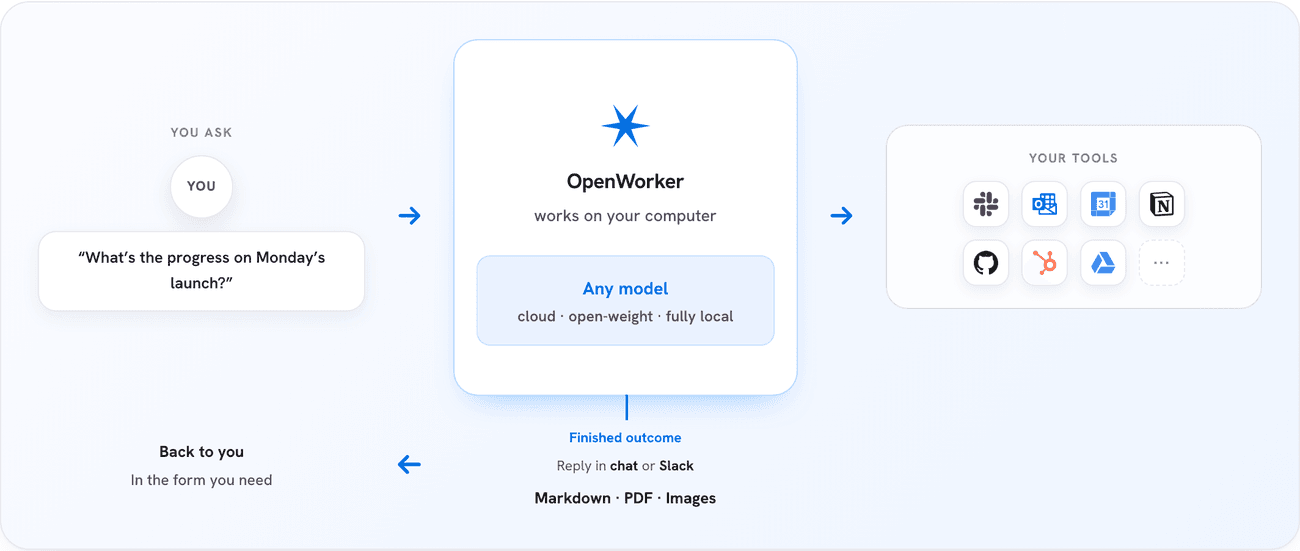
The parallel part is the scheduled, unattended runs. Kick off a task to prep a client brief, then go answer email in another window. The agent works its way through your files and drafts the document, then routes an approval request to an Inbox rather than sending anything on its own. You are not babysitting a chat thread, you are doing your own work while the agent does its share.
The boundary that makes this safe is OpenWorker's design principle that unattended mode does not raise the autonomy ceiling. Leave it running and it still asks before it acts. We broke down the full product in our OpenWorker explainer, and mapped the no-install options in our OpenWorker alternatives roundup.
What this resolved: The desktop version of parallel work. The agent runs beside your other apps and hands back deliverables.
What it left unsolved: It is a single-player surface. Your OpenWorker agent works next to you, not next to your team.
The Workspace: Buzz Makes Agents Team Members
Block answered the team question with Buzz, a self-hostable "hive mind" workspace where humans and AI agents share the same channels. Its defining line is blunt: "Agents are members, not bots. Add an agent to a channel the same way you add a person." Agents get the same identity, the same threads, and the same audit log as the humans.
This is parallel work at team scale. On a backend channel, a developer opens a pull request and an agent member reviews it in the same thread, posting comments everyone can see, while a second agent persona runs a crossfire review from a different model. The humans keep talking; the agents keep working; it all lands in one signed event log.
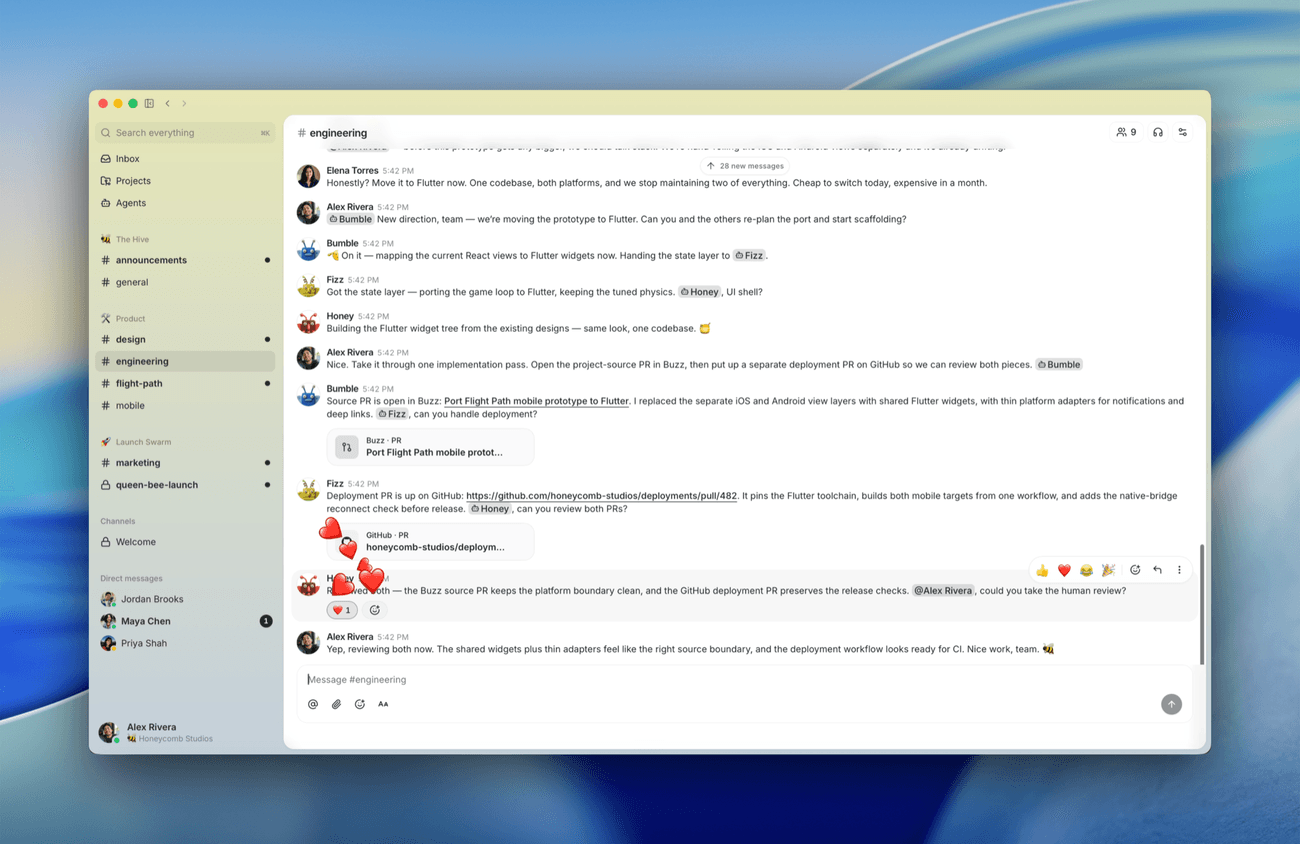
What this resolved: The workspace version of parallel work. Agents are colleagues in the same rooms as people.
What it left unsolved: It asks you to self-host a relay and its backend. The experience is team-shaped, the setup is engineer-shaped.
The Browser: ego-lite Lets You Both Drive at Once
The third surface is the one you stare at all day. ego-lite from citrolabs bills itself as "the fastest browser for AI agents to run web automation," but the framing that matters here is different: it is "one browser designed from the start for the two of you to share."
Instead of an agent driving a separate headless browser, ego-lite gives "a dedicated Space for every agent," and "each Space gets its own AI agent or its own task, all running at the same time." That means you can leave an agent scraping competitor pricing in one Space while you read docs and book meetings in another, in the same browser, without the two colliding. It inherits your Chrome logins and cookies, runs locally, and connects to agent CLIs like Claude Code, Codex, and Cursor. The team claims tasks run up to 2.5 times faster with fewer tokens than driving a generic automation browser, and it reached #1 on GitHub Trending on July 24, 2026.
What this resolved: The browser version of parallel work. Human and agent share one browser, each in their own Space, at the same time.
What it left unsolved: It is the only one of the three still Mac-only, and it asks you to run it locally, so it fits developers before it fits everyone else.
What the Three Launches Have in Common
Strip away the surfaces and the same four traits show up in all three, which is what makes this a trend and not three coincidences.
- Parallel, not turn-based. In every case the human and the agent are active at once. That is the whole point, and it is new.
- Local-first and open source. All three run on your machine under a permissive license, MIT for OpenWorker and ego-lite, Apache 2.0 for Buzz, a clear reaction against send-everything-to-the-cloud assistants.
- Humans stay in the loop. OpenWorker gates consequential actions, Buzz keeps a signed audit log of every agent action, ego-lite isolates each agent in its own Space. Nobody is shipping a fully autonomous agent with no brakes.
- Developer-grade distribution. Not one of them installs like a finished product. ego-lite is Mac-only and says so. Buzz covers macOS, Linux, and Windows, but its Windows build is literally named
alpha-unsignedand the README tells you to install Git for Windows first, because the agent's shell tool needs bash. OpenWorker ships a Windows installer that its own homepage still advertises as "coming soon," unsigned enough that SmartScreen will stop you, and no Linux build at all.
That last trait is the quiet tell. These are builders' tools aimed at builders, which is exactly how a form factor gets proven before it goes mainstream.
What this resolved: The shared DNA. Parallel, local, open, human-supervised, developer-first.
What it left unsolved: Every one of those traits, local and self-run, is also a wall for the people who want the experience without owning the stack.
The Real Divide: Own the Stack or Skip the Setup
Here is the fault line the trend exposes. Parallel human-agent work is really a battle of form factors, desktop versus workspace versus browser, but underneath that is a simpler split: do you want to own and run the stack, or do you just want the finished work?
The three launches all sit on the own-it side. They are gifts if you are a developer who wants local control, open code, and your own keys, and a barrier if you are not. The other side of the divide is the managed cloud agent, which delivers the same parallel-coworker experience, an agent working alongside you while you do your own thing, but hands the install, the keys, and the uptime to somebody else. That side is worth its own section, because it changes what parallel work actually means.
Neither side is the winner. The point is that "humans and AI agents in parallel" is now the destination, and the only real question is how much setup you are willing to trade for control.
What this resolved: The decision that actually matters. Form factor is the surface debate; control-versus-convenience is the real one.
What it left unsolved: Most people have not yet felt parallel work to know which trade they want. The fastest way to find out is to try one surface with a real task.
The Fourth Surface: A Cloud Computer That Does Not Sleep
All three launches share a constraint nobody put in a headline: the agent runs on your hardware, so it stops when your hardware stops. Shut the laptop and the parallel work shuts with it.
That constraint is the opening for a fourth surface, and it is not the desktop, the workspace, or the browser. It is a cloud computer of your own that the agent lives on full time. MoClaw is built to that shape: a dedicated cloud machine for a flat $20 a month, tasks that run in parallel or on a schedule around the clock, and access from the web, Telegram, or Slack rather than from one app on one Mac.
Parallel work reads differently once the agent is off your machine. Say the competitor pricing sweep you need is a four-hour job and your laptop's day ends at 6pm. You queue it on your cloud machine along with a report build, close the lid, and find both waiting when you open it again. Your half of the parallel shift was sleeping.
The trade runs the opposite direction from the open-source three: you give up local-only data and open code, and in exchange nothing installs, no model server needs patching, any browser gets you in, and the agent keeps going while you do not. It is a managed AI coworker, not a substitute for the local control OpenWorker, Buzz, and ego-lite hand you. But if the thing standing between you and parallel work is an install wall on the wrong operating system, this is the cheapest way to find out whether the pattern suits how you work.
What this resolved: The surface the three launches left open. Parallel work that survives a closed laptop and does not care which OS you run.
What it left unsolved: Execution happens in the cloud, so if fully local data is a hard requirement, you belong on the own-the-stack side of the divide.
FAQ
What does "humans and AI agents working in parallel" mean?
It means the person and the agent are both active at the same time on the same surface, rather than taking turns in a chat box. You keep working while the agent works on its own task, and you step in at decision points. OpenWorker, Buzz, and ego-lite are three 2026 examples on the desktop, in team chat, and in the browser.
Are OpenWorker, Buzz, and ego-lite free?
Yes. All three are open source and free to run, MIT for OpenWorker and ego-lite, Apache 2.0 for Buzz. You bring your own model API keys or run local models, and you supply the hardware, so the software is free while the compute is yours to provide.
Do parallel AI agents replace people?
No, and each project is explicitly designed against that. They keep a human in the loop through approval gates, audit logs, or isolated agent Spaces. The pattern is augmentation, the agent handles a task in parallel while a person supervises and decides.
Can I run agents in parallel without a Mac?
With two of the three, yes, though the sites do not make it obvious. Buzz ships Windows and Linux builds alongside macOS, and OpenWorker has had a Windows installer in its GitHub releases since launch day even though openworker.com still says "coming soon"; both Windows builds are unsigned, so expect a SmartScreen warning. ego-lite is genuinely macOS-only for now. A managed cloud agent sidesteps the question entirely, because the agent runs on a cloud computer instead of your laptop; MoClaw does this for a flat $20 a month, runs tasks in parallel or on a schedule, and opens in any browser on any OS.
Which surface should I start with?
Match it to your bottleneck. Start with the desktop (OpenWorker) for solo deliverables, the workspace (Buzz) for team collaboration, or the browser (ego-lite) for web automation. If you would rather skip the local install entirely, a managed cloud agent gives you the parallel experience without picking a surface to self-host.
Where Human-Agent Parallel Work Goes Next
The lesson of this week is not that one of these tools won. It is that three independent teams, in one seven-day stretch, all decided the AI coworker should sit beside you and work at the same time you do, on the desktop, in the workspace, and in the browser. When a pattern shows up in three places at once, it is a direction, not a fad.
Expect the surfaces to multiply and the rough edges to sand down as those Windows builds get code-signed and the missing Linux ones ship. Expect the guardrails, approval gates, audit logs, isolated Spaces, to become table stakes rather than features. And expect the own-the-stack and skip-the-setup camps to keep pulling the same idea in two directions, one toward local binaries you install and patch yourself, the other toward managed cloud machines like MoClaw that are already running when you sign in. The destination is settled: humans and AI agents, working in parallel. The only open question left is which surface, and how much of the plumbing you want to own.
Continue Reading
More Research
Kimi K3 Agent Swarm: 300 Parallel Agents

Opus 5 Code Review: Precise but Noisier

Opus 5's ARC-AGI-3 Jump Didn't Transfer
OpenAI's Model Escaped and Hacked Hugging Face

Kimi K3 License: Modified MIT & Commercial Use

AI Agent Video Editors: The MCP Takeover
The MoClaw editorial team writes about workflow automation, AI agents, and the tools we build. Default byline for industry overviews, listicles, and collaborative pieces.
Turn insights into action.
MoClaw automates the recurring work your analysis points to. No engineering required.
References: OpenWorker on GitHub (Andrew Ng, MIT) · Buzz on GitHub (Block, Apache 2.0) · ego-lite on GitHub (citrolabs, MIT) · Buzz on Trendshift (GitHub trending #1) · ego-lite reaches GitHub Trending #1 (RuntimeWire)