What Is Magnitude AI? Local Models for Agents

Magnitude AI is an open-source inference server that runs the best local models for your hardware and plugs into Claude Code, Codex or Cline. How it works.
Table of Contents
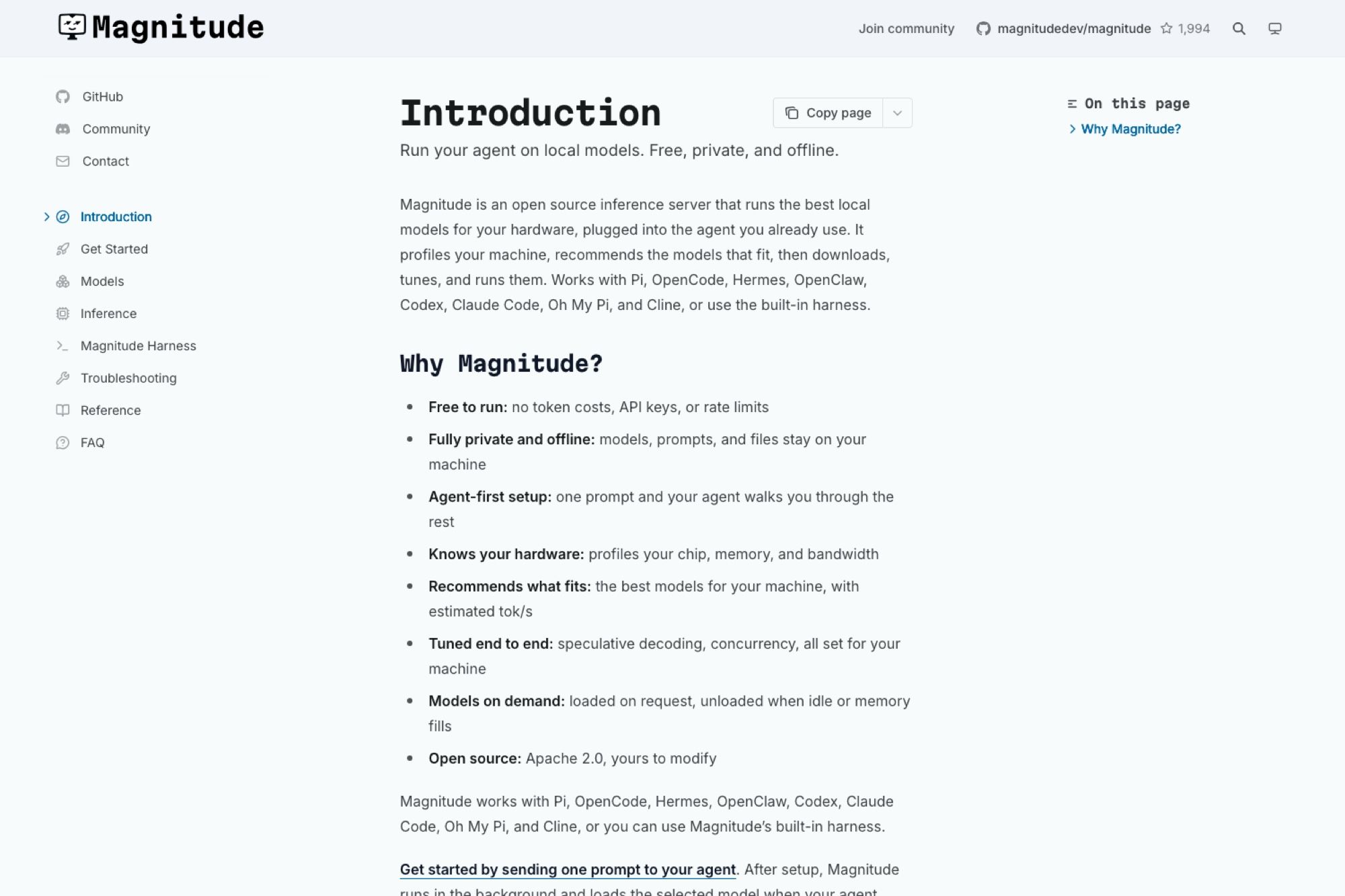
Your coding agent talks to somebody else's GPU. Every prompt, every file it reads, every half-finished function it writes on your behalf leaves the building, and you pay per token for the privilege. Magnitude AI is an open-source inference server built to break that arrangement without making you throw away the agent you already like: it profiles the machine in front of you, works out which local models actually fit it, then serves them to Claude Code, Codex, Cline or whatever else you're running.
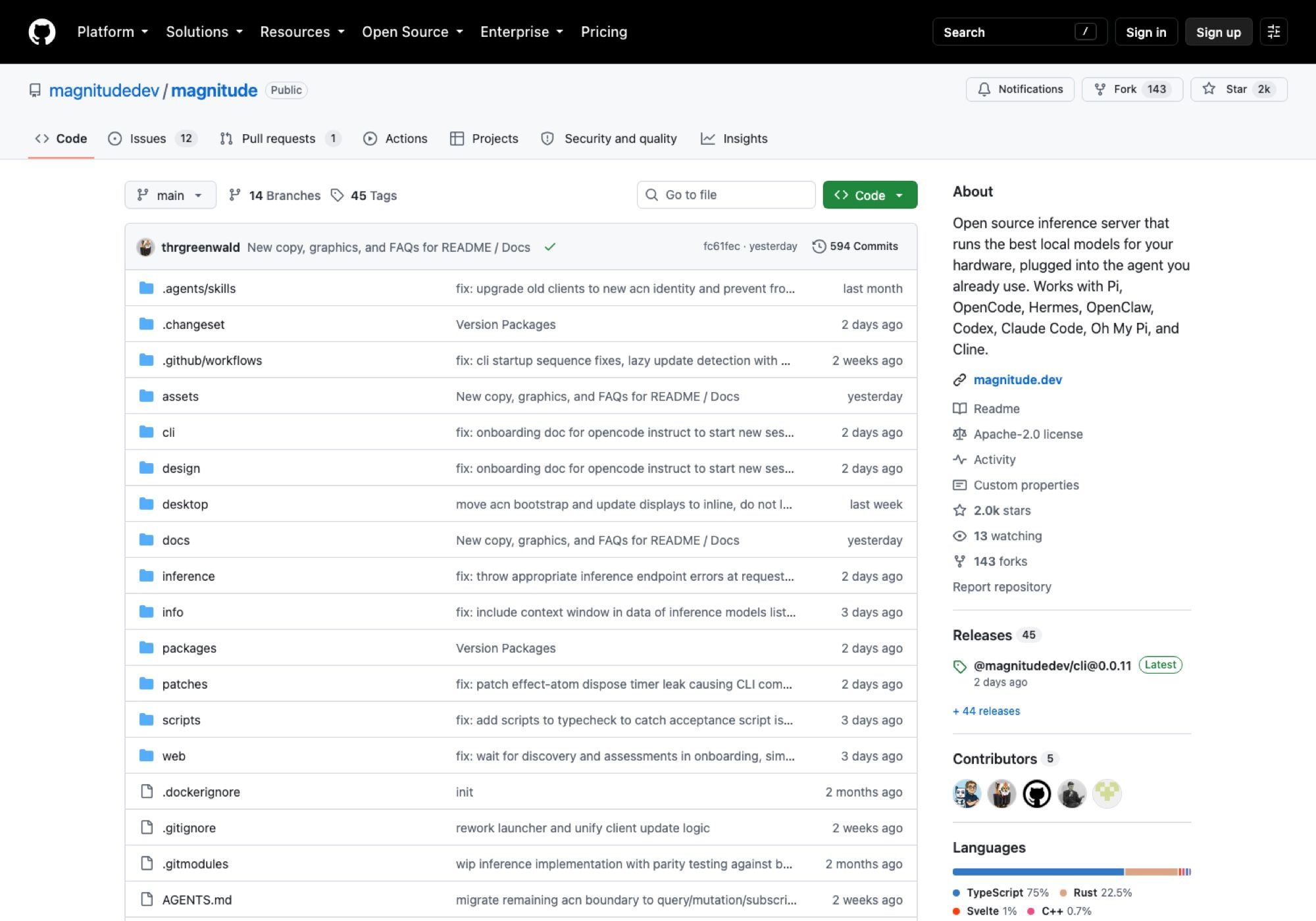
The project went public on 12 June 2026 and sat at 1,992 stars when I checked the GitHub API on 4 September. That's fast, but the version number is the more honest signal about where it is: the CLI on npm is at 0.0.11, published on 2 September, with five contributors on the repo. This is early software with a clear idea.
What Magnitude AI actually is
The category confusion is worth clearing up first, because Magnitude sits between two things people already know and gets mistaken for both.
It isn't an agent. It doesn't plan, it doesn't hold a conversation, it has no opinion about your codebase. And it isn't a model either, the way Qwen or Gemma or DeepSeek are models. Magnitude AI is the layer in between: a server that holds a catalog of local models, knows which ones your particular hardware can run at a usable speed, downloads and tunes the one you pick, and exposes it as an endpoint your existing agent connects to.
The closest familiar comparison is Ollama, and the maintainers address that head-on in their own FAQ. Their argument is that if you ask your agent to set Ollama up for you, the agent is guessing. It doesn't know your chip, it doesn't know which quantisation fits in your memory, and it certainly doesn't know how many tokens per second you'll get out of the result. Magnitude computes that instead of guessing at it.
How it decides what your machine can run
Installing Magnitude AI is one command, npm i -g @magnitudedev/cli, and the documented path after that is odd in a way I've come to like: you don't run the setup, you hand a paragraph to your agent and let it run the setup. The README literally gives you the text to paste, telling your agent to install the CLI, run magnitude docs onboarding, and follow what it says.
What happens next is the profiling step. Magnitude reads your chip, your memory and your bandwidth, then produces a shortlist of models with estimated tokens per second attached to each one. You choose from that shortlist. It downloads what you chose, sets up speculative decoding and concurrency for your specific machine, and rewrites your harness config so the agent you were already using now points at localhost instead of an API.
Models load when something asks for them and unload when they go idle or memory gets tight, which matters more than it sounds. A 30-billion-parameter model resident in RAM is not a background process. It's most of your laptop.
Which agents it plugs into
The list in the repo, as of September 2026, runs to eight: Pi, OpenCode, Hermes, OpenClaw, Codex, Claude Code, Oh My Pi, and Cline. There's also a harness built into Magnitude itself if you'd rather not bring one.
That list is the whole pitch, really. Most attempts at local inference ask you to adopt a new interface, which is a much larger ask than it looks, because the agent you use is a set of habits as much as a tool. Keeping Claude Code and swapping what's behind it is a change you can reverse on a Tuesday afternoon.
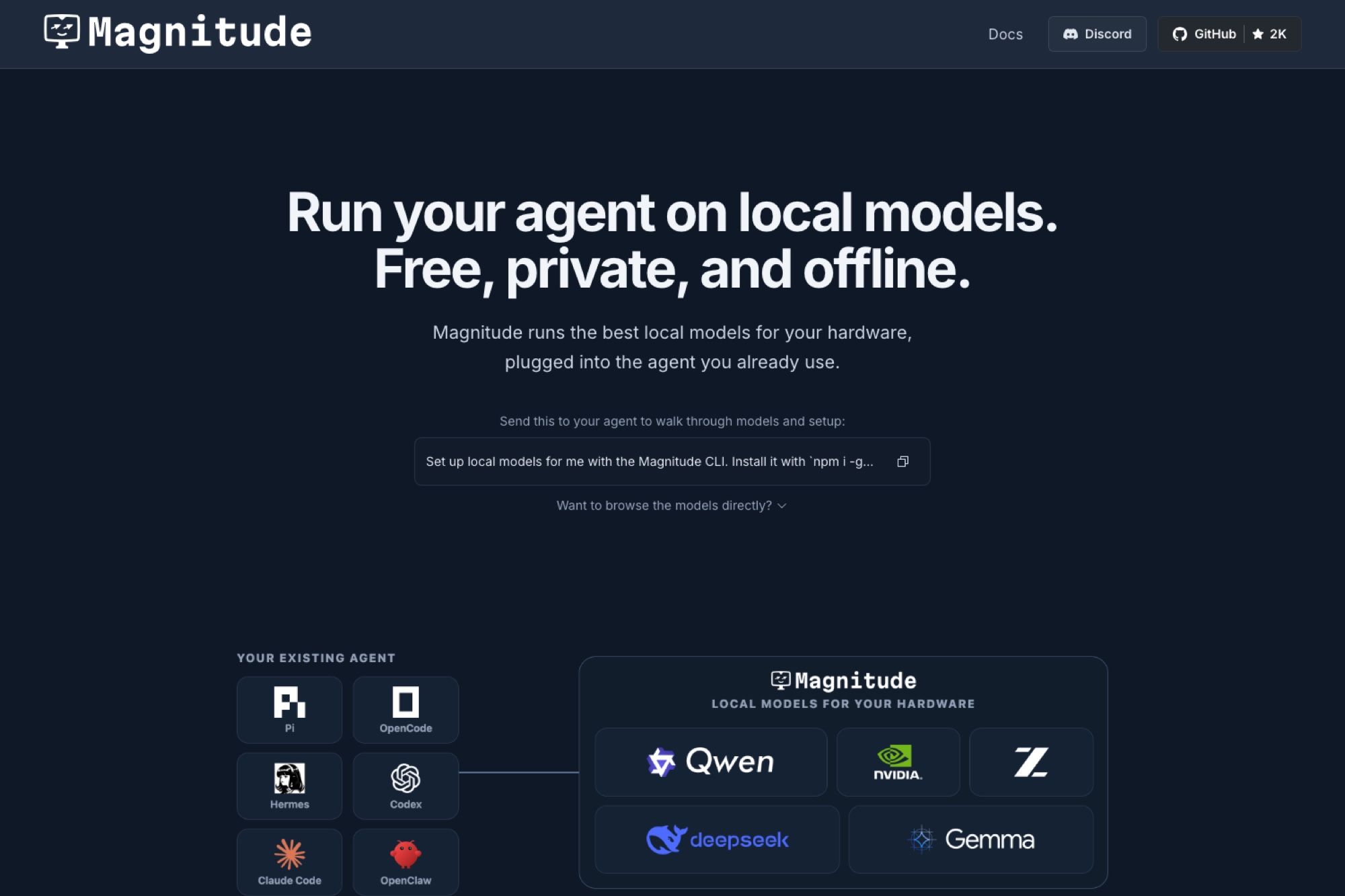
On the model side, the homepage shows Qwen, NVIDIA, Z, DeepSeek and Gemma. You aren't confined to the catalog: the docs point you at downloading compatible GGUF files from Hugging Face and running those instead.
One consequence of that design is that Magnitude AI is per-machine by construction. The profile it builds belongs to the laptop it ran on, so the desktop at home and the laptop on the train end up with different catalogs, different models and different speeds, and neither one knows what the other is doing. That's fine until you want to start something in one place and pick it up in another. MoClaw handles that half differently, giving you one cloud AI computer both devices reach into, which is a different job from the one Magnitude is doing rather than a competing answer to it.
Magnitude AI versus pointing your agent at Ollama
Both hand your agent a local endpoint. The difference is everything that happens before the endpoint exists.
With Ollama you make the decisions. Which model, which quant, whether 32 gigabytes is enough headroom for the context length you want, what to do when the answers start arriving at four tokens a second. Those are answerable questions, and plenty of people enjoy answering them. If you don't, they're a wall, and the wall is why most developers who try local models once go back to an API within a week.
Magnitude AI moves those decisions into a profiling step and a catalog with numbers attached. It's a smaller claim than "we made local models good," and a more useful one.
The trade is the usual one for any layer that makes choices for you: you inherit its opinions. If the catalog doesn't rate your GPU generously, or the tuning defaults don't suit an unusual workload, you're now debugging somebody else's inference stack rather than your own. At 0.0.11 that's a real risk, not a theoretical one.
What free, private and offline actually buy you
Three claims, and they're worth separating because they don't all pay off for the same person.
Free means no token bill and no rate limits, once you own the hardware. The catch is the word "own." A machine that runs a capable coding model comfortably is a purchase, and if you're renting compute anyway, local inference just moves the line item.
Private is the one with teeth. Prompts, files and model weights stay on the machine, so the question "did our source code go to a third party" has a clean answer, and that answer is the thing procurement and legal keep asking for. If you work under a contract that names data residency, this is the section that matters and the other two are decoration.
Offline means once Magnitude and a model are downloaded, no connection is needed. Useful on a plane, useful on an air-gapped network, useful more often than you'd expect in a building with bad wifi.
Where this gets complicated is that the same laptop is usually also your everyday machine. Local inference competes for the memory you need for a browser with forty tabs, a simulator and a dev server. That's the second place MoClaw fits into the picture rather than fighting it: a hosted cloud AI computer takes the long-running agent work off the machine you're typing on, so the local setup you just built stays available for the fast interactive stuff it's good at.
Who should install this
Two clear groups, and one that should probably wait.
Install it if privacy is a requirement rather than a preference. Healthcare, defence contracting, anything where a legal team has already written down which systems your code may touch, this is a straight answer to a question you've been fielding.
Install it if you're paying enough in tokens that the hardware maths works, and you already have the hardware. Somebody running an agent in a loop over a large repository all day is the case where local inference pays for itself quickly.
Wait if you need frontier-model quality on hard reasoning tasks. Local models have closed a lot of the gap and haven't closed all of it, and no server in front of them changes that.
Then there's the case Magnitude doesn't address at all: the agent needs to be running when you aren't. Heartbeats, scheduled runs, a long refactor you kick off before dinner. Local inference on a laptop dies when the laptop sleeps, which is a physical fact about laptops and not a flaw in the software. MoClaw exists for exactly that shape of problem, a hosted cloud AI computer that stays up so the scheduled work has somewhere to land, and it's genuinely complementary here: private local inference for the sensitive fast work, a cloud machine for the jobs that need to outlive your session. If you're weighing which side of that line your workload falls on, our guide to self-hosted AI agent alternatives walks through the same trade in more detail, and the cost breakdown for self-hosting puts numbers on the hardware side.
The honest read on maturity
Apache 2.0, five contributors, a CLI that shipped three patch versions in the first three days of September. The idea behind Magnitude AI is good, and the framing is unusually clear for a project this young.
What that means practically: try it on a machine where a bad afternoon is survivable, keep your API config around, and don't migrate a team onto it this quarter. The reason to look now is that the positioning is right, and positioning is the hard part. Plenty of projects have made local models run; this is one of the few that started from the question of how they reach the agent you already opened this morning.
FAQ
Does Magnitude replace my AI agent?
No. It replaces what your agent talks to. Claude Code, Codex, Cline and the rest keep working the way they did; setup rewrites their config so requests go to a local endpoint instead of a cloud API. The built-in harness is there if you want one, not because you need one.
Can I run AI agents without an API key?
That's the point of it. Once a model is downloaded there's no key, no token meter and no rate limit, because nothing leaves the machine. You're paying in electricity and hardware instead, which is a better deal for some workloads and a worse one for others.
What hardware do I need?
The project doesn't publish a minimum, deliberately. Magnitude AI profiles what you have and recommends models that fit it, with estimated tokens per second, so a modest machine gets a smaller model rather than a failure message. More memory means larger models. macOS and Linux are supported directly, Windows through WSL.
Is my data really staying local?
Prompts, files and weights stay on your machine, and once everything is downloaded it runs with no connection at all. Worth confirming against your own network policy rather than taking any project's word for it, but the design has no cloud component to leak through.
Is Magnitude AI production-ready?
Not yet, by its own version numbering. 0.0.11 on 2 September 2026, five contributors, three months old. Evaluate it, don't standardise on it.
Continue Reading
More Research
Is Context-Mode Open Source? The License

Sprix SAGE Router: Rerouting Agents Mid-Task

Fable51-Worlds: Text to Walkable 3D Worlds

Version Control for AI Agents: Atlas

Anthropic Commerce Agents: The Blueprint

OpenClaude: What Its License Actually Says
The MoClaw editorial team writes about workflow automation, AI agents, and the tools we build. Default byline for industry overviews, listicles, and collaborative pieces.
Turn insights into action.
MoClaw automates the recurring work your analysis points to. No engineering required.
References: https://github.com/magnitudedev/magnitude · https://docs.magnitude.dev · https://magnitude.dev · https://www.npmjs.com/package/@magnitudedev/cli · https://github.com/magnitudedev/magnitude/blob/main/LICENSE · https://docs.magnitude.dev/models