OpenClaude: What Its License Actually Says

OpenClaude has 32,000 stars and an MIT badge, but its LICENSE says the code derives from Anthropic's proprietary CLI. Read it before you install.
Table of Contents
Somebody on your team is going to paste npm install -g @gitlawb/openclaude into a terminal this week, and the honest question isn't whether OpenClaude works. It does. The question is what you just installed. OpenClaude has 32,044 stars as of 2 September 2026, roughly 9,000 forks, a release cadence measured in days, and a README badge that says MIT. The LICENSE file in the same repository says something considerably more complicated, and the gap between those two documents is the whole story.
Google already knows this is what people wonder about. Search the project name and the "People also ask" box surfaces "Is the Claude code leak real?" right under the official site. So let's answer the licensing question properly, with the file open.
What you actually install
OpenClaude is a terminal coding agent: prompts, tool calls, file edits, grep and glob, subagents, MCP servers, slash commands, streaming output. Version 0.30.0 landed on 31 August 2026 and the npm package @gitlawb/openclaude has been publishing since the repo's first day, 1 April 2026. You need Node 22 or newer, and ripgrep on your PATH or the first run complains. Bun only matters if you're building from source.
Two features stand out from the usual coding-CLI checklist. There's a repo map that ranks files by PageRank importance and injects a structural summary into context, inspectable with /repomap. And there are background sessions: openclaude --bg "fix failing tests" detaches a run from your terminal, with openclaude ps and openclaude logs -f to watch it. The docs are unusually careful about what that does and doesn't mean, which I'll come back to.
There's also a pixel-art companion that fires an arrow every time you press Enter. That is not a joke I'm making; /buddy set robinhood is a documented command. Take it as evidence that whoever maintains this repo is enjoying themselves.
The MIT badge and the LICENSE file don't agree
The README carries a blue shields.io badge reading license-MIT, linked to the LICENSE file. Open that file and the first word is not "MIT". It's "NOTICE".
Here is the text, in full, because paraphrasing it would soften it:
"This repository contains code derived from Anthropic's Claude Code CLI. The original Claude Code source is proprietary software: Copyright (c) Anthropic PBC. All rights reserved. Subject to Anthropic's Commercial Terms of Service."
The MIT grant that follows covers exactly one thing: "Modifications and additions by OpenClaude contributors ... where legally permissible". Not the program. The diffs. And the closing paragraph removes any remaining ambiguity:
"The underlying derived code remains subject to Anthropic's copyright. This project does not have Anthropic's authorization to distribute their proprietary source. Users and contributors should evaluate their own legal position."
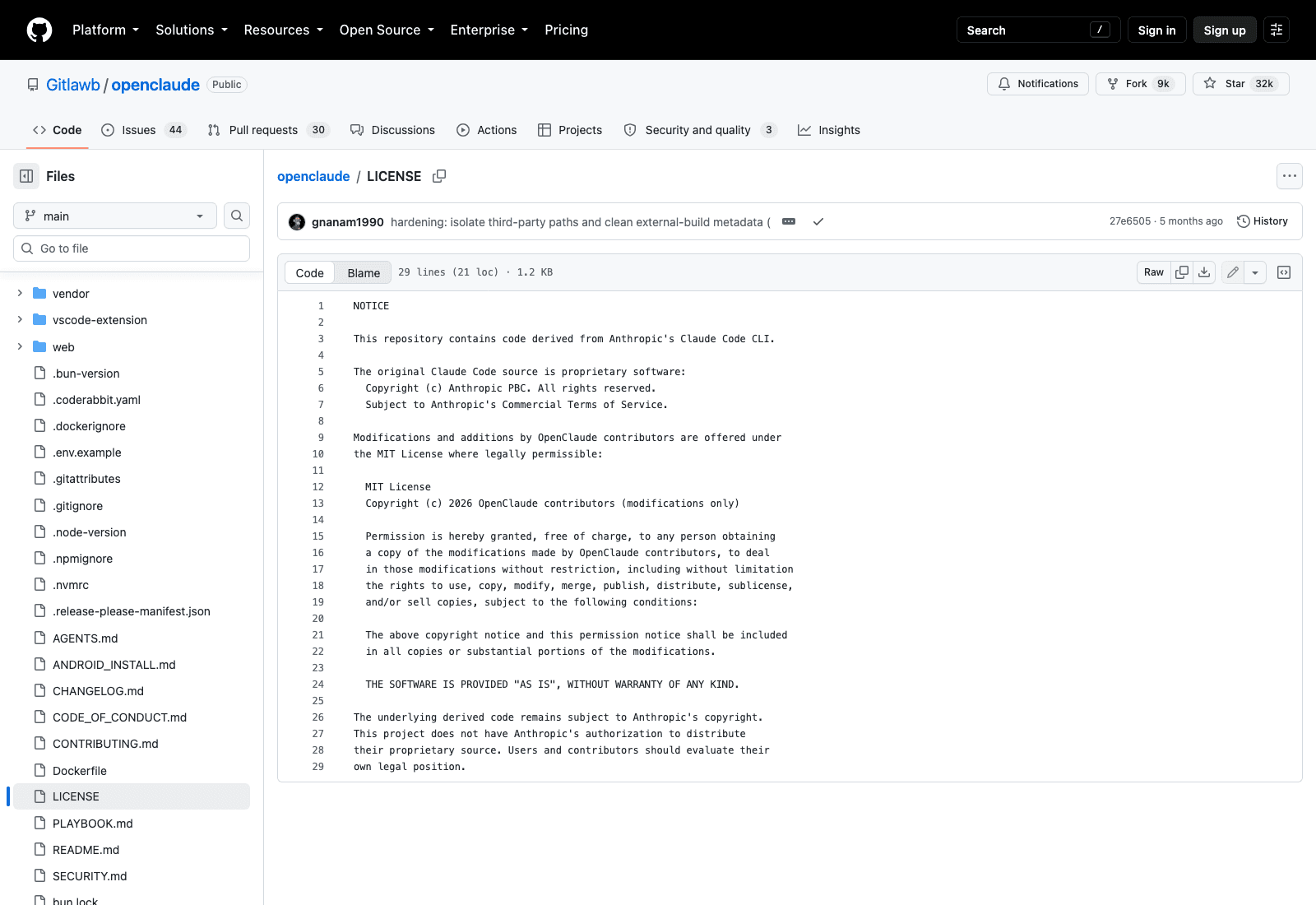
Twenty-nine lines, 1.2 KB, last touched five months ago. That NOTICE has been sitting there since roughly the repo's opening weeks, so this isn't a recent disclosure or a reaction to pressure. GitHub's own licence detector agrees, incidentally: the API reports NOASSERTION rather than MIT, which is what it does when a file doesn't match a known template.
None of this means the maintainers did something sneaky. They wrote it down, in the file you're supposed to read, in plain language. What it means is that the badge is doing work the file won't back up, and if your procurement process stops at the badge, you've skipped the part that matters.
Which models OpenClaude really runs
The marketing line is model neutrality, and the provider table is genuinely long: OpenAI-compatible endpoints, Gemini, GitHub Models, Ollama, LM Studio, Fireworks AI with 276 curated models, Xiaomi MiMo, LongCat, Cloudflare Workers AI, Z.AI's GLM coding plan, ClinePass, plus a handful of gateways including OpenCode Zen and a $10-a-month OpenCode Go tier covering 13 open models. There's even a community-maintained Arch Linux package if that's your world.
Now count the Anthropic rows. There are none, in the sense a reader expects. You cannot drop an Anthropic API key into a provider slot and go. Claude models reach OpenClaude two ways: through NEAR AI's unified gateway, or through the Bedrock / Vertex / Foundry row, which the table describes as "Anthropic-family cloud routes". The project's own homepage lists what it works with as "openai, gemini, codex, grok, ollama, lm studio, and 200+ models" and does not name Claude at all.
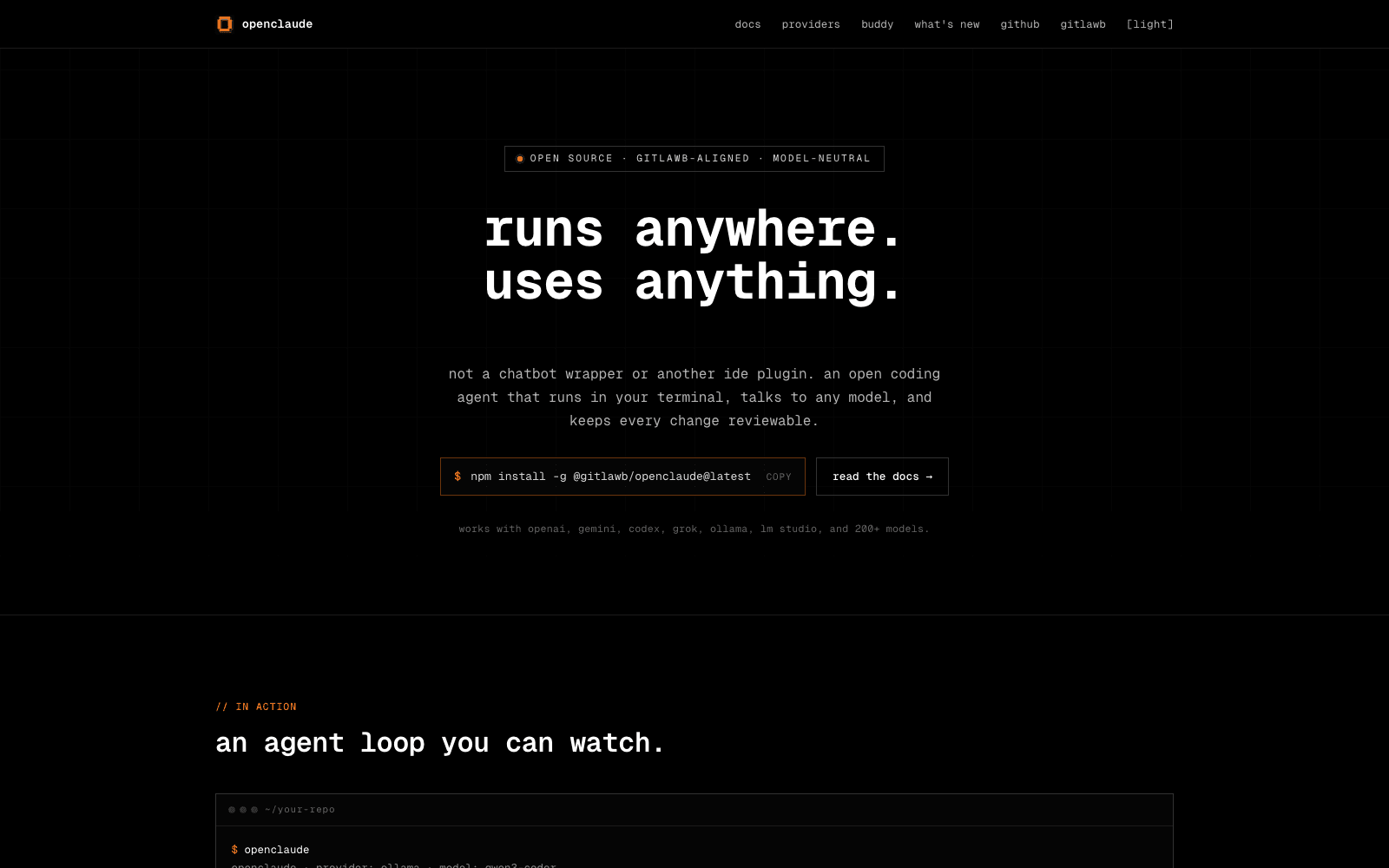
That's worth flagging because a lot of the coverage frames OpenClaude as "Claude Code, but you can swap in any model including Claude". The first half is accurate. The second half is a cloud-marketplace detour with its own account, its own billing, and its own approval path. If what you wanted was Claude models under a normal commercial agreement, plugging into MoClaw takes you there in one step rather than through a third-party gateway you'd then have to vendor-review separately.
The Claude Code fingerprints are still in the source
You don't need to diff anything to see the ancestry; the setup instructions give it away. The fastest OpenAI configuration in the README is this:
export CLAUDE_CODE_USE_OPENAI=1
export OPENAI_API_KEY=sk-your-key-here
export OPENAI_MODEL=gpt-4o
openclaude
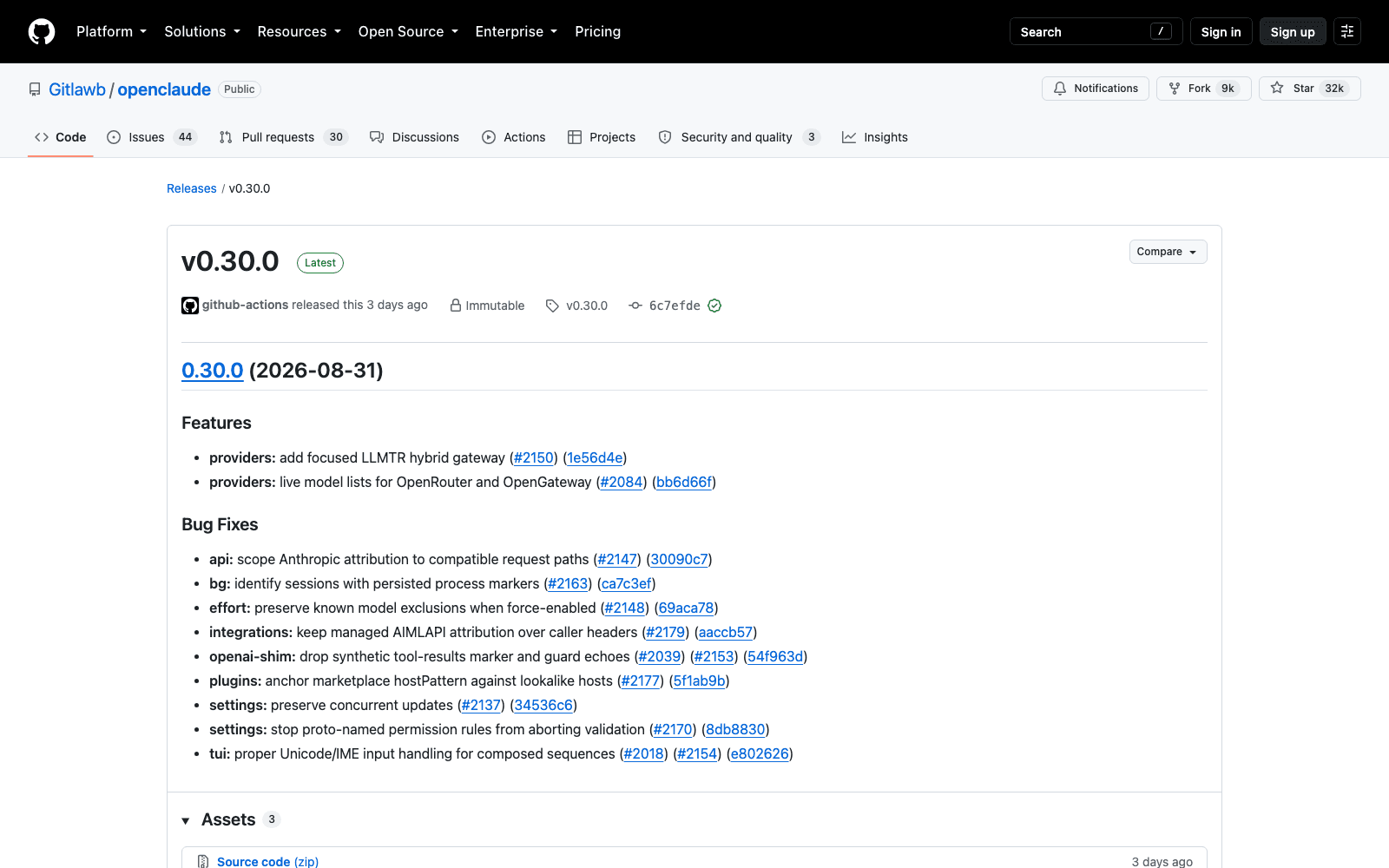
An environment variable named CLAUDE_CODE_USE_OPENAI is not a coincidence, and the 0.30.0 changelog carries a fix titled "api: scope Anthropic attribution to compatible request paths", alongside one for an openai-shim that drops a synthetic tool-results marker. Those are the maintenance burdens of a codebase that grew out of something else.
To their credit, the config story is clean. OpenClaude keeps state in ~/.openclaude and ~/.openclaude.json, refuses to read ~/.claude or project .claude/ directories, and the migration note tells you in bold not to copy Claude Code credentials or auth files across. New users start empty and never need Claude Code installed. That's the right call, and it's the kind of detail that suggests the project is trying to stay on the correct side of a line it knows exists.
So can you use it at work?
For a hobby project on your own machine, the practical risk is close to nothing, and you'd be joining tens of thousands of other people.
For anything with a company name attached, the LICENSE hands the decision to you in eleven words: "Users and contributors should evaluate their own legal position." That is not boilerplate. It's the maintainers declining to indemnify you, which they can't do anyway, because the grant they'd need doesn't exist. An MIT badge on a repository whose foundation is described in its own licence file as unauthorised proprietary source will not survive a serious vendor review, and the person who has to answer for it is whoever ran the install command.
Two follow-ups worth doing before you decide. Read the LICENSE yourself rather than trusting this article, since files change. And check whether the thing you actually need from OpenClaude is model flexibility or just an agent that isn't tied to one vendor's terminal, because those have different answers. Our write-up on what "free Claude Code" really costs walks through the same trade-off from the pricing side, and the managed OpenClaw alternative piece covers the hosted end of it.
The part nobody puts in the README
Background sessions are the feature I'd most want and the one the docs are most honest about. Quoting directly: they "are local child processes. OpenClaude does not start a daemon or network service." Session metadata lives under ~/.openclaude/bg-sessions/. Full terminal reattach isn't implemented yet; openclaude attach currently just points you at the log file. And unobservable force termination, host crashes, and power loss leave a session marked stale on every platform.
Read that again with a laptop in mind. Close the lid on a long refactor and the child process goes with it. Every agent CLI that runs as a local process has this shape, and it's the single thing a hosted machine fixes for free: MoClaw gives the run somewhere to live that isn't the hardware in your bag, so the overnight job is still going in the morning and you can pick it up from a different device.
There's a second version of the same problem on the governance side. A repository can be renamed, archived, or taken down between your evaluation and your rollout, and OpenClaude sits closer to that risk than most because of what its own NOTICE admits. Betting a team workflow on it means accepting that. Betting it on MoClaw means the thing you're depending on has a company behind it and a support address, which is a boring advantage right up until the week you need it.
Where this leaves you
OpenClaude is a well-run project with real engineering in it: the provider coverage is wider than anything comparable, the release notes are specific, and the maintainers documented the uncomfortable part instead of hiding it. Thirty-two thousand people starred it for reasons.
But the badge and the file disagree, and only one of them is a licence. Install it on your own machine if you're curious. Before it touches a repository your employer owns, open the LICENSE, read all twenty-nine lines, and make the call with the actual text in front of you rather than a blue rectangle from the README. Accurate as of September 2026, and worth re-checking, because this is exactly the sort of thing that changes without an announcement.
FAQ
Is OpenClaude free?
The software costs nothing to download and the npm package is public. Model usage is billed by whichever provider you configure, and one listed gateway, OpenCode Go, runs $10 a month for 13 open models. "Free" in the licensing sense is the murkier question covered above.
Is OpenClaude a fork of Claude Code?
Its own LICENSE says the repository "contains code derived from Anthropic's Claude Code CLI" and that the project "does not have Anthropic's authorization to distribute their proprietary source". Whether you call that a fork, a derivative, or something else, the file is unambiguous about the origin.
Does OpenClaude work with GPT and Gemini?
Yes to both. Gemini has its own provider row, API key only, and OpenAI models arrive through the OpenAI-compatible route or the Codex OAuth flow. Claude models are the awkward case: there's no direct Anthropic key path, only the NEAR AI gateway or Bedrock, Vertex and Foundry.
Can I use OpenClaude commercially?
The LICENSE tells users and contributors to "evaluate their own legal position", which is the maintainers saying they can't answer that for you. The MIT grant covers contributor modifications where legally permissible, not the derived base. Ask your own counsel before it goes near company code.
Is it still maintained?
Actively. Version 0.30.0 shipped 31 August 2026 with two provider features and nine bug fixes, the previous two releases landed on 19 August, and there were 44 open issues and 30 open pull requests when I checked on 2 September 2026.
Continue Reading
More Research
Is Context-Mode Open Source? The License

Sprix SAGE Router: Rerouting Agents Mid-Task

What Is Magnitude AI? Local Models for Agents

Fable51-Worlds: Text to Walkable 3D Worlds

Version Control for AI Agents: Atlas

Anthropic Commerce Agents: The Blueprint
The MoClaw editorial team writes about workflow automation, AI agents, and the tools we build. Default byline for industry overviews, listicles, and collaborative pieces.
Turn insights into action.
MoClaw automates the recurring work your analysis points to. No engineering required.
References: Gitlawb/openclaude (GitHub) · OpenClaude LICENSE (NOTICE) · OpenClaude v0.30.0 release notes · OpenClaude official site · openclaude AUR package