Free Claude Code: What That Actually Means
Free Claude Code routes the Claude Code CLI to 31 other model providers. What the proxy really does, what free means here, and where the risk sits.

Table of Contents
Free Claude Code is a local proxy that points the Claude Code CLI, Codex, or Pi at a model provider other than the one they shipped with. It does not unlock Anthropic's models at no cost. It removes Anthropic from the path entirely and substitutes one of 31 other providers, a few of which have genuinely free tiers and three of which run on your own hardware.
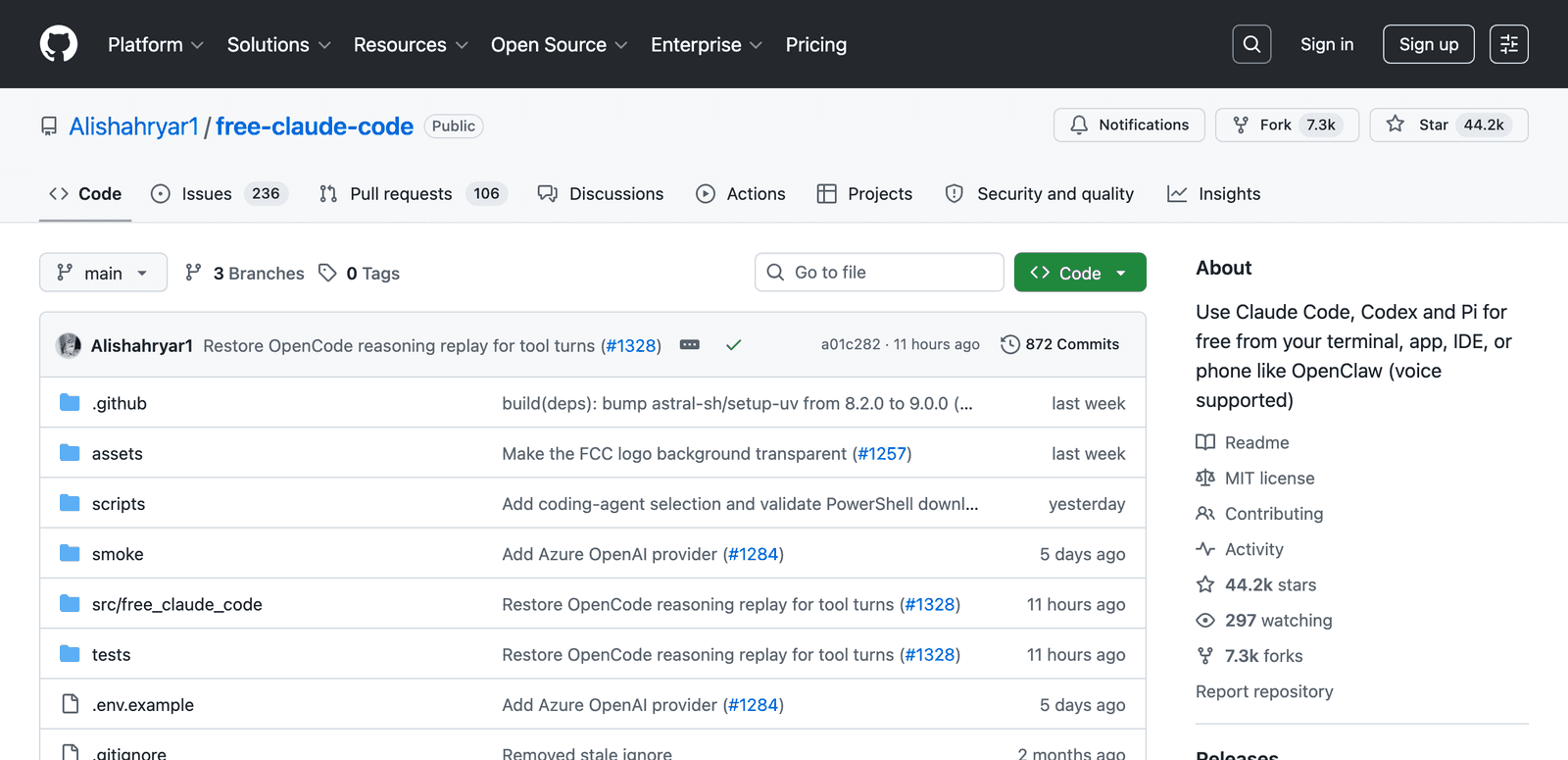
The project (Alishahryar1/free-claude-code) sat at 44,188 stars on August 4, 2026, according to the GitHub API on that date, from a repository created on January 28, 2026. That is roughly 234 stars a day sustained for six months, which is the kind of curve you normally only see on a model release. The name is doing a lot of that work, and the name is also the thing most people get wrong.
Key Takeaways:
- Free Claude Code (FCC) is a BYOK-style proxy plus an admin UI, MIT licensed, not a cracked or patched build of Claude Code.
- "Free" resolves to three different things: provider free tiers, a subscription you already pay for reused in a new client, and local models. Only the first is free in the plain sense.
- Anthropic is the one provider absent from FCC's list of 31, which tells you the design intent is substitution, not a discount.
- The compliance question worth asking is not about Anthropic's billing. It is whether your chosen provider's plan allows being driven from a third-party client.
- Local models work but need to be tool-capable and have enough context left over for a coding agent's system prompt and tool definitions.
What Free Claude Code actually does
FCC installs a local proxy and three launcher commands: fcc-claude, fcc-codex, and fcc-pi. You run fcc-claude instead of claude, and the CLI you already know starts up against a different backend. The agent's own model picker still works, because FCC generates a model catalog the client can read, so Claude Code's /model list fills with whatever providers you connected.
Everything else about the client stays where it was. FCC stores its own credentials under ~/.fcc/auth/ and, per its README, leaves an existing Codex login untouched. There is an admin UI for adding providers, validating a key before you commit to it, and routing model tiers separately, so Opus-class traffic can go to one model while a cheaper tier handles the rest.
The important structural point: this is a proxy, not a patch. Nothing about the Claude Code binary is modified. Your existing workflows keep working unchanged, including the kind of repeatable setups we walk through in our Claude Code recipes. That distinction matters for the risk section below, and it is the single most common misreading of the project.
Does this make Claude Code free? Where the cost actually moves
Three different things get called free in this project, and conflating them is how people end up disappointed.
| What "free" means here | Example from FCC's provider list | Actually free? |
|---|---|---|
| A provider free tier | open_router/openrouter/free, kilo/kilo-auto/free, NVIDIA NIM in the quick start |
Yes, within rate limits and model quality limits |
| A subscription you already pay for | OpenAI connected through your ChatGPT account, Kimi Code plan keys | No, you already paid. It is reuse, not savings |
| A local model | LM Studio, llama.cpp, Ollama | Marginal cost only: electricity plus the hardware you already bought |
The honest version of the pitch is: FCC removes the Anthropic subscription from a Claude Code workflow and lets you pay for tokens in some other way, including ways that cost nothing at low volume. That is a real thing to want. It is not the same as free Claude.
The quick start walks you through NVIDIA NIM specifically, which is the tell. NIM's build platform hands out a key in about a minute, so it is the shortest path from install to a working agent. It is also the provider whose free allowance you will exhaust first if you actually work all day.
What this proved: the cost does not vanish, it relocates to a provider you choose. What it left unsolved: nothing in FCC tells you which provider is cheapest for your workload, so you find out by running out.
The 31 providers, and the one that is missing
FCC's README lists 31 cloud and local providers. The cloud side covers the obvious names (OpenAI, Azure OpenAI, Google AI Studio and Vertex, Amazon Bedrock, Mistral, Cohere, DeepSeek), the fast-inference set (Groq, Cerebras, SambaNova, Fireworks), the aggregators (OpenRouter, Vercel AI Gateway, Hugging Face Inference Providers, GitHub Models), and the Chinese labs (Kimi API and Kimi Code, MiniMax, Z.ai).
Anthropic is not on that list.
That absence is the clearest statement of intent in the whole repository. You cannot use FCC to route Claude Code back to Claude on better terms, because Claude is not a destination the proxy offers. The tool exists to run Anthropic's client against everyone except Anthropic. Once you see that, the naming stops being confusing: "free" is shorthand for "without the subscription that normally comes with this client," and the way it achieves that is by swapping out the model behind it.
Practically, that also means the experience degrades or improves entirely along the axis of which model you picked. The README's own closing advice on providers is blunt about it: prefer tool-capable models, because a coding agent that cannot reliably call tools is not a coding agent.
How a request actually flows through the proxy
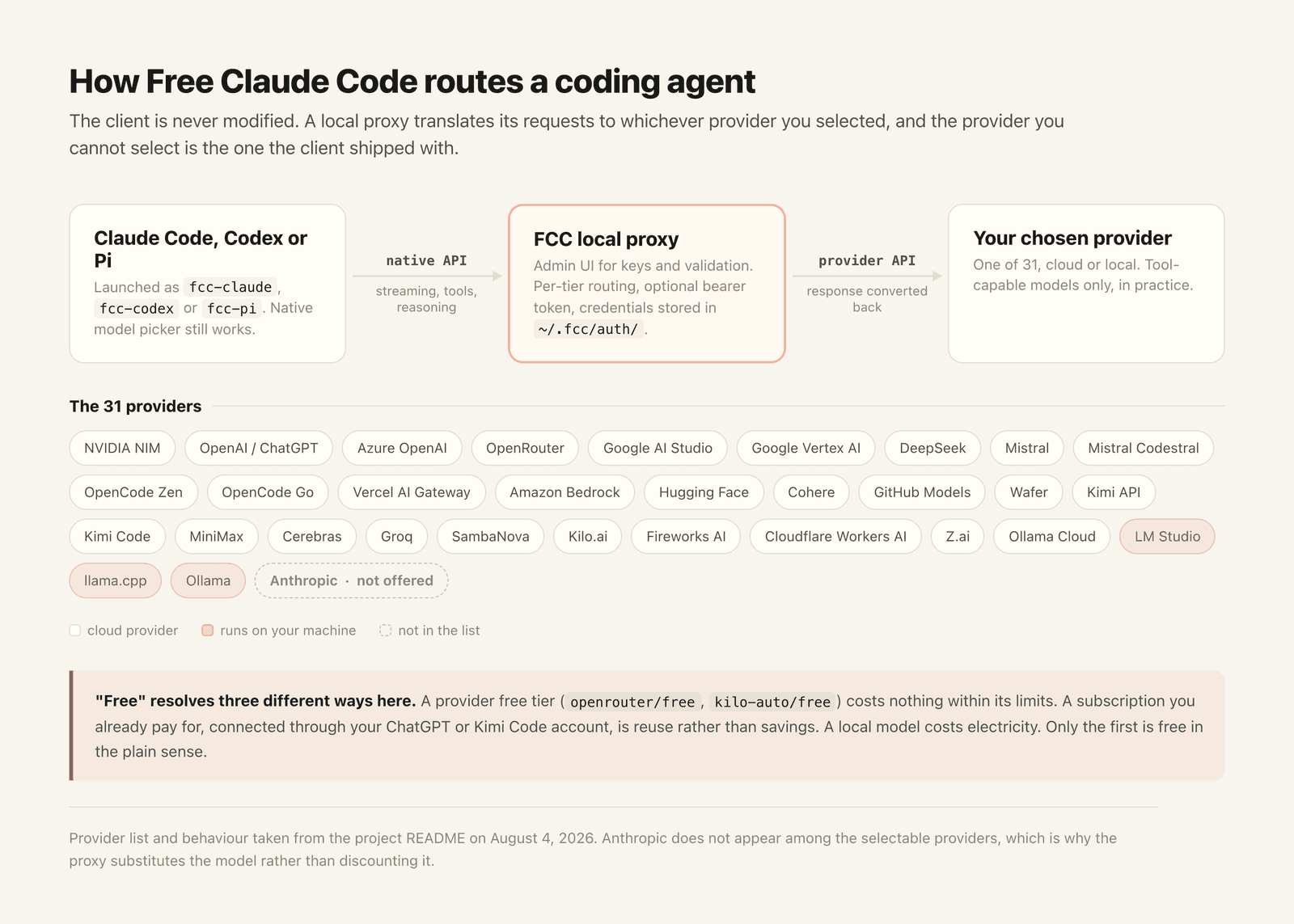
The path is short. Your client sends a request in the format it always used. The proxy translates it to the selected provider's API, streams the response back in the shape the client expects, and preserves the pieces that make an agent work: streaming, tool use, reasoning effort, and image input on models that support them.
Model-tier routing is the part worth understanding before you commit. FCC lets you map Fable, Opus, Sonnet, Haiku and fallback traffic to different models independently. In practice that means you can send planning-heavy calls to a strong model and let a cheap fast one handle the high-volume edits, which is the same tiering logic hosted platforms apply for you. Reasoning effort can either be passed through from the client or pinned in the proxy, and providers that do not support the control keep their own default behavior.
There is also optional bearer-token authentication on the local proxy. Turn it on. A proxy holding keys to 31 providers listening on localhost is exactly the kind of thing that becomes interesting the moment any other process on the machine gets curious.
What this proved: the translation layer is thorough enough that the client does not know it moved. What it left unsolved: parity is per-model, so a feature that works on one provider can silently stop working when you switch.
Running local models through a coding agent
The three local paths are LM Studio, llama.cpp, and Ollama, each pointed at by a base URL rather than a key. Ollama Cloud is treated as a separate provider from local Ollama, which is a small detail that will save you fifteen minutes of confusion.
The constraint that catches people is context, not capability. A coding agent spends a large slice of its window on its own system prompt and tool definitions before your code ever enters the picture. FCC's README calls this out directly: local models need enough context left for the agent's scaffolding. A model that looks fine in a chat UI can fail immediately as an agent backend for exactly this reason, and the failure looks like the agent forgetting instructions rather than like an error.
If your reason for looking at FCC was privacy rather than price, this is the branch that matters, and it is the branch where the honest answer is: try it on a real task before you migrate anything, because the gap between a local model chatting and a local model driving tools is wider than the benchmarks suggest.
The compliance question is about your provider, not Anthropic
This is where most coverage of the project gets it backwards.
FCC does not touch Anthropic's billing. There is no quota to bypass, because Anthropic is not in the request path at all once you switch providers. The thing to check sits one layer over, and FCC's own documentation is the source that flags it: the README notes that Kimi Code plans are for personal interactive coding-agent use and links to Kimi Code's community guidelines. The OpenAI provider is similar in shape, connecting through your ChatGPT account rather than an API key.
That is the actual pattern. Subscription plans are usually written around interactive use inside the vendor's own client. Driving one from a different client through a proxy is the part a terms-of-service review would look at, and the answer differs per provider. API keys billed per token are the boring, safe case. Subscription-backed connections are the ones to read carefully.
Three things worth checking before you standardize a team on this:
- Whether your provider's plan permits third-party clients at all.
- Whether the client you are running is licensed for use against a non-vendor backend, which is a question for Anthropic's Claude Code documentation and terms rather than for FCC.
- Where the keys live, and who on the team can read
~/.fcc/auth/.
None of that makes the project shady. It is MIT licensed, it does what it says, and the README is unusually candid about provider quirks. It does mean "we all just run this" is a decision with a paperwork component that a solo developer can skip and a company cannot.
When renting a hosted agent beats running your own proxy
There is a version of this problem where a local proxy is exactly right: you are one developer, you already have a provider you like, and you want your coding agent to use it. FCC solves that cleanly and the install is two commands.
The version where it stops being right is when the agent needs to keep running after you close the laptop. A proxy on your machine is bound to your machine. Scheduled work, long-running research, browser tasks, and anything that has to answer a message at 3am all want a runtime that lives somewhere else, and at that point you are no longer choosing a proxy, you are choosing where the agent runs.
That is the layer MoClaw sits at: a hosted agent with its own cloud computer, memory that survives a restart, and bring-your-own-key support so the model choice stays yours rather than being a property of the vendor. If you want the broader map of that space, including gateways and managed platforms, our BYOK platform guide covers how the options differ on pricing and control.
FAQ
Is Free Claude Code actually free?
The software is, under an MIT license. Whether your usage is free depends entirely on the provider you connect. Free tiers such as OpenRouter's and Kilo's free model slugs cost nothing within their limits, local models cost you electricity, and everything else bills normally. The project name refers to running the client without its usual subscription, not to free access to Anthropic's models.
Do I still need an Anthropic account?
Not for the model. Anthropic is not among FCC's 31 providers, so once you are running through the proxy your requests go somewhere else entirely. You still need the Claude Code client itself installed, and its own terms still apply to that software.
Can I use my own API key with Claude Code?
That is precisely what FCC is for. You add a key in the admin UI, validate it, and select a model. Keys are stored locally under ~/.fcc/auth/, and the proxy can require a bearer token before anything is allowed to talk to it.
Does it work with Codex and IDE extensions too?
Yes. The launchers cover Claude Code, Codex, and Pi, and the README documents connecting through VS Code and JetBrains via ACP. Codex uses a generated model catalog in its config, so its native model picker fills with FCC's providers the same way Claude Code's does, which leaves the Codex agent workflows you already run intact.
What happens when a provider is slow or down?
You switch in the admin UI and restart the agent. There is fallback-tier routing for model tiers, but the practical answer most people land on is keeping two providers validated so switching is a thirty-second operation rather than a research project.
Free Claude Code is a routing decision, not a free lunch
Strip away the name and this is a well-built BYOK proxy for coding agents, with an unusually wide provider list and a candid README. It moves your spend from one vendor to another, and in the best case to a free tier or your own GPU. It does not make Claude free, and the project never actually claims to.
Decide it on the axis that matters: if you want a different model behind a client you already like, this is the cleanest way to get one. If what you actually want is an agent that keeps working when you are not at the keyboard, the proxy is not the piece you were missing.
Repository figures verified against the GitHub API on August 4, 2026. Provider details from the project README as of the same date.
Continue Reading
More Guide
AI Travel Planning Workflow for Busy Teams

AI Travel Email Integration for Bookings

ChatGPT Codex: From Chat to Tasks

What Compound Engineering Actually Compounds

Running Claude Code Agents in Parallel

Grok 4.5 Agent Workflows: Tools and Fallbacks
The MoClaw editorial team writes about workflow automation, AI agents, and the tools we build. Default byline for industry overviews, listicles, and collaborative pieces.
Ready to put this into practice?
MoClaw runs browser tasks, research, and schedules automatically. Try it free.
References: Alishahryar1/free-claude-code on GitHub · Claude Code documentation · OpenRouter · Ollama · Vercel AI Gateway documentation · Kimi Code community guidelines · llama.cpp on GitHub · Hugging Face Inference Providers