Grok 4.5 Agent Workflows: Tools and Fallbacks
Grok 4.5 agent workflows explained: tool approval, reasoning effort, context compaction, prompt caching, the 200K price step, and region-aware fallbacks.

Table of Contents
Grok 4.5 agent workflows are multi-step AI systems that use grok-4.5 for reasoning, tool selection, context handling, and supervised fallback decisions. The practical question is whether a team can run grok 4.5 agentic tasks with tools, logs, cost controls, and regional safeguards that survive production use. The stakes are not abstract. xAI bills grok-4.5 at $2 per million input tokens below 200,000 prompt tokens and $4 above it, with the higher rate applied to every token in the request, so how a workflow carries context is a billing decision before it is an engineering one.
Key Takeaways
- Grok 4.5 fits best where the agent needs reasoning plus tool use, not just one-shot text generation.
- Tool calling should be governed by approval rules, schemas, logs, and task boundaries before the agent touches live systems.
- Reasoning effort, context compaction, prompt caching, and cost tracking should be treated as workflow settings, not hidden developer preferences.
- The price step at 200,000 prompt tokens sits at 40% of the 500,000-token window, so a long-running agent can double its own bill without anyone changing a prompt.
- Fallback rules should differ by workflow type, because a low-risk research brief and a customer-facing action do not deserve the same recovery path.
I learned this while reviewing a recurring research workflow. The model answer looked fine, but the run log was weak. I could not tell which tool had been called, whether the source pack had hit cache, or why one run cost more than the others. The fix was not a better prompt. It was a better operating record around the model.
Where Grok 4.5 Fits in Agent Workflows
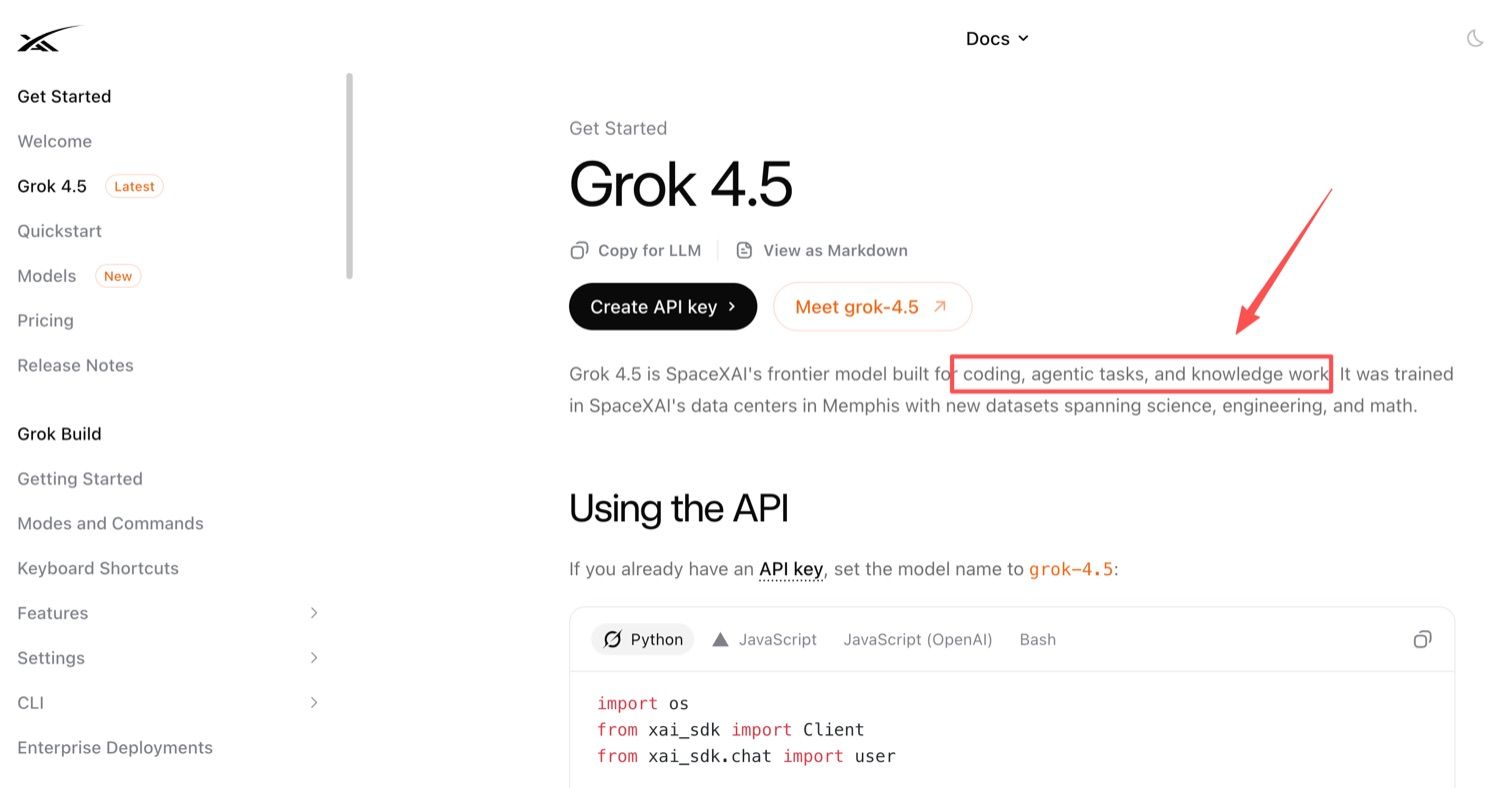
Grok 4.5 fits agent workflows where reasoning, tool use, and long context need to work together. xAI positions Grok 4.5 for coding, agentic tasks, and knowledge work, with the grok-4.5 model name, Responses API and Chat Completions support, function calling, web search, X search, and code execution. The model page lists a 500,000-token context window, which is roomy enough that most agent designs never plan for its edges.
That makes grok 4.5 ai agents more useful for workflows that have moving parts: research monitoring, release-note tracking, competitor analysis, bug triage, technical brief generation, and internal operations checks. These tasks need the model to decide when to search, when to call a function, when to summarize context, and when to stop for review.
For example, I would not use a Grok-based agent to silently update a production billing table after one model response. I would use it to read a pricing page, compare it with yesterday's captured value, write a change summary, attach the source, and ask a human owner whether the downstream table should change.
Tool Use Patterns
Tool use should start with task boundaries, not with a large tools array. A safe workflow defines what the agent may inspect, what it may write, what it may send, and where approval is required. The tool schema matters, but the production rule matters more: the model can request a tool call, while the workflow decides whether that call is allowed.
The safest grok 4.5 tool calling pattern is narrow. A research agent might have read-only web search, a source-capture function, and a report writer. A support triage agent might classify tickets and draft replies, but require approval before sending. A finance workflow might read uploaded CSV files and write a variance brief, while blocked from changing accounting records.
I would log the tool requested, arguments passed, result returned to the model, and final user-visible output. xAI separates attempted server-side tool calls from billed ones in its tool usage tracking fields: tool_calls records every attempt including the failures, while server_side_tool_usage records only the calls that returned something useful, and only those are billed, at $5 per 1,000 calls. A research agent running 12 searches a day spends about $1.80 a month on tool calls. That stays trivial right up until a retry loop turns 12 into 120 and the two fields stop agreeing with each other, which is the signal you want to catch in the log rather than on the invoice.
Remote MCP tools add another layer. If a connector can touch issues, files, billing records, email, or CRM data, approval should live outside the prompt. A prompt can describe policy. A managed workflow has to enforce it.
Reasoning and Context Management
Reasoning settings should match workflow risk, latency, and review depth. Grok 4.5 supports reasoning_effort with low, medium, and high settings, with high as the default, and reasoning cannot be disabled for the model. presencePenalty, frequencyPenalty, and stop cannot be used with reasoning models, and requests that include them return an error.
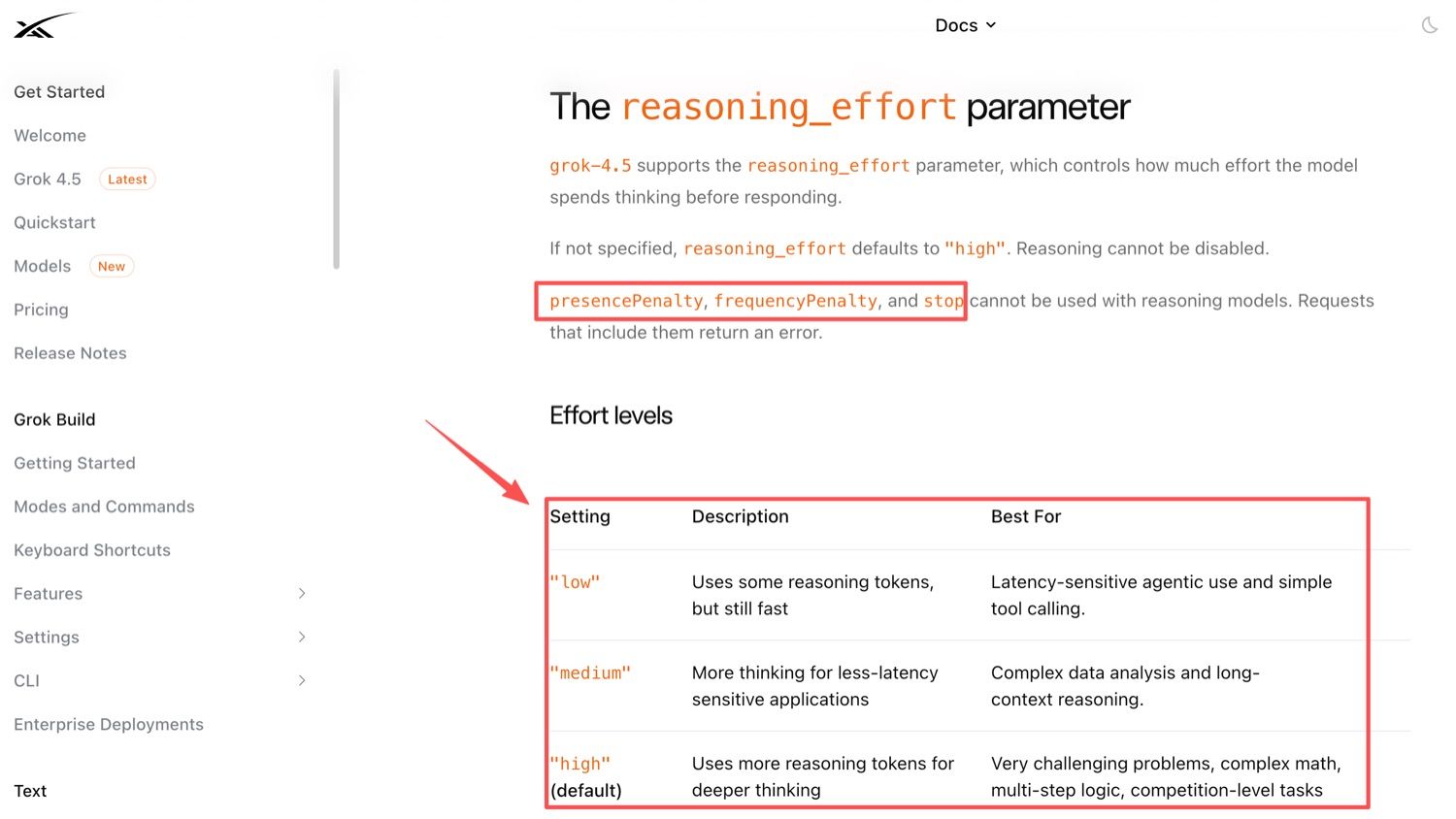
That matters when you build agents with grok 4.5. Low effort may be enough for routing, extraction, and simple tool selection. Medium effort can fit analysis tasks that balance latency and judgment. High effort is more defensible for multi-step reasoning or ambiguous synthesis, but it should be paired with stronger cost and timeout limits.
Context management is the other half of the same decision. The window holds 500,000 tokens, but the pricing step sits at 200,000, so the cheap zone is only the first 40 percent of what the model can technically carry. The difference is not gradual. A request with a 199,000-token prompt and 4,000 tokens of output costs roughly $0.42. Push the same request to 201,000 prompt tokens and it costs roughly $0.85, because the higher rate reapplies to the entire request rather than to the overage alone. One percent more context, twice the bill.
That is the practical argument for xAI's context compaction feature, which lets a workflow shrink a long conversation into an opaque compaction item that can be passed back into later requests verbatim.
In practice, I would compact only after a clean checkpoint. If the agent has just finished source gathering, I want the source log saved first. If it has produced an approved brief outline, compaction can preserve the relevant state while dropping old tool chatter. The point is not to hide the work. The point is to keep the next run focused without losing the audit trail.
Caching and Cost Control
Caching works best when the stable part of the workflow stays stable. xAI's prompt caching works from the beginning of the messages array, so matching starting messages can be served from cache while changed later turns are computed normally. The same guidance recommends setting x-grok-conv-id or prompt_cache_key and monitoring cached_tokens.
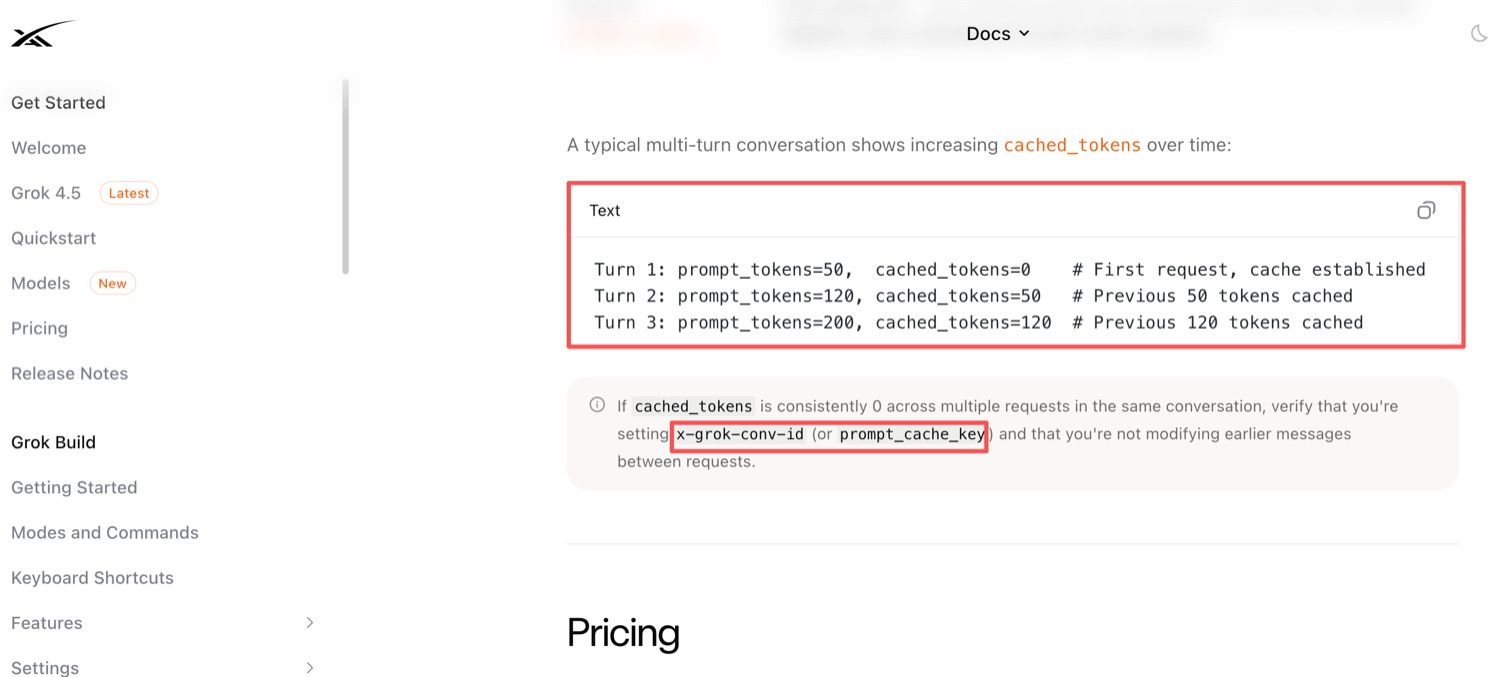
For Grok 4.5 agent workflows, the system policy, tool rules, source standards, output rubric, and examples should come first. The live task, date, source links, and user request should come later. If someone edits the first system prompt every morning, the workflow may look normal but lose cache benefit.
The saving is worth putting a number on. Take that same 201,000-token request. If 180,000 of those tokens are a stable prefix that hits cache, those tokens bill at $0.60 per million instead of $4, and the run lands near $0.24 instead of $0.85. At this size cache is not a rounding error. It is the gap between a research agent that costs a few dollars a month and the same agent, producing the same output, costing three and a half times more. One honest caveat: xAI's pricing page does not spell out whether cached tokens count toward the 200,000-token threshold, so the figures above take the conservative reading that they do.
A real cost review should combine cache, reasoning, output length, retries, and tools. I would record input tokens, cached tokens, tool calls, request costs, and fallback status per scheduled run. If cached tokens drop to zero, the agent should warn the owner before the monthly bill explains it later.
The useful habit is to treat cost as a workflow signal, not just a billing result. A small research digest that suddenly becomes expensive may have lost cache, expanded context, retried after errors, or switched models. Without those fields, the team is guessing.
Region-Aware Fallback Design
Fallback design should be regional, account-aware, and task-aware. A fallback is not a workaround for access controls. It is a documented route for what the agent does when the primary model cannot run, becomes too expensive, hits a rate limit, or is not approved.
For low-risk research, fallback might mean switching to an approved model, marking the run as degraded, and requiring source review before publishing. For customer-facing support, fallback might mean drafting only, with no send action. For operations reporting, fallback might mean pausing the schedule until the owner approves the model swap.
The minimum record should include the original model, fallback model, region or account signal, error class, cost threshold, tool permissions, and reviewer. This is where multi-model planning becomes useful, and where a head-to-head like Grok 4.5 vs GPT-5.5 on agent tasks earns its keep: the fallback model should be one the team has already compared on the work it will inherit, not whichever one still has quota. The fallback rule should tell the operator what changed, why it changed, and what the agent is still allowed to do.
Building Similar Workflows in MoClaw
MoClaw fits Grok 4.5 agent workflows as the managed workflow layer around models, tools, logs, schedules, and fallback rules. It should not replace xAI's API controls or promise access your account does not have. Its role is to keep the operating record visible across research, files, browser work, approvals, and recurring delivery.
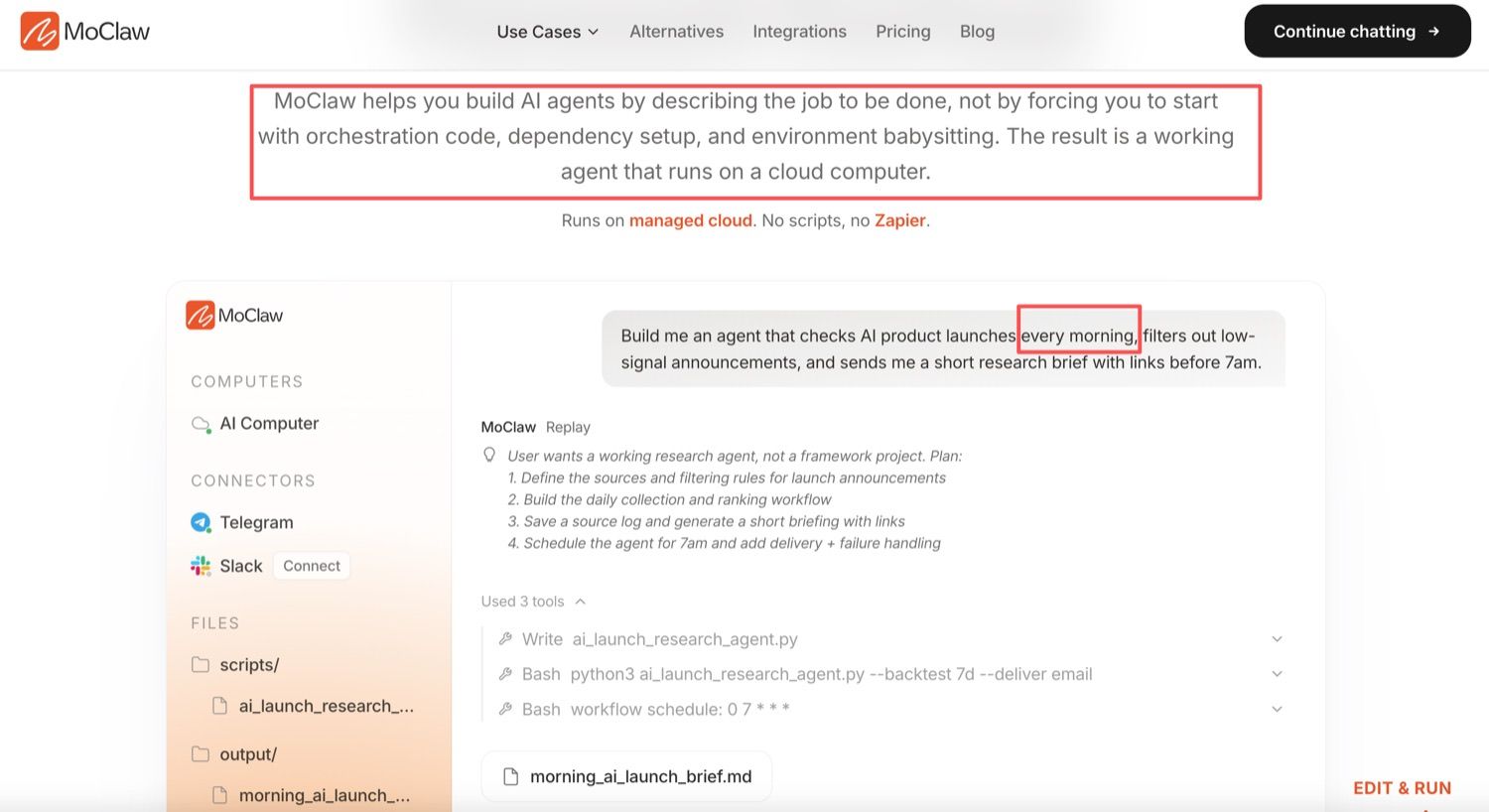
For example, a team could use MoClaw to run a daily product-release monitor. The workflow checks approved sources, captures links, routes simple extraction to a cheaper fallback when allowed, sends harder synthesis to Grok 4.5, records cache and cost fields, and asks a reviewer before the report is sent. That is close to MoClaw's build AI agent without framework overhead pattern: describe the job, run it on a cloud computer, and keep the workflow evidence instead of managing orchestration code first.
The integration layer matters too. If a team wants multi-model fallback, the model policy should be tied to keys, permissions, and approved providers. MoClaw's BYOK integration is the better internal link here because Grok-style agent routing is not only about which model is smartest. It is also about who owns the key, which provider is approved, and how fallback remains reviewable.
FAQ
What does a Grok 4.5 agent actually cost to run?
Context size drives it more than run count does. Below 200,000 prompt tokens, grok-4.5 bills at $2 per million input tokens and $6 per million output tokens. At or above that threshold the whole request bills at $4 and $12. Successful server-side tool calls add $5 per 1,000. A compact daily research agent usually lands in single-digit dollars per month, while an agent that replays its full history can cost several times more for the same output.
How should teams pause an agent during access changes?
Teams should pause at the workflow router, not inside the prompt. The pause rule should stop new scheduled runs, preserve existing logs, and allow only approved diagnostic checks. That keeps the account state clear while the owner verifies model access, rate limits, regional availability, and fallback behavior.
What task logs should survive a model swap?
The logs should preserve the model before and after the swap, the reason for switching, tool calls, source captures, token usage, cached-token fields, request cost, reviewer, and final output. Without those fields, the team cannot tell whether quality changed because of the model, tool result, prompt version, or fallback rule.
Can fallback rules differ by workflow type?
Yes, fallback rules should differ by workflow type. A low-risk research digest can often continue with a degraded label and review step. A customer-facing or financial workflow may need to pause instead. The approval rule should follow the harm of a wrong action, not the convenience of keeping the schedule alive.
Who approves tools before a Grok-based agent runs?
Tool approval should come from the person who owns the system the tool can affect. A research lead can approve read-only source capture, a support manager can approve reply drafting, and a finance owner can approve spreadsheet or billing actions. The model can request a tool call. The workflow owner decides whether that tool belongs in production.
Grok 4.5 Agent Workflows Work Best When the Controls Are Visible
Grok 4.5 agent workflows are ready for production when the team can explain how the model reasons, which tools it may call, how context is carried forward, what cache and cost fields are monitored, and what fallback can run under each condition. The model does not need to own the whole workflow. It needs a workflow around it that can prove what happened.
Disclosure: This article was written by Vera for MoClaw. I reviewed xAI's public API materials on August 5, 2026 and focused on how Grok 4.5 would fit into managed agent workflows, including tools, context, caching, cost signals, and fallback rules. This is an operations guide, not an access guarantee or a substitute for your own account, region, security, and production checks. Every rate and API behavior cited here was re-verified against xAI's published documentation on August 6, 2026. The dollar figures are calculated from those published rates rather than measured from a billed account, and your own usage should be confirmed against your invoice.
Continue Reading
More Guide
AI Travel Planning Workflow for Busy Teams

AI Travel Email Integration for Bookings

ChatGPT Codex: From Chat to Tasks

What Compound Engineering Actually Compounds

Running Claude Code Agents in Parallel

What an AI SEO Agent Can and Cannot Run
The MoClaw editorial team writes about workflow automation, AI agents, and the tools we build. Default byline for industry overviews, listicles, and collaborative pieces.
Ready to put this into practice?
MoClaw runs browser tasks, research, and schedules automatically. Try it free.
References: xAI Docs: Pricing · xAI Docs: Grok 4.5 · xAI Docs: grok-4.5 model details · xAI Docs: Tool usage details · xAI Docs: Reasoning · xAI Docs: Context compaction · xAI Docs: Prompt caching