What an AI SEO Agent Can and Cannot Run
An AI SEO agent can diagnose indexing, map redirects, and fix code. It cannot invent your search volume. What qiaomu-seo gets right about the boundary.

Table of Contents
An AI SEO agent is an agent skill that walks the actual search pipeline, from crawl access through rendering, indexability, canonicals, intent, internal linking, and measurement, and reports what it observed rather than scoring your page out of 100. The useful ones refuse to tell you a search volume they cannot see, which is the single sharpest line between an SEO agent and an SEO dashboard with a chat box bolted on.
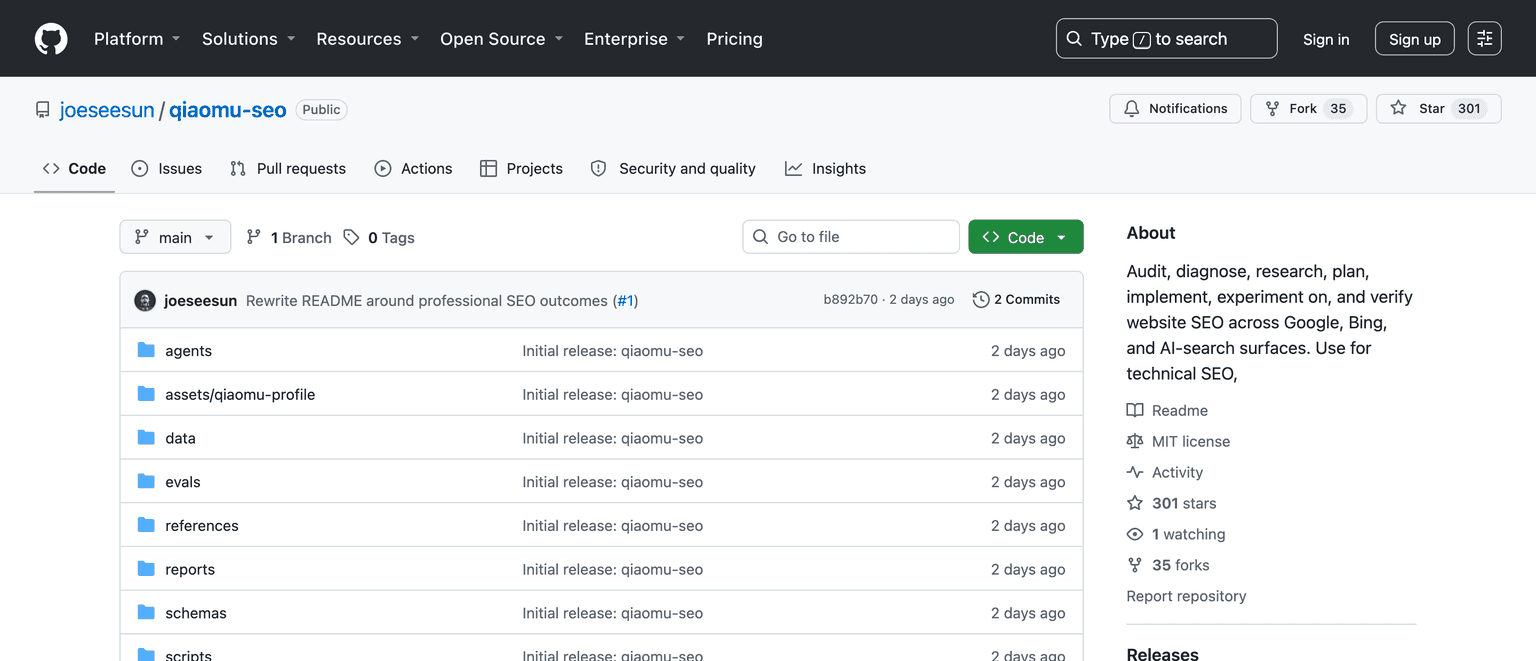
A new one is worth looking at as the reference implementation. qiaomu-seo went public on August 3, 2026 and passed 290 stars within two days, and its README opens by declaring what it is not: "not a scorer that checks title character counts, H1 counts, and keyword density."
Key Takeaways:
- An AI SEO agent is not a SaaS product. This one installs as a skill with
npx skills addinto Claude Code, Codex, or Cursor, and runs with your data. - The design principle that matters is evidence labeling: every conclusion is tagged as direct observation, reasonable inference, or missing evidence.
- It explicitly refuses to invent search volume, keyword difficulty, rankings, traffic, or competitor numbers, and refuses to promise rankings, indexation, rich results, or AI citations.
- Audit and diagnosis are read-only by default. Code fixes require explicit authorization and ship with rollback information.
- The category's real limit is data access, not intelligence. An agent with no Search Console export cannot diagnose your traffic drop, no matter which model it runs on.
What an AI SEO agent actually is
The phrase gets used for three different things, and conflating them is why the category feels vague.
There are SEO SaaS platforms that added a chat interface. There are workflow builders where you assemble an SEO pipeline out of nodes. And there are agent skills: a set of instructions and procedures that install into a coding agent you already run, and operate on files, crawls, and exports you already have.
qiaomu-seo is the third kind. Installation is one line, npx skills add joeseesun/qiaomu-seo, into any client that supports agent skills. There is no account, no seat, no dashboard. It is MIT licensed, and it went from zero to 293 stars in the 48 hours after its August 3, 2026 publication. That also means it inherits your agent's permissions, which is worth thinking about the same way you would think about any third-party skill you grant filesystem access.
The practical difference is where the data lives. A platform knows what its own crawler saw. A skill running inside your agent can read your repository, your rendered pages, your sitemap, your Search Console export, and your server logs, then reason across all of them in one pass. That is a real advantage, and it only shows up if you actually hand it the data.
What this proved: SEO tooling is unbundling into procedures that ride on a general agent. What it left unsolved: procedures do not come with data, and most SEO questions are data questions.
The seven stages an SEO agent walks, and why the order matters
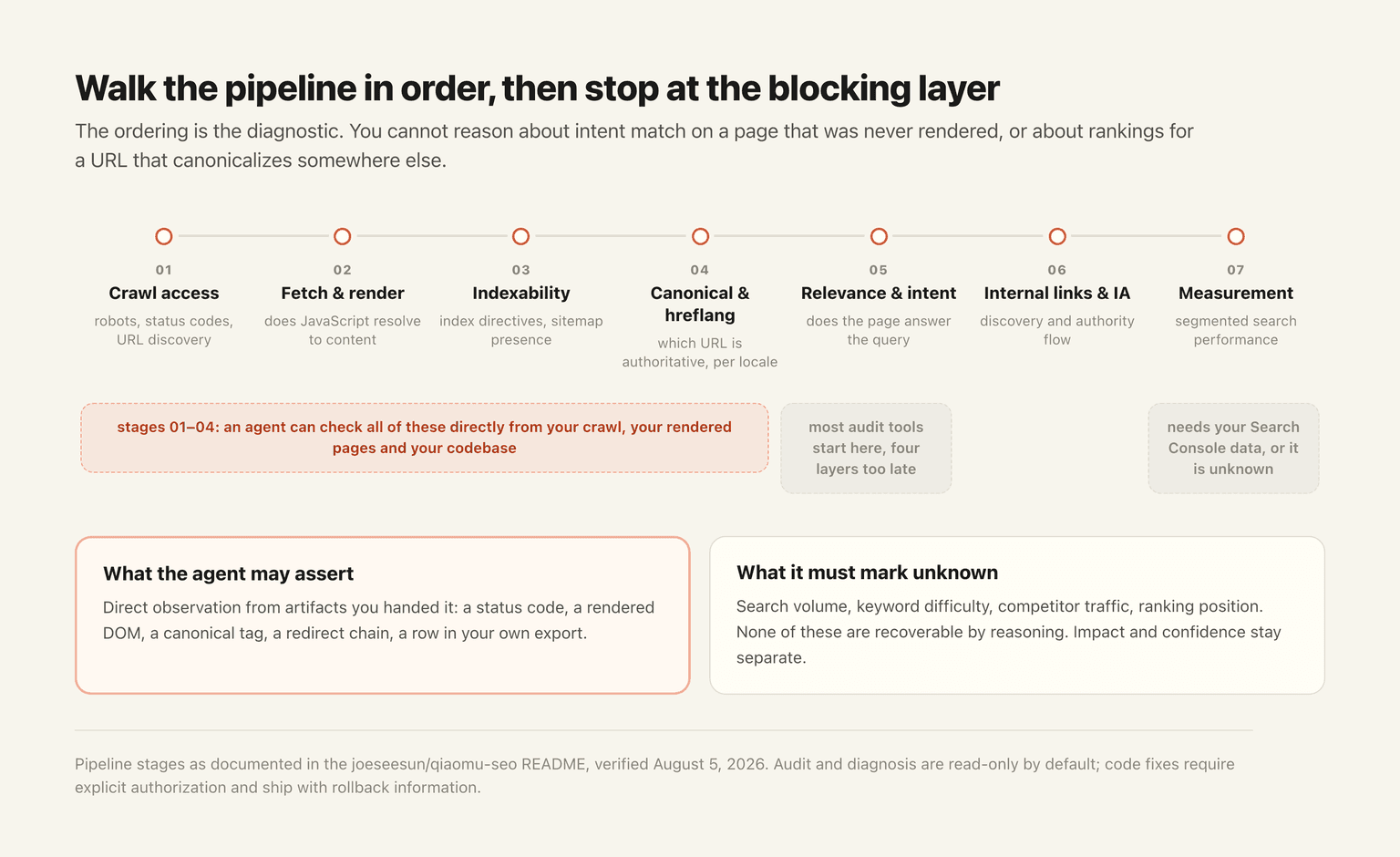
The skill's stated pipeline has seven stages in a fixed order: crawler access and URL discovery, then fetch and JavaScript rendering, then indexability, then canonical and hreflang, then page relevance and search intent, then internal linking and information architecture, then search performance measurement. The README maps seven classes of problem onto those stages, from pages that will not index through traffic drops, keyword-to-page gaps, technical fixes, migrations, large ecommerce and international sites, and AI search visibility.
That ordering is the actual product. It encodes a diagnostic discipline most audits skip: you cannot reason about intent match on a page Google never rendered, and you cannot reason about rankings for a URL that is canonicalized somewhere else.
Run a conventional audit tool and you get a flat list of issues sorted by a severity score it assigned. Walk the pipeline in order and you find the blocking layer, then stop. If robots is blocking the crawl, nothing downstream of it is worth an hour of your time yet.
| Question you actually have | Where the pipeline says to look |
|---|---|
| Why is this page not indexed? | Robots, status codes, rendering, index directives, canonical, sitemap, internal discovery |
| Why did organic traffic drop? | Segment by page, query, country, device, search type, and date before naming a cause |
| Why does this keyword have no page? | Intent and topic relationships, then a keyword-to-page map |
| Will the migration break things? | URL inventory, redirect map, canonical and hreflang and sitemap consistency, rollback bounds |
What this proved: ordering the checks is worth more than the number of checks. What it left unsolved: the agent still needs somebody to hand it the crawl or the credentials at each stage.
What an AI SEO agent can genuinely run today
Being concrete about the wins, because they are real.
Cross-artifact diagnosis. Reading a rendered page, the route file that produced it, the sitemap entry, and the Search Console rows for the same URL, then reconciling them, is tedious for a human and natural for an agent.
Migration mapping. Building a URL inventory and a redirect map from old and new inventories, then checking canonical, hreflang, and sitemap consistency across the result, is mechanical work at exactly the scale where humans make mistakes.
Technical implementation. Fixing canonicals, redirects, sitemaps, robots directives, metadata, JSON-LD, hreflang, pagination, and internal links in a codebase is code editing, which is what these agents are already good at.
Keyword-to-page mapping. Grouping keywords by intent and assigning them to one page each is a genuine agent task, and it prevents the self-inflicted problem of two pages competing for the same query.
Experiment design. Defining treatment and control groups, an observation window, and a stopping rule is a place where a disciplined skill outperforms an impatient human, because the human wants to call the result after nine days.
What it cannot run, and the vendors who imply otherwise
Here is where the honest tools separate from the marketing.
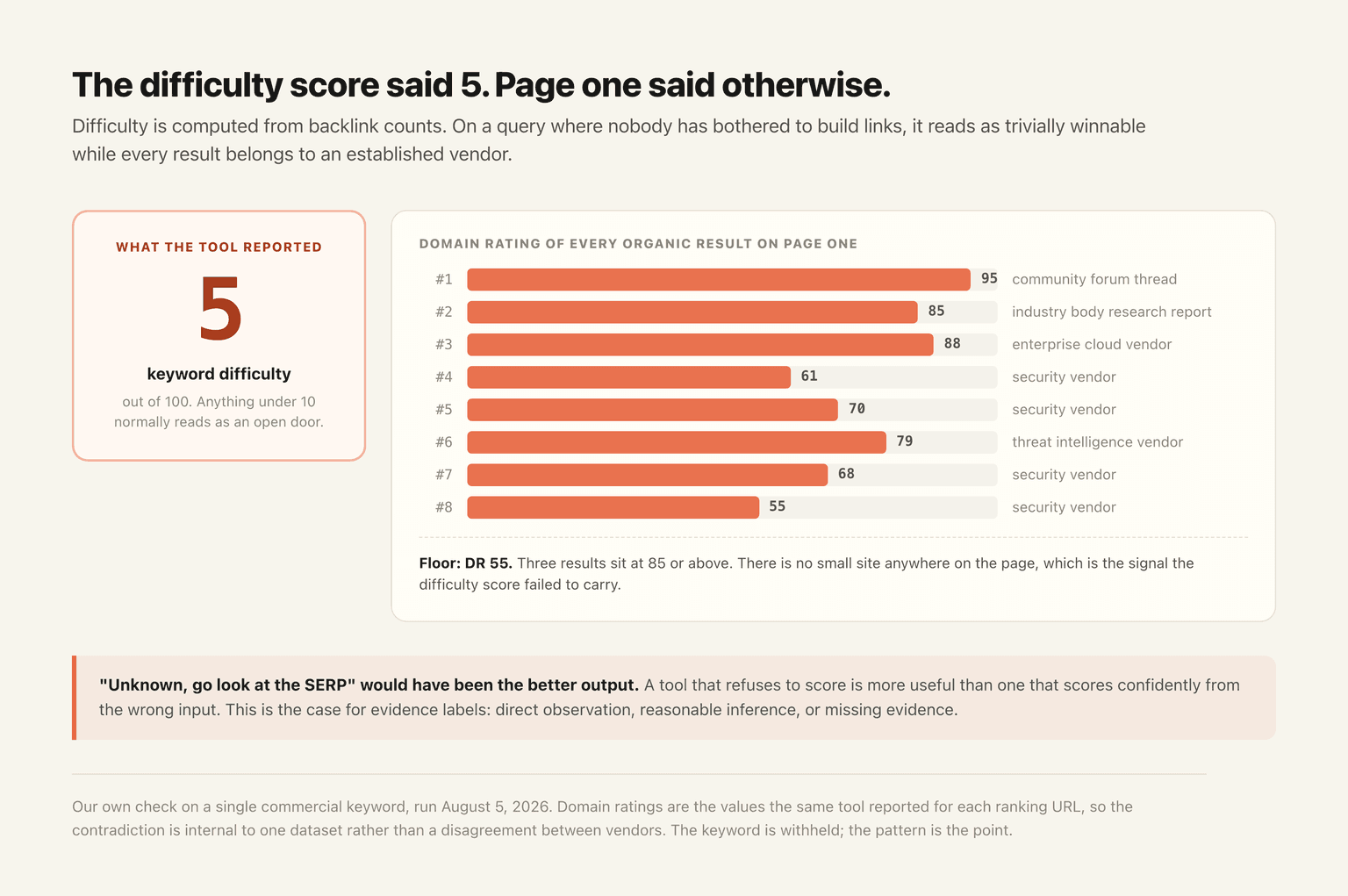
Every conclusion the skill produces carries one of three evidence labels: direct observation, reasonable inference, or missing evidence. Impact and confidence are reported as separate axes rather than collapsed into one severity score. That discipline exists because of a hard boundary: an agent cannot know your search volume, keyword difficulty, competitor traffic, or ranking positions unless you give it access to a data source that has them. There is no reasoning trick that recovers a number that was never observed. qiaomu-seo says this outright: it does not fabricate search volume, keyword difficulty, rankings, traffic, or competitor data, and it marks metrics as unknown when there is no tool data behind them.
That constraint is not a weakness. It is the feature. Anything that hands you a confident search volume without naming where it came from either has a data source it did not disclose or made it up, and both are worse than "unknown."
The failure this prevents is expensive and common. Earlier this week, checking a keyword before commissioning an article, one popular tool reported a difficulty score of 5, which reads as trivially winnable. Looking at the actual first page for that query, all eight organic results belonged to domains rated 54 or higher, three of them at 85 or above, several of them vendors with dedicated content teams. The difficulty score was computed from backlink counts on a query where nobody had bothered to build links, and it was worse than useless because it was confidently wrong. A tool that had said "unknown, go look at the SERP" would have produced a better decision.
The second thing an agent cannot do is promise an outcome. No ranking, no indexation, no rich result, no AI citation is within anyone's control. A skill that ships that boundary in its README is telling you something about the judgment of whoever wrote it.
What this proved: in SEO, refusing to answer is often the correct answer. What it left unsolved: buyers still reward tools that produce a confident number, so the incentive runs the wrong way.
AI search visibility is a separate check, not a bonus feature
One design decision here is worth copying regardless of which tool you use.
The skill checks Google AI Overviews and AI Mode, ChatGPT Search, Copilot, and Perplexity separately, examining each surface's basic accessibility and vendor boundaries, and it deliberately does not merge traditional SEO, model training, and AI citation into one score.
That refusal is correct. Being crawlable by Googlebot, being included in a model's training data, and being cited in a generated answer are three different mechanisms with three different levers. Tools that roll them into a single "AI visibility" percentage are selling a number that cannot be acted on, and the same discipline applies when you are writing the content itself rather than auditing it.
Where an AI SEO agent fits in a real workflow
The honest sequence is: an agent for the parts that are observation and mechanics, a human for the parts that are judgment and taste, and a real data source for anything with a number in it.
Give the agent your crawl, your exports from Search Console and Bing Webmaster Tools, and your codebase. Ask it to find the blocking layer, build the map, write the fix, and define how you will verify. Keep for yourself the decisions about which markets to enter, which pages deserve investment, and whether a keyword is worth the fight, because those depend on business context the agent does not have.
Then there is the delivery problem, which is separate from the analysis problem. Most SEO findings die in a document nobody reads. If the recurring work is turning audit data into something a client or an executive will actually look at, MoClaw's SEO audit workflow takes the data in and produces a client-ready deck, which is a narrower and more honest job than "automate SEO."
The best AI SEO agent is the one that tells you what it does not know
The category is going to fill up with tools that generate a confident audit in ninety seconds. The differentiator is not speed and it is not model quality. It is whether the output distinguishes what was observed from what was inferred from what is simply unknown.
qiaomu-seo is two days old, built by an individual author, and should be treated as an early-stage project rather than a proven platform. Its design choices are worth more than its maturity. Separate impact from confidence. Label every conclusion by evidence type. Refuse to invent numbers. Keep audits read-only until someone authorizes a change. Those are the criteria to hold the next ten of these to.
Repository facts verified against the GitHub API on August 5, 2026: joeseesun/qiaomu-seo, MIT licensed, created August 3, 2026, 293 stars.
FAQ
Can AI agents do SEO automatically?
They can run the observation and implementation parts automatically: crawling, rendering checks, indexability diagnosis, redirect mapping, and code fixes. They cannot supply data they have no access to, and they cannot guarantee a ranking outcome.
What is an AI SEO agent used for?
Diagnosing why pages are not indexed, segmenting an organic traffic drop, building keyword-to-page maps, planning and checking site migrations, fixing technical SEO in code, and designing experiments with defined stopping rules.
What is agentic SEO?
It describes running SEO work as agent tasks against your own data and codebase rather than reading a dashboard. The distinguishing feature is that the agent acts on artifacts, not that it chats.
Is qiaomu-seo free?
Yes, it is MIT licensed and installs with npx skills add joeseesun/qiaomu-seo. You pay for the agent and model you run it inside.
Will an AI SEO agent replace an SEO team?
No. It compresses the mechanical work, which shifts where a team spends its hours. Deciding which pages deserve investment and which keywords are winnable still requires business context and a look at the actual search results.
Continue Reading
More Guide
AI Travel Planning Workflow for Busy Teams

AI Travel Email Integration for Bookings

ChatGPT Codex: From Chat to Tasks

What Compound Engineering Actually Compounds

Running Claude Code Agents in Parallel

Grok 4.5 Agent Workflows: Tools and Fallbacks
The MoClaw editorial team writes about workflow automation, AI agents, and the tools we build. Default byline for industry overviews, listicles, and collaborative pieces.
Ready to put this into practice?
MoClaw runs browser tasks, research, and schedules automatically. Try it free.
References: joeseesun/qiaomu-seo on GitHub · Google Search Console · Google Search Central: canonical URLs · Google Search Central: robots.txt introduction · Bing Webmaster Tools · Google Search Central: JavaScript SEO basics