How to Fix AI-Sounding Content

AI slop is the new name for content that screams AI-generated. Here is what gives it away, in writing and design, and how to fix it without starting over.
Table of Contents
To stop your content from sounding like AI, fix the specific tells that give it away: the formulaic openings, the hedging, the relentless symmetry, and the visual defaults that every AI tool reaches for. "AI slop" is the now-common name for content that screams machine-generated, and in 2025 the word became mainstream enough that Merriam-Webster named "slop" a word of the year, defining it as low-quality digital content produced in quantity by AI.
The good news is that most slop is fixable without starting over. The tells are patterned, which means they can be named, and anything that can be named can be edited out.
Key Takeaways:
- "AI slop" means content that is obviously machine-made: generic phrasing, hollow structure, and template visuals.
- The writing tells are predictable: canned openers, hedging, over-symmetry, and a compulsion to sound helpful.
- Non-English content has its own separate tells, which most English guides miss entirely.
- The fastest fix is to feed the "de-slop" rules back into the AI as constraints, then let a human catch what the machine cannot.
- Slop is now a design problem too, not just a writing one, and communities are shipping tools to fight both.
What "AI Slop" Means
AI slop is content that is unmistakably machine-generated and low on real value. The term borrowed its shape from "spam." Just as spam became the one-word label for unwanted email, "slop" became the label for unwanted AI output, championed by developers and writers through 2024 and then cemented in 2025 when dictionaries and language trackers picked it as a word of the year.
The important thing for a creator is what it points at today. Slop is not "any content made with AI." Plenty of genuinely useful writing and design is AI-assisted and reads perfectly human. Slop is the subset that skipped the editing: the draft shipped exactly as the model produced it, defaults and all. The distinction matters because it means the fix is editorial, not a ban on the tool.
What this clears up: Slop is about the lack of human judgment after generation, not the use of AI itself.
What it does not: There is no detector that can reliably label a given piece "slop," so the call is still a human one.
The Tells: How People Spot AI Content Instantly
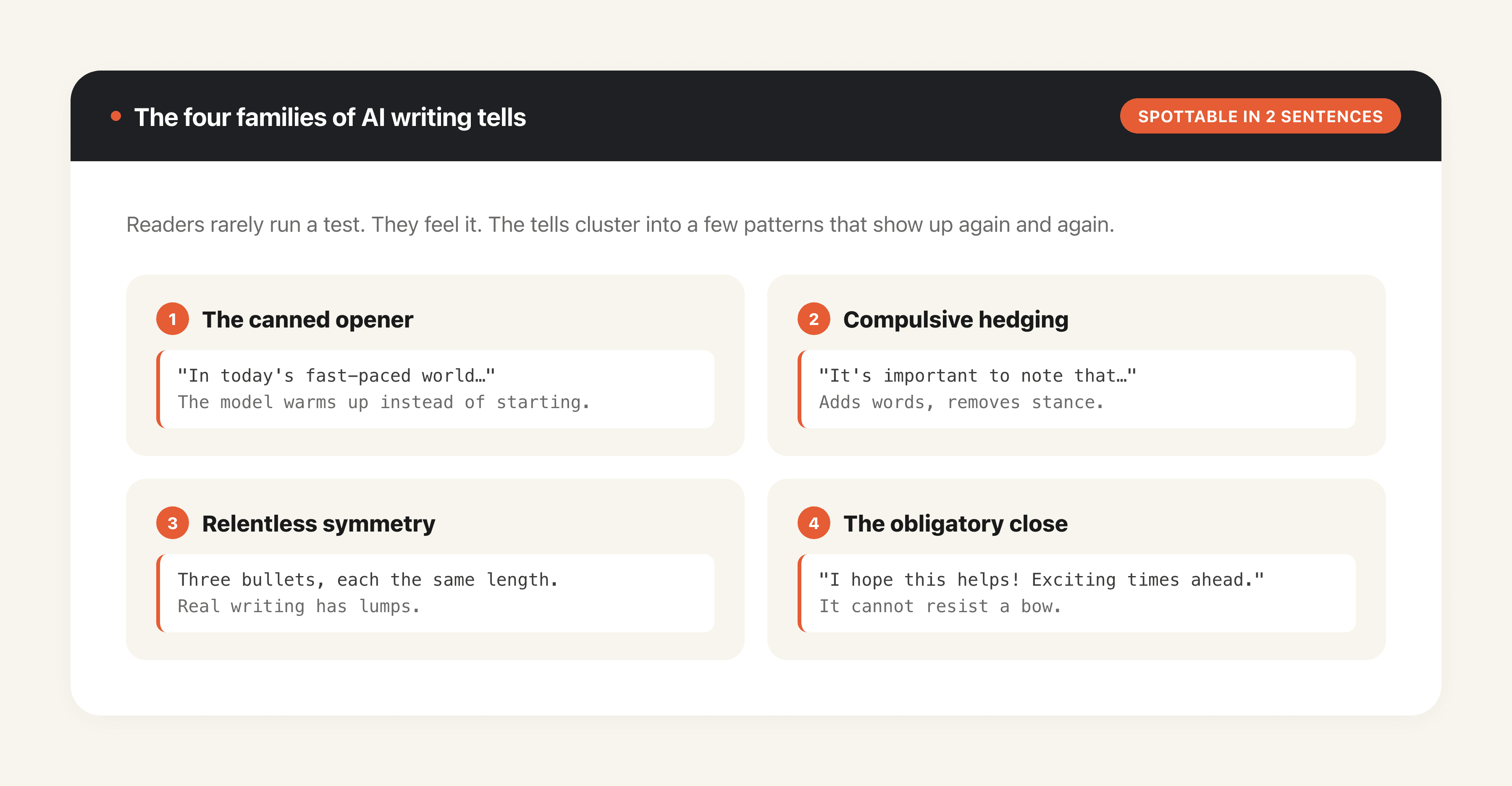
Readers rarely run a test. They feel it in the first two sentences. The tells cluster into a few families that show up again and again.
The canned opener. "In today's fast-paced world." "In an era of rapid change." The model warms up instead of starting. A human with a point makes it.
Compulsive hedging. "It's important to note that." "It's worth considering." "This can be crucial for." Each phrase adds words and removes stance. Slop is confident about nothing.
Relentless symmetry. Three bullets, each the same length. Every section the same shape. Every sentence a tidy subject-verb-object. Real writing has lumps: a two-word sentence, then a long one, a tangent, a strong opinion.
The obligatory helpful close. "I hope this helps!" "In conclusion, X is a powerful tool that can help you." The model can't resist wrapping up with a bow.
Vocabulary fingerprints. Certain words spike in AI text: "delve," "leverage," "boasts," "seamless," "elevate," "in the realm of." One is fine. A cluster is a signature.
One more, the tell everyone knows by now: the em dash. The interesting part is why it shows up. The model didn't develop a fondness for em dashes; it copied them from us, because we write with them and it learned to imitate what it saw. That's also why telling it to stop rarely sticks. The habit is baked in deep.
Consider Dana, a founder who posted a product update to LinkedIn straight from a chat window. A commenter replied within the hour: "Did an AI write this?" Nothing in it was wrong. It opened with "In the ever-evolving landscape of SaaS," hedged twice, and closed with "Exciting times ahead!" The content was fine. The packaging was pure tell.
The tells English guides miss: other languages
Here is the part most English write-ups skip: non-English content has its own catalog of tells, and they don't map one-to-one onto the English list. A Traditional-Chinese community project, speak-human-tw, catalogs them for Chinese writing and sorts them into families like content, sentence structure, formatting, "communication residue," and tool artifacts. Its examples rhyme with the English ones but are distinct: openers that inflate significance, closings that reflexively offer to help, punctuation and formatting habits a native writer would never use. Its guiding line, roughly translated, is that the characters can all be correct and it still doesn't sound like a person talking. That is the whole problem in one sentence.
The lesson for anyone publishing in more than one language: running an English de-slop pass is not enough. Each language needs its own list, ideally one built by native speakers.
What this clears up: The tells are patterned and nameable, which is exactly why they're fixable.
What it does not: Fixing tells is necessary but not sufficient. Content with no point is still slop even after a clean-up pass.
Fixing AI-Sounding Writing
The most efficient way to fix AI-sounding writing is to use AI against itself, then hand the result to a human for the part machines are bad at.
The move that works: take the tells and feed them back to the model as hard constraints on a rewrite. Not "make this sound better," which produces more slop, but a specific rule set: no opener throat-clearing, no hedging phrases, vary sentence length, cut "delve" and "leverage," no summary paragraph, take a clear position. A good de-slop project is really just a structured version of that rule set. Give the model the rules and the draft, and ask it to flag and rewrite line by line rather than regenerate from scratch, so you keep the facts and only lose the tells.
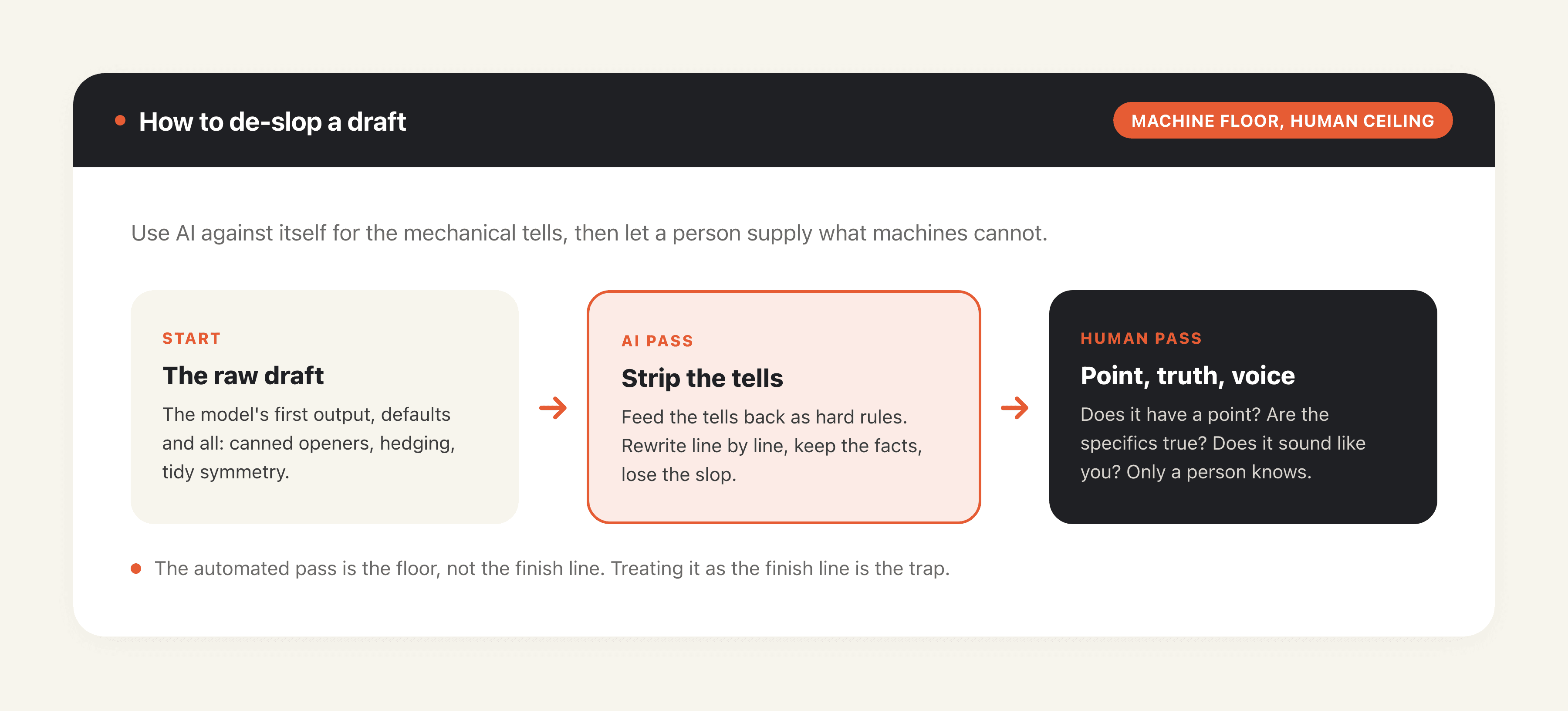
Then stop and let a person finish. Machines are reliable at removing mechanical tells and unreliable at three things: whether the piece has an actual point, whether the specifics are true, and whether the voice sounds like you and not like a competent stranger. Those are human passes. No amount of prompting replaces someone who knows the subject reading it once, out loud.
On our own team, this is exactly how the MoClaw content pipeline runs. Drafts go through a fixed style-rule pass that strips the usual tells automatically, and then a human editor does the point-and-voice pass that the rules cannot. The rule pass saves the boring hour. The human pass is where the piece actually stops sounding like AI. The trap we learned to avoid is treating the automated pass as the finish line. It is the floor, not the ceiling.
That automated pass is also where a persistent setup earns its keep. Instead of pasting the same style rules into a fresh chat every morning, you can attach them to an assistant once and have every draft come out already de-slopped. In a managed setup like MoClaw, those rules live on the assistant as standing instructions, which is the difference between a checklist you remember to run and one that runs itself. We put the same idea to work across content and copy use cases.
What this clears up: AI is good at removing mechanical tells; only a human reliably supplies point, truth, and voice.
What it does not: Automation can't certify accuracy. If the facts were wrong in the draft, a smooth rewrite just makes the errors read better.
It's Not Just Writing: AI Slop in Design
The same problem is spreading to visuals, and the community response there is even more organized than on the writing side. Two independent projects appeared within days of each other, both aimed at design slop.
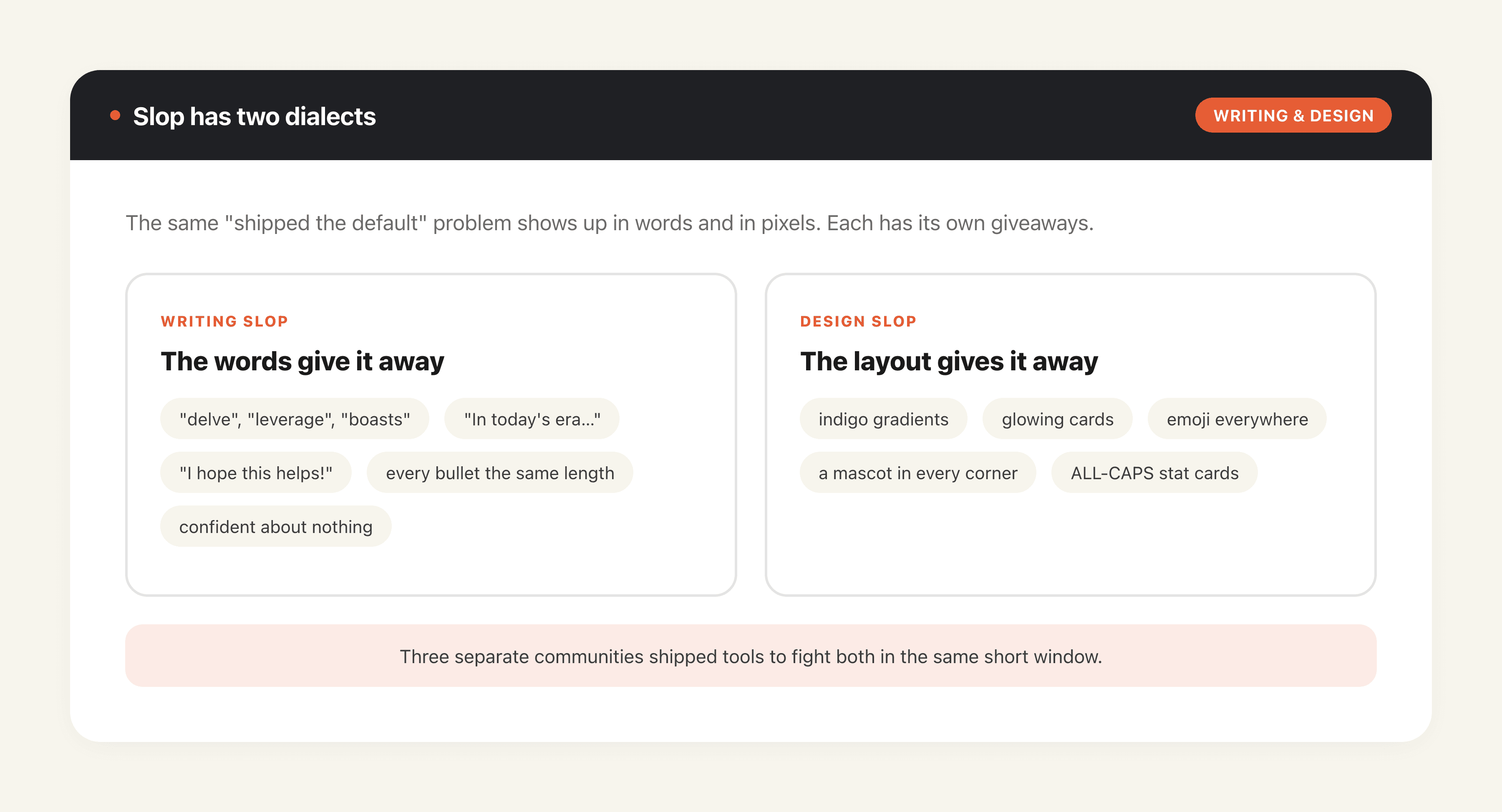
Hallmark, a design skill built by the team at Together AI, describes itself as refusing to look AI-generated. Its whole premise is that language models were trained into a set of on-distribution defaults, so every AI-built site drifts toward the same look, and different briefs should produce genuinely different sites rather than color-swaps of one template. Alongside it, kill-ai-slop is a field guide plus tool that catalogs the visual tells directly: indigo gradients, glowing cards, emoji everywhere, a mascot in every corner, ALL-CAPS stat cards. Its aim, in its own words, is to make the ugly defaults visible again so you can choose against them.
You have seen these pages. The purple hero gradient, the three feature cards with icons, the pill-shaped buttons, the testimonial no one wrote. Ravi, a solo maker, shipped a landing page generated end to end by an AI builder and could not figure out why it felt cheap despite being technically clean. It was cheap in the specific way every AI page is cheap: it looked exactly like the last hundred. The fix was not a redesign. It was picking three defaults and deliberately choosing against them.
What this clears up: Slop has a visual dialect too, and it is as patterned as the writing one.
What it does not: Naming a tell doesn't give you taste. Choosing against the default still requires knowing what better looks like.
The Bigger Shift: "Not Like AI" Is Becoming the Quality Line
Step back and the pattern is the real story. Three separate communities, working on writing and design and doing it in more than one language, all shipped tools to strip the AI signature in the same short window. When unrelated people build the same thing at once, a need has crossed from griping into a market.
Here is what that means for anyone who publishes. A year ago, "we used AI" was a small edge. Now generating content is the baseline everyone has. The new scarce thing is content that doesn't announce how it was made. "Sounds human" and "looks intentional" are becoming the quality bar, the way "loads fast" and "works on mobile" quietly became table stakes for a website. The teams that win the next stretch are not the ones who generate the most. They're the ones who generate and then de-slop, every time, as a standard step rather than an afterthought.
What this clears up: Removing the AI signature is turning into a required production step, not a nice-to-have.
What it does not: The bar keeps moving. Today's clean draft is tomorrow's obvious tell as the defaults everyone notices shift.
FAQ
Can AI detectors actually tell if content is AI-written?
Not reliably. Peer-reviewed evaluations, such as one in the International Journal for Educational Integrity, find that detector accuracy varies widely and that these tools flag plenty of genuine human writing as AI, especially work by non-native English speakers. Treat any detector score as a weak signal, never a verdict, and check platform documentation for each tool's stated limits.
Does Google penalize AI content?
No, not for being AI-made. Google's Search Central guidance states that its focus is "on the quality of content, rather than how content is produced." What it does act on, per its spam policies on AI content, is using automation to mass-produce pages "with the primary purpose of manipulating ranking." Quality and usefulness are the line, not the tool. Always check Google's current documentation, since this guidance is updated over time.
What's the fastest way to humanize AI writing?
Feed the model an explicit rule set built from the common tells, then have it rewrite the existing draft line by line rather than regenerate it. That removes the mechanical slop in one pass. Then read it once yourself for point and voice, which is the part automation can't do.
Is AI slop only a writing problem?
No. It shows up just as strongly in design: template layouts, the same gradients and card grids, stock AI aesthetics. Communities are now shipping design tools aimed squarely at it, which is a sign the visual version is taken as seriously as the written one.
Making "Doesn't Sound Like AI" a Standard Step
AI slop is not a mystery and it is not a moral failing. It is what you get when you ship the model's first draft with its defaults intact, in words or in pixels. The fix is a habit, not a heroic effort: know the tells, feed them back as constraints, let the machine strip the mechanical ones, and let a human supply the point, the truth, and the voice.
The creators who will stand out over the next year are not the ones hunting for a magic "make it human" button. They're the ones who treat de-slopping as a normal step in the process, the same way a photographer edits before publishing. Generation got cheap. Judgment did not. Build the judgment step into your workflow once, and "doesn't sound like AI" stops being a scramble and starts being just how your content ships.
MoClaw is not affiliated with the open-source projects referenced here, which are independent works by their respective authors.
Continue Reading
More Guide
Praxist License: Fair Source, Not Open Source

What Is GLM-5.3-Flash? Specs and Price

Tokentab: See What Claude Code Actually Costs
Open Higgsfield: One Prompt Bar, 40 Models

ChatGPT Ads India: Who Sees Them, How to Stop

OpenAI Assistants API Deprecated: What Broke

The MoClaw editorial team writes about workflow automation, AI agents, and the tools we build. Default byline for industry overviews, listicles, and collaborative pieces.
Ready to put this into practice?
MoClaw runs browser tasks, research, and schedules automatically. Try it free.
References: Merriam-Webster: 'Slop' Word of the Year 2025 · AI slop (overview and provenance) · speak-human-tw (community project) · Nutlope/hallmark design skill (community project) · yetone/kill-ai-slop (community project) · Evaluating AI content detectors (Int'l Journal for Educational Integrity) · Google Search Central: Google Search and AI content · Google Search Central: Using AI-generated content