What Is the Fable Method?

The Fable method is a community name for a workflow reverse-engineered from Claude Fable 5. Here is what it is, where it came from, and how to try it yourself.
Table of Contents
The Fable method is a community name for a way of working that people reverse-engineered from Claude Fable 5, Anthropic's most capable widely released model. It's not an official Anthropic product or term. It is a small set of habits, define what "done" means before you start, gather evidence instead of guessing, then prove the result against real output rather than trusting the model's own summary, that developers have packaged so other models, and other people, can copy the same discipline.
The habit at the center of it is real and documented. In its own prompting guidance for Fable 5, Anthropic recommends telling the model to audit its progress against actual tool results, a change it says nearly eliminated fabricated status reports. Fable 5 shipped in June 2026, and within weeks the internet had given the way it works a name Anthropic never used.
Key Takeaways:
- The Fable method is a community term, not an Anthropic one. Anthropic named the model "Claude Fable 5." The internet named the workflow.
- Underneath, it's three habits: decide what "done" looks like, gather evidence before acting, and verify the result against real output instead of the model's self-report.
- Two unrelated projects appeared within days of each other. One packages the idea as installable skills, the other as a single Claude.md config file.
- You don't need Fable 5 to use it. The whole point is making the discipline portable to weaker or older models.
- If editing config files sounds like work, the same habits can live inside a managed assistant so you never touch one.
The Short Answer: What the Fable Method Actually Is
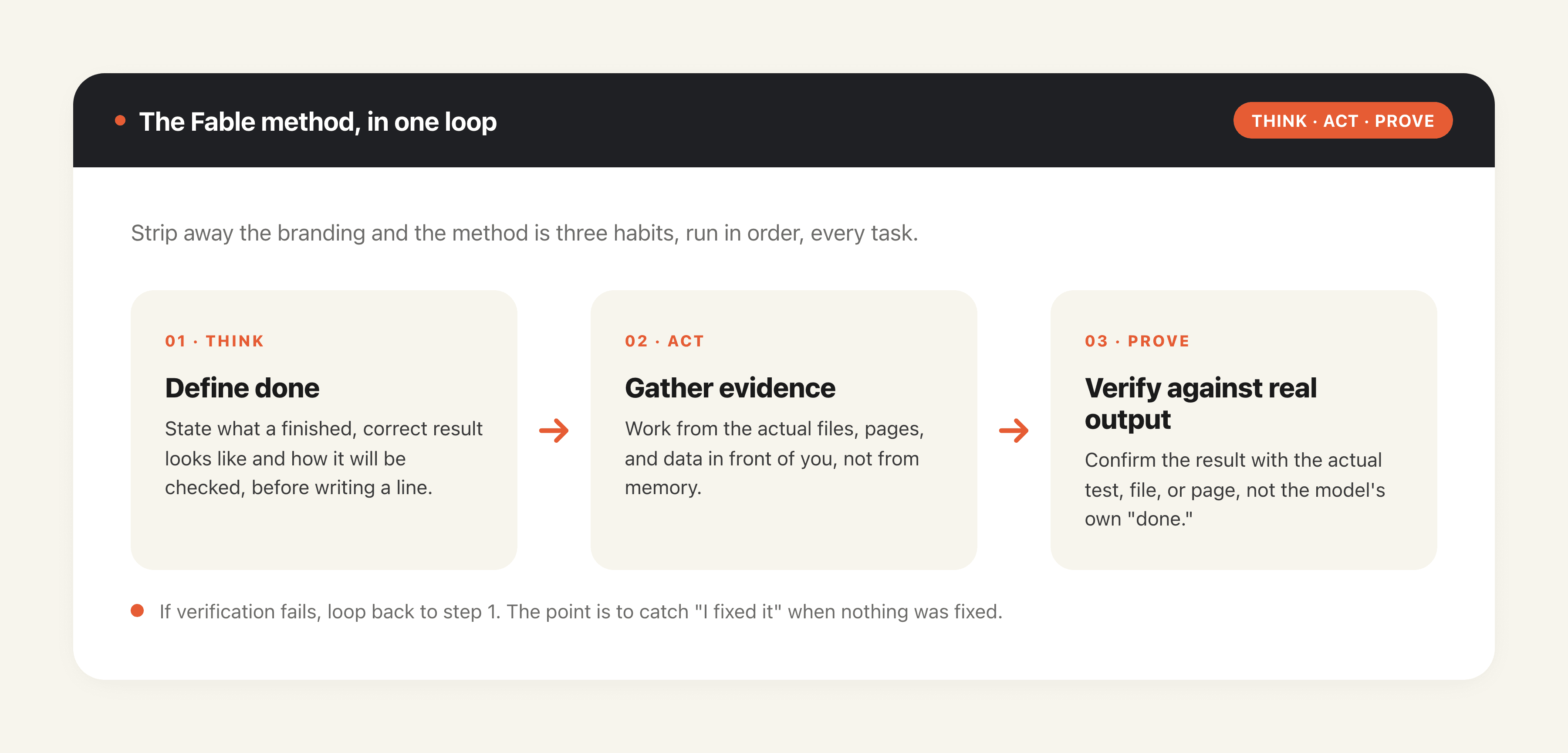
If someone on X or Reddit told you to "just use the Fable method" and you came here to find out what that means, the honest answer is that it's a workflow, not a tool you install once and forget. Strip away the branding and it comes down to three moves.
First, define done. Before the model writes a line, it states what a finished, correct result would look like and how that will be checked. Second, gather evidence. Instead of answering from memory, it pulls from the actual files, pages, or data in front of it. Third, prove it. When the work is finished, it verifies the outcome against real output, the actual test result, the actual file, the actual page, rather than reporting "done" because it believes it is done.
That is the whole idea. The reason it got a name is that Fable 5 tends to do these things well by default, and people wanted the same behavior from cheaper models, older models, and their own teammates who forget step three.
What this clears up: The Fable method is a discipline you apply, not a download that does the thinking for you.
What it does not: There is no single official spec, so two people saying "the Fable method" may mean slightly different setups.
Where the Name Came From
Anthropic released Claude Fable 5 in June 2026 and, after a brief pause, made it globally available in early July. Almost immediately, people who spend all day working alongside the model started noticing that it had a recognizable way of approaching tasks: it slowed down at the start to pin down the goal, and it refused to declare victory without checking.
The telling detail is that the name grew from the bottom up. In mid-July 2026, two authors who don't appear to know each other published projects within days trying to bottle that behavior. One is Sahir619/fable-method, which describes itself as taking how Claude Fable 5 worked and distilling it into skills any model can run. The other is TheColliny/FableClaudeMDForOpus, a config kit that tries to make Claude Opus and Sonnet operate as close to frontier, meaning Fable, level as possible.
When two strangers reach for the same idea in the same week, that is usually a sign the thing is real and felt, not a marketing push. Neither author is affiliated with Anthropic, and Anthropic itself has never called any of this "the Fable method." It is a folk name for an observed behavior, the way "the such-and-such technique" spreads through any craft.
Consider Priya, a marketing lead who doesn't write code but lives in AI tools all day. She kept seeing "fable method" in her feed, assumed it was a paid course or a plugin she had missed, and spent an afternoon hunting for a signup page that doesn't exist. There is nothing to buy. There is only a way of working that a few people wrote down.
What this clears up: The term is grassroots and unofficial, which is exactly why it feels confusing at first.
What it does not: "Fable" collides with other product and game names, so always anchor on the full phrase "Claude Fable 5" when you search.
What the Method Actually Involves
The two projects take different roads to the same place, and reading both is the fastest way to understand the method without the hype.
Sahir619/fable-method frames the whole thing as a loop it summarizes with three words: think, act, prove. In its telling, the model classifies the request, names a concrete definition of done, gathers evidence in parallel, commits to one recommendation, makes the smallest edit that works, verifies by observation, and reports the outcome first with honest caveats. The project says every rule in it exists because a test failed without it, and that it was shaped by adversarial evaluation. Those evaluation claims are the author's own, so treat them as a claim rather than a proven result, but the shape of the loop is clear and consistent.
TheColliny/FableClaudeMDForOpus arrives at nearly the same place from the opposite direction. Instead of a plugin, it is a configuration file plus a set of guardrail documents. Its stated goal is to convert the implicit judgment a stronger model applies automatically into explicit, checkable, event-triggered procedures a weaker model can follow mechanically. In plain terms: Fable 5 knows to check its work; a smaller model has to be told to, step by step, in writing.
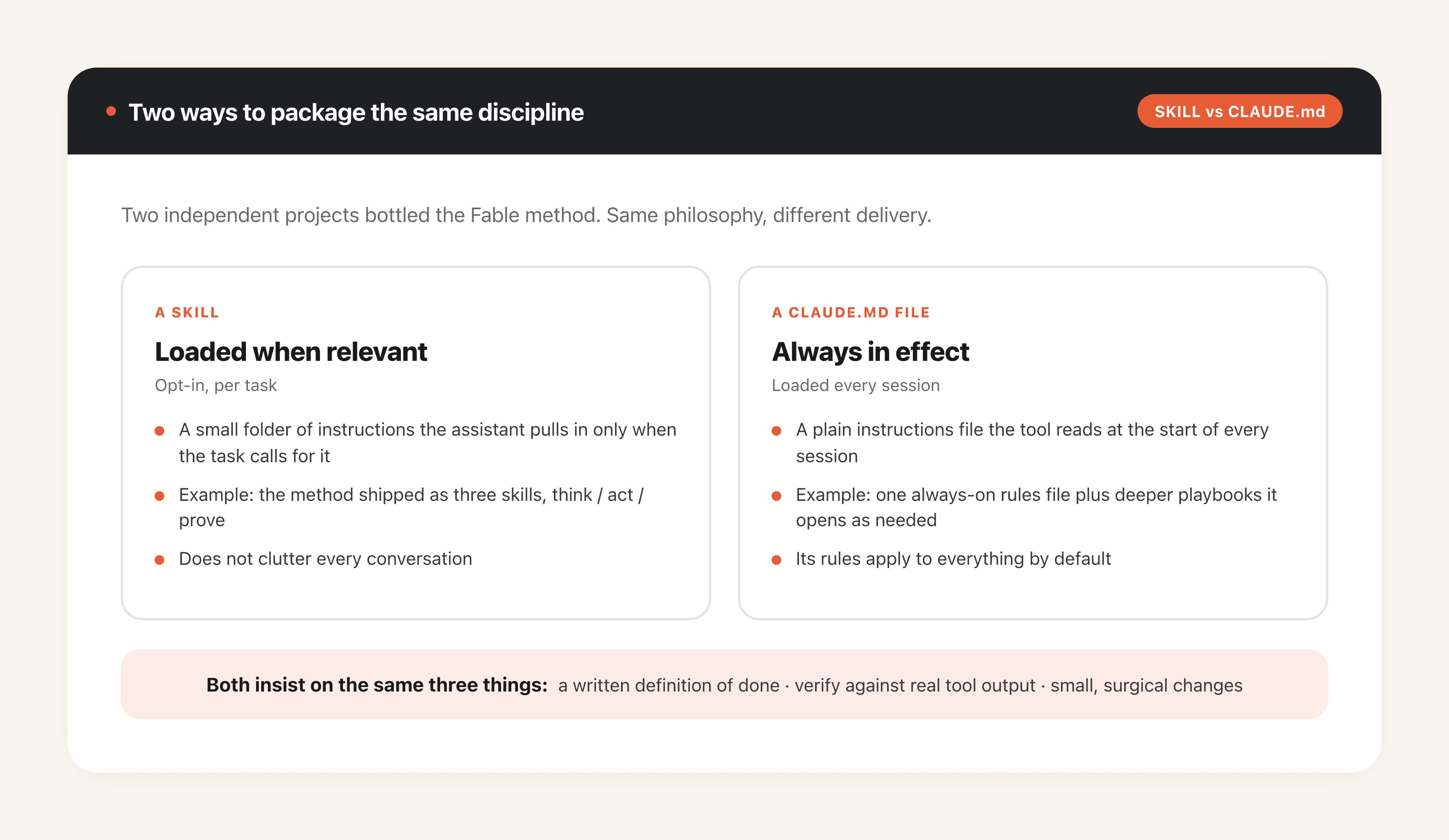
The two overlap on the substance. Both insist on a written definition of done. Both insist that verification happens against real tool output, not the model's own account of what it did. Both push for minimal, surgical changes rather than sprawling rewrites. Where they part ways is packaging, and that distinction is worth understanding if you're not technical:
- A skill is a small, self-contained folder of instructions the AI loads only when it is relevant. Anthropic's own documentation describes skills as modular capabilities that package instructions and resources the model uses automatically when they apply. Sahir619/fable-method ships the method as three such skills.
- A Claude.md file is a plain instructions file that a tool like Claude Code reads at the start of every session, so its rules are always in effect. TheColliny's kit lives here: one always-on file that sets the ground rules, plus deeper playbooks the model opens when needed.
Same philosophy, two delivery mechanisms. One is opt-in per task, the other is always loaded.
What this clears up: The method is a verification loop first, and a file format second.
What it does not: Because these are independent hobby projects, their exact rules differ, and neither is a canonical standard.
How to Try the Fable Method Yourself
There are two honest paths, and they suit different people.
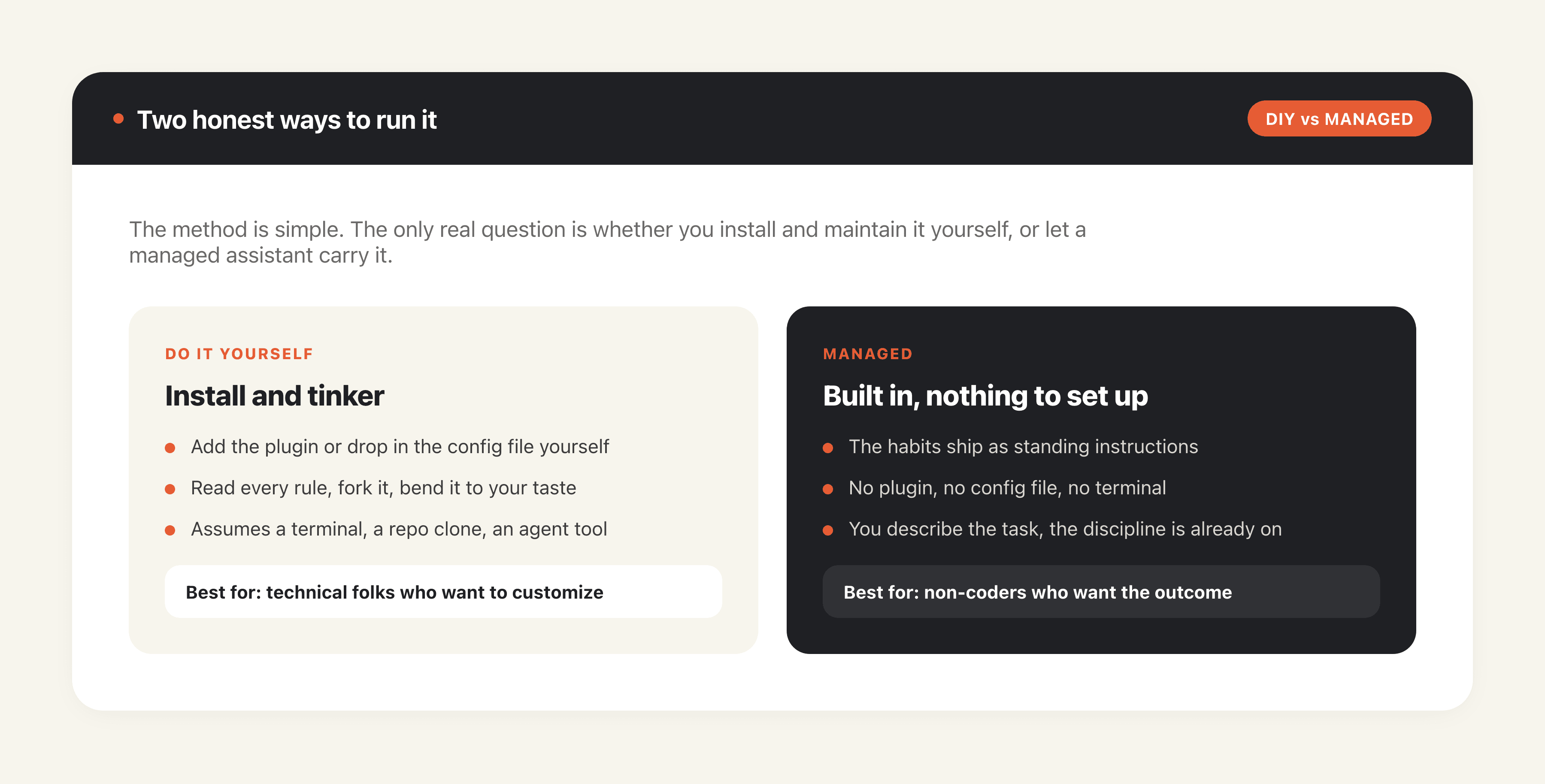
If you use Claude directly and like to tinker
Both projects are public and free to read. If you already run Claude Code or a similar agent, you can install Sahir619/fable-method as a plugin, or drop TheColliny's Claude.md file into your project so its rules load automatically. This is genuinely useful if you want to see the seams and adjust the rules to your own taste.
Be clear-eyed about the friction, though. This route assumes you're comfortable with a terminal, with cloning a repository, and with the idea that a config file governs how your assistant behaves. For a developer, that is a Tuesday. For Priya from earlier, every one of those steps is a small wall. The method is simple; the plumbing to install it is not, if code is not your world.
If you don't want to configure anything
The habits themselves are portable, and you can practice them by hand in any chat. Start every task by asking the model to state what a correct, finished result looks like. Tell it to work from the actual document or data, not its memory. And at the end, ask it to show you the real output that proves the work, the actual result, not a summary of one.
The deeper point is that this discipline doesn't have to be something you re-paste every morning. A managed assistant can carry these habits as standing instructions, so "define done, gather evidence, verify against real output" is simply how it works, with no plugin to install and no config file to maintain. That is the entire reason a managed platform like MoClaw exists: the methodology is built in, and you spend your time on the work instead of the setup. The same verify-your-work discipline runs underneath most of the workflows in our use case library, and we dug into the managed-versus-DIY tradeoff in our guide to real AI agent use cases. If the DIY steps above made you wince, that gap is the one a managed route is meant to close. If they made you curious, the DIY route will teach you more.
What this clears up: You can adopt the Fable method with zero code, just by changing how you brief the model.
What it does not: Doing it by hand every time is repetitive, which is the whole argument for baking it in somewhere.
Is the Fable Method Worth the Hype?
Having read both projects end to end, here is our honest take, with no stake in either repository.
The substantial part is real. Verifying a model's work against actual tool output, rather than its own status report, catches a specific and common failure: the confident "I fixed it" when nothing was fixed. This is not folklore. It is the exact behavior Anthropic itself recommends in its Fable 5 prompting guidance, where instructing the model to check progress against real results nearly removed fabricated status updates. If you take one thing from the method, take that.
The overhyped part is also real. A good chunk of what circulates under "the Fable method" is common sense with a new label. Define what success looks like before you start. Make small changes. Check your work. Any careful person, and every decent engineer, has done this forever. Naming it doesn't make it new, and a few of the rules floating around are just prompt-engineering hygiene dressed up as a movement.
So: worth learning, not worth worshipping. Marcus, a solo founder who runs his whole operation through an AI assistant, tried the full plugin, kept the define-done and verify-against-output habits, and quietly dropped the parts that felt like ceremony. That is probably the right relationship to have with it. Take the verification loop. Leave the branding.
What this clears up: The core habit is worth adopting because it targets a genuine failure mode.
What it does not: No independent benchmark proves these packaged versions beat simply prompting the model well, so adopt the idea, not the claims.
FAQ
Is the Fable method official?
No. It is a community term. Anthropic named the model Claude Fable 5, but it has never published or endorsed anything called "the Fable method" or "the Fable workflow." The name comes from independent developers who observed how the model works and wrote it down. Always read it as a folk description, not an official standard.
Do I need Claude Fable 5 to use it?
No, and that is the point. Both community projects exist specifically to run the same discipline on other or weaker models, including older Claude versions. Fable 5 tends to do these things by default, so the method is really about coaxing that behavior out of models that do not.
What is the difference between the Fable method and just writing good prompts?
Good prompting is mostly about phrasing a request clearly. The Fable method is about the loop around the request: defining what "done" means up front, working from real evidence, and verifying the finished result against actual output. You can write a beautifully phrased prompt and still skip all three, which is exactly the gap the method tries to close.
Can non-developers use it?
Yes. The file-based versions assume some technical comfort, but the underlying habits need no code at all. Ask the model to define success, work from the real document, and prove the result. A managed assistant can hold those habits for you so you never touch a config file.
Where the Fable Method Goes From Here
The most interesting thing about the Fable method is not any single rule inside it. It is that within weeks of a new model shipping, strangers were racing to bottle the way it works and hand that discipline to lesser tools. That pattern will repeat with every capable model that follows. The specifics will change; the instinct, capture the good behavior and make it portable, will not.
For a non-technical reader, the practical takeaway is smaller and more durable than the hype suggests. You don't need a plugin, a config file, or Fable 5 itself to get most of the benefit. You need to make three habits non-negotiable: say what done looks like, work from real evidence, and check the result against real output. Whether you wire that into Claude Code, keep it as a standing instruction inside a managed assistant, or simply say it out loud in every chat, the method is only as good as your willingness to make the model prove its work.
MoClaw is not affiliated with or endorsed by Anthropic. Claude and Claude Fable 5 are products of Anthropic. "The Fable method" is a community term, and the two open-source projects referenced here are independent works by their respective authors.
Continue Reading
More Guide
Praxist License: Fair Source, Not Open Source

What Is GLM-5.3-Flash? Specs and Price

Tokentab: See What Claude Code Actually Costs

Open Higgsfield: One Prompt Bar, 40 Models

ChatGPT Ads India: Who Sees Them, How to Stop

OpenAI Assistants API Deprecated: What Broke

The MoClaw editorial team writes about workflow automation, AI agents, and the tools we build. Default byline for industry overviews, listicles, and collaborative pieces.
Ready to put this into practice?
MoClaw runs browser tasks, research, and schedules automatically. Try it free.
References: Anthropic: Introducing Claude Fable 5 · Anthropic: Prompting Claude Fable 5 · Anthropic: Redeploying Fable 5 · Sahir619/fable-method (community project) · TheColliny/FableClaudeMDForOpus (community project) · Anthropic: Agent Skills Overview