Claude Skills for Marketing

Claude skills are no longer just for coders. Here is how marketers use them for copywriting, CRO, and campaign work, with no programming required.
Table of Contents
Claude skills are prepackaged bundles of instructions that make an AI assistant work like a specialist in one task, and marketers are now using them for copywriting, conversion optimization, SEO, and campaign planning without writing a line of code. Anthropic calls them Agent Skills and describes them as folders of instructions and resources that Claude loads only when they're relevant. They started as a tool for developers. In 2026 they became one of the more interesting things happening in marketing.
The shift is visible in the open. Within a single stretch this summer, marketers, designers, and salespeople all published skill collections for their own jobs, and the marketing set is the most developed of them. If you've heard the phrase "Claude skills for marketing" and wondered whether it is for you when you don't code, the short answer is yes, and here is how.
Key Takeaways:
- A "skill" is a packaged bundle of expertise; install it, and the AI follows that field's best practices on its own.
- Claude skills began in coding and spread to marketing, design, and sales through 2026, with marketing the most built-out.
- Marketing works well because the tasks are patterned: copy frameworks, CRO checklists, and campaign structures are exactly what a skill can package.
- You don't need to code to use them, though the do-it-yourself install path still assumes some technical comfort.
- A managed assistant can carry the same playbooks with nothing to install, which is the fastest route for non-technical teams.
Skills, Briefly, for Non-Developers
A skill is a small folder of instructions that teaches an AI assistant how an expert approaches one specific job, the same way every time. Anthropic's own definition, from its October 2025 announcement, is plain: "Skills are folders that include instructions, scripts, and resources that Claude can load when needed." The assistant pulls the skill in only when the task calls for it, so having many installed doesn't clutter every conversation.
The useful mental model is a checklist written by a senior specialist, one the AI reads and follows so you don't have to. Ask a plain assistant to "improve my landing page" and you get generic advice. Ask an assistant with a conversion skill installed, and it works through the same ordered framework a seasoned optimizer would, starting with your value proposition and ending with your call to action.
One thing to clear up early, because it trips people up: you don't need Claude Code, the developer tool, to use skills. Anthropic's announcement says you can "use them across Claude apps, Claude Code, and our API." Claude Code is one delivery option among several, not a requirement.
What this clears up: A skill is packaged expertise the assistant applies automatically, not a program you run.
What it does not: A skill supplies method, not judgment. It still needs you to bring the real page, product, and goal.
Why Marketing Is the Breakout Use Case
Skills were born in engineering, where the work is full of repeatable procedures. What surprised people in 2026 is how fast the idea jumped functions. In one short window this summer, three unrelated collections appeared: a large marketing set from coreyhaines31/marketingskills, a design set from jakubkrehel/skills, and a sales prospecting skill in Kappaemme-git/codex-first-customer-finder-skill. Coding was the first domain. It is no longer the only one.
Marketing broke out first among the non-coding functions, and the reason is structural. A huge share of marketing work is patterned. Copywriting runs on frameworks. Conversion optimization runs on checklists. Paid campaigns have standard structures, SEO audits have standard passes, and email sequences have standard beats. That patterning is exactly what a skill is good at capturing. The parts of marketing that resist packaging, taste, positioning, knowing your specific customer, are still yours. The repeatable scaffolding around them is what a skill hands off.
Elena, a fractional marketer juggling four early-stage clients, put it simply: the skills don't replace her strategy, they remove the part where she rebuilds the same CRO checklist from memory for the fourth time this month. The framework is the commodity. Her read on which fix matters for this client is not.
What this clears up: Marketing led the spread because its daily work is unusually procedural, and procedures package cleanly.
What it does not: Packaging the procedure doesn't package the strategy. The skill gives you the frame, not the call.
What's Inside a Marketing Skill Set
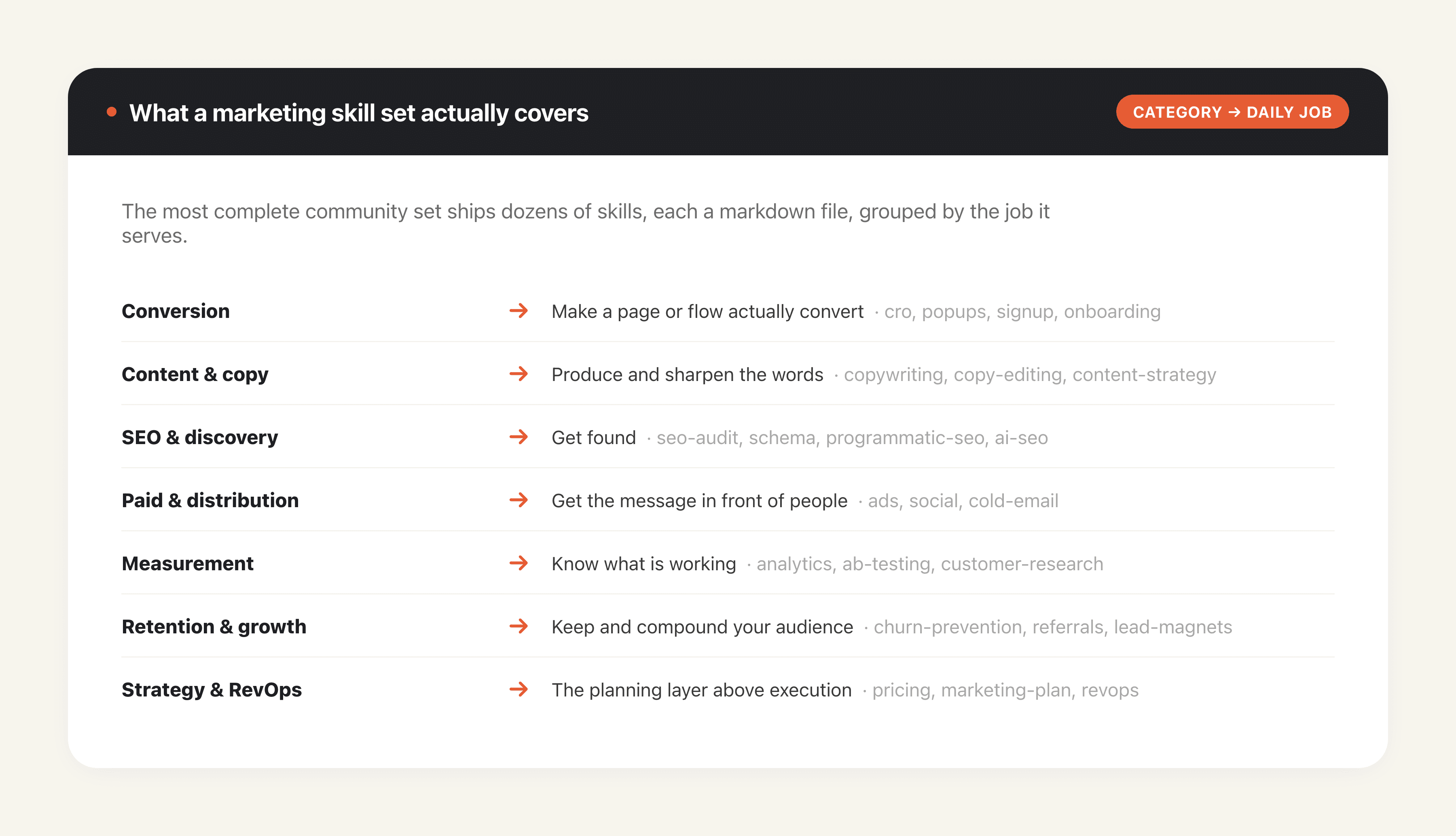
The marketingskills collection is the most complete sample, so it is worth seeing what it actually contains. It ships dozens of individual skills, each a markdown file, grouped by the job they serve. The real categories include:
- Conversion optimization: CRO, landing pages, popups, paywalls, signup and onboarding flows. The daily job: making a page or flow actually convert.
- Content and copy: copywriting, copy editing, content strategy, product marketing. The daily job: producing and sharpening the words.
- SEO and discovery: SEO audits, schema, site architecture, programmatic SEO, AI-answer optimization. The daily job: getting found.
- Paid and distribution: ads, ad creative, social, SMS, cold email, directory submissions. The daily job: getting the message in front of people.
- Measurement and testing: analytics, A/B testing, customer research. The daily job: knowing what is working.
- Retention and growth: churn prevention, referrals, lead magnets, community. The daily job: keeping and compounding the audience you have.
- Strategy and RevOps: pricing, marketing plans, sales enablement, revenue operations. The daily job: the planning layer above execution.
To go past the catalog and see how one behaves, our team installed the collection and ran its conversion optimization skill on a real page. The honest report: it is a well-organized senior-marketer's brain, not a magic button. Before saying anything, it asked for the page type, the conversion goal, and where traffic came from. Then it worked in impact order, value proposition first, then the headline, then call-to-action placement and copy, flagging weak button text like "Submit" and pushing for value-bearing copy instead. It even checks for a stored product-marketing context file so it doesn't re-ask what you've already told it.
What it did well was structure and completeness: it didn't skip the boring, high-impact basics the way a rushed human does. What it could not do was supply the judgment. It didn't know our customer, our positioning, or which of its solid suggestions actually mattered most for us. That was still our call. Used as a thorough first-pass reviewer that never forgets the fundamentals, it earned its place. Treated as a replacement for a marketer, it would fail.
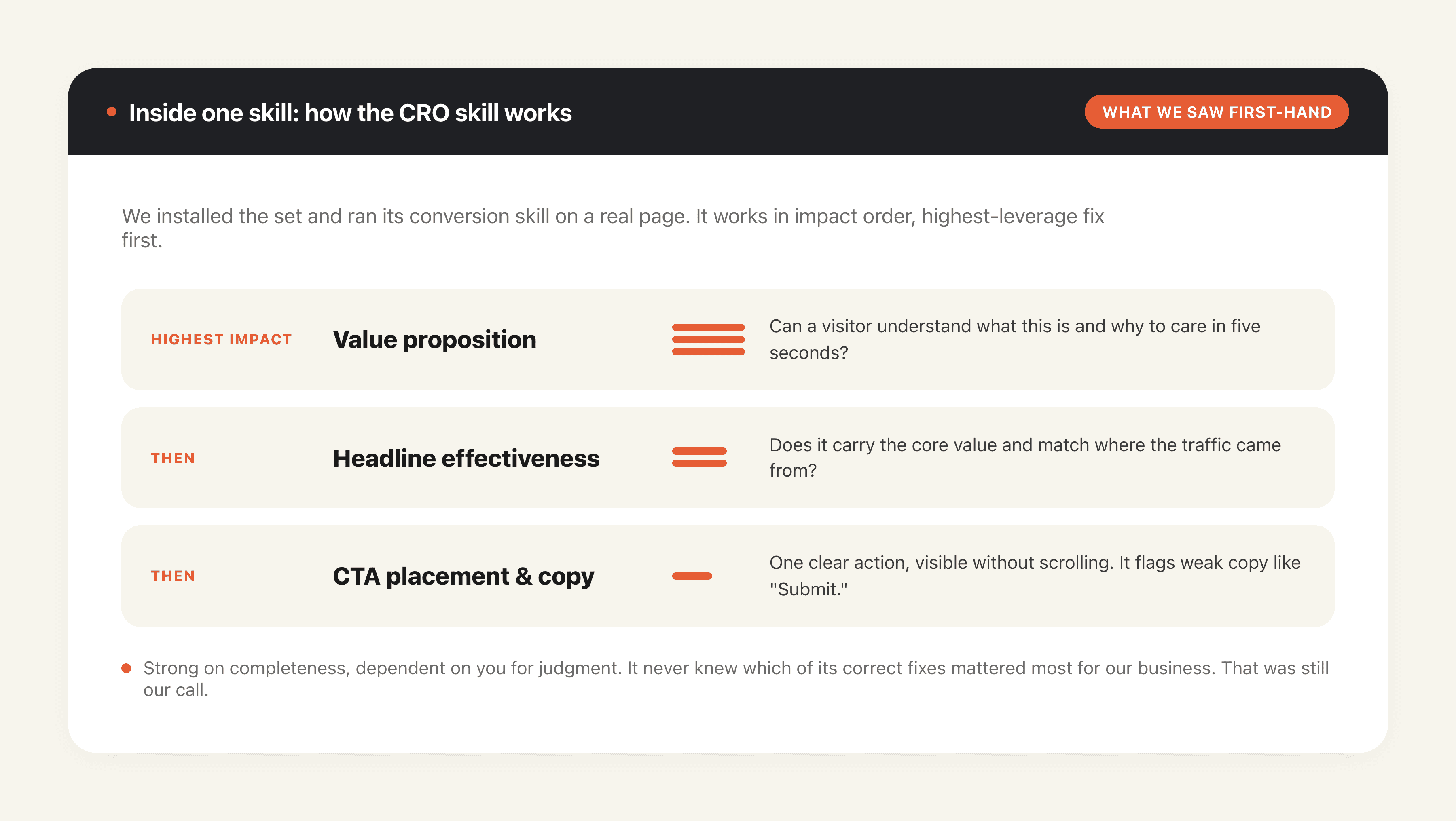
What this clears up: A marketing skill is a structured expert checklist, strong on completeness, dependent on you for judgment.
What it does not: It won't tell you which of its correct recommendations is the one worth doing first for your business.
Three Marketing Skills Worth Starting With
If installing a few dozen skills at once feels like a lot, start with the three that pay off fastest for a small team.
Conversion optimization. Point it at a page that is not converting and it walks the fundamentals in impact order, from value proposition to call to action. This is the one to reach for when traffic arrives but nobody acts.
Copywriting. Give it a rough draft or a blank page and a brief, and it applies proven copy frameworks instead of generic phrasing. Best when you know what to say but not how to say it sharply.
SEO audit. Hand it a URL and it runs the standard on-page passes a specialist would, surfacing the misses that quietly cost rankings. Useful when you suspect a page underperforms in search but can't name why.
Start with just the conversion skill on your pricing page, ship the three fixes it flags as basics, and only then decide whether the rest of the set is worth your time. Starting narrow beats installing everything and using nothing. There's a practical reason too: cram too many skills into one conversation and the assistant gets less focused, not more, so a tight working set often beats the whole shelf.
What this clears up: You don't have to adopt a whole library; a couple of high-frequency skills prove the value first.
What it does not: The starter list is generic. Your best first skill depends on where your specific funnel leaks.
One Skill That Tries to Be the Whole Department
The starter set above is deliberately narrow. The opposite bet also exists, and it went up on 17 August 2026: marketing-os packages fourteen modules as a single Claude skill and calls the result an entire marketing department. Audit, GEO, copy, hooks, paid ads, email, social, launch, positioning, competitive, app store and analytics each get their own module, with a slop-pattern catalogue and a rubrics file underneath them.
What keeps this from being another awesome-list is the router. Roughly two thousand tokens load first, and each task pulls only the module it needs, so fourteen modules cost nothing until one of them is called. That design choice is why a bundle this size can sit in a session at all; the alternative, which several skill collections still take, is to push everything into context and watch focus degrade in exactly the way described above.
The author's framing is that it was built by tearing down the most-starred marketing skill repositories on GitHub, from 44,000-star collections down to 100-star craft pieces, then adding three things none of them had: a score on every output, an artifact instead of advice, and an explicit "what I couldn't determine" section in every report. That last one is the interesting discipline. A marketing audit that names its own blind spots is more useful than one that quietly fills them in.
Practical notes. It's MIT, pure markdown with no executable code, and installs as a Claude Code plugin with /plugin marketplace add Yuzzyuk/marketing-os followed by /plugin install marketing-os@marketing-os. Claude web and desktop take the zipped release through Settings, and Codex or Cursor users copy skills/marketing-os/ into their own skills directory. Before any of that, copy brand-context.template.md to brand-context.md and fill it in, because every module reads it and skipping it is how you get output the README itself describes as competent and interchangeable.
Two caveats worth carrying. It sat at 204 stars and 47 forks on 20 August 2026, and the repository has not been pushed since the twenty-seven seconds after it was created, so there's no maintenance record to judge yet. And a fourteen-module bundle is the opposite of the start-narrow advice above; the honest way to use it is to call one module, not to treat installing it as progress.
What this clears up: All-in-one marketing skills exist, and progressive loading is what makes them survivable inside one session.
What it does not: A bundle that scores its own work still scores it with a heuristic. Treat the numbers as a sorting order, not a measurement.
Using Marketing Skills Without Touching Code
There are two honest routes, and they suit different people.
The do-it-yourself route
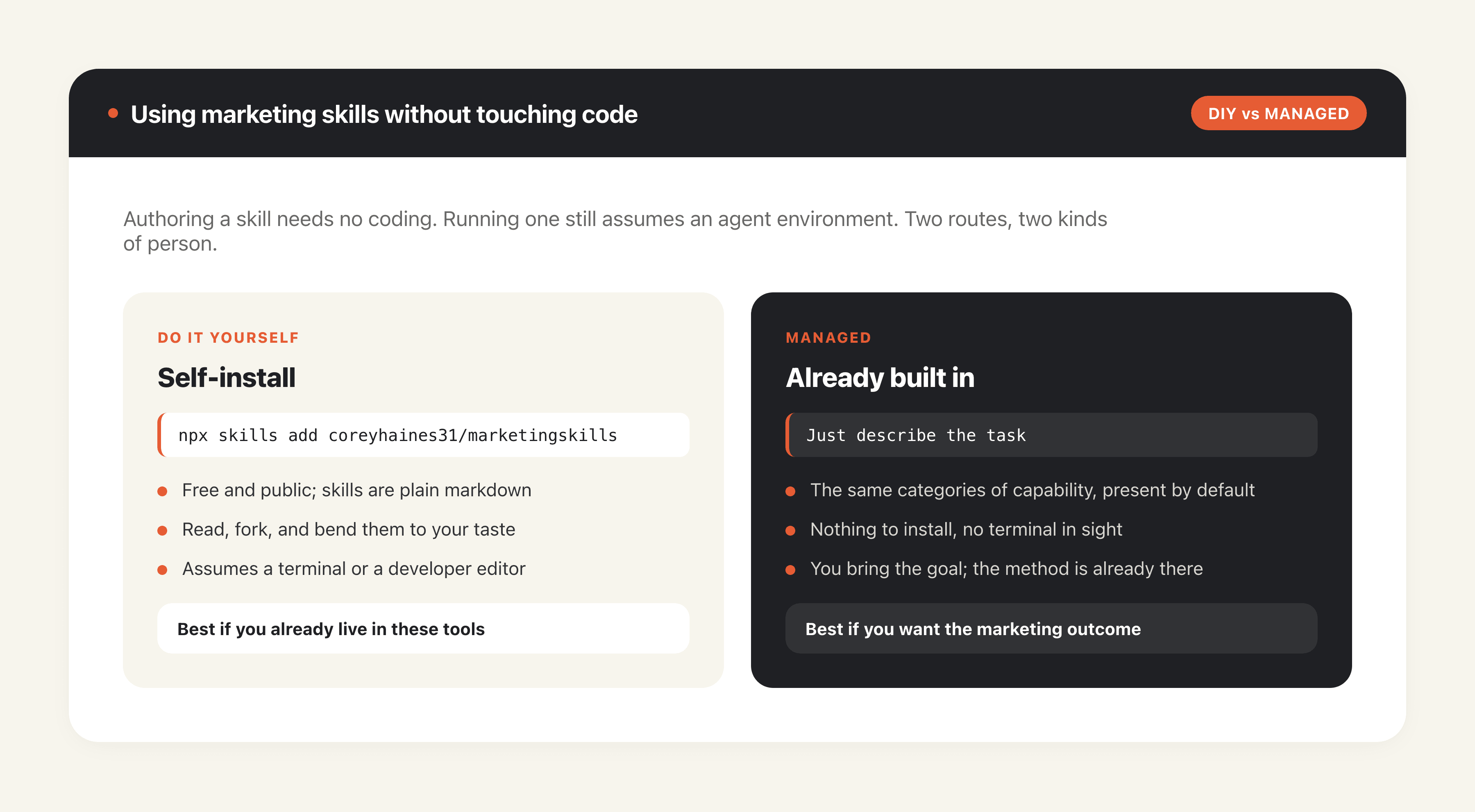
The marketing skills are public and free. If you already work inside an agent tool like Claude Code, Cursor, or Codex, you can add the whole set with a single command such as npx skills add coreyhaines31/marketingskills, or install it as a Claude Code plugin, and then invoke a skill by name or just by asking in plain language.
Here is the honest friction. Authoring a skill needs no coding, because skills are plain markdown. But installing and running them still assumes you've an agent environment set up, that you're comfortable in a terminal or a developer editor, and that a command like the one above doesn't make you close the tab. For a technical marketer, that is a five-minute setup and a genuine win. For a founder who has never opened a terminal, each of those is a real step, and there are several. The skills themselves are simple. The surface you run them on is not always.
The managed route
The alternative is to have the playbooks already present in an assistant you just talk to. In a managed setup like MoClaw, the same categories of marketing capability, copy, conversion, SEO, campaign work, are built in, with nothing to install and no terminal in sight. You describe the task, and the assistant applies the method. We wired this into the marketing and content use cases so the setup step disappears.
To be fair to both sides: the do-it-yourself route wins if you want to read every skill, fork it, and bend it to your exact taste, and you already live in these tools. The managed route wins if your goal is the marketing outcome and you would rather not become a part-time systems administrator to get it. Neither is wrong. They serve different people, and honestly, sometimes the same person on different days.
What this clears up: Non-coders can absolutely use marketing skills; the only real question is whether you self-install or let a managed assistant carry them.
What it does not: The managed route trades maximum customization for zero setup. If deep tinkering is the point, do it yourself.
FAQ
Do I need Claude Code to use skills?
No. Anthropic's documentation states that skills work across Claude apps, Claude Code, and the API, so Claude Code is one option rather than a requirement. A managed assistant can also carry skills for you, which removes the developer tooling entirely. Check Anthropic's current docs for the surfaces supported at any given time.
Are community skills safe to install?
Treat them like any code or configuration from the internet. A skill can include instructions and scripts, so review what it does before installing, prefer well-known authors and repositories, and be cautious with anything that asks for credentials or takes actions on your accounts. When in doubt, read the skill file first; they're plain text and readable.
Can skills replace a marketing team?
No. A skill packages a method, not judgment. In our own hands-on test, the conversion skill was excellent at applying a complete framework and useless at knowing which fix mattered most for our specific business. It makes a small team faster and more thorough. It doesn't decide strategy or understand your customer.
What's the difference between a skill and a prompt template?
A prompt template is text you paste in once. A skill is a persistent, structured capability the assistant loads automatically when a task calls for it, and it can bundle multiple instructions and resources rather than a single message. In practice, a skill behaves like a specialist the assistant can consult, while a template is a one-off note.
Where Claude Skills for Marketing Are Heading
Marketing was the first non-coding function to get a serious skill library, but the same summer showed it won't be the last. The design set packages craft like animation, typography, layout, and color. The sales skill turns a product idea or URL into an evidence-backed shortlist of likely first customers. Three functions, the same pattern: take the repeatable expertise of a role and hand it to an assistant.
The direction is clear. Skills are becoming the way functional expertise travels, the same way templates and playbooks did before them, except these ones do the work rather than just describe it. For a marketer, the takeaway is not to install everything today. It is to notice that the frameworks you spent years internalizing are becoming portable, and to decide where you want to apply your judgment now that the scaffolding builds itself. We will cover the design and sales sides in their own pieces as this cluster grows.
MoClaw is not affiliated with or endorsed by Anthropic, and is not a fork or hosted version of any open-source project. Claude is a product of Anthropic. The skill collections referenced here are independent works by their respective authors.
Continue Reading
More Guide
How to Build Claude Skills for Agent Workflows

HyperFrames Workflow: Video Rules as Skills

Skill Zoo: Reusable Agent Skills for AI Workflows

Meta Skills AI, Explained

Claude Anthropic Skills, Explained

What Are AI Agent Skills? A Practical Guide

The MoClaw editorial team writes about workflow automation, AI agents, and the tools we build. Default byline for industry overviews, listicles, and collaborative pieces.
Ready to put this into practice?
MoClaw runs browser tasks, research, and schedules automatically. Try it free.