Cheaper Manus AI Alternative: 2026 Guide

Manus runs $20 to $200 a month on credits and its free tier is disputed by its own docs. 8 Manus AI alternatives, prices rechecked August 2026.
Table of Contents
Manus AI alternatives sort by what you actually wanted Manus to do: cloud-computer task execution, research, app building, or recurring automation. For the closest fixed-price replacement, MoClaw is the cleanest $20/month option. For free self-hosting, OpenManus or n8n make more sense.
One warning about every other list you will read on this topic. Manus prices are usually quoted from second-hand round-ups, and those round-ups are wrong right now: they still list a free tier and a $20-a-seat team plan that are not on Manus's pricing page. Every number on this page was read off the vendor's own pricing page on August 12, 2026, and where a vendor hides pricing behind a login, this page says so instead of guessing.
The other thing sticker price does not capture: Manus bills credits, so what you pay depends on what you run, not what you subscribe to.
Key Takeaways
Key Takeaways:
- Manus AI is still useful for autonomous cloud-computer tasks, especially research, browsing, code execution, and prototype generation.
- The main reasons people search for a cheaper Manus AI alternative are server reliability, credit opacity, context limits, invite-only access, production gaps, and privacy or data residency concerns.
- MoClaw is the most direct fixed-price alternative at $20/month because it pairs a cloud computer with browser control, scheduled tasks, multi-channel access, 50+ skills, and 1,000 included credits.
- NxCode is the cheapest app-building pick at $5/month on its Lite tier. Genspark is stronger for research synthesis at $24.99/month, or $19.99 billed annually, with a free tier capped at about one deep-research run per day.
- Free and open-source routes can work, but they shift cost from subscription fees to setup time, hosting, API keys, and maintenance.
- The right answer comes from four questions: is the task one-time or recurring, what kind of work are you doing, what are your cost and compliance constraints, and do you need persistent memory or just task execution?
What Manus AI Costs in 2026
Manus AI is a general AI agent that runs tasks in a cloud environment with browser, terminal, and file-system access. Reviews such as Taskade's Manus AI review describe its core value as autonomous multi-step execution: you give it a goal, it browses, installs dependencies, writes code, analyzes files, and returns a finished artifact.
That model is powerful, but the pricing is hard to forecast. Here is what Manus actually publishes, read off its pricing page on August 12, 2026:
| Manus plan | Price | Included credits | Concurrent tasks | Scheduled tasks |
|---|---|---|---|---|
| Standard | $20/month | 4,000/month plus 300 refresh daily | 20 | 20 |
| Custom | $40/month | 8,000/month plus 300 refresh daily | 20 | 20 |
| Extended | $200/month | 40,000/month plus 300 refresh daily | 20 | 20 |
| Teams & Businesses | Not published | Not published | Not published | Not published |
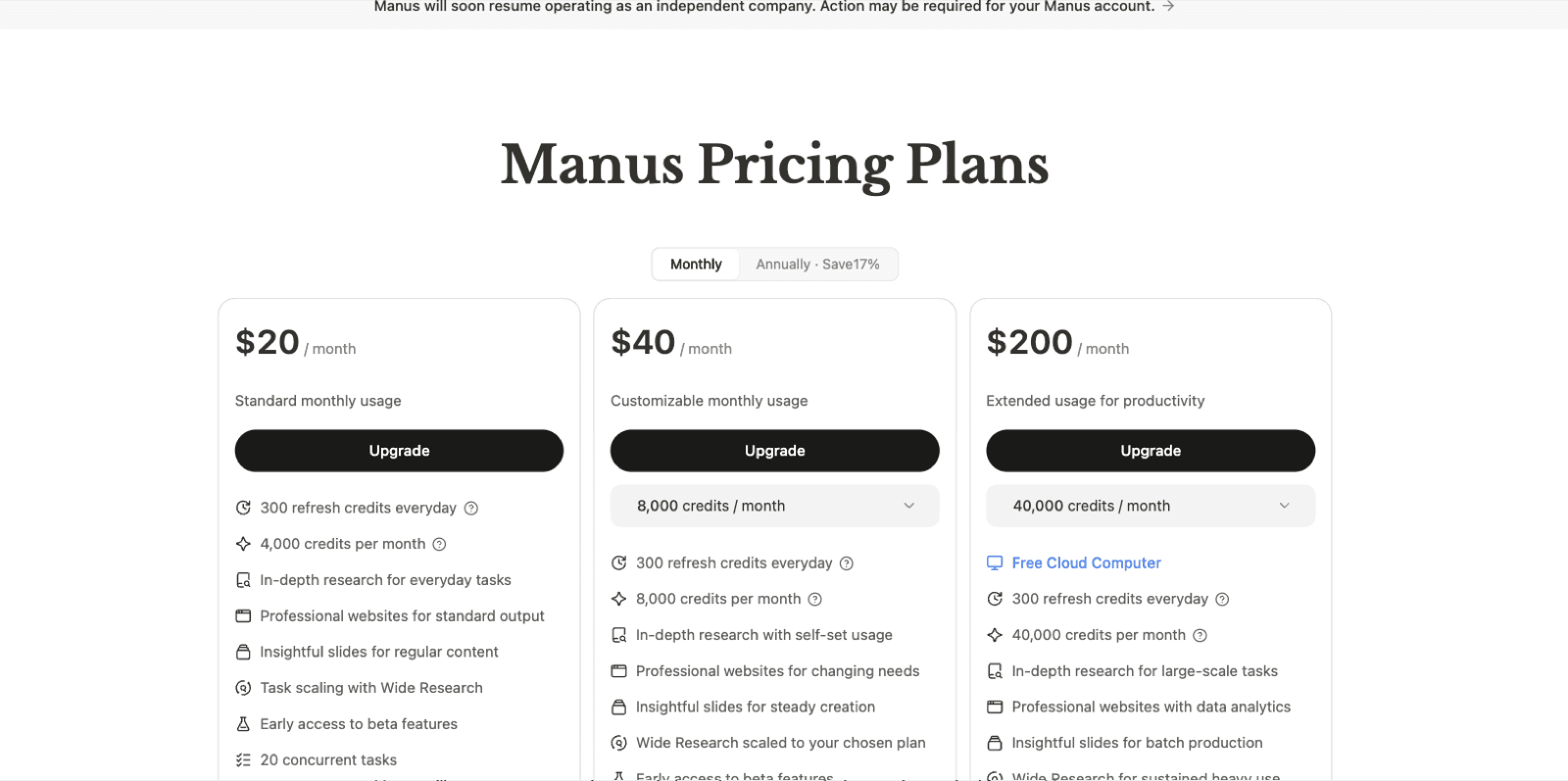
Two corrections to what is circulating. First, Manus's pricing page shows three individual tiers and no free plan card. Its own plans documentation, however, still describes a "Free Plan" with "limited monthly credits" and no numbers, so Manus publishes two accounts of its own entry tier and we cannot date when they diverged. Treat any round-up that quotes a confident free-tier allowance as unsourced, and check your own account. We pulled that apart properly in Is Manus AI free?. Second, the team plan has no public price at all: it is a "Get Team" contact form, not $20 a seat.
One more thing worth knowing before you commit to an annual anything: as of August 2026 a banner across Manus's own pricing page reads that Manus "will soon resume operating as an independent company" and that action may be required for your account. That is a corporate-structure change, not a product one, but it is the kind of thing to factor into a twelve-month commitment.
The hidden problem is not that $20/month is unusually high. It is that a simple query might use a small number of credits while a deep research run can consume hundreds or more. When a task fails, pauses, or needs retries, users feel the cost twice: once in credits and again in time spent recovering the work.
Why People Look for Cheaper Manus AI Alternatives
The buyer intent behind "cheaper alternative to Manus AI" usually starts with price, then quickly turns into reliability and control.
Server reliability. Hands-on coverage from MIT Technology Review found Manus promising but also noted crashes and overload during testing. If your work depends on a cloud agent during business hours, "server busy" is not a small inconvenience.
Credit opacity. Users cannot reliably estimate credit burn before a task starts. That makes Manus harder to budget for deep research, long browser sessions, or exploratory coding.
Context limits. Large projects still need splitting, summarizing, or manual restarts. A cheap alternative is not useful if it loses continuity on the work that matters.
Invite-only access. Multiple reviews note that Manus remained constrained by access controls and waitlists. A cheaper tool with immediate access may be more useful than a powerful one your team cannot reliably start.
Production gaps. Manus can create impressive prototypes quickly, but complex business logic, payments, authentication, and deployment still need human review. NxCode's Manus review makes this distinction clearly: rapid prototypes are not the same thing as production systems.
Privacy and data residency. Cloud execution means credentials, files, and browsing sessions move through remote infrastructure. For sensitive work, a self-hosted option or private cloud workspace may matter more than saving a few dollars.
Route 1: Direct Manus Replacements
Direct replacements are for users who like the Manus idea: an agent with a working environment, not just a chat box. The best cheaper choices are fixed-price cloud workspaces or focused autonomous agent products.
| Tool | Entry price | Best fit | Why it is cheaper or safer than Manus | Main caveat |
|---|---|---|---|---|
| MoClaw | $20/month | Direct cloud-computer replacement, recurring tasks | Fixed plan, 1,000 included credits, browser control, scheduled tasks, Telegram and Slack access | Best for ongoing workflows, not only one-off research marathons |
| NxCode | $5/month | Full-stack app builders | Dual-agent planning, permanent credits, structured acceptance criteria | Narrower focus on app creation |
| Genspark | $24.99/month, $19.99 billed annually | Research and synthesis | Often stronger for multi-agent research output | Free tier is capped at roughly one deep-research run per day |
| Lindy | Plus $29.99 displayed, $49.99 in its own structured data | Business workflow automation | Multi-agent automation and many integrations | Jumps to $99.99 and $199.99 on Pro and Max |
MoClaw is the closest fit if your search intent is "I want Manus, but predictable." The MoClaw Manus alternatives map frames Manus as strongest for open-ended research, first-draft content, and small repeated browser tasks, but weaker for high-risk execution and long sessions. MoClaw's fit is different: a managed cloud agent workspace for recurring work, with web, Telegram, and Slack access.
NxCode is the bargain pick for application builders. Its 2026 Manus alternatives guide emphasizes a Conductor plus Virtuoso structure, where planning and execution are separated. That can be more useful than pure autonomy when you need acceptance criteria before code generation.
Genspark is the direct competitor to test when your job is research quality rather than workflow ownership. Lindy, by contrast, is less "cheap" but fits teams that care about native integrations, approvals, and business processes. Lindy's Manus alternatives guide is useful for comparing that automation-oriented lane.
Route 2: Free and Open-Source Options
Free options are real, but they are not free in the same way. They usually save subscription cost and add setup cost.
| Tool | Price | Deployment | Best fit | Tradeoff |
|---|---|---|---|---|
| OpenManus | Free | Self-hosted | Developers who want a Manus-like architecture without a subscription | Requires setup, hosting, model keys, and maintenance |
| Vellum | Free tier, then Mighty $30 / Super $100 / Ultra $200 a month; self-hosting has no platform fee | Cloud, or self-host on your own hardware, a VPS, or a private cloud | Personal assistant with memory and credential isolation | The free-and-open-source path is the self-hosted one, not the cloud one |
| OpenClaw | Free. MIT-licensed, no subscription exists | Self-hosted on macOS, Linux, or Windows | Technical users who want model flexibility and full control | You operate it; that is the whole cost |
| n8n | Free self-hosted or paid cloud | Workflow automation | Scheduled integrations and trigger-action flows | Not an autonomous cloud computer by itself |
Two of these get consistently misdescribed. Vellum is not a macOS-only freeware download: it is a cloud platform with paid tiers plus an open-source build you can deploy to your own hardware, a VPS, or a private cloud. And OpenClaw has no subscription at any price. It is MIT-licensed under the OpenClaw Foundation, with 385,994 GitHub stars and 81,122 forks as of August 12, 2026, and it installs on macOS, Linux, and Windows from one command. Any comparison quoting a monthly fee for OpenClaw is quoting something that does not exist.
OpenManus and OpenClaw make sense if your team can manage infrastructure. n8n is a different category, but it belongs in the comparison because many Manus tasks are really workflow tasks: scrape a page, watch a form, summarize an email, write to a database, notify Slack. If the workflow is repeatable, a self-hosted automation stack may beat an autonomous agent. For the baseline project and the choice between self-hosting and managed cloud operation, see our OpenClaw self-hosting comparison.
Route 3: Specific Use Cases
Many buyers overpay because they compare "AI agent" labels instead of use cases. A cheaper Manus AI alternative should match the job.
| Use case | Better fit | Typical entry price | Why |
|---|---|---|---|
| Deep research and cited reports | Genspark, ChatGPT Deep Research, Claude Research | $20 to $24.99/month | Stronger research workflows and long-document handling |
| Terminal and coding workflows | Claude Code | $20/month | Strong developer workflow, repo context, GitHub and GitLab fit |
| Full-stack app generation | NxCode, Replit Agent, Cursor | $5 to $20/month | More structured around building and editing software |
| Recurring scheduled browser work | MoClaw, n8n, Lindy | Free to $199.99/month | Scheduling, repeatability, and integrations matter more than raw autonomy |
| Broad no-code integrations | Zapier, Make, Lindy | Free to $199.99/month | Trigger-action systems beat agents for predictable processes |
This is why "cheaper" can mean several things. Claude Code at $20/month is not cheaper than Manus Standard, but it may be cheaper for coding because it wastes fewer cycles on the wrong interface. n8n can be free if self-hosted, but only if someone owns setup and maintenance. MoClaw is not the lowest sticker price, but it removes the waitlist and opaque credit anxiety for users who want a managed cloud agent workspace.
Decision Framework: Four Questions
1. Is your task one-time or recurring?
For one-time research, try Genspark, ChatGPT Deep Research, Claude Research, or Manus if you already have access. For recurring work, choose MoClaw, n8n, Lindy, Zapier, or Make, because scheduling and repeatability are the real requirements.
2. What is your primary work type?
Research and writing point toward Claude, Genspark, or Perplexity-style tools. Code and apps point toward NxCode, Claude Code, Replit Agent, Cursor, or Devin. Workflow automation points toward n8n, Lindy, Zapier, Make, or MoClaw when the workflow needs browser control.
3. What are your cost and compliance constraints?
If the budget is under $20/month, start with OpenManus, OpenClaw, n8n self-hosted, self-hosted Vellum, or NxCode Lite at $5. If compliance, sensitive credentials, or data residency matter, self-hosted or private-workspace options beat generic cloud execution.
4. Do you need persistent AI memory or just task execution?
Manus is mainly a task executor. It is built to complete a job and move on. If you need continuity, look at Vellum for personal memory or MoClaw for ongoing cloud workflows. If you only need a one-off artifact, memory matters less than task quality and cost predictability.
Quick Comparison Table
| Alternative | Price | Best for | Open source | Self-host option | Manus problem it solves |
|---|---|---|---|---|---|
| MoClaw | $20/month, 1,000 credits, 3-day free trial | Direct replacement, recurring cloud-agent work | No | No | Credit opacity, scheduling gaps |
| NxCode | Lite $5/month, Pro $20/month | Structured app building | No | No | Production-planning gaps, expiring credits |
| Genspark | $24.99/month, or $19.99/month billed annually | Research quality | No | No | Research depth and synthesis |
| Vellum | Free tier, then $30 / $100 / $200 a month; self-host free | Personal AI memory | Yes | Yes | Session resets, credential visibility |
| OpenManus | Free | Self-hosted Manus-style agent | Yes | Yes | Subscription cost and access limits |
| n8n | Free self-hosted | Repeatable workflow automation | Yes | Yes | Recurring tasks and integrations |
| Lindy | Plus reads $29.99 on the page and $49.99 in the page's own schema | Business workflow agents | No | No | Team process automation |
| Claude Code | Included in Claude Pro $20/month | Terminal and code workflows | No | No | Coding quality and repo workflow |
Prices read off each vendor's own pricing page on August 12, 2026.
One of them does not agree with itself, and it is worth knowing about before you budget. Lindy's pricing page displays $29.99 per user per month for its Plus plan. The JSON-LD structured data embedded in that same page declares the same Plus plan at $49.99 with a one-month billing duration, and people who subscribed in early August were charged $49.99. We cannot tell from the outside which number is the live one, so if you are costing out Lindy, price it from your own invoice or checkout screen rather than from any comparison table, including this one.
That is the general rule this whole page runs on. Vendors in this category change prices faster than anyone re-checks them, and most round-ups are quoting each other rather than the source.
Final Takeaway
Manus proved that autonomous cloud-computer execution can feel magical. The cheaper Manus AI alternatives in 2026 are valuable because they turn that idea into more predictable buying decisions: fixed pricing, open-source control, better research output, stronger coding workflows, or repeatable automation.
For a direct managed replacement, start with MoClaw at $20/month. For the lowest app-building price, test NxCode at $5/month. For free control, evaluate OpenManus, Vellum, or n8n self-hosted. The winning choice is the one that keeps the original Manus promise while removing the specific problem that pushed you to search for an alternative in the first place.
Trust-Building Patterns Across Any Autonomous Agent
The practices that build trust across any autonomous agent, including Manus and its alternatives.
Run any new agent in observe-only mode for the first week. The agent plans, you approve every action. After a week of clean approvals, expand to bounded autonomy.
Set hard cost and time caps. Per-task and per-day caps. The agent stops and escalates if it exceeds. One feedback loop can burn five figures overnight.
Audit every external write. A persistent log of what the agent did, reviewable by a human. Catches drift and useful for debugging.
Pin the model. "Always latest" is a 2 AM page. Pin and roll forward at your team's pace.
Keep credentials out of prompts. API keys, customer PII, internal credentials live in environment variables, never in the prompt.
Reproduce failures in staging. When the agent does something unexpected, reproduce it in a staging environment and tune. Do not patch in production.
Run a Friday review ritual. Fifteen minutes a week, the team looks at what the agent did, what it missed, and the false-positive rate.
Section summary: Observe-only first, hard caps, full audit, pinned model, credential hygiene, staging reproduction, weekly review. Boring is what stays alive.
Related MoClaw Reading
Is Manus AI free? What you actually get: the free-tier question in full, including the docs-versus-pricing-page contradiction
Is Genspark free? The free tier is 1 a day: Genspark's tier ladder and credits-per-dollar math
FAQ
What is the cheapest alternative to Manus AI?
OpenManus, OpenClaw, and n8n self-hosted are free, and Vellum is free if you self-host it rather than using its cloud tiers. For a managed cloud-computer experience closer to Manus, MoClaw is $20/month and NxCode starts at $5/month for app-building workflows.
Is MoClaw cheaper than Manus AI?
MoClaw is not always cheaper than Manus Standard on base price, since both sit around $20/month. It is cheaper in predictability: users get a fixed plan, included credits, immediate access, scheduled tasks, and no surprise task burn from an opaque credit model.
Which Manus AI alternative is best for coding?
Claude Code is the cleaner fit for terminal-first coding, while NxCode is better for structured app generation with planning before execution. Manus can prototype software, but production logic still needs human review.
Which Manus AI alternative is best for recurring tasks?
MoClaw, n8n, Lindy, Zapier, and Make are better fits than Manus for recurring tasks. Pick MoClaw when the workflow needs a managed cloud computer and browser control, n8n when you want self-hosted workflow automation, and Lindy when team integrations matter.
Should I use a free Manus AI alternative or a paid one?
Use a free option if you can manage setup, hosting, model keys, and maintenance. Use a paid managed option if you need reliability, support, scheduling, and predictable onboarding. The cheapest tool is the one that stays usable after the first week.
Price Manus AI Alternatives From Your Own Invoice, Not a Comparison Table
Every number on this page was read off a vendor's own pricing page and stamped with the date, and it still is not enough. Lindy's page contradicts its own structured data. Manus's pricing page and its documentation disagree about whether a free plan exists. Genspark hides its ladder behind a sign-in. This category changes price faster than anyone re-checks it, including us.
So treat any comparison table, this one included, as a shortlist generator rather than a budget. Put the two tools that fit your work shape on a real card, run one real week of your actual workload through each, and read the invoice. That number is the only one that is definitely about you. It also settles the question this whole page circles: for recurring work, a metered agent and a flat one diverge exactly as fast as your usage grows.
Continue Reading
More Comparison
AI Agent vs Automation Tool: 5 Myths for 2026

AI Agent Platform Comparison: 7 Picks for 2026

Self-Hosted AI Agent Alternatives 2026

Zapier Alternative: 2026 Selection Guide

7 Devin AI Alternatives and What They Cost

12 Best OpenClaw Alternatives in 2026
The MoClaw editorial team writes about workflow automation, AI agents, and the tools we build. Default byline for industry overviews, listicles, and collaborative pieces.
Choosing between tools? Let MoClaw run the work.
Always-on AI assistant on its own cloud computer. No switching required, no setup.
References: MoClaw product page · MoClaw: Manus AI Alternatives in 2026 · NoCode MBA: Manus AI Pricing 2026 · MIT Technology Review: Manus AI hands-on review · NxCode: Best Manus AI Alternatives in 2026 · NxCode: Manus AI Review 2026 · Lindy: Best Manus AI Alternatives · Vellum: Best Manus Alternatives in 2026 · Jotform: Top Manus AI Alternatives · Taskade: Manus AI Review