Inside OAK, an On-Device AI Agent Kernel

OpenSparX's OAK runs AI agents fully on-device, routing about 80% of requests without loading a model at all. What it does, and where its numbers disagree.
Table of Contents
The phrase on-device AI agent usually conjures someone cramming a large language model into a phone and waiting. OpenSparX published a C++ project on 10 August 2026 that argues the opposite: in its own demo, the model isn't loaded at all. A voice request to turn on the air conditioning routes in 0.02 milliseconds through pattern matching, and the total round trip of 87 milliseconds is spent almost entirely on the MCP call that actually talks to the vehicle. The repository is OpenSparX/MasterAgent, though the README calls it OAK, for Open Agent Kernel.
Key Takeaways
- OAK is an agent runtime written in C++, created 10 August 2026, sitting at 233 stars on 15 August. Its LICENSE file is plain Apache 2.0, which settles a conflicting signal discussed below.
- The core claim is a routing split: roughly 80% of requests resolve through deterministic pattern matching in microseconds, and only the remaining 20% invoke a local model.
sparx runworks with no model downloaded at all. Deterministic skills still answer.- Published numbers disagree with each other. The README says sub-100ms and demonstrates 87ms; the marketing site says under 50ms. Neither is independently verified.
- On-device buys privacy and latency, and it costs you model size, uptime, and any work that needs to continue after the device sleeps.
What an on-device AI agent actually means here
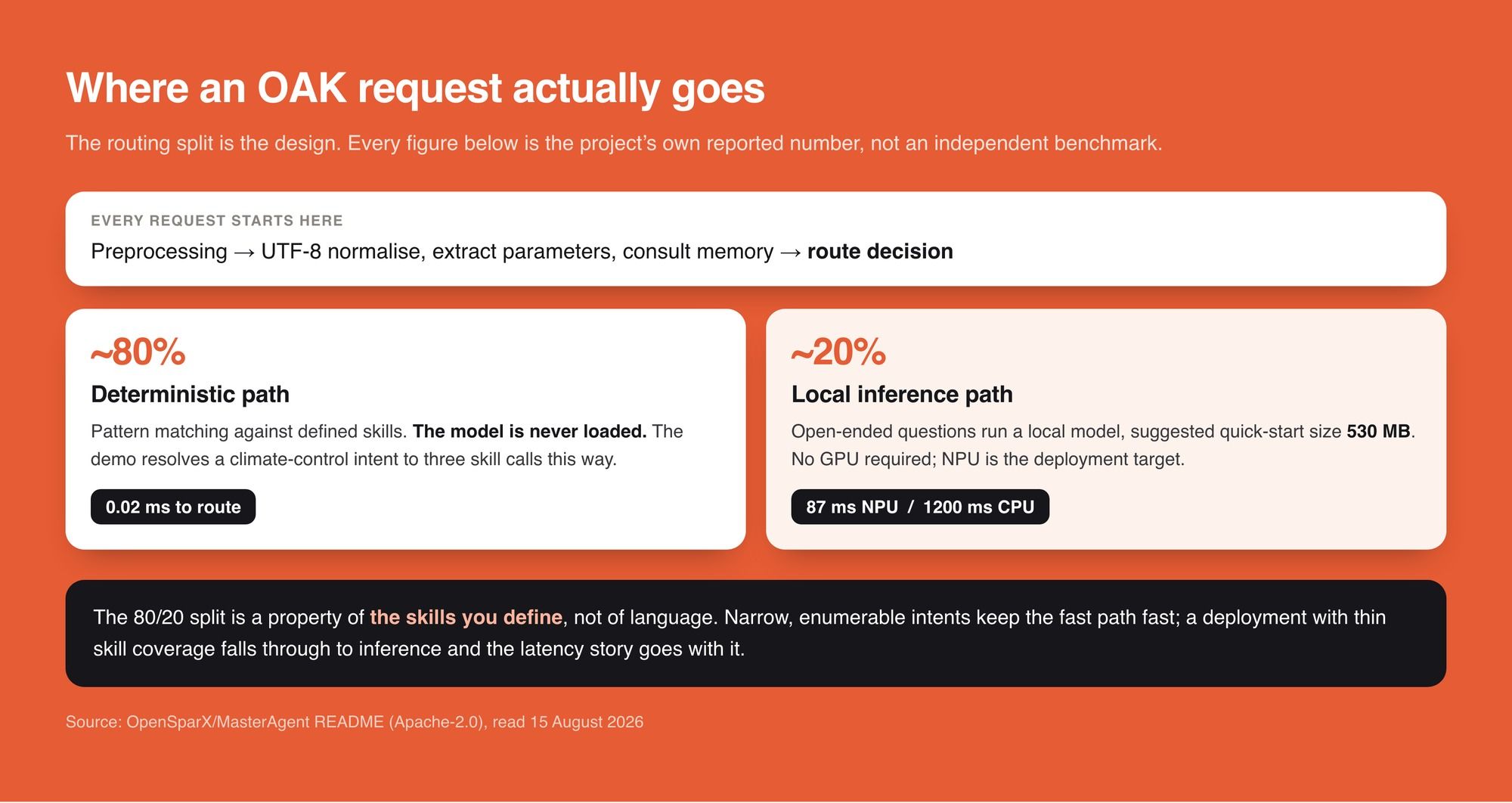
Most agent frameworks assume a network hop is the price of admission: your input goes to a datacentre, a large model reasons about it, and a response comes back. OAK's design treats that as the exception rather than the rule. Input gets normalised, parameters extracted, memory consulted, and then a route decision fires. Simple, recognisable intents go to a skill engine measured in microseconds. Open-ended questions go to a local model.
That split is the whole argument, and it's a genuinely different bet from the one most of the industry is making. "Turn on the AC, set it to 22 degrees, interior mode" doesn't require reasoning; it requires reliable parsing. Sending it to a language model is slower, more expensive, and less predictable than a lookup table would be. OAK's demo resolves that intent to three skill calls without waking a model, and the 87 milliseconds it reports go to vehicle.climate over MCP.
Deterministic routing, and why "the model was not invoked" is the headline
The README prints a line at the end of its demo that most projects would bury: Route: deterministic | Model: not invoked. An agent framework advertising that its model did nothing is making a specific claim about where latency and unpredictability come from.
There's a cost to this design that the project is upfront about elsewhere in the README. Pattern matching handles what it was written to handle. The 80/20 split isn't a property of language; it's a property of the particular skills you've defined, so a deployment with sloppy intent coverage falls through to inference far more often and the latency story collapses. In the automotive demo the intents are narrow and enumerable, which is the friendliest possible case.
Run sparx run with no model at all and deterministic skills still respond. That's a reasonable way to see how much of your own workload is genuinely open-ended, independent of whether you ever adopt this project.
The hardware story: CPU, and Qualcomm NPU
OAK is written in C++ and targets CPU for development anywhere, with Qualcomm NPU as the deployment path. The README claims a 14× speedup at 3.5× less power on NPU versus CPU, from the same code against a different backend. The gap shows up in the inference numbers it publishes: 87ms on NPU against 1200ms on CPU for the same work, and a separate CPU transcript showing 142ms to first token with 1830ms total for a 28-token answer.
No GPU is required, which for edge deployment is the point. Getting started pulls qwen2.5-0.5b-instruct at 530 MB, and the size tells you what tier of reasoning is realistically on the table.
Who an edge AI agent kernel is built for
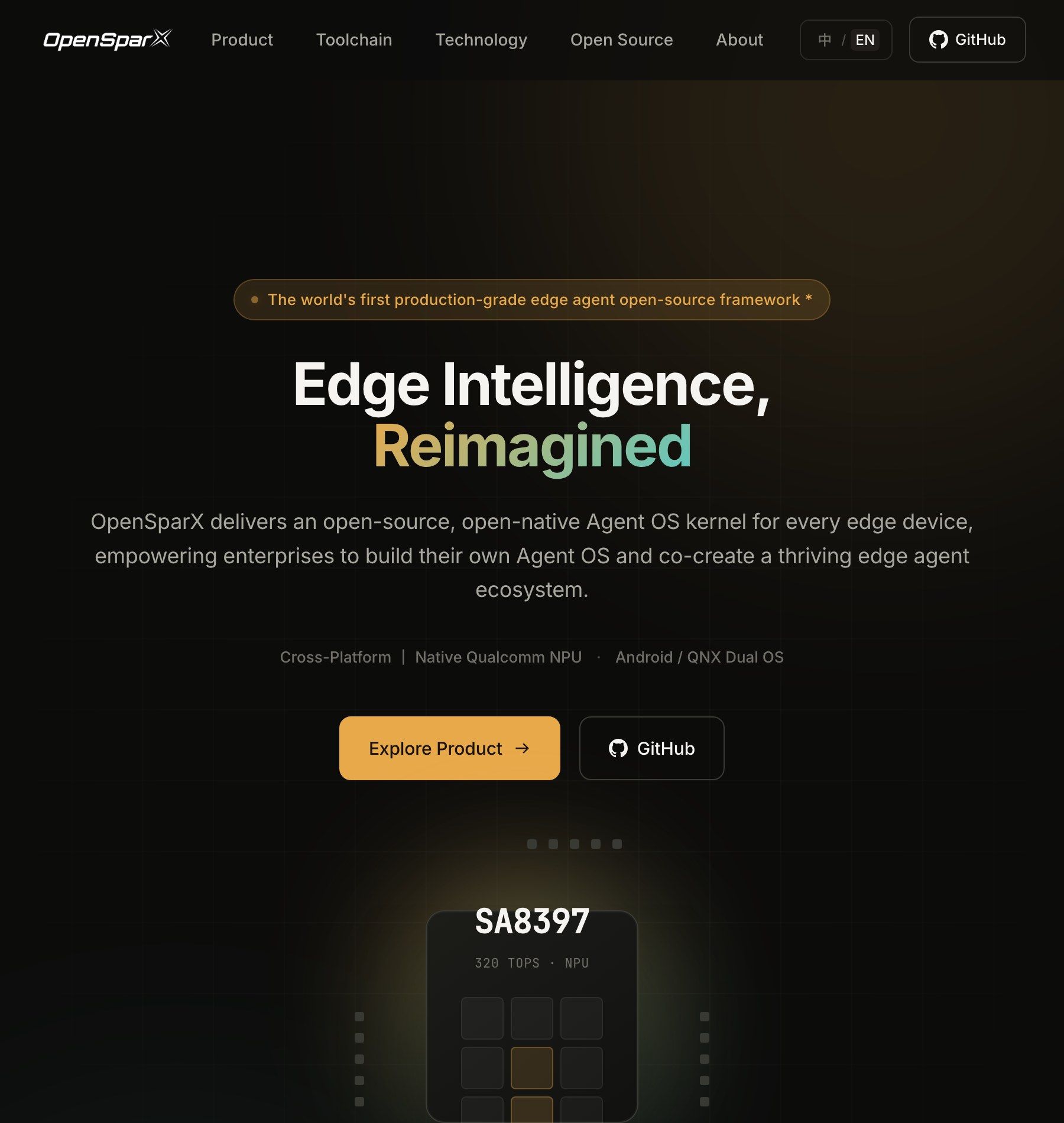
The repository topics give away the intended audience before the README does: automotive, embedded, iot, npu, qualcomm. The OpenSparX site names Android and QNX as a dual-OS target and puts a Qualcomm SA8397 at 320 TOPS on its landing page, which is a car-cabin part, not something in a laptop. The demo being a climate-control voice assistant is not an arbitrary choice either.
That framing makes the design coherent in a way it isn't if you evaluate it as a desktop tool. A vehicle can't assume connectivity through a tunnel, can't send cabin audio to a datacentre without a privacy argument, and can't wait 2 seconds to acknowledge "turn on the AC." Deterministic routing at 0.02ms solves a real constraint there. An edge AI agent in an appliance, a kiosk, or an industrial controller faces the same three pressures.
Read the "Linux kernel for AI agents" slogan as the ambition rather than the current state. What OpenSparX describes on its site is an Agent OS kernel that device manufacturers build their own products on top of, which is a platform play, and platform plays are judged on adoption by other companies rather than on stars. Five days in, there's nothing to judge yet.
The numbers don't fully agree with each other
Anyone evaluating this should notice a discrepancy before quoting a figure. The README leads with "sub-100ms" and its demo totals 87ms. The OpenSparX website headlines "<50ms" latency alongside "85%+ NPU utilization" and "100% offline ready." Those are different claims, and the site's banner describes OAK as the world's first production-grade edge agent open-source framework with an asterisk attached to the phrase.
A second, smaller mismatch: the README's version badge reads 2.1.18, while the most recent published GitHub release on 15 August 2026 is v2.1.15, tagged 12 August. Releases v2.1.14 and v2.1.6 landed the same week, so this is a fast-moving repository rather than an abandoned one, but the badge is ahead of the tags.
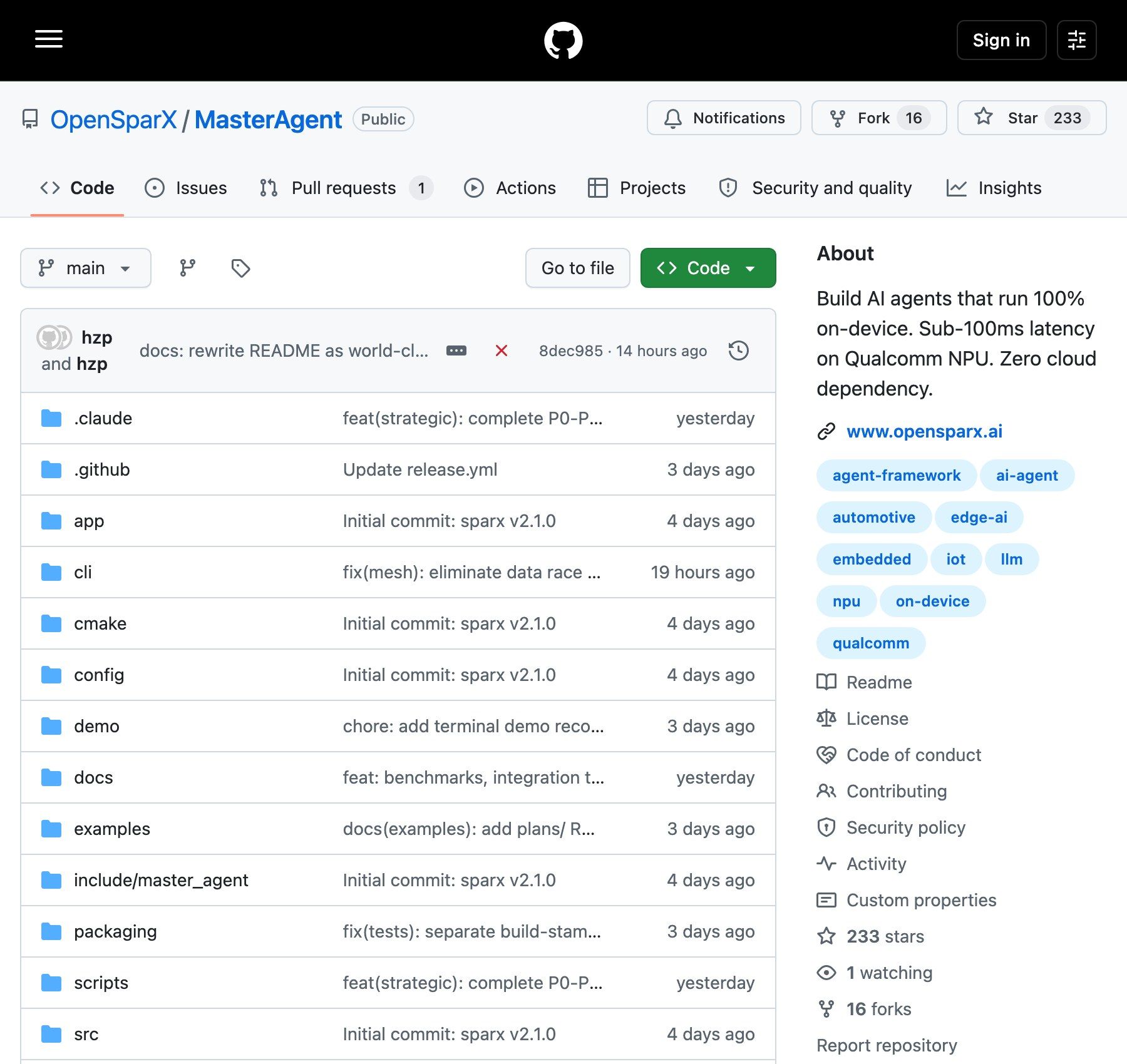
The repository page fills in the rest of the picture, and some of it is worth knowing before you clone. Two contributors, one of whom is listed as claude. Sixteen forks and a single watcher against 233 stars, which is the signature of a project people are bookmarking rather than tracking. The codebase is 96.6% C++. And the most recent commit at the time of writing, a README rewrite pushed roughly fourteen hours earlier, carries a failing check.
That last detail explains a fair amount. A README rewritten yesterday for maximum impact is exactly where you'd expect version badges and latency claims to drift away from what the tags and the demo actually say.
None of these figures come from an independent benchmark. Every latency number in this article is the project's own reported measurement, and OAK is five days old.
About that licence
GitHub's API reports the licence as NOASSERTION for this repository, while the README carries an Apache 2.0 badge. Those two signals disagree often enough that the API result alone should never settle it. Reading the raw LICENSE file resolves it: the text is the standard Apache License, Version 2.0, January 2004. Commercial use is permitted under the usual Apache terms.
This matters more than it sounds. Automated tooling reads the API field, and a NOASSERTION can quietly disqualify a dependency in a procurement review over what turns out to be a metadata artifact. It cuts the other way too, and we've been caught by the reverse case: a project whose API said nothing while the actual file carried a non-commercial clause.
What on-device genuinely costs you
Privacy is the clean win. Data never leaves the device, there's no telemetry, and storage is encrypted at rest with device-bound keys, so an on-device AI agent removes an entire category of compliance argument. Latency is the second win, and for anything with a physical control loop it's not a small one.
The costs are structural rather than fixable. A 530 MB model reasons like a 530 MB model, so anything needing genuine synthesis is out of scope. Nothing runs while the device is off, which rules out the whole class of work where you hand over a task and collect it later. And state is bound to that device, so the agent that knows your context on your laptop knows nothing on your phone.
That's the boundary where a different tool takes over rather than a flaw in OAK's design. MoClaw covers the other side of it as a hosted cloud AI computer: work that has to survive a closed lid, run for hours, and be picked up from whichever device you happen to be holding. Neither replaces the other, and the deterministic-routing insight cuts across both, since a request that doesn't need a frontier model shouldn't be paying for one wherever it runs.
Where this sits against the alternatives
The README includes a comparison table putting OAK against LangChain, AutoGPT, and Apple Intelligence on eight rows, including crash recovery via write-ahead log, formal verification, multi-device mesh, and on-device learning. Read it as positioning rather than as an audit; vendor comparison tables select rows the vendor wins. The rows worth independently checking are WAL-based crash recovery and the multi-device mesh, because those are hard to build and easy to claim.
The more useful comparison is against the shape of your own workload. If most requests are narrow commands against a known set of actions, deterministic routing will beat a language model on every axis. If most requests are genuinely open-ended, you're going to be in the 20% path constantly, running a small model on modest hardware, and the architecture's advantages mostly evaporate. Our writeup on running Kimi K3 locally on CPU covers what that second scenario actually feels like, and running Inkling locally makes a similar point from a different angle.
FAQ
What does "on-device AI agent" mean?
An agent whose reasoning, routing, and storage all run on local hardware with no network call to a model provider. In OAK's case it goes further than usual: most requests resolve through deterministic pattern matching without invoking a model at all, so "on-device" describes where the work happens and also how little model work there is.
Do on-device agents need a GPU?
Not for OAK. It targets CPU for development on any machine and Qualcomm NPU for deployment, with the README reporting roughly 14× the throughput at 3.5× lower power on NPU. A CPU-only run works; it just spends around 1200ms on inference where NPU spends 87ms.
Is OAK open source?
Yes, under Apache 2.0. GitHub's API returns NOASSERTION, which is a metadata quirk, and the LICENSE file in the repository is the standard Apache 2.0 text.
Can it run without downloading a model?
Yes. sparx run responds to deterministic skills with no model present. Only open-ended questions require pulling one, and the quick start suggests qwen2.5-0.5b-instruct at 530 MB.
Is it production-ready?
The repository was created on 10 August 2026 and this article was written five days later, so there's no track record to point at. Its published performance figures are self-reported and internally inconsistent in places. Treat the architecture as the interesting part and the numbers as claims awaiting independent measurement.
Continue Reading
More Research
AI Agent Sandbox: What It Is and Isn't

Vercel eve Software Factory, Explained

GLM-5.3 Found 2,436 Real Vulnerabilities

MiroFish: Open-Source Swarm Prediction Engine
Cambium: A Governance Standard for LLM Corpora

SwarmForge: Uncle Bob's Agent Orchestration
The MoClaw editorial team writes about workflow automation, AI agents, and the tools we build. Default byline for industry overviews, listicles, and collaborative pieces.
Turn insights into action.
MoClaw automates the recurring work your analysis points to. No engineering required.
References: OpenSparX/MasterAgent (OAK) on GitHub · OpenSparX · OAK releases · OAK LICENSE (Apache 2.0) · OAK README