AI Models
Claude Opus 5, Online in MoClaw
Run Claude Opus 5 online in MoClaw's managed AI computer. No API key, no setup. Open MoClaw, pick Ultra — it defaults to Opus 5 — type a task, and go. Anthropic's newest flagship, close to Fable 5 quality at roughly half the price, on your existing plan.
MoClaw is an independent managed AI computer where you can run frontier models with no setup or self-hosting.
All integrationsSee Claude Opus 5 in action
Real demos, built with MoClaw running Claude Opus 5.
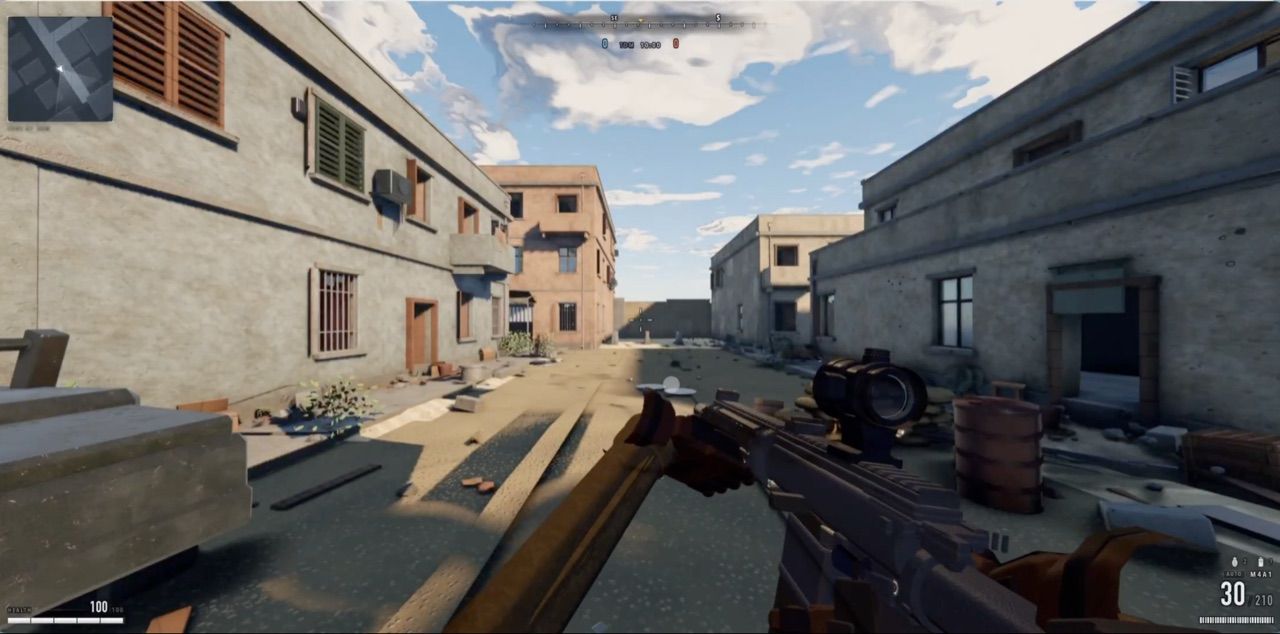
A Call-of-Duty-grade FPS from a single prompt
55,000 lines of Three.js with no external assets, generated in one shot by Opus 5 orchestrating 11 subagents in parallel. A community demo of the model's long-horizon coding, not MoClaw output.

A watercolor 3D world in one HTML file
A procedurally generated watercolor-style 3D landscape with a million wind-simulated grass blades, built by Opus 5 as a single self-contained HTML file.

A motion-designer-grade video from one prompt
Opus 5 produced a polished motion-graphics video in 22 minutes from a single prompt, finished in one revision.
What Claude Opus 5 Is Built For
The kind of work Claude Opus 5 is made for.
Review and refactor real codebases
Opus 5 reads large diffs and multi-file repos and reasons about them the way a senior reviewer would, the code-review and refactor loop MoClaw runs end to end with a live file system.
Try itLong-horizon, multi-step agent runs
Built for autonomy: planning across stages, delegating to subagents, and checking its own work over long runs, exactly the kind of task MoClaw's managed computer is built to sustain.
Try itDeep analysis and knowledge work
Point it at sources or a dataset and it reasons, analyzes, and turns findings into a structured deliverable, not just a wall of text.
Try itPeak reasoning without the top-tier bill
A five-level effort dial trades compute for depth: keep most of Opus 5's capability at lower effort and cost, turn it up when a task earns it. Auto handles the call for you.
Try itHow it works
3 steps to wire up Claude Opus 5, no engineering required.
- 1
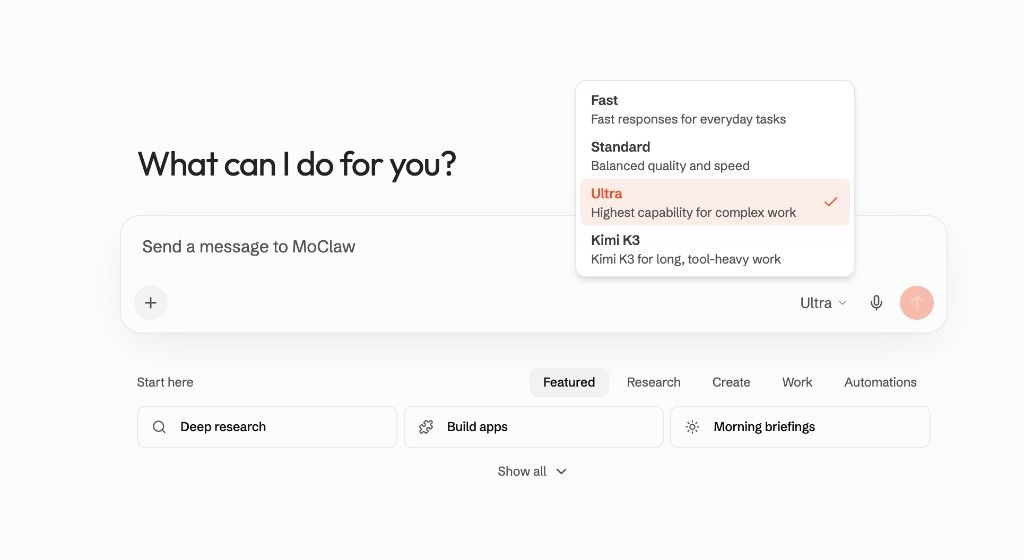
Pick Ultra — it is Opus 5
In MoClaw's chat model picker, Ultra is the highest-capability option and defaults to Claude Opus 5. Choose Ultra, send a task, and Opus 5 runs it as your agent. No waitlist, no setup, no separate key.
- 2
Or let Auto route to it
On Auto, MoClaw picks the right model per turn and routes to Opus 5 when a task needs heavy reasoning: code review, multi-step agent runs, deep analysis, with no configuration from you.
- 3
Switch mid-conversation
Switch to Ultra (Opus 5) in the middle of a thread and the rest keeps working, and your files, history, and prompt caching carry over, with no re-setup.
Why Run Claude Opus 5 Inside MoClaw
What is Claude Opus 5?
Claude Opus 5 is Anthropic's newest and most capable Opus-tier model, released on July 24, 2026. Anthropic positions it as delivering performance close to Fable 5, its most capable model, on many tasks while costing roughly half as much, and it is now the default model on Claude's own Max plan and the strongest option on Claude Pro. It ships with a 1-million-token context window, up to 128K output tokens, adaptive thinking on by default, and a five-level effort dial. Anthropic also calls it its most aligned Opus model to date, the least easily talked into misuse.
The effort dial is the headline: at lower effort Opus 5 keeps most of its capability while spending fewer tokens, so a lookup doesn't cost flagship prices; at higher effort it does the deep, multi-step reasoning you'd expect from the top Opus tier. Those long-horizon, self-checking, subagent-delegating tasks are exactly what MoClaw is built to run.
Running Claude Opus 5 on MoClaw
MoClaw is a managed AI computer: a persistent cloud machine with a browser, a file system, and tools already wired up. Point a task at Opus 5 and MoClaw runs the work end to end, instead of you managing an API key, metering a billing account, and gluing tools together. In the chat model picker, Ultra is the highest-capability tier — and Ultra defaults to Claude Opus 5, so choosing Ultra is how you put Opus 5 to work as your agent. You can also let Auto route to it when a task needs heavy reasoning; files, history, and credits carry across every model. Switch to Ultra mid-thread and the rest keeps working, with prompt caching carried over so long conversations stay cheap.
Opus 5 pricing and access
On Anthropic's own API, Opus 5 is priced at $5 per million input tokens and $25 per million output tokens, the same as Opus 4.8 and about half of Fable 5's $10 / $50. On MoClaw, Opus 5 runs on your existing plan credits with no separate provider bill to manage and no key to wrangle; BYOK remains an option if you'd rather meter usage on your own Anthropic account at those provider rates. Either way there is no allowlist to clear and no setup: in MoClaw, open the model picker and choose Ultra — Ultra defaults to Opus 5.
Effort: tuning cost against depth
Opus 5's five-level effort setting (low, medium, high, xhigh, max) controls how much the model thinks and works before it answers. Anthropic recommends high for most intelligence-sensitive work and xhigh for coding and agentic tasks, with low and medium as deliberate levers to cut token cost and latency when a task doesn't need the depth, and max reserved for cases where correctness outweighs cost. Effort is calibrated per model, so Opus 5's high is not the same setting as another model's high. On MoClaw you don't tune this by hand: Auto weighs it per turn and spends more only when the task earns it.
Claude Opus 5 on MoClaw vs the Anthropic API directly
Pick the one that fits how you use AI.
| MoClaw (managed) | Anthropic API / DIY | |
|---|---|---|
| Setup | None. Pick Ultra in any chat — Ultra defaults to Opus 5. | Create an API key, wire the endpoint, and manage billing. |
| Tools | Browser, files, code, and schedules already connected. | Build and maintain your own tool layer. |
| Cost model | Runs on your plan credits with prompt caching and no markup. | $5 / $25 per M tokens metered call by call ($10 / $50 in fast mode). |
| Switching models | Swap Opus 5 for another frontier model in one click. | Re-plumb per provider and endpoint. |
Pairs with
Integrations people commonly connect alongside Claude Opus 5.
FAQ
Quick answers about pricing, privacy, and limits.
- Is Claude Opus 5 available on MoClaw?
- Yes. Opus 5 runs inside MoClaw's managed AI computer. In the model picker, choose Ultra — Ultra defaults to Claude Opus 5 — with no self-hosting and no API key required. Auto can also route to it for reasoning-heavy tasks. It is covered by your MoClaw plan.
- What is Claude Opus 5?
- Opus 5 is Anthropic's newest and most capable Opus-tier model, released July 24, 2026. It has a 1-million-token context window, up to 128K output tokens, adaptive thinking, and a five-level effort dial, and it is now the default model on Claude Max.
- How much does Claude Opus 5 cost?
- On Anthropic's API, Opus 5 is $5 per million input tokens and $25 per million output tokens, the same as Opus 4.8 and about half of Fable 5. On MoClaw it runs on your monthly plan credits with no markup, so you can use it without metering an API account yourself.
- How is Opus 5 different from Fable 5?
- Fable 5 is Anthropic's most capable tier and priced accordingly ($10 / $50 per M tokens). Opus 5 lands close to Fable 5 on many tasks at half the cost ($5 / $25), which makes it the better default for most heavy reasoning. Reach for Fable 5 only on the hardest long-horizon agent runs.
- What's the difference between Opus 5 and Opus 4.8?
- Opus 5 is the successor to Opus 4.8 at the same price. Anthropic reports a higher ceiling across coding, agentic, and knowledge work, plus a five-level effort dial that lets you trade cost for depth. For most Opus-tier work it's a straight upgrade.
- What is the effort dial and do I need to configure it?
- Opus 5 has a five-level effort setting: lower effort spends fewer tokens while keeping most of its capability, higher effort does deeper multi-step reasoning. You don't have to tune it by hand. On Auto, MoClaw factors it in so hard tasks get the depth they need without paying the full cost on every turn.
- Can I use Claude Opus 5 without an API key?
- Yes. Opus 5 runs inside MoClaw's managed AI computer via the Ultra tier (Ultra defaults to Opus 5), so there is nothing to set up and no key to wrangle. If you would rather meter usage on your own Anthropic account, BYOK routes Opus 5 calls to your key at provider rates.
- What is Opus 5's context window?
- Opus 5 ships with a 1-million-token context window, so it can work over large repositories, long documents, and multi-file projects in a single session.
- Is Opus 5 good for coding and agentic tasks?
- That is its focus. Anthropic reports state-of-the-art results across coding and agentic work, and Opus 5 is built for long-horizon runs: planning across stages, delegating to subagents, and checking its own work. On MoClaw those run end to end, with a browser, files, and tools already connected.
Related reading
Guides that go deeper on Claude Opus 5 and AI automation.
How to Access Claude Opus 5: Every Path
How to access Claude Opus 5 across the Claude apps, the API (model id claude-opus-5), Claude Code, GitHub Copilot, Bedrock, and Vertex AI. Plans and setup.
Opus 5's ARC-AGI-3 Jump Didn't Transfer
Opus 5's ~4x ARC-AGI-3 lead collapses to a statistical tie with Kimi K3 and Fable 5 on a held-out suite. What the Witness benchmark says about picking a model.
Opus 5 Code Review: Precise but Noisier
In CodeRabbit's own test, Opus 5 wrote more precise review comments but caught fewer known bugs and 4x the nitpicks. What that means for your code review agent.