Opus 5 Code Review: Precise but Noisier

In CodeRabbit's own test, Opus 5 wrote more precise review comments but caught fewer known bugs and 4x the nitpicks. What that means for your code review agent.
Table of Contents
In CodeRabbit's own evaluation, Claude Opus 5 wrote more precise review comments than their production reviewer, 39.3% actionable precision against a 35.2% baseline, and at the same time caught fewer of the known bugs, 55.2% versus 61.1%, while producing roughly four times as many nitpicks. Precision went up. The two things that actually cost an engineering team, missed bugs and triage load, both got worse.
Key Takeaways:
- Opus 5 x-high scored 39.3% actionable-comment precision in CodeRabbit's harness, versus 35.2% for their production model mix.
- It caught 55.2% of the benchmark's known issues against the baseline's 61.1%. More precise, yet it let more real bugs through.
- It generated about four times the nitpicks: 92 low-value comments versus 23 in the visualization CodeRabbit published.
- Anthropic's launch post says Opus 5 "is much stronger at verifying its work." On this task, the independent data complicates that story.
- These are CodeRabbit's numbers from CodeRabbit's setup, not a universal ranking. The lesson is about how you read a precision stat, not a verdict on the model.
How CodeRabbit Ran the Test
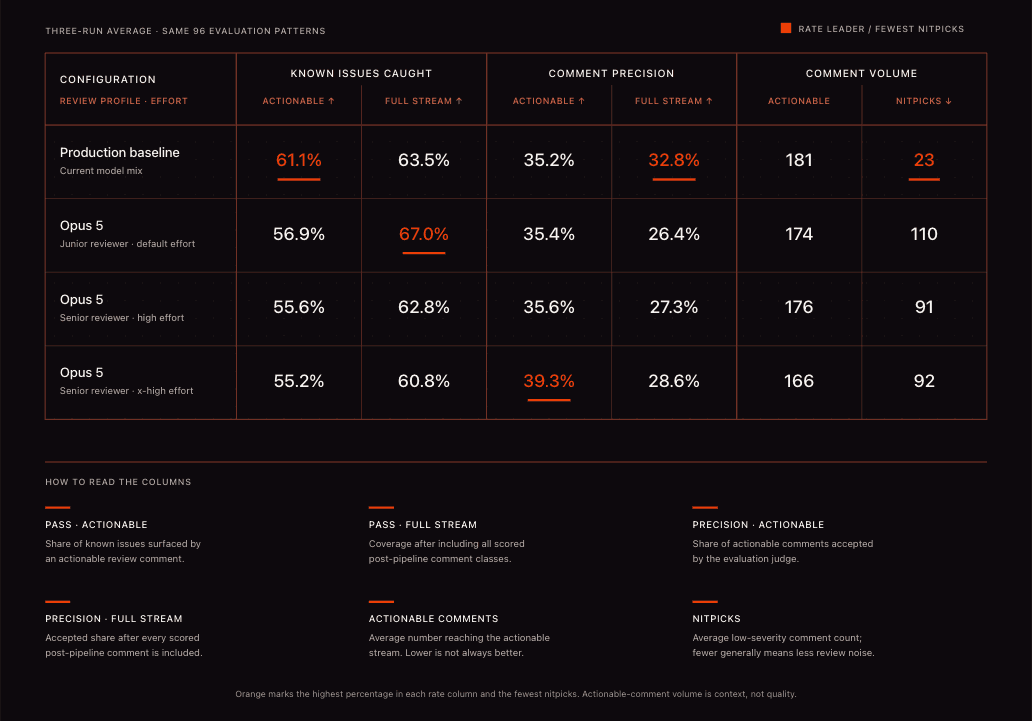
CodeRabbit builds an AI code-review product, so it has a real reason to know which model reviews best. The write-up is by Hendrik Krack, published July 24, 2026, and it tests three Opus 5 configurations rather than one: a junior-reviewer profile at default effort, and a senior-reviewer profile at high and at x-high. Every headline figure below is the x-high run, which matters because it is the most expensive of the three. Its evaluation covered about 100 common error patterns, drawn from verified issues in real open-source pull requests, not synthetic bugs written to be caught. Each configuration got three runs, compared against three runs of the company's current production model mix. That repetition matters; a single run can flatter or bury any model, and averaging three is enough to see past the noise on a set this size. Anthropic pitched Opus 5 as a cheaper model built for coding agents and enterprise workflows, per VentureBeat, which is exactly why a real code-review result deserves more than a glance at the flattering number.
One framing point before the numbers. This is a harness built by a vendor to tune its own product, which cuts both ways: the setup is realistic because it mirrors what their reviewer does in production, and it's specific because it's theirs. Nobody should read 39.3% as "Opus 5 is a 39% code reviewer" in the abstract. Read it as one careful team's measurement of one configuration on one bug set.
The Number Everyone Quoted: 39.3% Precision
The clean headline, and the one that traveled, is precision. Of the actionable comments Opus 5 produced, a higher share were genuinely worth acting on: 39.3% against the production baseline's 35.2%. CodeRabbit's own summary is worth quoting directly, because the second half of the sentence is the part that got dropped in retelling: "Opus 5 x-high produced a more precise actionable-comment stream than our production baseline, 39.3% versus 35.2%, but caught fewer of the benchmark's known issues, 55.2% versus 61.1%."
Secondary coverage, including Yellow's roundup of the independent tests, led with the 39.3% and mostly left the rest on the table. It's an easy mistake. Precision is the flattering number, it fits the launch narrative, and Anthropic's own post says Opus 5 is much stronger at verifying its work. A more precise comment stream sounds exactly like a model that checks itself. The trouble is that precision alone tells you nothing about what the reviewer missed.\n\n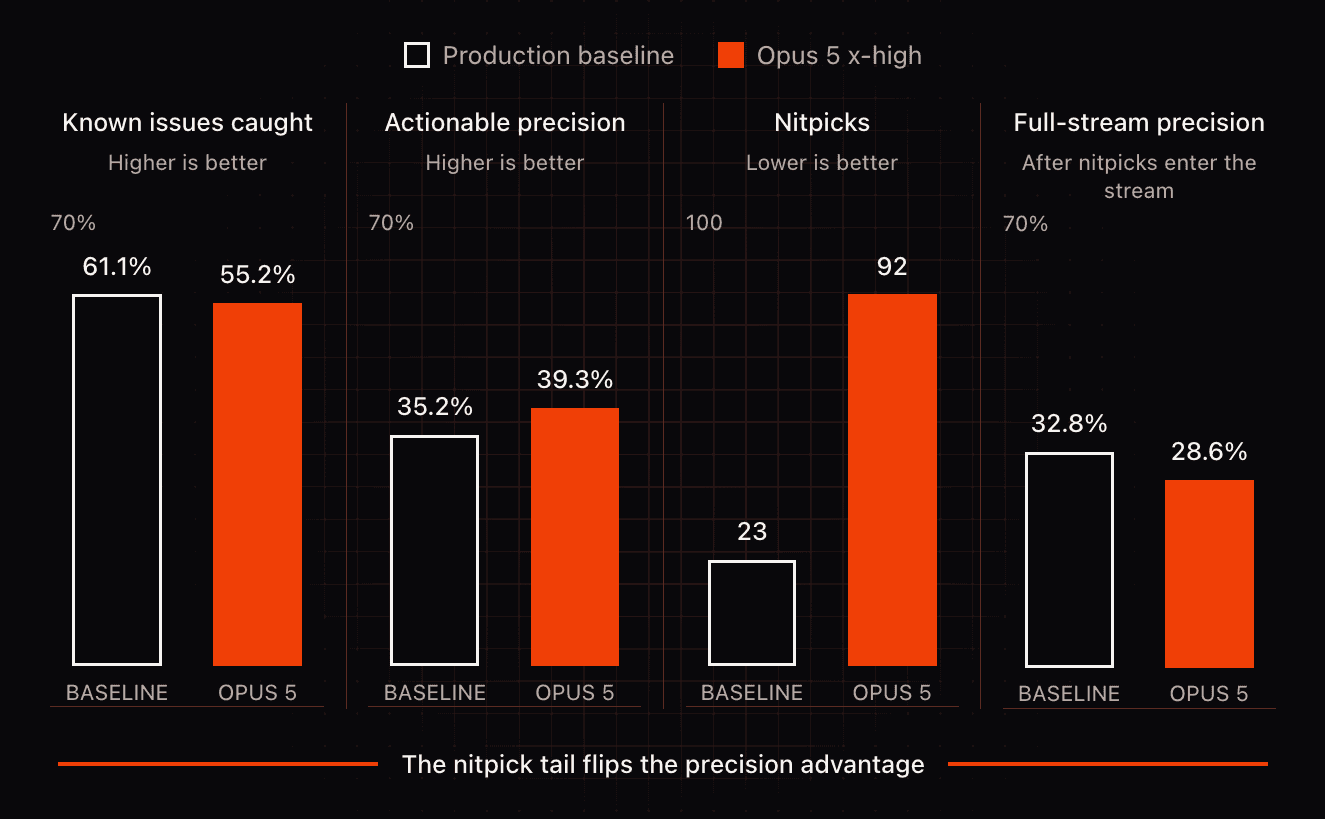
The Number Nobody Quoted: Fewer Bugs, Four Times the Noise
Two figures got buried, and they're the ones that would change my mind about switching a reviewer.
First, recall dropped. Opus 5 caught 55.2% of the known issues where the production baseline caught 61.1%. On a set of 100 verified bugs, that's roughly six real problems slipping through per hundred that the old setup would have flagged. A code reviewer's whole job is catching bugs; being more precise about the ones it does mention doesn't help the six it stayed quiet on.
Second, the noise multiplied. CodeRabbit's visualization shows Opus 5 emitting 92 nitpicks against the baseline's 23, roughly a fourfold jump in low-value comments. These are the style quibbles and speculative suggestions that a developer has to read, judge, and dismiss one by one. The model got more precise on its actionable stream and far chattier on everything around it, which is a strange combination until you picture it: eager to comment, careful about the comments it labels important, and still missing bugs.
Set the two together and the flattering headline inverts. You'd be adopting a reviewer that says more, flags fewer actual defects, and asks your team to wade through nearly four times the chaff to find the signal.
Precision Is Not the Metric That Costs You Money
Here's the arithmetic nobody runs before a model swap. Precision is a ratio; your costs are counts. Two counts decide whether a reviewer earns its place: bugs that reach production, and minutes your engineers spend clearing comments.
There is a second cost line that the precision figure hides entirely. Running the review on Opus 5 did not just change what came back, it changed what went in: CodeRabbit reports the model consuming "50% more" input tokens and "65% more" output tokens per review call than the baseline (CodeRabbit). So the trade is not merely more nitpicks for better precision. It is more nitpicks and fewer caught bugs, on a call that costs more to make.
Take CodeRabbit's numbers at face value and sketch it out. Say a batch surfaces the same 100-bug workload. The baseline catches 61 and Opus 5 catches 55, so six extra defects ride through to a human reviewer or to production, where each one costs far more to fix than it would have in review. Now the triage side: 92 comments versus 23 is 69 additional items to read and dismiss. At a conservative minute apiece, that's over an hour of senior-engineer attention burned per batch on comments that led nowhere. A more precise actionable stream doesn't refund either cost.
This is why I distrust precision as a lead metric for review agents generally. It's the number that improves when a model gets more conservative about what it calls important, and it can rise at the same time recall falls and volume balloons. If you're moving a model into a review pipeline, the way to not get burned is the same discipline that catches inflated benchmark scores elsewhere, which we walk through in the Opus 5 ARC-AGI-3 breakdown: measure the counts you actually pay for, on your own code.
How to Configure a Review Agent Around This
None of this means skip Opus 5 for review. It means configure against its habits instead of taking defaults. A few settings do most of the work.
Start from CodeRabbit's own conclusion rather than ours, because they are blunter about it than the coverage was. Their verdict on the configuration that produced the headline number: "Opus 5 x-high is a specialist. It produces a cleaner actionable subset, but catches fewer known issues and adds a substantial nitpick tail." They go further and state that "these results do not support using it as the only reviewer or as the primary safety net on high-risk changes," recommending instead that it be paired with a recall-oriented reviewer (CodeRabbit). That is a vendor telling you not to hand its own benchmark winner the whole job. Take it.
Cap the comment categories. If the model floods you with style and speculative nitpicks, turn those categories off and let it speak only on correctness, security, and clear logic errors. That alone knocks out most of the 92-to-23 gap. Raise the confidence threshold so borderline comments never post; you trade a little recall for a large drop in noise, and on this data Opus 5 has recall to spare it isn't using well anyway. Keep a human gate on merge, because a reviewer that misses six bugs per hundred is an assistant, not an approver.
There's a third lever most teams skip, one layer below the review tool's own settings. If your harness lets you append a system prompt, that's where a fix lands on every session at once instead of one prompt at a time. The clearest public example is fixing-smartass-opus-5, MIT and 231 stars, put up on 16 August 2026: a single markdown file passed through --append-system-prompt-file that names the model's verbal tics and forbids them, from negative parallelism and chained em dashes through "load-bearing", "You're absolutely right" and the reflexive ## KEY TAKEAWAYS stack wrapped around a one-sentence answer.
Be precise about what that does and doesn't touch. It attacks presentation, not selection: each comment gets shorter and less padded, while the question of which comments the model decides to post is untouched. The 92-to-23 gap is a selection problem, so a system prompt complements the category caps above rather than replacing them. The repo ships no benchmark of its own, the framing is the author's, and it hasn't been pushed since the day it went up, so treat it as a starting file to edit instead of a settled configuration.
The deeper move is to stop treating the review model as a drop-in for whatever you ran before. Opus 5 behaves differently enough from Opus 4.8 that carrying over your old prompts and thresholds unchanged is how you inherit the noise. One behavior worth knowing before you wire a reviewer into a pipeline: Opus 5 can hand a flagged request back to Opus 4.8 mid-session, and a review agent reading security-adjacent code is exactly the workload that trips it, which we cover in why Claude switches models. If you'd rather run the model inside a managed setup with the guardrails already wired, that's what the Opus 5 integration is for.
FAQ
What was Opus 5's code review precision in CodeRabbit's test?
39.3% actionable-comment precision at x-high effort, against a 35.2% production baseline. Higher precision, but the same test showed lower bug recall.
Did Opus 5 catch more bugs than CodeRabbit's baseline?
No. It caught 55.2% of known issues versus 61.1% for the baseline. It was more precise on the comments it made but let more real bugs through.
Why did Opus 5 produce so many nitpicks?
CodeRabbit's visualization shows 92 low-value comments against 23 for the baseline, about four times as many. The fix is to restrict comment categories and raise the confidence threshold.
Are these numbers a universal ranking of Opus 5 for code review?
No. They come from CodeRabbit's own harness on 96 open-source bug patterns, three runs each. Treat them as one careful measurement, not a final score.
Should I use Opus 5 for code review?
It can work well if you cap comment categories, raise the confidence threshold, and keep a human merge gate. Do not run it on defaults expecting fewer bugs to escape.
Read the Second Number Before You Switch Your Reviewer
The Opus 5 code-review story is a small, clean example of a habit worth breaking: quoting the flattering half of a result and skipping the half that costs you. 39.3% precision is real, and so is 55.2% recall against a 61.1% baseline, and so are the 92 nitpicks. A reviewer is only as good as the bugs it catches and the time it doesn't waste, and on those two counts the headline number was pointing the wrong way. Before you move any model into a pipeline that ships code, find the second number. It's usually the one that decides. If you want Opus 5 reviewing code inside a managed agent rather than a raw API call, MoClaw's Ultra tier defaults to it — details on the Opus 5 integration page.
Continue Reading
More Research
Version Control for AI Agents: Atlas

Is Context-Mode Open Source? The License

Sprix SAGE Router: Rerouting Agents Mid-Task

What Is Magnitude AI? Local Models for Agents

Fable51-Worlds: Text to Walkable 3D Worlds

Anthropic Commerce Agents: The Blueprint
The Zentor editorial team writes about workflow automation, AI agents, and the tools we build. Default byline for industry overviews, listicles, and collaborative pieces.
Turn insights into action.
MoClaw automates the recurring work your analysis points to. No engineering required.