Why Claude Switched Models to Opus 4.8

Why did Claude switch models? Opus 5 flags offensive cybersecurity requests and answers with Opus 4.8. What triggers it, what still works, and the setting.
Table of Contents
If Claude told you it switched models mid-conversation, here is what happened: Claude Opus 5 ran an automated safety check on your request, classified it as higher-risk offensive cybersecurity work, and answered with Claude Opus 4.8 instead. It is a routing decision, not a refusal, and Anthropic labels the reply with the model that actually wrote it.
This fires far less than the equivalent mechanism did on the previous generation. Anthropic's help documentation states that "in early testing, Opus 5 traffic ran into cyber fallbacks 85% less than Fable 5" (Anthropic Support). If you are seeing it repeatedly on work you consider ordinary, that is worth knowing before you start rewriting prompts.
Key Takeaways:
- Opus 5 runs classifiers on every request. A flag re-runs it on Opus 4.8 and labels the response, and the model picker then stays on the fallback model for the rest of that conversation.
- Source-code vulnerability scanning, security triage and writing secure code all stay on Opus 5. Exploit generation, binary-based vulnerability scanning and penetration testing are the flagged categories.
- The switch is on by default across Claude's consumer and work surfaces. On the API it is off by default and has to be opted into.
- There is a documented setting to turn the switching behavior off: Settings, then Capabilities, then "Switch models when a message is flagged."
- The predecessor version of this mechanism had no override at all, which is the substance of an open Claude Code bug report. That gap is the thing Opus 5 closed.
What You Are Seeing When Claude Switches Models
The notice is deliberate. Anthropic's documentation says "you'll see a notice explaining that the model switched, and the response will be labeled with the model that answered" (Anthropic Support).
That labeling matters more than it looks. A model swap changes output length, tool-calling behavior and reasoning depth, so a conversation that starts on Opus 5 and continues on Opus 4.8 can produce a visible quality change that has nothing to do with your prompt. If you have ever watched a session get suddenly terser and assumed you had degraded your own context, check the label first.
What the notice proves: the switch is designed to be observable rather than silent. What it leaves unsolved: it tells you a flag fired, not which part of your input tripped it.
It Is a Fallback, Not a Refusal
This is the distinction most coverage gets wrong, and it changes what you should do about it.
A refusal means the request was declined. A fallback means Claude re-runs the blocked request on a less capable model inside the same conversation, described in Anthropic's documentation as "our next-most-capable model." In the ordinary case your question still gets a response, and the system has made a routing decision rather than a content one.
Two details qualify that, and both matter more than the headline. First, the fallback is not guaranteed to succeed: "Opus 4.8 has its own safety systems. If your request is also blocked on Opus 4.8, you can edit your message and retry" (Anthropic Support). Second, and more consequential day to day, the switch is sticky. Anthropic's documentation states that after the switch "the model picker stays on the less capable model for the rest of the conversation." One flagged message downgrades the whole session, not just that turn.
Practically, that means the failure mode is not a blank wall. It is a quieter, subtler cost: you continue on a different tier than the one you selected, and if you did not read the label you would not necessarily know why every later answer felt different.
What the fallback design proves: Anthropic optimized for continuity over hard blocking, at the price of a session-wide downgrade. What it leaves unsolved: there is no published figure for how often the fallback lands on work the user considered routine.
What Still Works on Opus 5
Anthropic is explicit that security work broadly remains available. Per the help documentation, you "can still use Opus 5 for security work, including scanning source code for vulnerabilities, triaging security issues, and building secure code" (Anthropic Support).
That covers most of what a working security engineer does day to day. Reviewing a codebase for injection flaws, triaging a report from a scanner, hardening an authentication flow, writing tests for a known weakness class: none of these are the targeted categories. Trade coverage of the launch reached the same read, describing Opus 5 as able to find vulnerabilities while remaining restricted on generating exploits for them (Cybersecurity News).
What this proves: the boundary is drawn around offensive capability, not around the word "security." What it leaves unsolved: the boundary is described in categories, not in a testable specification, so edge cases resolve at runtime.
What Gets Routed to Opus 4.8
The documented categories are narrow and specific: exploit generation, binary-based vulnerability scanning, and penetration testing (Anthropic Support).
Note the shape of that list. It is not "anything involving security." It is offensive tooling: producing working exploit code, analyzing compiled binaries for weaknesses, and simulating attacks against systems. Anthropic's launch materials frame Opus 5 as the most aligned Opus model to date and the least susceptible to being tricked into misuse, which is the design intent this classifier serves (Anthropic).
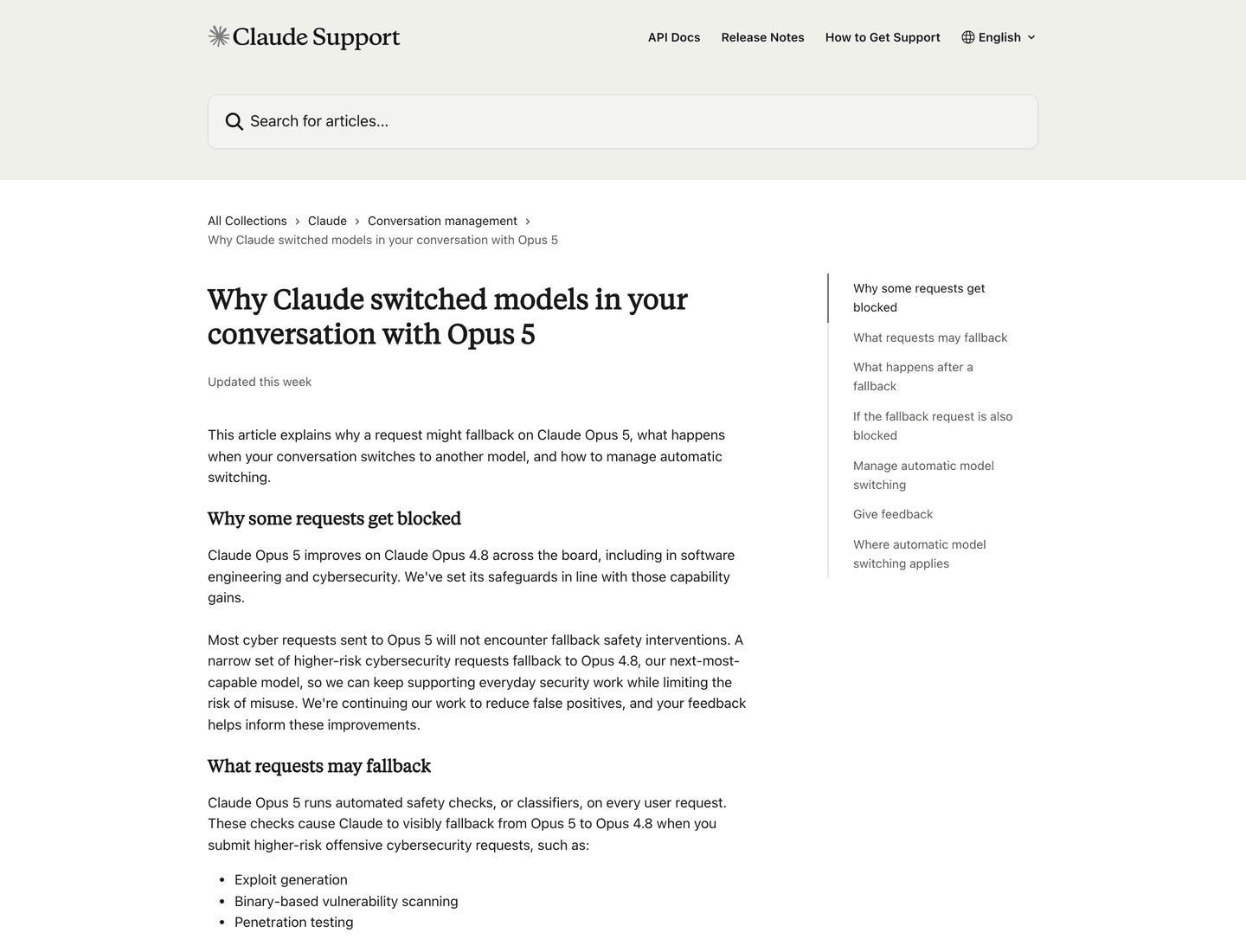
What this proves: the categories are stated plainly enough to plan around. What it leaves unsolved: classifiers operate on language, and the categories are defined by intent, so the mapping between the two is where false positives live.
Where the Switch Applies, and Where It Does Not
The coverage is broad on the product surfaces and different on the API.
Automatic switching is active on Claude on the web, Claude Mobile, Claude Desktop, Claude Cowork, Claude Code, Claude Design, Claude for Microsoft 365, Claude Tag, and Claude Science. On the API, automatic switching is not on by default and requires opt-in configuration (Anthropic Support).
That asymmetry is worth internalizing if you are building on Claude. A behavior your users hit in the desktop app is not a behavior your API integration inherits, and a difference between what you reproduce in the app and what your service does in production may come down to this setting rather than to your prompt. If you are wiring Opus 5 into an application, our walkthrough of how to access Opus 5 covers the surfaces and model identifiers.
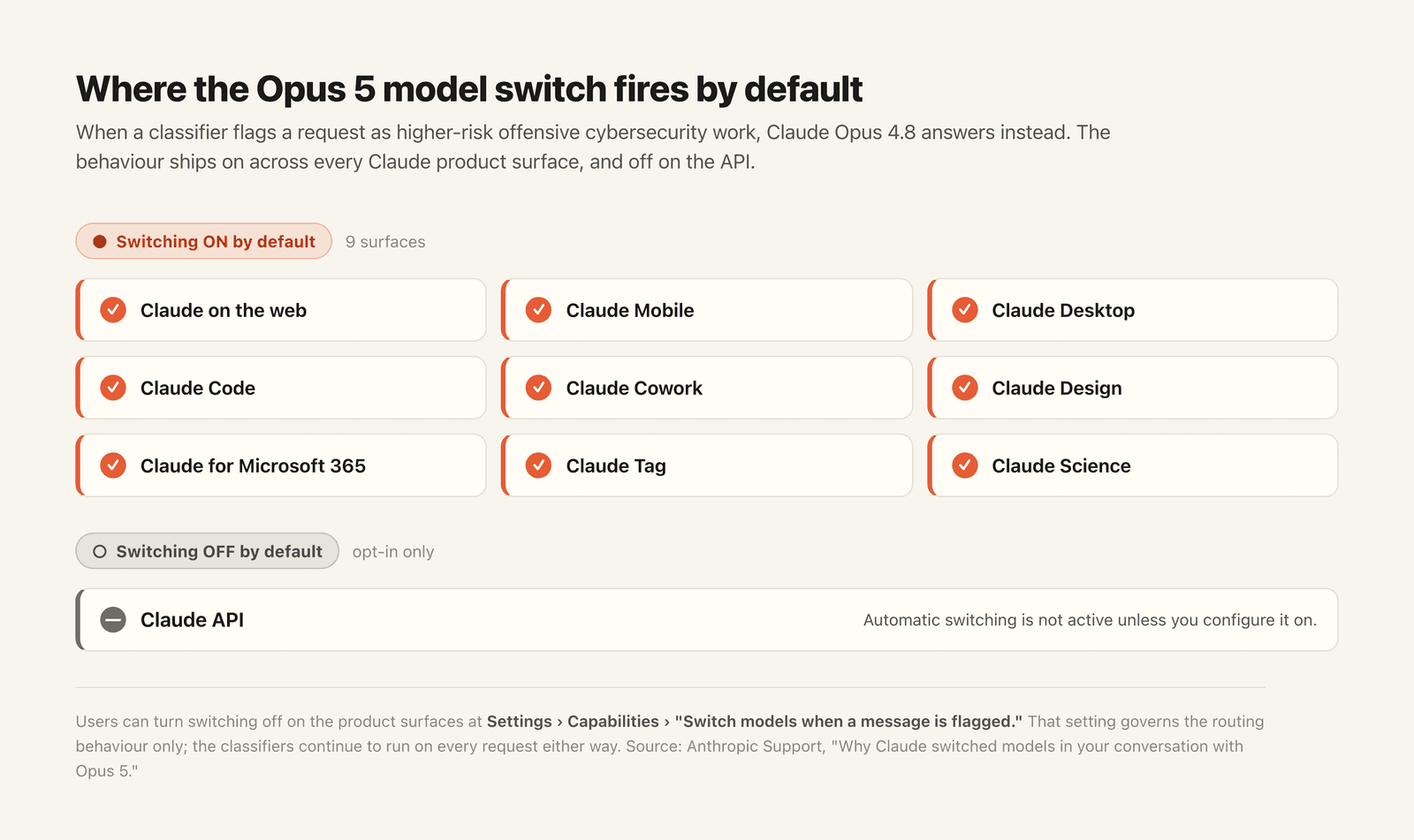
What this proves: the app default and the API default are opposites, on purpose. What it leaves unsolved: teams that test in the app and ship on the API are comparing two different configurations without being told so.
The Fable 5 History That Explains the Complaints
The mechanism did not arrive with Opus 5, and its previous incarnation is why the search term exists at all.
An open bug report on the Claude Code repository documents the Fable 5 era version, with the labels area:model and bug. It describes three failures stacked together: the classifier auto-switched from Fable 5 to Opus 4.8 without consent, the /model command failed to restore the original model and instead returned "Kept model as Opus 4.8," and /config exposed no way to manage the behavior (claude-code #67246).
The false positive in that report is the clearest illustration anyone has published of how these classifiers actually misfire. A user was editing a software design document for an Amazon Bedrock provider-failover mechanism, meaning retrying a request against a backup cloud provider during an outage. The document was, in the reporter's words, "dense with words like outage, AWS, InvokeModel, fallback, circuit breaker, provider failure. Pure resilience engineering, nothing remotely cyber/bio. The classifier appears to have pattern-matched that vocabulary as security-adjacent."
That is the failure mode in one example. Resilience engineering and attack tooling share a vocabulary, and a classifier reading language rather than intent can collide the two. Nothing in that document was offensive security work; it simply read like it.
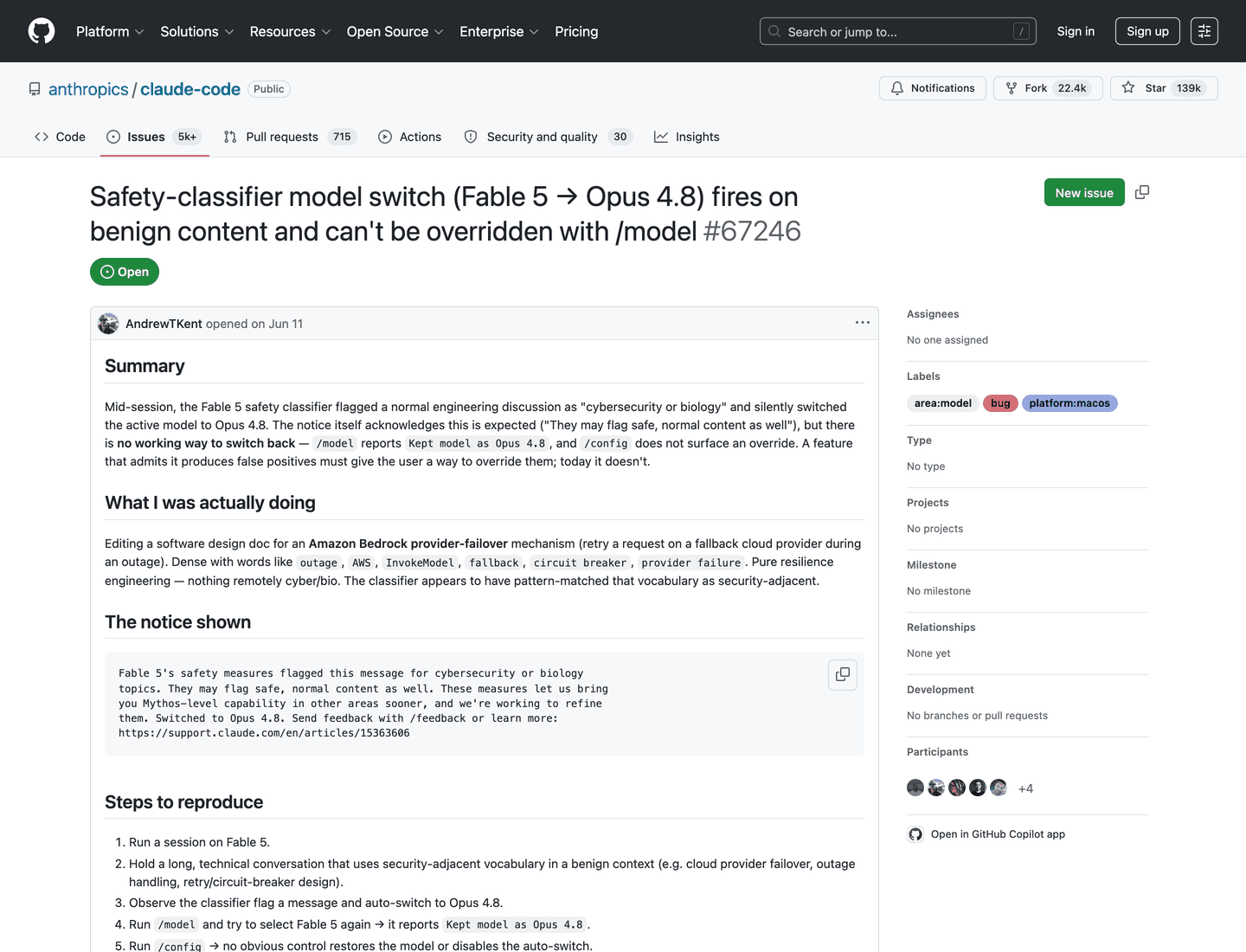
What the history proves: the complaints were about the absence of an override, not the existence of a classifier. What it leaves unsolved: the vocabulary-collision problem is structural, and a lower firing rate reduces its frequency without removing it.
The Setting That Controls Switching, and What It Does Not Change
Opus 5 ships the control the previous version was missing. Anthropic documents a toggle at Settings, then Capabilities, then "Switch models when a message is flagged," which turns automatic switching off (Anthropic Support).
Read that precisely, because the distinction is important. The setting governs the switching behavior, not the classifiers. The safety checks still run on every request; what the toggle changes is whether a flagged request gets routed to Opus 4.8. Anthropic's documentation describes the toggle without specifying the resulting behavior on a flagged request, so this is a place to test rather than assume.
For requests you believe were flagged incorrectly, the documented path is the product one: "use 'Send feedback' to report it. Reports of incorrectly blocked requests help us narrow and improve these safeguards" (Anthropic Support). That is the mechanism Anthropic says it uses to tighten the boundary, and the Bedrock failover example above is exactly the kind of report that does it.
What this proves: the override gap that drove the original complaints is closed, and there is an official channel for false positives. What it leaves unsolved: the classifier itself remains outside user control by design.
FAQ
Why did Claude switch models in my conversation?
Opus 5 ran an automated safety check on your request and classified it as higher-risk offensive cybersecurity work, so Claude Opus 4.8 answered instead. You get a notice, and the response is labeled with the model that produced it.
Is the model switch a refusal?
No. A refusal declines the request. This routes it to Opus 4.8, described by Anthropic as its next-most-capable model, and you still receive an answer.
Can I stop Claude from switching models?
There is a documented setting: Settings, then Capabilities, then "Switch models when a message is flagged." It controls the switching behavior. The classifiers themselves continue to run on every request regardless.
Does the conversation switch back to Opus 5 afterwards?
Not on its own. Anthropic's documentation states that after a fallback the model picker stays on the less capable model for the rest of the conversation, so a single flagged message downgrades the whole session rather than just that turn.
Does this happen on the Claude API?
Not by default. Automatic switching is active across Claude's app surfaces including Claude Code and Claude Cowork, but on the API it requires opt-in configuration.
Why did it trigger on work that has nothing to do with security?
Classifiers read language, and some engineering vocabularies overlap with attack vocabularies. The clearest documented case is a Claude Code report where a design document about cloud provider failover, dense with terms like outage, fallback and circuit breaker, was pattern-matched as security-adjacent. Anthropic's stated path for these is the Send feedback button.
How often does this happen on Opus 5?
Anthropic's documentation reports that in early testing, Opus 5 traffic hit cyber fallbacks 85% less than Fable 5. There is no published absolute rate.
Check the Model Label Before You Debug Your Prompt
The practical takeaway is smaller than the mechanism suggests. When an answer arrives shorter, blunter or less capable than the session before it, the first thing to check is the label on the response, not your own prompt.
If the label says Opus 4.8 and you asked for Opus 5, you have a routing event with a documented cause, a documented setting, and a documented reporting path, and none of those require you to change how you write. If the label says Opus 5, the problem is somewhere else entirely and this article is not the one you need.
The broader pattern is worth holding onto as models get routed rather than simply invoked. Deployment behavior is now part of model behavior, and the version of a model you are served can differ from the version you selected. We ran into the same theme comparing Opus 5 against Kimi K3, where the capability scores tied and the deployment shape did all the deciding. To run Opus 5 without wiring up the plumbing yourself, pick Ultra in MoClaw — Ultra defaults to Claude Opus 5 — and MoClaw runs it as a managed agent.
Continue Reading
More Guide
AI Tools for Ecommerce: Choose by Workflow

macOS Harness: browser-use Hands Over a Mac

MyContext: A Local-First Context Layer for AI

What Is Cumora? AI Agents as Teammates

Personal AI Agents Explained for Real Work

Is Manus AI Free? What You Actually Get
The Zentor editorial team writes about workflow automation, AI agents, and the tools we build. Default byline for industry overviews, listicles, and collaborative pieces.
Ready to put this into practice?
MoClaw runs browser tasks, research, and schedules automatically. Try it free.
References: Anthropic Support: Why Claude switched models in your conversation with Opus 5 · Anthropic: Introducing Claude Opus 5 · claude-code issue #67246: classifier switch with no override · Cybersecurity News: Opus 5 finds vulnerabilities but stays restricted on exploits · Anthropic docs: choosing a model · VentureBeat: Anthropic launches Claude Opus 5