AI Orchestration: Models for Different Roles

AI orchestration coordinates multiple models and agents in one workflow. Learn the core patterns, from routing to orchestrator-workers, with examples.
Table of Contents
AI orchestration is the coordination of multiple AI models, agents, and tools inside a single workflow, so that each part of a task is handled by the component best suited to it. Instead of sending everything to one large model and hoping, orchestration assigns roles: a cheap model routes, a specialized model does the work, and another checks the result.
IBM defines it as "the coordination and management of artificial intelligence models, systems and integrations," and its companion definition of agent orchestration sharpens it to "coordinating multiple specialized AI agents within a unified system to achieve shared objectives." The practical version is a question of assignment: which model plays which role, and who decides. That is what this guide is about, using the patterns from Anthropic's canonical writeup on building effective agents reframed for the multi-model case.
Key Takeaways:
- AI orchestration coordinates several models, agents, and tools in one workflow, matching each role to the right component instead of overloading one model.
- The foundational split, per Anthropic, is workflows (LLMs orchestrated through predefined code paths) versus agents (LLMs that dynamically direct their own process).
- Five composable patterns cover most needs: prompt chaining, routing, parallelization, orchestrator-workers, and evaluator-optimizer.
- Multi-model orchestration means assigning a cheap model to easy slots (routing, simple workers) and a frontier model to hard ones (decomposition, synthesis, evaluation).
- Orchestration is moving from framework code you wire yourself into agent-native features you configure.
What Is AI Orchestration?
AI orchestration is what turns a pile of capable models into a system that reliably finishes a task. A single frontier model can do a lot in one call, but real work is rarely one call. It is classify, then fetch, then draft, then check, and each of those steps has a different ideal handler. Orchestration is the layer that routes the work through those steps and decides who does what.
The most useful distinction to start with is Anthropic's, because it governs how much orchestration you even need. Anthropic separates two architectures. Workflows are "systems where LLMs and tools are orchestrated through predefined code paths." Agents are "systems where LLMs dynamically direct their own processes and tool usage, maintaining control over how they accomplish tasks." The difference is who holds the steering wheel: your code, or the model.
That choice matters more than any framework. A workflow is predictable, debuggable, and cheap, because you wrote the path. An agent is flexible and handles open-ended tasks, but it is harder to reason about and easier to send off the rails. Anthropic's own guidance is to reach for the simpler one first: "find the simplest solution possible, and only increase complexity when needed." Most production orchestration is workflows, not fully autonomous agents, and that is the right default.
What this resolved: Orchestration coordinates multiple components through a task, and the first design decision is workflow (code-directed) versus agent (model-directed).
What it left unsolved: Knowing the two architectures does not tell you which pattern to use. That is the next section.
Core Orchestration Patterns
Anthropic documents five composable workflow patterns. They are worth learning as named building blocks because almost every real orchestration is one of them, or a combination. Here is each one, reframed for the multi-model case: which role each model plays, not just how the data flows.
Prompt chaining. Per Anthropic, this "decomposes a task into a sequence of steps, where each LLM call processes the output of the previous one." In a multi-model setup, the models in the chain need not be the same. A cheap model can do the first-pass extraction and a stronger one the final reasoning step, since not every link needs frontier horsepower.
Routing. Routing "classifies an input and directs it to a specialized followup task." This is the clearest multi-model win: a small, fast, cheap model reads the input, decides what kind of request it is, and dispatches it to the right specialized model. The router itself is the cheapest component in the whole system, and it saves you from sending every query to your most expensive model.
Parallelization. Here "LLMs can work simultaneously on a task and have their outputs aggregated programmatically." Useful when subtasks are independent, or when you want several models to attempt the same task and vote. Different models can run the parallel branches, which is how you get diversity of approach rather than one model's blind spots repeated.
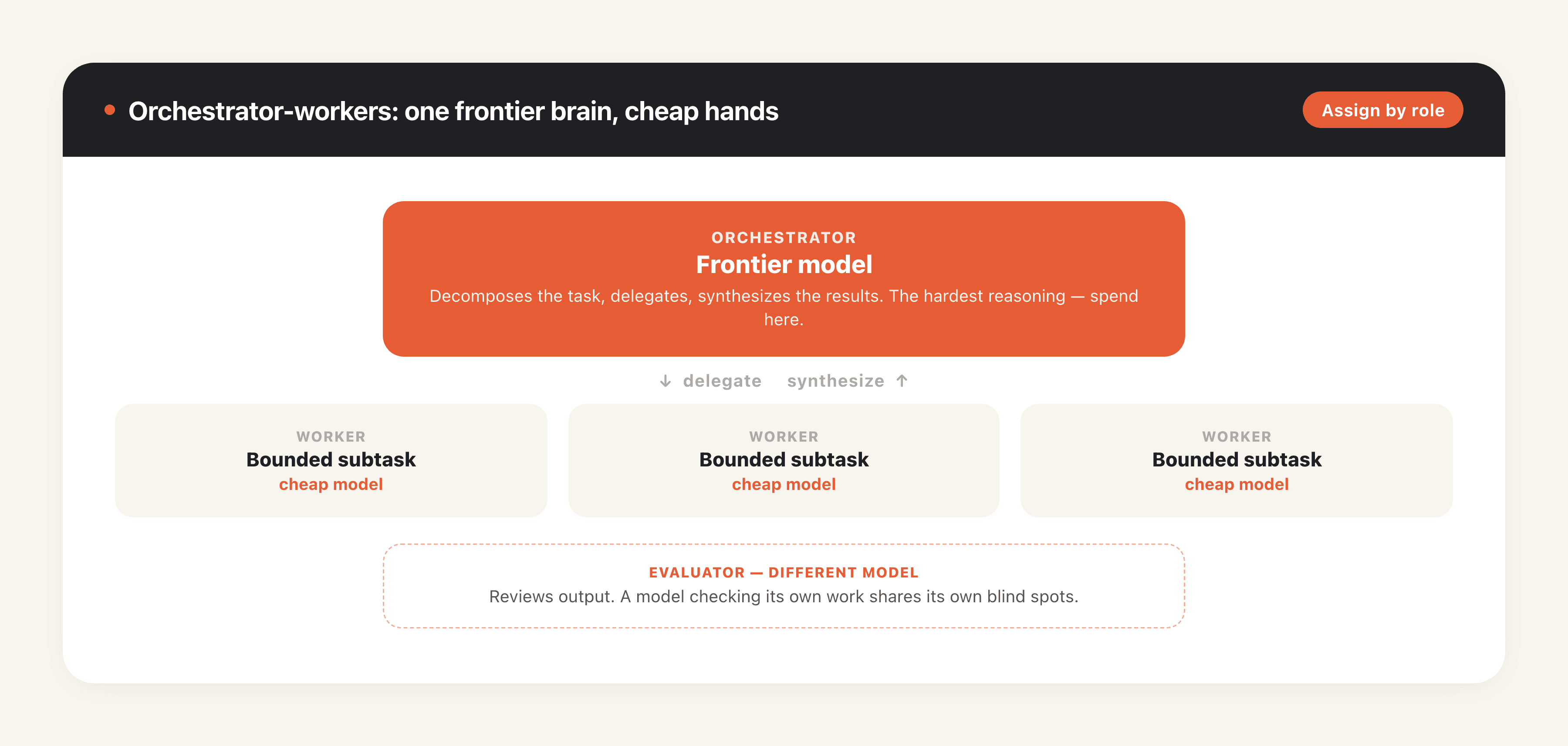
Orchestrator-workers. This is the pattern that deserves the most depth. Anthropic describes it as a workflow where "a central LLM dynamically breaks down tasks, delegates them to worker LLMs, and synthesizes their results." The central orchestrator is doing the hard cognitive work, decomposition and synthesis, so it should be your strongest model. The workers do bounded, well-scoped subtasks, so they can be cheaper. This split is the heart of multi-model orchestration: one frontier brain directing several cheaper hands.
Evaluator-optimizer. In this loop, "one LLM call generates a response while another provides evaluation and feedback." The generator and evaluator are different roles and often should be different models, because a model reviewing its own output shares its own blind spots. A separate evaluator, even a differently-tuned one, catches what the generator missed.
Tom, a solo developer shipping an AI code-review bot, ran a single frontier model to both write and check summaries and kept missing subtle factual slips. He split it: one model drafts the review, a different model family evaluates it against the diff and returns pass or revise. On a test set of 120 pull requests, the two-model loop caught 14 wrong claims the single-model version had waved through. Same patterns, different eyes, and the errors that shared one model's blind spot did not survive the second.
What this resolved: Five named patterns, each mapped to which model role it needs: router, worker, generator, evaluator, orchestrator.
How practitioners are actually orchestrating. The pattern-to-model mapping is not theory. Here is the conversation on X right now, builders wiring an orchestrator plus advisor plus workers, a CTO reconciling K models, and engineers routing cheap-vs-frontier by role:
Combine that with Fable 5 advisor and Gemini 3.5 flash workers to solve the most complex problems.
Give it an ambitious /goal and walk away. Come to a verified deliverable.
Better Defaults (not Usage Caps) – Engineers can choose any model they want, but defaults matter. We’re experimenting with defaulting to open weight mod…
Instead, we built a multi-model (Sonnet 4.6 + Opus 4.8) code review agent that caught 53.6% issues at $3.91 a PR (m…
but almost no one is talking about the actual hard part:
you cannot run a company on one giant agent with every tool, every file, and no accountability. that's not autonomy. that's a fog machine.
here's how we're building…
GPT 6
Fable 5.5
Gemini 3.5 Pro
Grok 5
Spark 2
Kimi 3
Minimax M3.5
GLM 6
DeepSeek v4.5
Mistral 4
Qwen 4
MiMo 3
Never in the history of LLMs has the frontier been so multipolar. The benefits to agent labs and agent orchestration / LLM council judges/sidekickin…
What it left unsolved: Knowing the patterns does not tell you which model to put in each slot. That is a cost-and-capability decision, next.
Multi-Model Orchestration: Cheap vs. Frontier Models per Role
The reason multi-model orchestration exists is economic. If quality and cost were free, you would run your best model everywhere. They are not, so the skill is putting expensive capability only where it changes the outcome.
A workable rule of thumb by role:
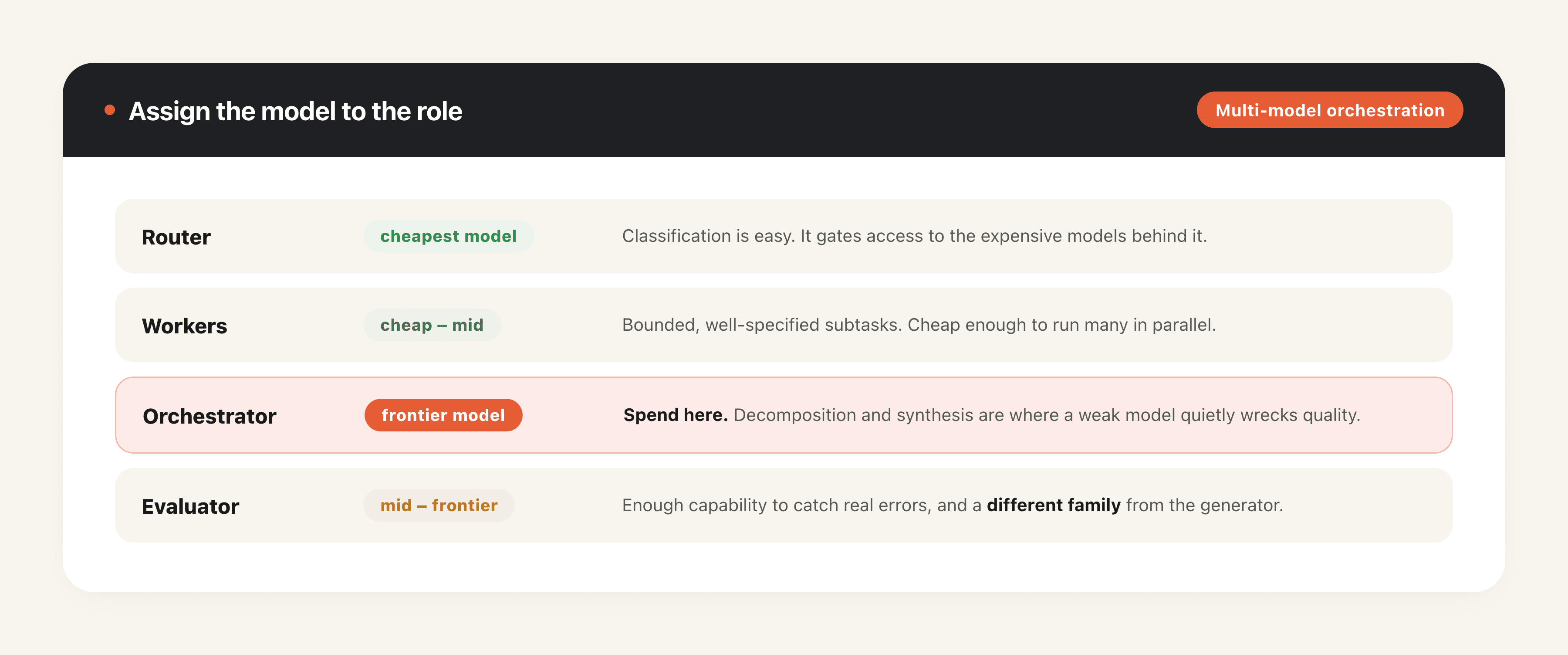
- Router: cheapest model. Classification is easy. A small model routes accurately and costs almost nothing per call, and it gates access to the expensive models behind it.
- Workers: cheap to mid. Bounded, well-specified subtasks rarely need a frontier model. If the task is "extract the dates from this text," a small model is not just cheaper, it is fast enough to run many in parallel.
- Orchestrator: frontier. Decomposition and synthesis are the hardest reasoning in the system. This is where a weaker model quietly wrecks quality, by splitting the task badly or stitching results together wrong. Spend here.
- Evaluator: mid to frontier, and different from the generator. The evaluator needs enough capability to catch real errors, and it needs to not share the generator's failure modes. A different model family is often worth more than a bigger one.
Elena, an indie developer building a customer-support automation, learned this by overspending. Her first version sent every ticket to a frontier model end to end, and the bill scaled with her users. She rebuilt it as an orchestration: a tiny model routes the ticket by type, mid-tier workers draft the common cases, and the frontier model is reserved for the orchestrator role on genuinely ambiguous tickets. Same quality on the hard cases, a fraction of the cost on the easy majority, because the expensive model stopped touching work that never needed it.
A caution worth stating plainly: Anthropic does not prescribe per-role model tiering as a rule. Its guidance is about adding complexity "only when it demonstrably improves outcomes" and consciously trading latency and cost for performance. Per-role model assignment is a reasonable application of that principle, not a law. Measure before you assume a cheaper model holds up in a given slot.
What this resolved: A role-by-role guide to model assignment, with the expensive model reserved for orchestration and evaluation.
What it left unsolved: The right model per slot is workload-specific. The only way to know a cheap model holds is to test it on your actual task.
Multi-Model Orchestration in Practice: Codex-Orchestration
Abstractions get real when you watch someone wire them up. Codex-Orchestration is a small open project (MIT licensed) that does exactly the assign-models-to-roles thing inside Codex workflows, and it is a clean illustration of where the ecosystem is heading.
Per its README, it "adds three simple roles to a Codex task" and lets you "bring models like Claude Fable 5 into Codex, give each model a role, and let Codex coordinate the work." The three roles are its own vocabulary, not Anthropic's pattern names, so it is worth reading them on their own terms:
- Planner "creates the plan and improves it after feedback." Optional; without it, the current Codex model plans.
- Advisor "reviews the plan, finds important gaps, and approves it when it is ready." Also optional.
- Executor "implements the approved plan." Required.
The orchestration logic is the interesting part. Per the README, "the model selected for the Codex task remains in charge. It passes work between the roles, checks every result, and gives you the final answer." It also enforces independence: "Planner and Advisor must use different configured model routes so the review is independent," and it stops "as soon as the Advisor returns PLAN_APPROVED, with a safety limit of five reviews." A concrete setup from the README reads: planner: Claude Fable 5 High, advisor: GPT-5.6 Sol High, executor: GPT-5.6 Luna Extra High.
Do not over-map this onto Anthropic's patterns. The Advisor is spiritually close to an evaluator, and the Planner-to-Executor flow rhymes with orchestrator-workers, but the project uses its own model and does not claim to implement the named patterns. What it does show is the direction of travel: assigning distinct models to distinct roles, once a matter of hand-written framework code, is becoming a configuration line inside an agent tool. The independence requirement, a different model for the reviewer than the planner, is the same evaluator-should-differ-from-generator instinct, expressed as a setup flag.
What this resolved: A real, inspectable example of multi-model role assignment, and evidence that orchestration is moving from framework code into agent-native configuration.
What it left unsolved: Codex-Orchestration is a small project with its own vocabulary. It illustrates the pattern; it is not a general orchestration standard.
Local-First Orchestration, With the Gates Held by a Human
The orchestrator-workers pattern assumes the orchestrator gets to act. A project that went public on 2026-08-14, sjc88661/multi-agent-discuss, which calls itself Multi-Agent Workbench, takes the opposite position on exactly that point, and it collected 200 stars and 23 forks in its first two days.
The design puts several CLI agents in one browser-based room: Claude Code, Codex CLI, and a generic-pty adapter for anything else that runs in a terminal. Each agent is bound to a role card, written as editable YAML, defining its permissions and decision boundaries. An orchestrator engine drives the flow much as the orchestrator-workers pattern describes, but execution, risky commands and merges stop and wait for a person. Approvals get classified low, medium or high risk, and the whole system is event-sourced: 23 event types in an append-only log, with the timeline, terminals and diffs projected from it rather than stored, so you can reconstruct why a change happened instead of only what changed.
Two caveats before anyone installs it. It's MIT licensed and local-first by design, with no accounts and no telemetry and a Fastify backend bound to 127.0.0.1:3020, which is the appeal and also means you are the one keeping it running. It's also honest about being early: the README marks it MVP with phases 1 through 3 shipped, and the worktree isolation that gives each code-writing agent its own checkout is still listed as in progress rather than done.
Watch it as a counter-current to the direction this guide closes on. If orchestration keeps migrating toward something the agent handles for you, Multi-Agent Workbench is a bet that the decision points are precisely the part you should never hand over.
How MoClaw Orchestrates Models Behind the Scenes
Everything above assumes you are the orchestrator: you pick the patterns, assign the models, and wire the routes. MoClaw takes the opposite stance. It orchestrates behind the scenes, so a single task can invoke different capabilities for different subtasks without you managing any of the routing.
The concrete version: when a MoClaw task involves, say, pulling data, reasoning over it, and formatting the result, those are different kinds of work with different ideal handlers. Rather than exposing a router, a worker config, and an evaluator loop for you to assemble, MoClaw handles the decomposition and delegation internally. You describe the outcome. The platform decides how to break it up and which capability handles each piece.
The honest tradeoff is control versus overhead. A framework like the Codex example or a library such as CrewAI gives you total command of every role and model, which is exactly what you want when orchestration is your product. It also means you own the wiring, the failure handling, and the bill optimization. MoClaw's position is that for most people, orchestration should be invisible infrastructure, not a thing they build. You lose fine-grained control over which model runs which slot. You gain not having to think about it. Which side of that line you want depends on whether orchestration is the thing you are building, or just the thing standing between you and the result. You can see how multi-step tasks resolve without manual routing in MoClaw's use case library.
What this resolved: MoClaw orchestrates internally, trading fine-grained control for zero routing overhead, which suits people who want the result rather than the wiring.
What it left unsolved: If orchestration is your product, you want the framework control MoClaw deliberately hides.
FAQ
What is AI orchestration?
AI orchestration is the coordination of multiple AI models, agents, and tools within a single workflow so each subtask is handled by the best-suited component. Instead of routing everything to one large model, orchestration assigns roles, such as a cheap model to classify and route and a stronger model to reason and synthesize, and manages the flow between them.
What is the orchestrator-workers pattern?
Orchestrator-workers is a workflow where, per Anthropic, a central LLM dynamically breaks a task into subtasks, delegates them to worker LLMs, and synthesizes their results. In multi-model setups the orchestrator should be your strongest model, since decomposition and synthesis are the hardest reasoning, while the workers can be cheaper because their subtasks are bounded.
Do I need an orchestration framework?
Not always. If orchestration is your product, a framework like CrewAI or LangGraph gives you full control over roles and models. If you just want the result, a managed agent that orchestrates internally removes the wiring entirely. Anthropic's advice applies: start with the simplest approach and add orchestration complexity only when it demonstrably improves outcomes.
What is the difference between LLM orchestration and AI orchestration?
They are used almost interchangeably. LLM orchestration usually emphasizes coordinating multiple language-model calls, while AI orchestration is broader, covering models, agents, tools, and integrations in one system. In practice, if you are assigning roles across several models and managing the flow between them, you are doing both.
Where AI Orchestration Is Actually Heading
The patterns are stable, and that is the useful news: prompt chaining, routing, parallelization, orchestrator-workers, and evaluator-optimizer will still describe orchestration next year. What is changing is where the orchestration lives. The Codex-Orchestration example is a small signal of a large shift, from orchestration as framework code you write, toward orchestration as a feature you configure or, increasingly, one the agent handles for you.
The practical takeaway does not depend on guessing the endpoint. If you are building an orchestration product, learn the five patterns cold and assign models by role, cheap where the task is bounded, frontier where decomposition and evaluation happen. If you just need multi-step work to get done, let a managed agent orchestrate and spend your attention on the outcome instead of the routing. Either way, the core idea outlives every framework: the right model for each role beats the biggest model for every role, and the systems that win are the ones that stop paying frontier prices for work a cheap model would have finished.
Continue Reading
More Guide
Multi-Model AI Agent Guide: 2026 Decisions

What Is Hermes Bot Mode? Bots and Routines

OpenAI Assistants API Deprecated: What Broke

MCP Tools: What They Are and Which to Use

OpenAI Models Not Available in Cursor Nov 12

Coding Agent Security: When Your Tools Lie
The MoClaw editorial team writes about workflow automation, AI agents, and the tools we build. Default byline for industry overviews, listicles, and collaborative pieces.
Ready to put this into practice?
MoClaw runs browser tasks, research, and schedules automatically. Try it free.
References: Anthropic: Building Effective Agents (patterns and workflows vs agents) · Codex-Orchestration: assigning models to roles in Codex (GitHub README) · IBM: What Is AI Orchestration? · IBM: What Is AI Agent Orchestration? · CrewAI: open-source multi-agent orchestration framework