OpenAI Models Not Available in Cursor Nov 12

OpenAI models not available in Cursor from November 12, 2026. Which features your own API key still covers, which it doesn't, and how to check.
Table of Contents
If you open Cursor's model picker one morning in November and the GPT entries have quietly gone, nothing broke. OpenAI published its decision on 28 August 2026, and the reporting landed the following day, which is the date carried by both CNBC's writeup and Latent Space's digest. The substance: OpenAI intends to wind down the contract that supplies its models to Cursor, with a proposed shutoff of 12 November 2026. What set it off was SpaceX's acquisition of Anysphere, Cursor's parent company, which closed on 14 August. Everything below is accurate as of 31 August 2026, and the date on the wall is still a proposal rather than a settled fact.
Most of what got published in the 48 hours after the announcement told you to switch models and move on. That advice is fine as far as it goes. It also skips the part that will actually bite people, which is that the obvious workaround covers a much smaller slice of Cursor than almost anyone assumes.
Key Takeaways
- OpenAI has proposed 12 November 2026. Its own help page adds that Cursor "may choose to end access sooner", and that a confirmed termination date gets published only once both companies agree on one.
- Cursor is not shutting down, and its catalogue mostly survives: Anthropic, Google, Moonshot and Z.ai models stay, as do Cursor's own Composer and the Grok line.
- Michael Truell put OpenAI at roughly 5% of Cursor traffic. That figure counts deliberate selections, so it understates exposure; Cursor Router spreads Auto requests across GPT-5.5 as well.
- Pasting in your own key buys back chat models and nothing else. Tab, Auto, Cloud and Background Agents, Automations, the CLI and Cursor's API and SDK all keep using models Cursor supplies, and cannot be pointed at your credentials.
- The surfaces a personal key can't reach are precisely the unattended ones.
- Moving to your own OpenAI account moves the invoice with it, and a ChatGPT subscription does not include API usage.
- OpenAI has also said it won't ship new models to Cursor between now and the cutoff, so the gap widens before it closes.
What OpenAI Actually Put in Writing
The help centre article is short and unusually blunt for a vendor notice: "OpenAI is planning to wind down our contract providing OpenAI models to Cursor. We have proposed a transition period of November 12, 2026. During that period, we would continue providing Cursor access to the OpenAI models it uses today. Cursor may choose to end access sooner. We will share the official termination date as soon as it is confirmed between both companies."
Read that twice, because three separate things in it are conditional. The date is a proposal rather than a deadline; the cut could land earlier, at Cursor's discretion and not OpenAI's; and no confirmed termination date exists yet from either company. Anyone telling you GPT access in Cursor ends on 12 November is repeating a proposal as though it were settled.
OpenAI posted the same summary to its own account that night, and set out its reasoning on its site: having seen the ownership change, it invoked a change-of-control provision, saying it could not be confident the models would be used within its terms of service. Truell replied publicly a little over an hour later that his team was "speaking with the OpenAI team to resolve this", and put OpenAI models at about 5% of Cursor user traffic. Two weeks passed between the acquisition closing and the notice going out. For the primary sources rather than the commentary, CNBC's report and Latent Space's writeup both carry the November 12 figure.
Anysphere's editor had somewhere around a million active users when the notice went out, so a small percentage still lands on a lot of desks.
Who Is Affected Is Bigger Than the 5% Number
That 5% has been repeated everywhere, usually as reassurance. It measures the wrong thing.
The number describes requests where somebody deliberately picked a GPT model. But Cursor's own documentation says Cursor Router, the machinery behind Auto, distributes requests across GPT-5.5, Claude Opus 5, Grok 4.5 and Claude Fable 5. Auto is the setting people leave alone. So a developer who has never once opened the model picker can still be sending work to an OpenAI model several times an hour, and that developer shows up in no tally of deliberate GPT usage.
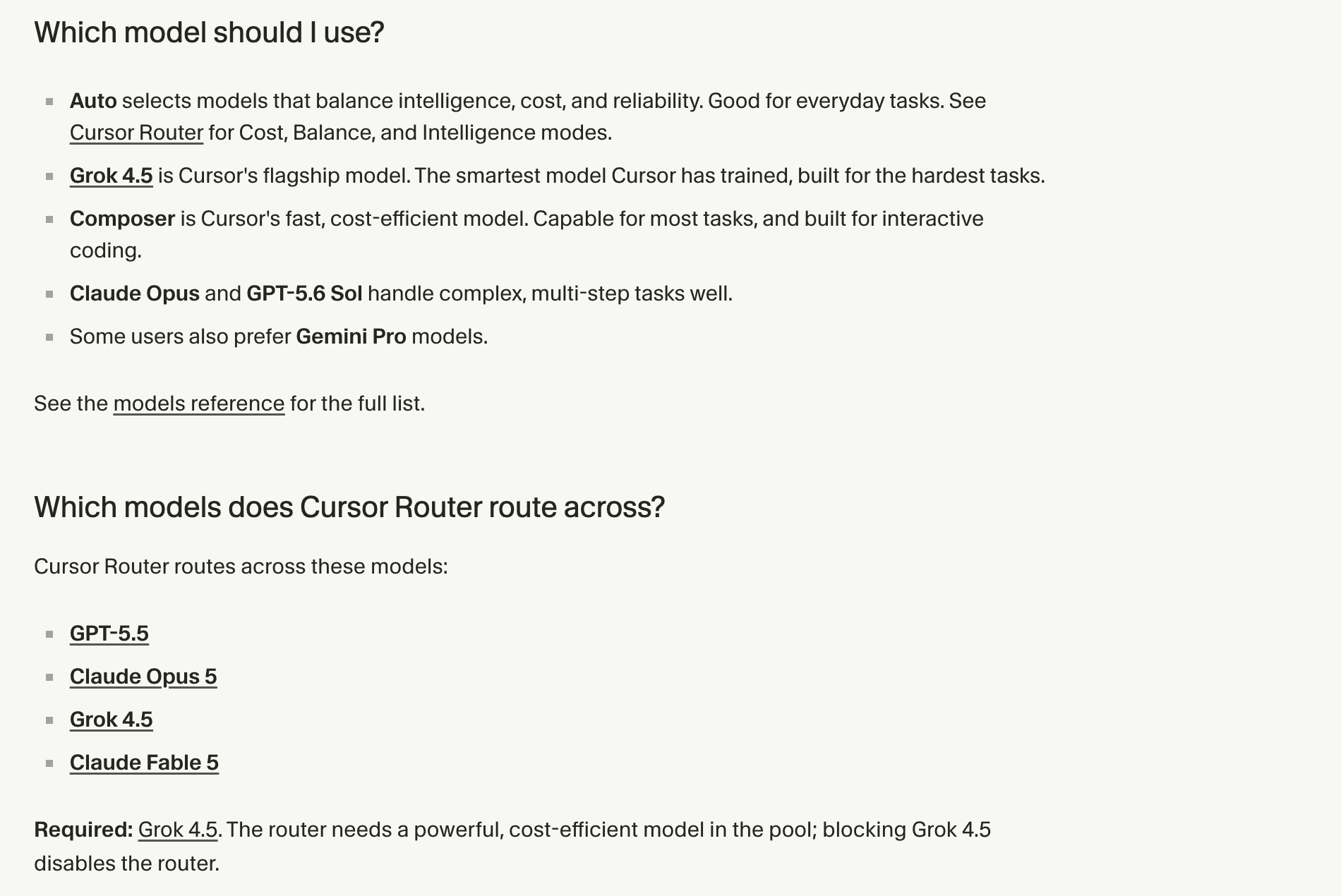
Whether Cursor rebalances the router before November is anyone's guess; it plausibly will, since the docs note the pool needs a strong, cost-efficient model in it. Either way, the honest version of the impact question isn't "do we use GPT" but "does anyone here know what Auto has been picking."
What Survives, and What Freezes
The catalogue does not collapse. Cursor's docs still list Anthropic, Google, Moonshot and Z.ai models next to Composer and the Grok line that arrived with the new owner, and an OpenAI contract has no bearing on any of them. Your repository, your rules files, your extensions and your keybindings are untouched too. Entries disappear from a picker; that's the whole physical event.
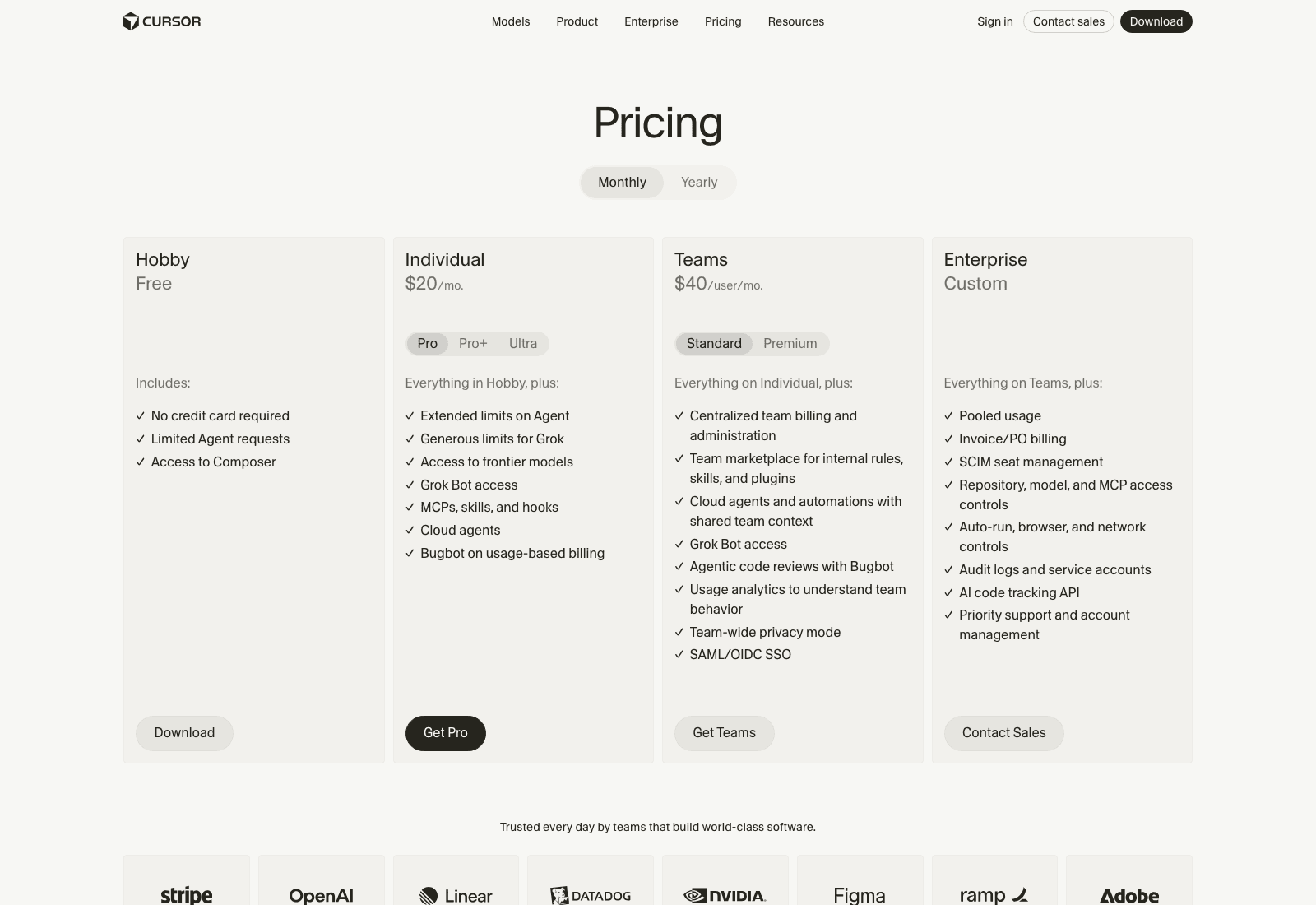
The pricing page is a useful tell. That $20 Individual plan advertises "Generous limits for Grok", "Grok Bot access" and "Access to frontier models", and never names an OpenAI model once, while OpenAI's own logo still sits in the customer strip at the bottom. The page was written before this week and nobody has been back to it since.
One more detail worth catching while you're there: GPT-5.6 Sol carries promotional pricing in Cursor's model docs through 21 November 2026, nine days after OpenAI proposes to stop supplying it. Vendor pages get maintained by different teams on different weeks, so a date you read in a doc is worth re-checking before you plan a quarter around it.
What does freeze is the list itself. OpenAI has said it won't add new models to Cursor during the wind-down, so the GPT options in there are pinned to today's set. Any team that standardised on a specific GPT model for code review, refactors, or a custom agent now has a deadline it didn't choose.
Your Own API Key Covers Less Than You Think
Here's the part the roundups glossed over, and it's the reason a personal key isn't the clean substitution it sounds like.
Yes, Cursor lets you paste in an OpenAI key and keep using GPT after the cutoff. You create a key on an API account with billing configured, open Cursor Settings, go to Models, paste it in, enable the model you want, then select it in Chat or Agent. Available models and rate limits then follow your OpenAI organisation rather than your Cursor plan.
What it doesn't do is restore the editor. Cursor's documentation is blunt about the boundary: custom keys work with chat models, and Tab completion carries on using Cursor's built-in models. OpenAI's help article goes further and enumerates the gap in its own words, saying Cursor "doesn't support 'Bring your own key' in Cursor Tab, Auto, Cloud or Background Agents, Automations, the Cursor CLI, or Cursor's API and SDK", because those features use models Cursor supplies or routes itself and cannot accept your credentials. Gateway setups inherit the identical restriction.
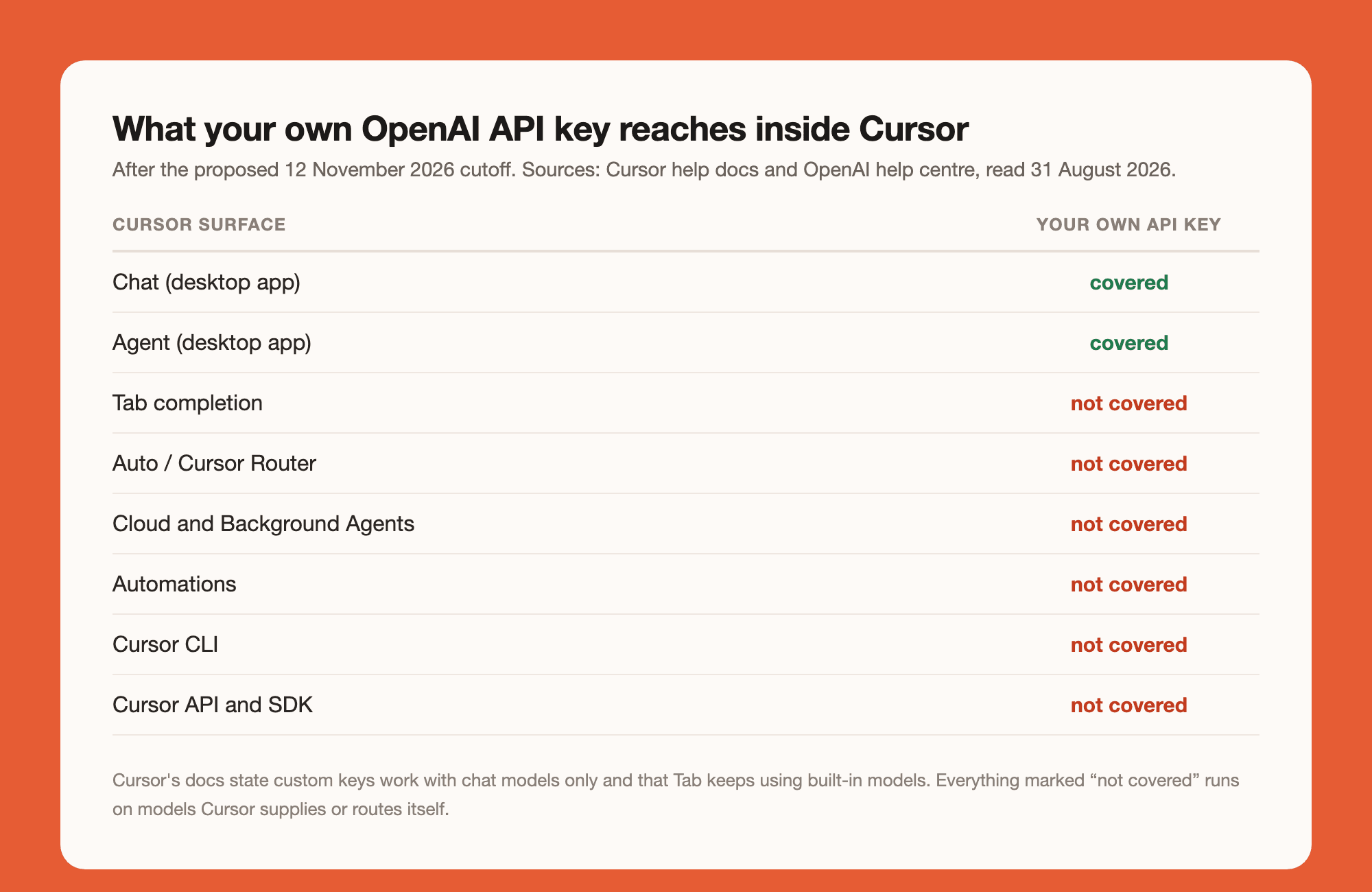
Read that list again and notice its shape. Everything a personal key restores is something you sit in front of and watch; everything it leaves behind runs while you're doing something else, whether that's background agents, scheduled automations, or CLI jobs in CI. The workaround preserves the interactive half of the editor and quietly drops the unattended half.
That distinction matters more than the vendor argument that caused it. Interactive work is portable, because a human is right there to notice a bad answer and switch models. Unattended work is where a silent substitution actually costs you, and it's also the half that stops the moment your machine sleeps. MoClaw lives in that second category: a hosted cloud AI computer that stays up so scheduled and long-running jobs have somewhere to land, sitting next to your editor rather than replacing it.
"Model Not Available" Already Means Something Here
Worth knowing before you file a bug: Cursor's docs already have an entry for this exact phrase. It says some models may not be available in certain regions because of restrictions set by the model providers rather than by Cursor, and that when this happens those models simply don't appear.
So the string most people will type into a search box in November already has a Cursor-native meaning, and the November case is the same mechanism with a different cause. A provider restricted access; the models stopped showing up. That the restriction is contractual rather than geographic changes nothing about what you see. Users have been posting variants of this in Cursor's forum and on the OpenAI developer community for months, long before any of this was about a contract.
The remedies Cursor lists for that situation are Auto mode, a different provider, or your own API key. Two of the three have a wrinkle here, since Auto is one of the surfaces a personal key cannot cover, and it's the one routing across GPT-5.5 in the first place.
The Invoice Moves With You
Pasting a key changes who bills you, and that catches people out. A ChatGPT subscription does not include OpenAI API usage; they're separate products on separate meters. Your Cursor subscription keeps charging for Cursor, and OpenAI starts charging you at API list prices for the requests that used to be bundled.
For light chat use that's often cheaper. For heavy agent loops it usually isn't, because the requests that burn tokens fastest are the long agentic runs, and those are exactly the ones a per-token bill makes visible. Nobody can tell you which side you land on without your own usage numbers, so pull them before November rather than after your first surprise invoice.
There's a second-order effect too. Once the models come from your own account, model availability tracks your OpenAI organisation's access rather than Cursor's negotiated catalogue. If your org doesn't have access to a given model tier, it won't appear, and that's a support conversation with OpenAI instead of with Cursor. Splitting one bill into two also splits the person you escalate to, which is the sort of thing that only becomes obvious at 2am.
Four Paths, Ranked by What They Cost You
Switch models inside Cursor. Cheapest by a wide margin, and for most people it's the whole answer. Claude Opus 5, Grok 4.5, Composer and Gemini Pro are all still there. If your prompts weren't written against GPT-specific quirks, you'll spend an afternoon on this.
Run the Codex IDE extension alongside Cursor. OpenAI's Codex extension installs inside Cursor and runs its own agent panel, authenticating with either an eligible ChatGPT subscription or an API key. It deliberately sidesteps Cursor's model picker, and OpenAI is explicit that it "does not change the model used by Cursor Chat, Agent, Tab, Auto, Cloud Agents, or other Cursor services". You get Codex next to Cursor, not Codex inside Cursor's own features. Our notes on running Codex agent workflows go deeper on that path.
Route through a compatible gateway. If your organisation already sends model access through Amazon Bedrock, Azure OpenAI or another OpenAI-compatible endpoint, Cursor can point at a custom base URL. OpenRouter and Vercel AI Gateway may work, with the caveat that some model-specific controls don't survive the trip through a custom endpoint, and the same coverage limits apply regardless.
Move the unattended work off the editor entirely. If what you actually lose on 12 November is a nightly agent run rather than a chat window, no key configuration inside Cursor fixes it, because that surface was never yours to configure. Work that has to happen on a schedule belongs on a machine that's awake on that schedule, which is the gap MoClaw covers: the editor keeps your interactive loop, and the hosted machine keeps the jobs that run at 3am. When model access sits somewhere you don't have to renegotiate for, switching which model does the work becomes a setting rather than a migration. That's a smaller promise than "never get cut off again", and it's the honest size of it.
Cursor's Own Channels Have Not Caught Up
If you went looking for this on Cursor's site, you wouldn't have found it. Search for OpenAI models not available in Cursor and what comes back is press coverage of a corporate dispute, not a settings page telling you what to change.
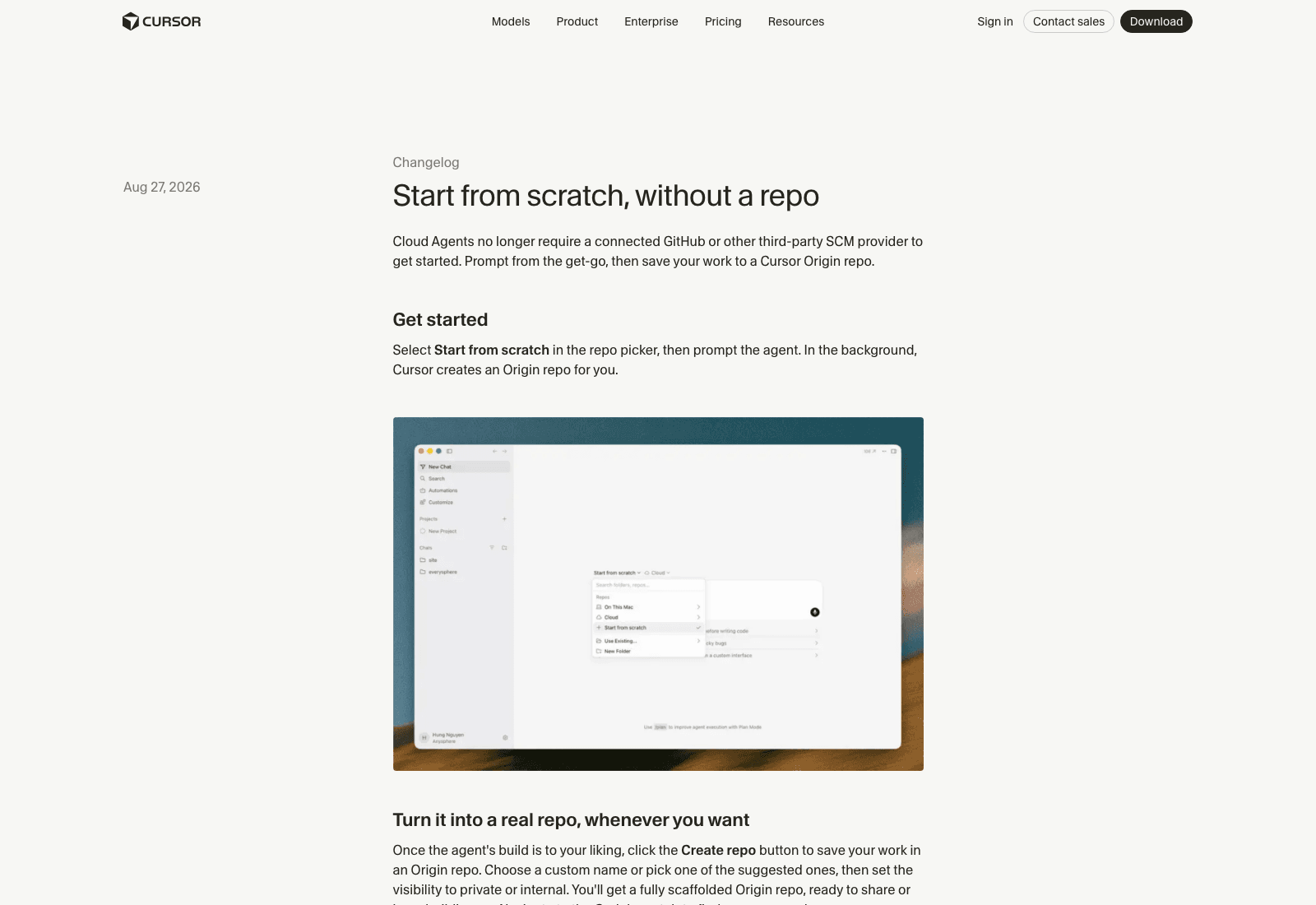
The newest changelog entry as of 30 August is dated 27 August and covers Cloud Agents starting without a repo, while the models documentation still lists GPT-5, GPT-5.4 and GPT-5.6 variants with no annotation. Nothing on cursor.com acknowledges the transition period, which is consistent with a company that says it's still negotiating rather than announcing. Treat that silence as information, not reassurance. Screenshot the pages you plan around; we did, because vendor pages get rewritten and old wording disappears.
Access Is a Business Term, Not a Technical One
None of this is a story about model quality. GPT-5.6 Sol will work exactly as well on 13 November as it did on 11 November. What changed is a contract between two companies, one of which was bought by a third.
The same shape has repeated all year. Vendors retire endpoints on their own schedule, as OpenAI did when it deprecated the Assistants API. Suppliers swap a model out from under a product, which is what happened when Claude silently switched models on Opus 5 fallback, and pricing mechanics move underneath you, as a tokenizer change did to Sonnet 5 migration costs. The editor you standardise on inherits every one of its suppliers' business risks, which is the uncomfortable footnote to any Cursor, Copilot and Claude Code comparison.
The lesson isn't that Cursor made a mistake. It didn't; it got bought, which is what successful startups do. The lesson is narrower and more useful: if a single business relationship can remove a model from your workflow overnight, that relationship is part of your architecture whether you designed it that way or not.
Frequently Asked Questions
Is GPT gone from Cursor right now?
No. OpenAI has proposed 12 November 2026 as the end of the transition period and says it will keep supplying the models Cursor uses today until then. Nothing had been switched off as of 31 August 2026.
Is Cursor shutting down?
No. OpenAI is ending its own model-supply agreement. Cursor keeps operating with its own models and its agreements with other providers.
Why is OpenAI cutting Cursor off?
SpaceX acquired Cursor's parent company, and OpenAI invoked a change-of-control provision. Its public statement says it cannot be confident the technology would be used within OpenAI's terms of service, and it hasn't framed the move as being about Cursor's product.
Does this affect Claude, Gemini or Grok in Cursor?
No. Only OpenAI's direct supply is ending. Anthropic, Google, Moonshot and Z.ai models remain, and so do Cursor's own Composer and Grok models.
Can I just paste my own OpenAI API key and carry on?
For local Chat and Agent, yes. Not for Tab, Auto, Cloud or Background Agents, Automations, the Cursor CLI or Cursor's API and SDK, all of which use models Cursor supplies and cannot accept your key.
Will my Cursor subscription get cheaper?
Cursor hasn't said anything about pricing. As of 31 August the plans are unchanged at Hobby free, Individual $20 per month, Teams $40 per user per month.
What to Settle Before 12 November
Two questions decide how much of this touches you, and both are worth answering this week rather than in November. First, check whether anything you run unattended depends on a GPT model, because that's the category no key configuration inside Cursor will restore. Second, look at what Auto has actually been selecting for your team, since the 5% headline was never a measurement of your exposure.
Then pick a model and move on. For most people, waking up to OpenAI models not available in Cursor will mean an afternoon of work and a slightly different picker. For the teams with a nightly agent pinned to GPT, it's a question about where the unattended work should have been running all along, and sorting that out now beats testing a migration against a system that's already broken.
Keep watching the date, too. This is currently a proposal with a soft edge on both sides: Cursor can end it early, the two companies can still confirm something different, and the page that would tell you is one neither of them has updated yet.
Continue Reading
More Guide
OpenAI Assistants API Deprecated: What Broke
MCP Tools: What They Are and Which to Use

Coding Agent Security: When Your Tools Lie

OpenAI Python HTTPX2: What Actually Breaks

Goldie: App Store Screenshots, Automated

Headcount: Claude Code as an Org Chart

The MoClaw editorial team writes about workflow automation, AI agents, and the tools we build. Default byline for industry overviews, listicles, and collaborative pieces.
Ready to put this into practice?
MoClaw runs browser tasks, research, and schedules automatically. Try it free.
References: OpenAI: Our decision on Cursor following its acquisition by SpaceX · OpenAI Help Center: Using OpenAI models in Cursor · Cursor Docs: API keys · Cursor Docs: Available models · CNBC: OpenAI to end model access to Cursor after SpaceX acquisition · Latent Space AINews: OpenAI shuts off Cursor · OpenAI: Codex IDE extension