Sonnet 5 vs 4.6: The Hidden Cost Jump

Sonnet 5 keeps Sonnet 4.6's per-token rates but a new tokenizer produces ~30% more tokens. Here is the real cost math and the migration traps to avoid.
Table of Contents
Claude Sonnet 5 keeps the exact per-token prices of Sonnet 4.6, yet an equivalent request can cost you more. Anthropic's own docs state that Sonnet 5's new tokenizer produces approximately 30% more tokens for the same text, so even with unchanged rates, the same prompt bills higher.
The Sonnet 5 vs Sonnet 4.6 cost story fits in one line: same rate card, higher bill. This is the fact almost nobody put in a headline, and it is the one that will surprise your finance team in September. Per-token pricing is unchanged and Anthropic discloses the tokenizer change openly. The cost still moves, because you are paying for more tokens per request. Here is the exact math and the migration traps that go with it.
Key Takeaways:
- Sonnet 5 uses a new tokenizer that produces ~30% more tokens for the same text; per-token rates are unchanged from Sonnet 4.6 ($3/$15 standard)
- Introductory pricing of $2/$10 runs through August 31, 2026, which hides the tokenizer effect until September
- On September 1, an equivalent workload can jump ~50% overnight as intro pricing ends and the token inflation is already baked in
- Three breaking API changes will 400 your requests on migration: manual extended thinking, non-default sampling params, and unrevisited max_tokens
The Cost Change Almost Nobody Led With
The launch coverage focused on capability: Sonnet 5 is more agentic, close to Opus 4.8, cheaper to run. All true. The quiet part is in the migration notes. A drop-in model upgrade that keeps the same rate card can still raise your bill if each request now counts more tokens, and that is exactly what the new tokenizer does.
This is not a hidden fee or a trick. It is arithmetic that most write-ups skipped. And it is already showing up in real invoices. One SaaS founder on r/SaaS reported their Anthropic bill going from about $140 to $278 in a month with a basically flat request count, after digging into per-request token counts. On r/vibecoding, another dev noticed session limits draining faster and started tracking it to confirm they were not imagining it. The tokenizer is the mechanism behind that pattern.
What this resolved: the cost change is real, disclosed, and token-driven. What it left unsolved: the intro pricing is masking how big it gets, covered next.
The Headline Math: One Workload Across Three Price States
The clearest way to see the Sonnet 5 vs Sonnet 4.6 cost difference is a worked example. Take a modest production workload that, measured on Sonnet 4.6's tokenizer, runs 2,000,000 input tokens and 400,000 output tokens per day, about $360 a month. Now watch the same text move through three price states.
| State | Rate (in/out) | Tokens billed (same text) | Monthly cost |
|---|---|---|---|
| Sonnet 4.6 (baseline) | $3 / $15 | 2.0M in / 0.4M out | $360 |
| Sonnet 5 intro (through Aug 31) | $2 / $10 | 2.6M in / 0.52M out | $312 |
| Sonnet 5 standard (Sept 1 on) | $3 / $15 | 2.6M in / 0.52M out | $468 |
The +30% tokenizer inflation turns 2.0M/0.4M into 2.6M/0.52M in every Sonnet 5 row. During the intro window, the lower $2/$10 rate more than offsets the extra tokens, so the workload is actually cheaper than Sonnet 4.6 was: $312 versus $360. That is the trap. The intro discount hides the inflation, so migrations look like a small win in July and August.
Then September 1 arrives. Rates snap to $3/$15, the token inflation is still there, and the same workload costs $468. That is up 50% from the August bill of $312, and 30% above the old Sonnet 4.6 baseline, which is exactly the tokenizer effect since the per-token rate matches 4.6. Nothing about your traffic changed. Two variables moved at once, in the same direction.
Marcus, an indie dev running a support-triage bot, migrated in July, saw his bill dip, and mentally filed Sonnet 5 as cheaper. He had not read the intro-pricing end date. If he does the substitution now, he can plan for the September step-up instead of getting ambushed by it.
What this resolved: a concrete three-state cost model you can drop your own numbers into. What it left unsolved: your exact increase depends on content shape, so measure it, do not assume 30% flat.
Why It Costs More: The New Tokenizer
Anthropic is explicit: Sonnet 5 uses a new tokenizer, and the same input text produces roughly 30% more tokens than on Sonnet 4.6, with the exact increase depending on content. It is not an API change: request and response shapes are identical, and no code changes are required for the tokenizer itself.
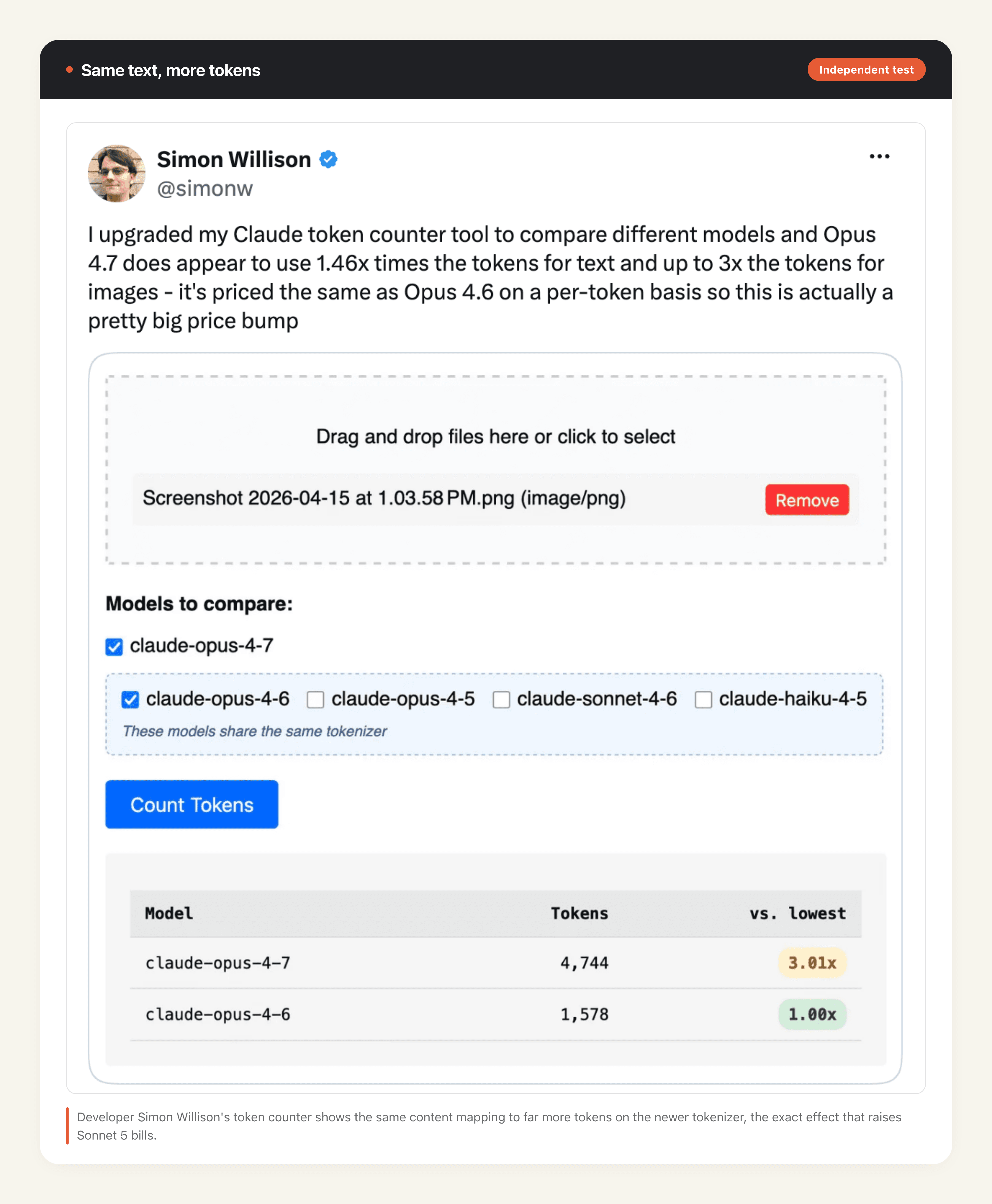
The effect is on anything you measure or budget in tokens. Usage fields report higher counts for the same text. Your 1M context window holds less actual text, since each token now covers less of it. And max_tokens limits tuned for 4.6 may truncate equivalent output. The fix for measurement is simple and non-negotiable: do not reuse token counts from earlier models. Recount your real prompts with Anthropic's token counting against Sonnet 5 before you finalize any budget.
What this resolved: the mechanism is a denser tokenizer, and you can measure it directly. What it left unsolved: the increase varies by workload, so only your recount gives your real number.
Can Prompt Caching or the Batch API Offset It
Partly, and this is the lever most cost write-ups skip. The tokenizer produces more tokens no matter what, but you do not have to pay full input rate on all of them.
Prompt caching bills repeated context at a steep discount to the standard input rate, so a workload where most of each request is stable, cached context feels the inflation far less: more tokens, yes, but the bulk billed at the cache-read rate rather than full input. The Batch API runs asynchronous jobs at a discount as well. For an input-heavy, repetitive workload, the two together can absorb a real chunk of the 30%.
Where they do not help is net-new output. Generated text is never cached, so an output-heavy agent, the kind that writes long responses on every call, feels the tokenizer close to fully. This is why the increase is workload-shaped, not a flat number. A retrieval bot re-sending the same system prompt and knowledge base can blunt most of the hit through caching. An autonomous writing or refactor agent that emits thousands of fresh output tokens per run cannot. Before you assume caching saves you, model your own split of cached versus uncached and input versus output. That ratio, not the headline 30%, decides your real exposure.
What this resolved: caching and batch soften the tokenizer hit for input-heavy, repetitive workloads. What it left unsolved: output-heavy agent runs still pay close to the full inflation, so it is not a universal fix.
The September 1 Trap Nobody Is Pricing In
Say it plainly, because it is the single most useful sentence in this article: the real cost jump is not on migration day, it is on September 1, 2026. That is when introductory pricing ends and the standard $3/$15 rate meets a token count that is already ~30% inflated.
If you budget off your July or August Sonnet 5 invoice, you will underestimate your September run rate by roughly half for a stable workload. Teams that migrate now and forecast off intro-window bills are baking in a bad number. Pull the standard-rate row of the table above into your forecast today, and set a calendar reminder for the September 1 change so it is a planned line item, not a surprise.
What this resolved: the danger date is Sept 1, not launch. What it left unsolved: whether your team's forecast already uses standard rates, which only you can check.
Migration Checklist: The Three 400-Error Traps
Sonnet 5 is a drop-in replacement for Sonnet 4.6, but three behavior changes will return a 400 error if you migrate blind. From the migration guide:
- Swap the model ID.
claude-sonnet-4-6becomesclaude-sonnet-5. That part is trivial. - Trap 1, manual extended thinking.
thinking: {type: "enabled", budget_tokens: N}now returns a 400 error. It was deprecated on 4.6 and is removed on Sonnet 5. Move to adaptive thinking, which is on by default, and use the effort parameter instead of a token budget. - Trap 2, sampling parameters. Setting
temperature,top_p, ortop_kto any non-default value returns a 400 error. Remove them entirely and steer behavior through your system prompt. This constraint arrived earlier on Opus 4.7, so Opus migrators have seen it; Sonnet-only teams have not. - Trap 3, max_tokens sizing. Because adaptive thinking is now on by default and thinking counts against max_tokens, and because the tokenizer inflates output, an output limit tuned for 4.6 can truncate equivalent responses. Revisit any max_tokens set close to your expected output length.
One more inherited constraint that trips people: assistant message prefilling is still unsupported and returns a 400, unchanged from 4.6. Use structured outputs or system-prompt instructions instead.
Anika, a platform engineer, ran her migration in a staging branch first and caught two of these in an afternoon: a leftover temperature: 0.2 on her extraction endpoint and a budget_tokens call buried in a rarely-used reasoning path. Both would have 400ed in production. A staging pass is cheap insurance.
What this resolved: the four concrete steps and three traps for a clean migration. What it left unsolved: your codebase may hide these params in unexpected paths, so grep before you ship.
Should You Migrate to Sonnet 5 Anyway
Yes, for most teams, with eyes open. Sonnet 5's agentic performance is close to Opus 4.8 at a fraction of Opus pricing, with real gains over 4.6 in reasoning, tool use, and coding. Anthropic's own framing at launch called it "our most agentic Sonnet yet," one that runs autonomously at a level that recently required larger, more expensive models. It also adds a 1M context window and, notably, the first real-time cybersecurity safeguards in the Sonnet tier, where flagged requests return a successful 200 response with a refusal stop reason rather than an error.
The honest caveat is the one this whole article is about: budget for the September step-up, not the intro-window bill. If your workload is cost-sensitive and output-heavy, run the arithmetic on standard rates before you commit, and cross-check the full rate landscape in our Claude Sonnet 5 pricing breakdown. The capability upgrade is real; the cost is just higher than the unchanged rate card implies.
What this resolved: the capability case for migrating is strong. What it left unsolved: the go or no-go on cost-sensitive workloads depends on your recounted, standard-rate numbers.
FAQ
Is Sonnet 5 more expensive than Sonnet 4.6?
Per token, no, the rates are identical ($3/$15 standard). Per equivalent request, yes, because the new tokenizer produces about 30% more tokens for the same text. Effective cost is up even though the rate card is not.
Why is my Claude bill higher after upgrading to Sonnet 5?
Almost certainly the tokenizer. The same prompts now count roughly 30% more tokens. Check your per-request token counts, not just your request volume, which may be flat.
Why am I getting a 400 error on temperature with Sonnet 5?
Sonnet 5 returns a 400 if temperature, top_p, or top_k is set to a non-default value. Remove those parameters and guide behavior via the system prompt.
What happens to my costs on September 1, 2026?
Introductory $2/$10 pricing ends and standard $3/$15 takes over. Combined with the token inflation already in effect, a stable workload can cost roughly 50% more than its August intro-priced bill.
Do I need to change my code to migrate?
Swap the model ID, remove non-default sampling params, migrate off budget_tokens to adaptive thinking, and revisit max_tokens. For a plain-English overview of the model itself, see what's new in Claude Sonnet 5. Aside from those, code that ran on Sonnet 4.6 runs on Sonnet 5.
Recount Before You Commit the Model Swap
Sonnet 5 is a genuine upgrade, and for many teams it is the right move this quarter. Just do not let the unchanged rate card or the intro discount fool your forecast. Recount your real prompts against the new tokenizer, model the September 1 standard-rate row, and clear the three 400-error traps in staging before you ship.
If your team includes non-technical people who need Sonnet 5's capability without touching an API key, token budgets, or migration traps, MoClaw runs Claude Sonnet 5 behind a plain-English agent from July 10, 2026, so they get the model without the plumbing. For the developers doing the migration, the work is the same either way: measure first, then swap.
Editor's note: Availability, pricing, and benchmark details here were verified against primary sources (Anthropic) on July 9, 2026. This space moves fast, especially preview status and regional rollouts, so check the linked sources before making production decisions.
Continue Reading
More Tutorial
Run GLM-5.3 in Claude Code: Full Setup

GLM-5.3 reasoning_effort: low, high or max

How to Use Grok: Every Access Path

How to Use Kimi K3 in Codex

Run Kimi K3 in an Agent, No Self-Hosting

I Made a Product Video With video-shotcraft
The MoClaw editorial team writes about workflow automation, AI agents, and the tools we build. Default byline for industry overviews, listicles, and collaborative pieces.
Stop doing this manually.
MoClaw runs on its own cloud computer - research, monitoring, reports, browser tasks. No setup. No self-hosting.
References: Claude Docs: What's New in Sonnet 5 · Anthropic: Introducing Claude Sonnet 5 · Claude Docs: Token Counting · Finout: Claude Sonnet 5 Hidden Costs · The New Stack: Claude Sonnet 5 Launch · Claude: Introducing Sonnet 5, Our Most Agentic Sonnet (X post)