Claude Sonnet 5 Pricing: Intro Ends Aug 31

Claude Sonnet 5 pricing: $2/$10 intro rates through August 31, 2026, then $3/$15 standard. Full breakdown vs Sonnet 4.6, Opus 4.8, Grok 4.5, and Gemini.
Table of Contents
Claude Sonnet 5 pricing is $2 per million input tokens and $10 per million output tokens under introductory rates through August 31, 2026, then $3 per million input and $15 per million output after. It is also the default model for Claude's Free and Pro plans, so there is a genuinely free way to use it at the consumer tier.
That is the pricing in two sentences. The detail that matters for anyone budgeting past summer is the August 31 deadline and a tokenizer wrinkle that makes the September change bigger than it looks. Here is the full breakdown.
Key Takeaways:
- Intro pricing: $2 input / $10 output per million tokens, through August 31, 2026
- Standard pricing: $3 input / $15 output per million tokens from September 1, 2026
- Sonnet 5 is the free-plan default on Claude.ai, so consumer access exists at no cost
- A new tokenizer produces ~30% more tokens per request, so effective cost rises more than the rate change alone
Claude Sonnet 5 Pricing at a Glance
Anthropic launched Sonnet 5 on June 30, 2026 and positioned it as a cheaper way to run agents, with performance close to Opus 4.8. Claude Sonnet 5 pricing has two states: an introductory window and the standard rate that follows it.
During the intro window, $2/$10 undercuts the old Sonnet 4.6 rate of $3/$15 outright. After August 31, Sonnet 5 lands on that same $3/$15 rate. So on paper, Sonnet 5 at standard pricing costs exactly what Sonnet 4.6 did. The catch, covered below, is that each request now counts more tokens.
What this resolved: the headline numbers and the two pricing states. What it left unsolved: whether standard-rate Sonnet 5 truly matches 4.6 in practice, which the tokenizer complicates.
The Full Pricing Table, Date-Stamped
All figures below are per million tokens, verified as of July 9, 2026. Competitor rates move often, so confirm against each vendor before you budget.
| Model | Input | Output | Notes |
|---|---|---|---|
| Claude Sonnet 5 (intro, to Aug 31) | $2 | $10 | Introductory pricing |
| Claude Sonnet 5 (standard, Sept 1 on) | $3 | $15 | Same rate as Sonnet 4.6 |
| Claude Sonnet 4.6 | $3 | $15 | Prior generation |
| Claude Opus 4.8 | ~$5 | ~$25 | Frontier reasoning tier |
| GPT-5.6 Sol (preview) | $5 | $30 | OpenAI flagship, limited preview |
| GPT-5.6 Terra (preview) | $2.50 | $15 | Everyday tier, ~GPT-5.5 at 2x cheaper |
| Grok 4.5 | $2 | $6 | Cheaper output, 500K context, EU-blocked at launch |
| Gemini 3.1 Pro | $2 | $12 | Up to 200K-token prompts |
| Gemini 3.5 Flash | $1.50 | $9 | Cheaper, lighter tier |
Sources: Anthropic and the Claude pricing docs for Sonnet, SpaceXAI's release notes for Grok 4.5, and an independent API pricing comparison for the Gemini figures.
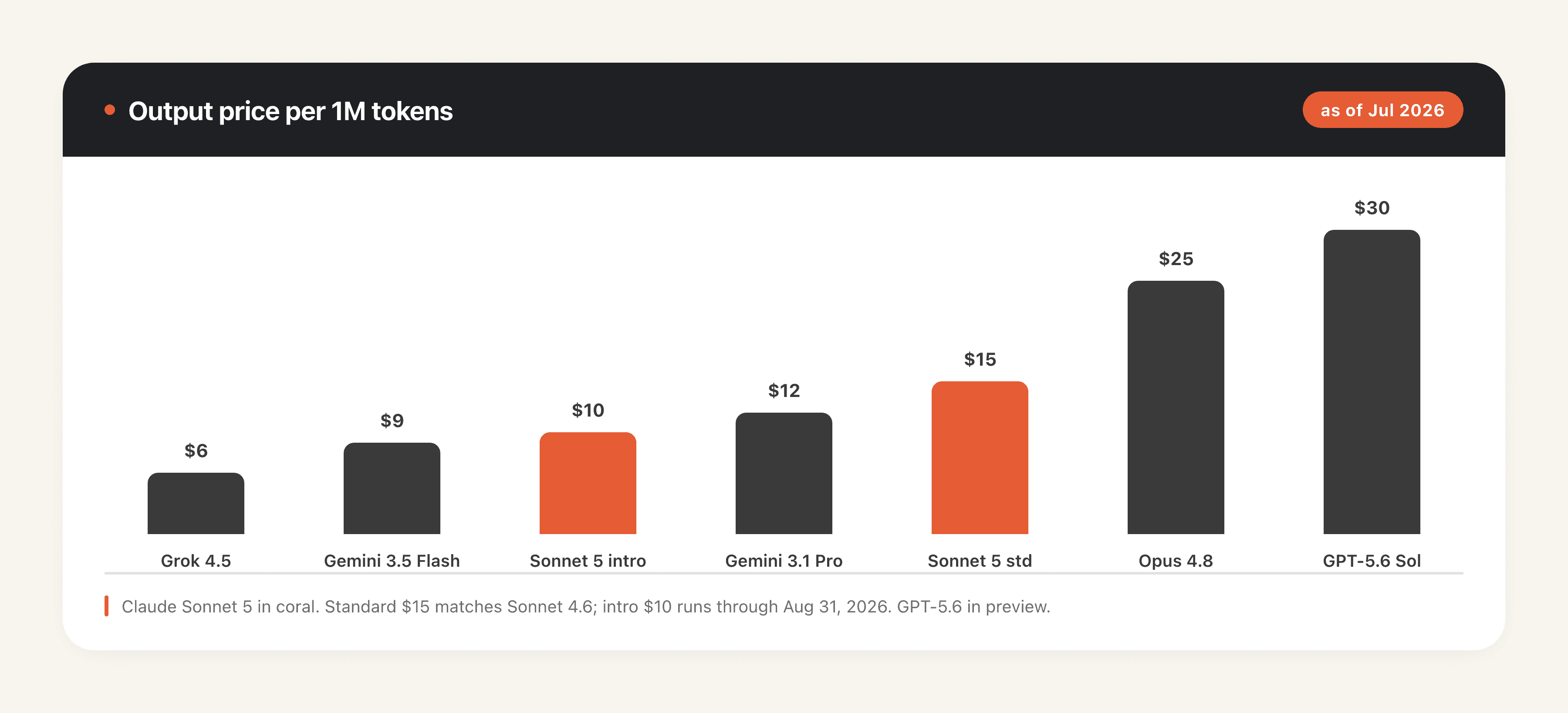
What this resolved: where Sonnet 5 sits in the July 2026 price landscape. What it left unsolved: sticker rates are not effective cost, which the next sections address.
What Actually Changes on September 1
Two things move at once, and both push cost up. First, the obvious one: intro pricing ends and rates go from $2/$10 to $3/$15. Second, the one that is easy to miss: Sonnet 5's new tokenizer already produces about 30% more tokens for the same text than Sonnet 4.6, with per-token rates unchanged.
Combine them and a stable workload can cost roughly 50% more in September than it did on the August intro-priced bill. It is not a rate hike alone; it is a rate hike stacked on top of token inflation that was there the whole time. We work the full arithmetic in a separate breakdown of the Sonnet 5 tokenizer cost change, including a three-state table you can drop your own numbers into.
Lena, a solo founder running a research agent, saw her July Sonnet 5 bill come in below her old 4.6 bill and assumed she had saved money for good. She had not read the end date. Forecasting off standard rates now, rather than the intro invoice, is the difference between a planned cost and a September surprise.
What this resolved: the September change is rate plus tokenizer, not rate alone. What it left unsolved: your exact increase depends on content shape, so recount your prompts.
How Sonnet 5 Compares to Opus, Grok, and Gemini
Against its own family, Sonnet 5 is far cheaper than Opus 4.8 (roughly $5/$25) while landing close to it on agentic tasks, which is the entire pitch: most of the capability at a fraction of the price. If you were reaching for Opus out of habit, Sonnet 5 is the reason to re-check.
Against rivals, the picture is mixed and worth being honest about. Grok 4.5 has a cheaper output rate ($6 versus Sonnet 5's $15 standard) and claims stronger token efficiency, but it is EU-blocked at launch and carries a smaller 500K context window. Gemini 3.5 Flash is cheaper still on sticker price but sits in a lighter capability tier. OpenAI's newest family, GPT-5.6, is still in limited preview: its flagship Sol matches Opus 4.8's premium $5/$30, while the everyday Terra tier ($2.50/$15) lands near Sonnet 5's standard rate. Sonnet 5 undercuts Sol by a wide margin and roughly ties Terra. Sonnet 5's differentiators are its 1M context window and its near-Opus agentic performance, not being the rock-bottom price. It competes on capability-per-dollar at the frontier, not on being the cheapest token.
What this resolved: Sonnet 5 wins on capability-per-dollar, not lowest sticker price. What it left unsolved: which trade matters depends on your workload, region, and context needs.
Ways to Access Sonnet 5 by Budget
Three tiers, from free to full API control.
- Free: Claude.ai's Free plan uses Sonnet 5 as its default model. For a full rundown of the model, see our Claude Sonnet 5 overview. For chat-style use, you can try the model without paying anything. The limit is that you get the chat product, not agent workflows or automated output.
- API: pay-as-you-go at the rates in the table above, with full control over prompts, tools, and integration. This is the developer path, and it comes with the migration traps and tokenizer recount covered in our cost guide.
- Inside an agent workspace: if you want Sonnet 5 wrapped in research-to-output agent workflows without touching an API key, MoClaw runs it from July 10, 2026. This suits non-technical users and lean teams who want the capability, not the plumbing.
Ravi, a consultant who is not a developer, did not want to manage API billing or hit the free-plan ceiling mid-project. Running Sonnet 5 through a MoClaw agent let him hand off research-and-draft tasks and get finished documents back, which the chat-only free tier could not do.
What this resolved: a clear free-to-API-to-agent ladder. What it left unsolved: the right rung depends on whether you need chat, code control, or hands-off output.
FAQ
Is Sonnet 5 cheaper than Opus?
Yes. Sonnet 5 runs $2/$10 intro and $3/$15 standard, versus Opus 4.8 at roughly $5/$25, while delivering agentic performance close to Opus. For most workloads it is the better value.
What happens to Sonnet 5 pricing after August 31, 2026?
Introductory $2/$10 pricing ends and standard $3/$15 pricing begins on September 1. Because the tokenizer already bills ~30% more tokens per request, effective cost can rise about 50% from the intro-window bill for a stable workload.
Is there a free version of Sonnet 5?
Yes, at the consumer tier. Sonnet 5 is the default model on Claude.ai's Free plan. That gives you the chat model, not automated agent workflows.
How does Sonnet 5 pricing compare to Grok 4.5?
Grok 4.5 has a lower output rate ($6 vs $15 standard) and a strong token-efficiency claim, but it is EU-blocked at launch and has a 500K context window versus Sonnet 5's 1M. Compare on your workload and region, not sticker price alone.
Locking In the Intro Window While It Lasts
Through August 31, 2026, Sonnet 5 at $2/$10 is genuinely cheaper than the model it replaces, which makes the intro window a real, if temporary, discount. The mistake is treating that number as permanent. Budget off the standard $3/$15 rate, remember the tokenizer adds ~30% more tokens per request, and you will not be surprised in September.
If you want Sonnet 5's capability without managing API keys or watching a deadline, MoClaw runs it behind a plain-English agent from July 10. Try it on the Sonnet 5 workspace page, and use the intro window to see whether the model earns a place in your stack before the standard rate kicks in.
Editor's note: Availability, pricing, and benchmark details here were verified against primary sources (Anthropic, OpenAI, xAI, and Google) on July 9, 2026. This space moves fast, especially preview status and regional rollouts, so check the linked sources before making production decisions.
Continue Reading
More Guide
Ox Alpha: What We Know So Far

Claude Code Session Manager: Wake for Mac

Grok Speaking Gibberish: What Actually Helps

How to Build Claude Skills for Agent Workflows

Claude Code AGENTS.md: What Actually Loads

Herdrm: One Mac Console for Every Coding Agent
The MoClaw editorial team writes about workflow automation, AI agents, and the tools we build. Default byline for industry overviews, listicles, and collaborative pieces.
Ready to put this into practice?
MoClaw runs browser tasks, research, and schedules automatically. Try it free.
References: Anthropic: Introducing Claude Sonnet 5 · Claude Docs: What's New in Sonnet 5 · TechCrunch: Anthropic Launches Sonnet 5 as a Cheaper Way to Run Agents · SpaceXAI: Developer Release Notes (Grok 4.5 Pricing) · IntuitionLabs: AI API Pricing Comparison 2026 · OpenAI: Previewing GPT-5.6 Sol (pricing tiers)