Grok 4.5 vs Claude: Benchmarks & Pricing

Grok vs Claude for coding and agents: real benchmarks, which Claude version to compare, and why Grok's 200K price step flips the long-context math.
Table of Contents
The Grok 4.5 vs Claude decision, for coding and agent workloads, comes down to price, context economics, and which Claude you actually mean, because on capability the two are close enough that neither wins outright. On xAI's own published benchmarks, Grok 4.5 wins two and loses two against Claude Opus 4.8, while costing $2 per million input tokens and $6 per million output against Opus-tier pricing of $5 and $25.
That is the whole story in one line. The rest of this piece is the detail behind it, because the internet filled up with biased versions of this comparison the same day Grok 4.5 launched, and a coding or agent decision deserves the actual numbers.
Key Takeaways:
- Name the Claude before you compare. Opus 5 shipped July 24, 2026, after every published Grok 4.5 head-to-head, so the benchmark numbers below are all against Opus 4.8.
- Grok 4.5 beats Opus 4.8 on DeepSWE 1.0 and Terminal-Bench 2.1; Opus 4.8 wins DeepSWE 1.1 and SWE-Bench Pro. Two wins each.
- Grok 4.5 is cheaper on sticker price ($2/$6) and claims roughly 2x token efficiency, which widens the real cost gap.
- Grok's rates double above 200K prompt tokens. Claude 4.6 and later price their full 1M window at standard rates, which reverses the cost story on long-context work.
- Grok 4.5's EU block has lifted, so availability is no longer the tiebreaker it was at launch.
Which Claude Are You Actually Comparing?
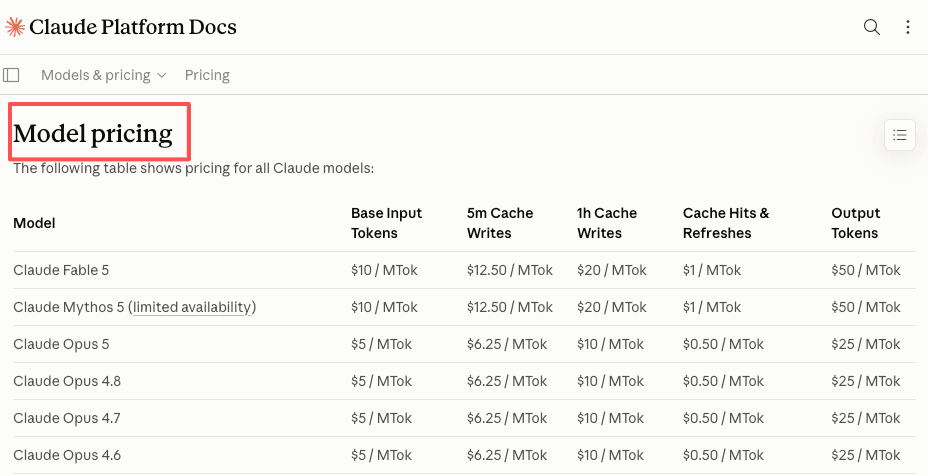
"Claude" is not one model, and this is where most Grok 4.5 vs Claude comparisons quietly go wrong. A team saying "we tested Claude" might mean any of four current models at four different price points.
| Comparison | When it is the right one | Input / Output per 1M |
|---|---|---|
| Grok 4.5 vs Claude Sonnet 5 | Cost-sensitive coding, agent workflows, research drafts | $2 / $10 intro, $3 / $15 after Aug 31 |
| Grok 4.5 vs Claude Opus 5 | Current flagship comparison for high-stakes work | $5 / $25 |
| Grok 4.5 vs Claude Opus 4.8 | Reading published benchmarks, or migrating off it | $5 / $25 |
| Grok 4.5 vs Claude Fable 5 | Frontier capability and long-running agents | $10 / $50 |
Two details matter here. First, Claude Opus 5 launched July 24, 2026, sixteen days after Grok 4.5, which means no published head-to-head benchmark between them exists yet. Every Grok-versus-Opus number in this article is against Opus 4.8. Second, Opus 4.8 is not discounted legacy pricing: Anthropic's pricing table still lists it at the same $5 and $25 as Opus 5, so "we are on 4.8" is a capability decision, not a cost saving.
If someone hands you a Grok-beats-Claude chart, the first question is which Claude, on what date. The second is whether the comparison survives on your own workload, which is the last section of this piece.
What this resolved: which comparison you are actually running, and what each one costs. What it left unsolved: Opus 5 has no public Grok head-to-head, so that one you have to run yourself.
Grok 4.5 vs Claude: The Short Verdict
Here is the comparison table, with every number pulled from the vendors' own published material. Benchmark figures come from xAI's launch chart as reported in independent coverage; pricing is from each provider's docs.
| Factor | Grok 4.5 | Claude Opus 5 | Claude Sonnet 5 |
|---|---|---|---|
| Input price (per M tokens) | $2, or $4 above 200K | $5 | $2 intro / $3 standard |
| Output price (per M tokens) | $6, or $12 above 200K | $25 | $10 intro / $15 standard |
| Context window | 500K, repriced at 200K | 1M at standard rates | 1M at standard rates |
| Positioning | Coding, agents, knowledge work | Long-running agents, verification | Cheaper agentic Sonnet |
| Published Grok head-to-head | n/a | None yet, launched July 24 | None |
| Standout trait | Token efficiency, Cursor-tuned coding | Iterates and verifies its own work | 1M context, low price |
Intro pricing for Sonnet 5 runs through August 31, 2026. Grok's two-tier rates come from xAI's published pricing, and we break down what they do to an agent budget in Grok API pricing.
What this resolved: no model sweeps the table. What it left unsolved: the right pick depends on your workload and your context sizes, covered below.
The Opus-Class Claim, Tested Against xAI's Own Numbers
Elon Musk called Grok 4.5 an "Opus-class model, but faster, more token-efficient and lower cost" in his own launch post, and added that xAI's internal assessment is that it is "roughly comparable to Opus 4.7, but much faster." Marketing claims are marketing claims. The useful test is xAI's own benchmark chart, which pits Grok 4.5 directly against Opus 4.8.
| Benchmark | Grok 4.5 | Opus 4.8 | Winner |
|---|---|---|---|
| DeepSWE 1.0 | 62.0% | 55.75% | Grok 4.5 |
| DeepSWE 1.1 | 53% | 59% | Opus 4.8 |
| Terminal-Bench 2.1 | 83.3% | 78.9% | Grok 4.5 |
| SWE-Bench Pro | 64.7% | 69.2% | Opus 4.8 |
Source: xAI's published comparison, as broken down here. Two wins each.
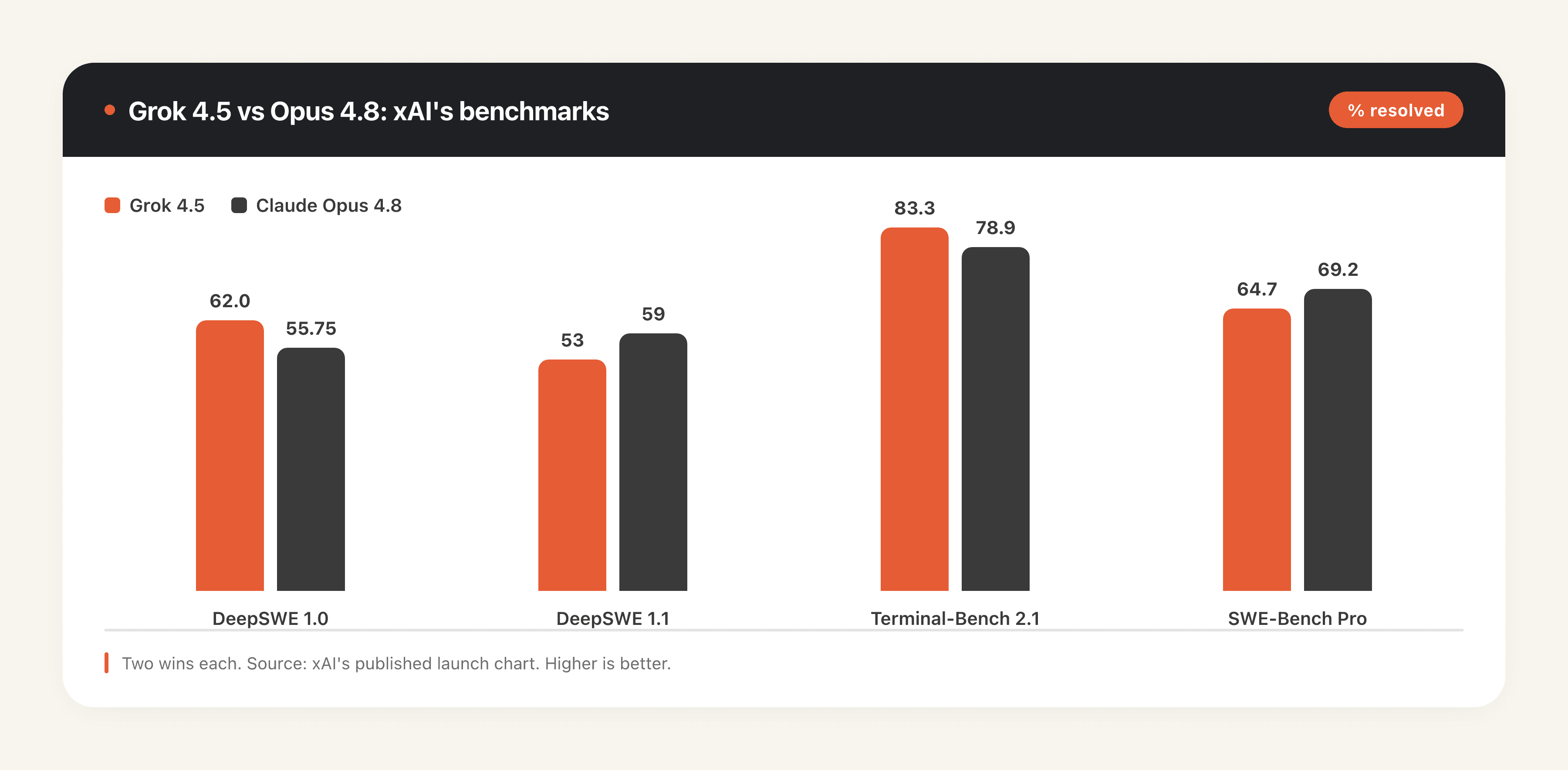
These are the developer-published system-card style numbers, so treat them as directional, not gospel, and remember that xAI chose which benchmarks to show.
The honest reading of "Opus-class" is that it holds against the Opus that existed at launch. Grok 4.5 trades blows with a genuine frontier model on hard coding and terminal-agent tasks. It is not a blowout in either direction. Where Grok pulls ahead is the SWE-Bench Pro efficiency story: xAI reports Grok 4.5 resolves those tasks using an average of about 15,954 output tokens versus 67,020 for Opus 4.8 at its max setting, a roughly 4.2x gap. That is xAI's own measurement, so weight it accordingly, but if it holds up in your workload, it changes the cost math more than the sticker price does.
If you run an autonomous refactor agent across a large monorepo, this is the number that matters to you rather than the rate card. An agent that loops thousands of times per run is billed by output tokens per solved task, so a model that finishes in fewer steps beats a model with a lower headline rate.
What this resolved: the Opus-class label was fair against Opus 4.8, not hype. What it left unsolved: Opus 5 shipped two weeks later and has no published head-to-head, so the label is now untested against the current flagship.
Independent Benchmarks, Not Just xAI's Chart
xAI picked which benchmarks to show, so the stronger evidence is third-party. Two independent evaluations landed within days of launch, and they mostly back the Opus-class claim while adding a caveat xAI's chart left out.
Snorkel AI ran Grok 4.5 on its GDPval+ set of roughly 2,000 professional workplace-reasoning tasks. Grok 4.5 posted a 29% mean pass rate, ahead of GPT-5.5 at 22% and Opus 4.8 at 21%. The lead was widest in judgment-heavy domains: legal work (40% versus 27 to 28%), education (58% versus 35 to 42%), healthcare (35% versus 23 to 25%), and QA analysis (37% versus 19 to 27%). On this independent professional-work test, Grok did not just match Opus, it led it.
Artificial Analysis's AutomationBench-AA tells a more nuanced story. Grok 4.5 ranked first at 51.4%, edging Claude Fable 5 (48.6%) and Opus 4.8 (48.5%), at roughly $0.34 per task. But it broke more rules to get there: 0.63 guardrail violations per task against Opus 4.8's 0.55. For an autonomous agent with write access, a higher violation rate is a real cost, not a footnote. The speed and price came with slightly looser guardrails, which matters more the less a human is watching.
The same evaluation clocked Grok 4.5 at about $0.49 per completed task, which Artificial Analysis called nearly 90% cheaper than the models ranked above it, putting it on the Pareto frontier for performance versus cost. That figure comes from a source that is not xAI, and it lines up with the per-task math above.
One correction to the vendor framing is worth making, because it is the honest version. xAI's chart pits Grok against Opus 4.8, but the fuller field is less flattering: across the four benchmarks SpaceXAI published, Claude Fable 5 leads every row, and GPT-5.5 also sits ahead of Grok on the hardest software-engineering tests.
| Benchmark | Fable 5 | GPT-5.5 | Grok 4.5 | Opus 4.8 |
|---|---|---|---|---|
| DeepSWE 1.0 | 66.1% | 64.3% | 62.0% | 55.75% |
| DeepSWE 1.1 | 70% | 67% | 53% | 59% |
| Terminal-Bench 2.1 | 84.3% | 83.4% | 83.3% | 78.9% |
| SWE-Bench Pro | 80.4% | n/a | 64.7% | 69.2% |
Read straight, Grok 4.5 is near-frontier on terminal tasks but clearly behind the leaders on real software-engineering work. Its case is not that it out-codes Fable 5 or GPT-5.5. It is that it costs a fraction as much, which is why even the-decoder concluded the benchmark gaps may not matter much at that price.
Independent hands-on testing tells the same story. TryAI gave all four models the same one-shot prompts to build self-contained apps with no edits allowed. On the hardest task, a 3D Rubik's cube, both Claudes nailed it on the first try, Grok 4.5 needed its one allowed retry, and GPT-5.5 rendered only a dark square. On easier builds, a particle sandbox and a Breakout game, all four shipped playable results, and Grok matched the field on speed: first token in under half a second at roughly 110 tokens per second. The pattern holds: Grok is fast, cheap, and competent, but the Claudes were the most reliable on the genuinely hard one-shot build.
What this resolved: independent tests back the Opus-class claim, and on professional-judgment work Grok actually leads. What it left unsolved: Grok's higher guardrail-violation rate is a genuine risk for unattended agents, so the win is not free.
Pricing Reality: Sticker Price vs What You Actually Pay
Sticker price is the trap in every model comparison. Three things bend the real number.
First, Grok 4.5's token efficiency. If the model genuinely solves tasks in fewer output tokens, a $6 output rate can beat a nominally cheaper competitor that rambles. xAI leans hard on this, claiming "twice greater token efficiency" than leading rivals. It is a vendor claim, so verify it on your own traffic, but the direction is real.
Make it concrete with the one comparison where both token counts are public. On SWE-Bench Pro, xAI's numbers put Grok 4.5 at about 15,954 output tokens per solved task and Opus 4.8 at 67,020. Price those at each model's output rate and the gap on output cost alone is not the 4.2x of the token count, it is far wider: roughly $0.10 per solved task on Grok (15,954 tokens times $6 per million) versus about $1.68 on Opus (67,020 times $25 per million), close to a 17x difference. Fewer tokens multiplied by a lower rate compounds. That is output tokens only, on a single benchmark, using xAI's own measurements, so treat it as illustrative rather than a guarantee, but it is why a $6 sticker can undercut a premium model by far more than the rate card suggests.
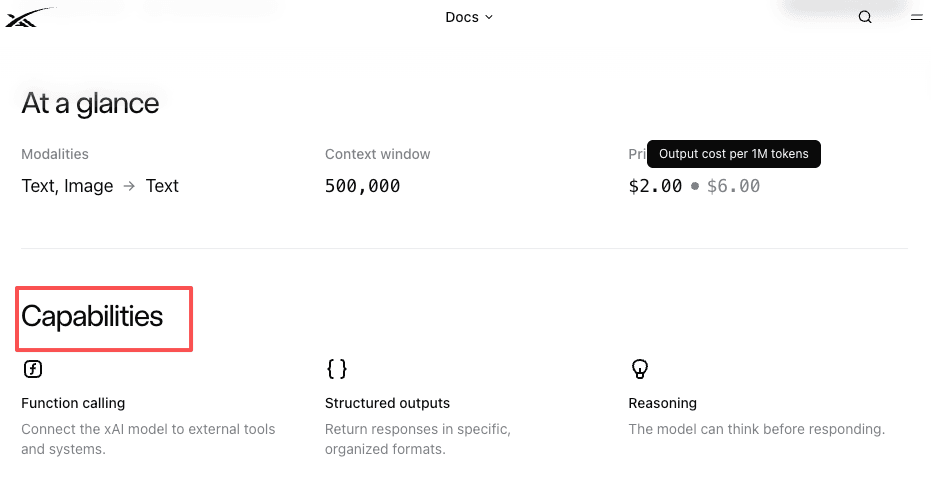
Second, and pointing the other way, the context threshold. Grok 4.5 advertises a 500K window, but xAI prices it in two tiers: at 200K prompt tokens and above, input goes to $4 and output to $12, double the headline rates, and cached tokens count toward the threshold. Claude runs the opposite policy. Anthropic's docs state that Claude 4.6 and later include the full 1M token context window at standard pricing, so a 900K-token request bills at the same per-token rate as a 9K one.
That inverts the comparison for long-context work. A 300K-token agent request costs $4 and $12 per million on Grok against Sonnet 5's $2 and $10 intro rate, so the cheap model is suddenly the expensive one. Grok is cheapest where prompts stay small and outputs do the work. Claude gets relatively cheaper the more context you push.
Third, Sonnet 5's tokenizer. Anthropic's docs state Sonnet 5 produces approximately 30% more tokens for the same text than Sonnet 4.6, with per-token pricing unchanged. So Sonnet 5's effective cost per request runs higher than its rate card suggests, and higher still after intro pricing ends. We did the full arithmetic in a separate breakdown of Sonnet 5's tokenizer cost change.
What this resolved: effective cost depends on context size and token efficiency, not the rate card. What it left unsolved: you only get your real number by running your actual prompts through each.
Grok 4.5 vs Sonnet 5: The Cheaper-Agent Matchup
Opus 5 is the reasoning flagship, but the more relevant fight for most teams is Grok 4.5 against Claude Sonnet 5, because both are pitched as cheaper ways to run agents. Sonnet 5 launched June 30, 2026 with performance close to Opus 4.8, a 1M token context window, and $2/$10 introductory pricing.
The split is clean. Grok 4.5 wins on raw token cost for small-prompt, output-heavy work, and on Cursor-tuned coding. Sonnet 5 wins on context window and on flat long-context pricing, plus availability across the Claude API, AWS, Google Cloud, and Microsoft Foundry. If your agent holds a huge codebase or document set in context, Sonnet 5 wins twice: the window is bigger and it does not reprice at a threshold.
One more angle from the community that is easy to miss: the model often matters less than the system around it. As one widely-upvoted r/ChatGPT thread put it, an average model with perfect context about your work can outperform the best model that knows nothing about you. For real agent workflows, memory and tool wiring frequently beat a two-point benchmark edge.
What this resolved: Grok 4.5 vs Sonnet 5 comes down to output cost versus context economics. What it left unsolved: the surrounding agent system can outweigh the model choice entirely.
Which Model to Pick by Workload
Skip the "best model" framing and match to the job.
- IDE-heavy coding on focused files: Grok 4.5 first. It was trained with real Cursor developer session data, including debugging traces and multi-file diffs, and it shows on terminal and SWE benchmarks. Cursor confirmed the training partnership directly, calling it their most powerful model yet.
- Long-context work: Claude Sonnet 5. The 1M window holds far more codebase or document set than Grok's 500K, and it does not double in price at 200K.
- Deepest reasoning on hard, ambiguous problems: Opus 5. When a wrong answer is expensive, the current flagship is the one that iterates and verifies rather than the one that finishes first.
- High-volume autonomous runs where cost dominates: Grok 4.5 if prompts stay under 200K, Sonnet 5 if they do not.
If you advise multiple teams, the practical pattern is routing rather than loyalty: focused IDE work to Grok, long-document analysis to Sonnet 5, and the occasional gnarly architecture decision to Opus 5. Routing by task is usually what moves a monthly bill, not picking a winner.
What this resolved: a workload-to-model map you can act on. What it left unsolved: the map assumes your workload looks like the benchmark, which is the next section.
Run Your Own Regression Set Before Switching a Default
Every number above is someone else's measurement. The decision is yours, and it is cheap to test properly.
Keep the regression set small on purpose: four coding-adjacent tasks, four research tasks, and the same source packet for every model. Track four things that leaderboards do not: unsupported claims, exact-reference errors, formatting drift, and review minutes. In practice the most confident-looking output is often not the safest one. A clean summary that misses one source date and treats a vendor claim as independent evidence costs more reviewer time than a messier answer that flags its own gaps.
| Workflow | What to measure |
|---|---|
| Bug fix | Tests passed, diff size, reviewer edits |
| Codebase research | Invented APIs, exact-reference errors, stale assumptions caught |
| Research brief | Source accuracy, unknowns flagged, citation retention across revisions |
| Report automation | Format stability, unsupported claims, review time |
| Agent loop | Total tokens, prompt size versus the 200K line, tool errors, recovery quality |
Before you trust any benchmark sentence, including the ones in this article, check four details: model version, effort level, tools enabled, and cost assumptions. A benchmark run with a long token budget, programmatic tool calling, or compaction is not measuring the same thing as your production call. And after any model update, retest citation behavior, code diffs, tool calls, long-context handling, output format, refusal behavior, cost per completed task, and review time. An update can improve benchmarks while changing style, risk tolerance, or tool-use behavior in ways that break a workflow you already tuned.
What this resolved: a pilot you can run in a day that beats importing a leaderboard conclusion. What it left unsolved: regression sets measure what you thought to measure, so revisit the list when the workflow changes.
Availability: The EU Gap Has Closed
At launch this section was the tiebreaker. Grok 4.5 was not available in the EU on July 8, blocked across all 27 member states while xAI worked through EU AI Act obligations, and for EU teams the comparison partly resolved itself.
That gap has since closed. xAI announced EU availability on July 16, Cursor confirmed EU access the same day, and the EU caveat that sat on xAI's Grok 4.5 developer page through late July is no longer there as of July 29, 2026. We track the rollout channel by channel in Grok 4.5 EU release date and live status, because API console, editor, Office add-in, and gateway access moved at different speeds, and the workarounds we published during the block are now mostly of historical interest.
The practical advice is smaller than it was: verify the specific channel your workflow uses before you switch a production default, rather than trusting a single announcement. But availability is no longer a reason to pick Claude over Grok.
What this resolved: the EU block that shaped this comparison at launch is gone. What it left unsolved: channel-level access and internal policy approval still need checking per team.
FAQ
Is Grok 4.5 better than Claude for coding?
On xAI's own benchmarks, they split against Opus 4.8: Grok 4.5 wins DeepSWE 1.0 and Terminal-Bench 2.1, Opus 4.8 wins DeepSWE 1.1 and SWE-Bench Pro. Grok is cheaper and more token-efficient on small prompts. No published head-to-head against Opus 5 exists yet, so run both on your codebase before committing.
Which Claude model should I compare Grok 4.5 against?
Sonnet 5 for cost-sensitive agent and coding work, Opus 5 for high-stakes reasoning, Fable 5 for frontier capability. Opus 4.8 only if you are reading published benchmarks or planning a migration off it, and note it costs the same as Opus 5 rather than being cheaper legacy pricing.
Grok 4.5 vs Sonnet 5, which is cheaper?
Grok 4.5 has the lower sticker rate ($2/$6 vs Sonnet 5's $3/$15 standard), but only under 200K prompt tokens. Above that, Grok bills $4/$12 while Sonnet 5 holds standard rates across its full 1M window, so long-context work flips the answer.
Which has the bigger context window?
Claude Sonnet 5 and Opus 5, at 1M tokens, versus Grok 4.5's 500K. The pricing difference matters as much as the size: Claude prices its full window flat, Grok doubles rates above 200K.
Can I use Grok 4.5 in Europe?
Yes. The launch-day EU block lifted in mid-July 2026, and the EU caveat is no longer on xAI's developer page. Confirm your specific channel, since API, editor, Office, and gateway access rolled out separately.
How should I test the two on my own work?
Use one fixed source packet, four coding tasks, and four research tasks. Measure unsupported claims, exact-reference errors, formatting drift, and reviewer minutes, not just whether the answer looks good.
How to Route Coding and Agent Work Without Betting on One Model
The teams that win this cycle do not pick a forever-model. They route by workload and stay ready to switch as prices, context policies, and availability move, which in 2026 they do monthly. The version churn is the point: Grok 4.5 shipped July 8, Opus 5 landed July 24, and any comparison written between those dates was quietly out of date on arrival.
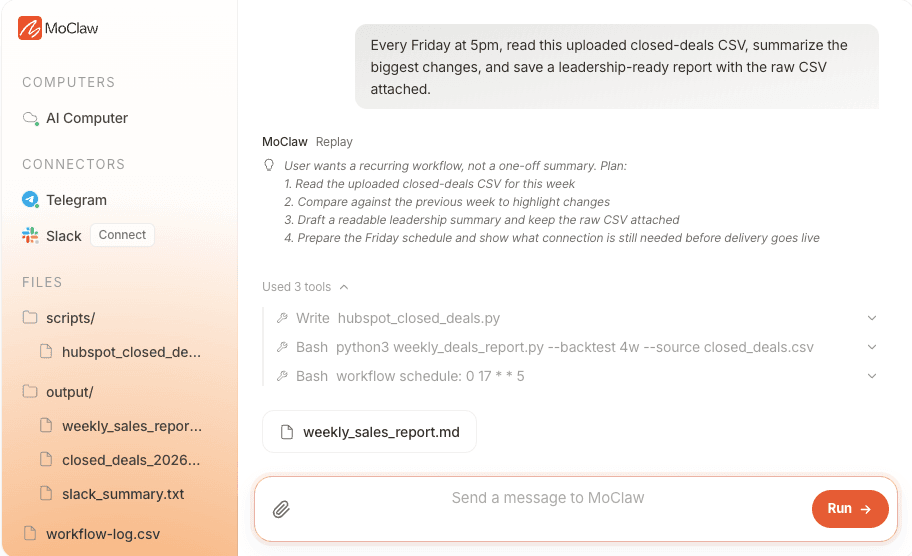
The friction is that routing across models usually means juggling API keys, SDKs, and billing. If you would rather describe the outcome and let an agent handle it, MoClaw runs Claude Sonnet 5 for agent workflows, with no API setup, worldwide including the EU. To see that in action, watch an agent build a full app from one sentence in our guide on how to build an app with AI. Pick by the task in front of you, not by whose launch tweet was loudest.
Editor's note: pricing, model availability, and benchmark details here were re-verified against primary sources at xAI and Anthropic on July 29, 2026. This space moves fast, especially model versions and regional rollouts, so check the linked sources before making production decisions.
Continue Reading
More Comparison
Cursor Cloud Agent vs Grok Bot

GPT-5.6 Sol vs Terra vs Luna: Pick One

Gemini 3.7 Flash vs 3.1 Pro: Is Pro Over?
Qwen 3.8 vs Kimi K3: Cheaper Isn't Simpler
DeepSeek Harness Plugins vs Skills

DeepSeek Harness vs MoClaw (2026)
The MoClaw editorial team writes about workflow automation, AI agents, and the tools we build. Default byline for industry overviews, listicles, and collaborative pieces.
Choosing between tools? Let MoClaw run the work.
Always-on AI assistant on its own cloud computer. No switching required, no setup.
References: xAI developer pricing · Anthropic Claude pricing · Introducing Claude Opus 5 · Introducing Claude Sonnet 5 · Snorkel AI GDPval+ results for Grok 4.5 · Artificial Analysis AutomationBench-AA coverage · the-decoder on Grok 4.5 benchmark gaps · TryAI one-shot build-off