Claude Code Recipes for Knowledge Workers
Claude Code recipes for knowledge workers turn meetings, reports, research, documents, and data cleanup into repeatable, reviewable team workflows.
Table of Contents
Claude Code recipes for knowledge workers are reusable task instructions that package meeting notes, reports, research, documents, and data cleanup into repeatable workflows.
Key takeaways:
- "Recipes" is a content framing term here, not a confirmed Anthropic feature name.
- Claude Code is still officially coding-first, so knowledge work recipes should respect its file, terminal, and review boundaries.
- Useful recipes define sources, output format, checks, and human review before the task starts.
- Claude Code business workflows work best when the output is a draft, summary, table, or file that a person can inspect.
- MoClaw fits the cloud workflow layer when recurring tasks need files, delivery, and review outside a local coding setup.
Vera here. I think of a good recipe as the opposite of a heroic prompt. Instead of asking an AI to "make this better," I want the reusable instruction to say what sources to read, what to produce, what to ignore, what to flag, and when to stop. That difference matters when knowledge work automation moves from one clever output to a workflow the team may reuse every week.
What "Claude Code Recipes" Should Mean for Knowledge Work
A Claude Code recipe should mean a reusable work pattern. It is not a magic feature label, and it should not be presented as an official Anthropic product category unless Anthropic names it that way in current materials.
Anthropic positions Claude Code as an agentic coding system that reads codebases, changes files, runs tests, and delivers committed code. That official center of gravity matters. When knowledge workers borrow the "recipe" idea, they are adapting a coding-first tool pattern into structured file and document work.
Reusable task instructions, not a magic feature
A useful recipe is a short operating brief. It should include the task goal, source location, allowed inputs, output format, review criteria, and stop conditions.
For example, a weak instruction is: "Summarize this folder." A recipe is: "Read the meeting notes in this folder, extract decisions, owners, deadlines, unresolved questions, and customer-impact items, then create a one-page action summary. Do not invent owners. Mark missing dates as unknown."
That is an AI productivity recipe because it makes the work repeatable. The value is not that the agent guesses better. The value is that the task shape stays stable.
Where Claude Code is still coding-first
Claude Code can work with files beyond code, but its primary design focus remains software development. It is built around local projects, repositories, command-line work, file edits, checks, and review.
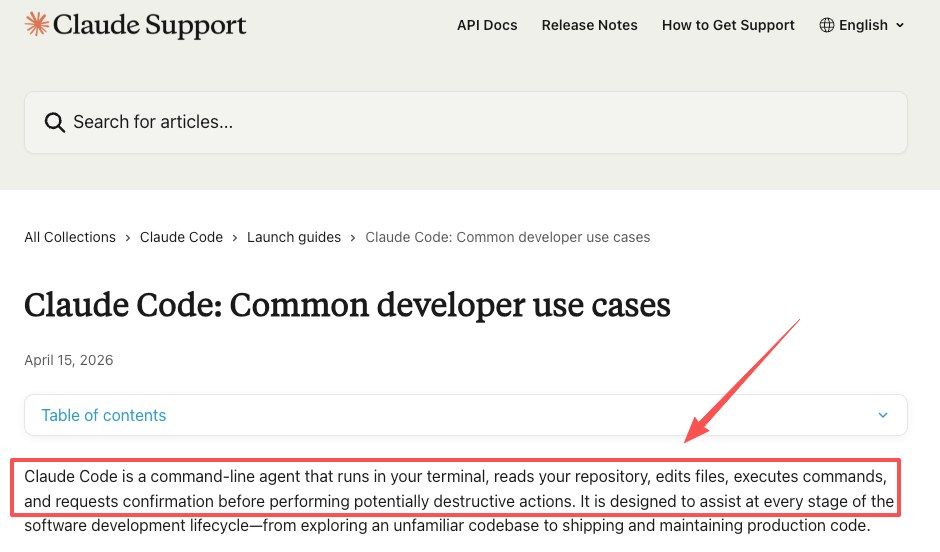
Claude Code functions as a command-line agent that can read repositories, edit files, execute commands, and request confirmation before potentially destructive actions. This makes it powerful, but it also means knowledge workers should avoid treating it as a generic document assistant with no boundaries.
If the recipe touches client documents, financial data, private notes, or final deliverables, the workflow needs clear source rules and human approval.
Practical Recipe Examples
The best Claude Code for work examples are narrow enough to review. Start with one folder, one output type, and one owner.
Meeting notes to action summary
This recipe turns raw notes into a clean follow-up summary. The instruction should identify the source files, the expected sections, and the uncertainty rules.
A practical recipe might produce: decisions, action items, owners, deadlines, blocked items, and questions for the next meeting. It should preserve quotes only when needed and mark unclear ownership instead of assigning tasks based on guesswork.
I saw the same problem in meeting-note drafts. In one batch of 9 summaries, 6 captured the main discussion correctly, but 4 still needed edits before sharing. Two assigned ownership too strongly, one turned a tentative date into a deadline, and one missed an unresolved customer-impact question. That is why I treat meeting recipes as draft systems, not decision systems.
Weekly report from a folder
A weekly report recipe is useful when a team stores updates, exports, or notes in a shared project folder. The recipe can read the week's files, compare them with the previous structure, and draft a report.
The instruction should define the sections: wins, risks, numbers, blockers, decisions needed, and source files reviewed. It should also say what not to do: do not smooth over missing data, do not merge two conflicting numbers, and do not call a forecast final unless the source file labels it final.
This is where Claude Code business workflows can help operations teams, but only if someone owns the final file.
Research synthesis from source files
A research recipe can turn saved articles, transcripts, notes, and PDFs into a synthesis brief. It should separate confirmed facts from interpretation and include a source table.
A recipe for research synthesis should ask for claims, evidence, confidence, and unknowns. If the source set is incomplete, the output should say that directly.
Spreadsheet and document cleanup
A cleanup recipe can normalize headings, remove duplicate rows, flag missing fields, rename files, or create a cleaner draft document. This is useful, but it needs strong boundaries.
For spreadsheets, the recipe should say whether it can edit the original file or must create a copy. For documents, it should say whether changes should be tracked, summarized, or saved as a new version. For client work, the output should remain draft-only until reviewed.
Review Gates Before Using Outputs
Recipes become risky when teams trust the format more than the evidence. A clean table can still be wrong. A polished report can still hide missing sources.
Source checks
Every recipe should include a source check. Which files were read? Which files were skipped? Which file looked stale? Which source contradicted another?
Source checks make the result easier to review. They also stop the recipe from becoming an invisible authority. If a meeting note, export, or research file is missing, the output should show the gap.
Human edits
Human edits are not a failure. They are part of the workflow. The recipe should define where human judgment belongs: tone, final recommendation, client interpretation, legal sensitivity, financial claims, and ownership assignments.
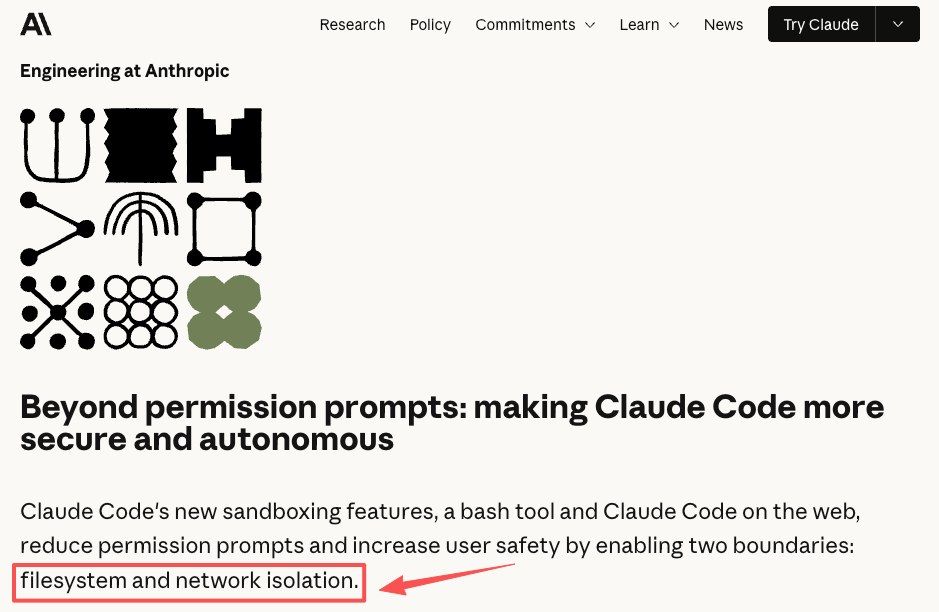
Anthropic's sandboxing work focuses on giving Claude Code safer boundaries around filesystem and network isolation. Knowledge work recipes need the same mindset in plain language: limit access, draft first, review before final use.
Final file ownership
A recipe should name who owns the final file. If Claude Code creates a report, who approves it? If it cleans a spreadsheet, who checks the formulas? If it drafts client-facing language, who decides it can be sent?
Ownership matters because files outlive prompts. A recipe may create the draft, but a person should own the canonical version.
How MoClaw Fits This Workflow
MoClaw fits when the recipe idea needs a managed cloud workflow rather than a local coding-first environment. It should not be described as Claude Code, and it should not be framed as an Anthropic replacement. The fit is different: recurring digital work, browser-based tasks, file outputs, delivery, and review checkpoints.
For teams turning AI productivity recipes into recurring work, MoClaw's AI workflow automation describes workflows involving browser tasks, files, reports, logs, and scheduled delivery. MoClaw's automate tasks with AI fit simpler recurring tasks that need a dedicated AI assistant path rather than a developer terminal.
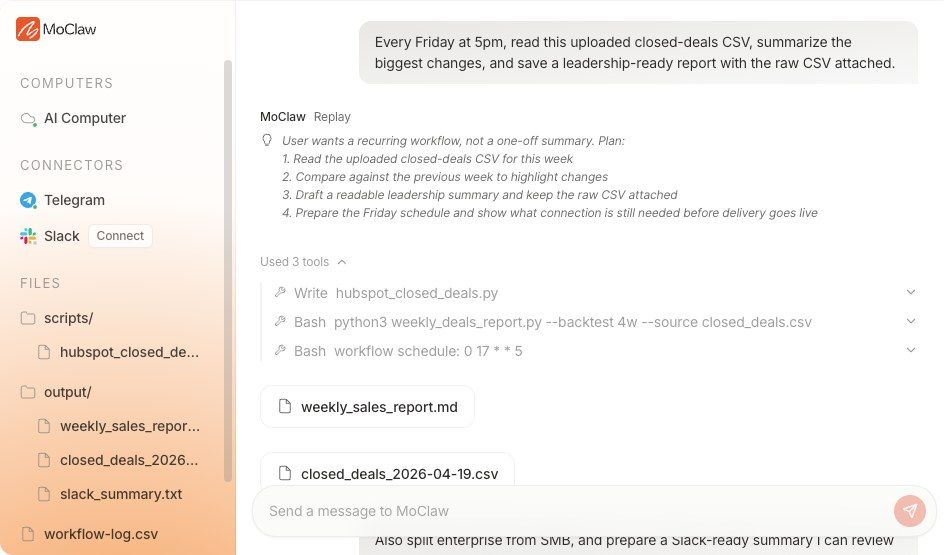
The practical split is simple. Use Claude Code recipes when the task lives naturally in a project folder and benefits from file-level review. Use a managed cloud workflow when the task should recur, run in a persistent workspace, and return deliverables for human checking.
FAQ
Can non-engineers use these recipes without managing a codebase?
Yes, if the workflow is set up around clear folders, safe copies, and reviewable outputs. Non-engineers should avoid recipes that require command-line setup, repository permissions, or destructive file actions unless a technical teammate prepares the environment.
Where should a team store reusable recipe instructions?
Store them where the team already keeps workflow rules: a shared folder, internal wiki, project README, or dedicated recipe library. Each recipe should include owner, version, allowed sources, output format, review rule, and last-tested date.
What if a recipe includes private client documents?
Treat the recipe as sensitive. Limit access to the client folder, require draft-only output, avoid unnecessary copying, and record who reviewed the final file. If the documents include regulated or contractual data, ask the responsible legal, security, or client owner before reuse.
Can recipes be shared across departments?
Yes, but only after removing department-specific assumptions. A sales recipe may not fit finance. A research recipe may not fit legal. Share the structure, then let each department define sources, approval rules, and final ownership.
Claude Code Recipes Work When They Stay Reviewable
Claude Code recipes for knowledge workers are most useful when they make repeated work clearer, not when they pretend judgment has disappeared. A strong recipe turns Claude Code for work into a repeatable flow: read the right sources, produce the right artifact, show the gaps, and stop for review. That is how knowledge work automation becomes dependable enough for meetings, reports, research, documents, and data tasks.
Continue Reading
More Guide
What Is Hermes Bot Mode? Bots and Routines

OpenAI Assistants API Deprecated: What Broke

MCP Tools: What They Are and Which to Use

OpenAI Models Not Available in Cursor Nov 12

Coding Agent Security: When Your Tools Lie

OpenAI Python HTTPX2: What Actually Breaks
The MoClaw editorial team writes about workflow automation, AI agents, and the tools we build. Default byline for industry overviews, listicles, and collaborative pieces.
Ready to put this into practice?
MoClaw runs browser tasks, research, and schedules automatically. Try it free.
References: Anthropic — Claude Code · Claude Code — Common developer use cases · Anthropic — Claude Code sandboxing