Claude Code SEO Skill: Fire Your SEO Agency

A Claude Code SEO skill audits SEO, AEO, GEO, LLMO and Naver on its own. What it checks, what it refuses to do, and the caveat in its own README.
Table of Contents
The pitch is right there in the repository name, and it is not subtle. A Claude Code SEO skill called fire-your-seo-agency shipped on 26 August 2026, and by 28 August it had 274 stars and 73 forks. Its opening line asks whether you're paying $400 to $2,500 a month for an SEO or "AI visibility" retainer, then suggests you stop, on the grounds that most of what that money buys is public standards and repeatable checklists.
That argument deserves a harder look than the marketing around it invites. Some of it holds. One part of it doesn't travel, and the repo is oddly quiet about which part.
Key Takeaways:
- fire-your-seo-agency is a Claude Code skill that audits five search surfaces separately: SEO, AEO, GEO, LLMO and Naver.
- It opens with a crawler-eye scorecard carrying evidence, not a list of recommendations.
- Its refusal list is specific: no bought links, no engagement pods, no guaranteed-ranking claims, no cloaking.
- The canonical reference documents are Korean; the English files under
references/en/are mirrors for human readers. - The traffic results in the README come from the author's own Search Console and cannot be independently checked.
What the skill actually is
A Claude Code skill, installed either as a plugin (/plugin marketplace add leopard627/fire-your-seo-agency, then /plugin install) or by cloning the repo into .claude/skills/. You invoke it with /fire-your-seo-agency audit my site and it starts with a crawler-eye pass, reading your site the way a bot does with no JavaScript, before it proposes changing anything.
What comes back first is a scorecard rather than a plan: five rows, each marked pass, warning or fail, each carrying its evidence. The README's own example reads like a site that has never been looked at properly — body copy server-rendered but 214 detail pages missing from the sitemap, no FAQ structured data at all, no llms.txt, a robots policy that hasn't decided what to do about GPTBot, and a brand name spelled three different ways across the site. Only then does it propose priorities, implement them, and schedule a re-measurement.
Five lanes, five different graders
The structural idea is the good part, and it's worth stealing whether or not you install anything.
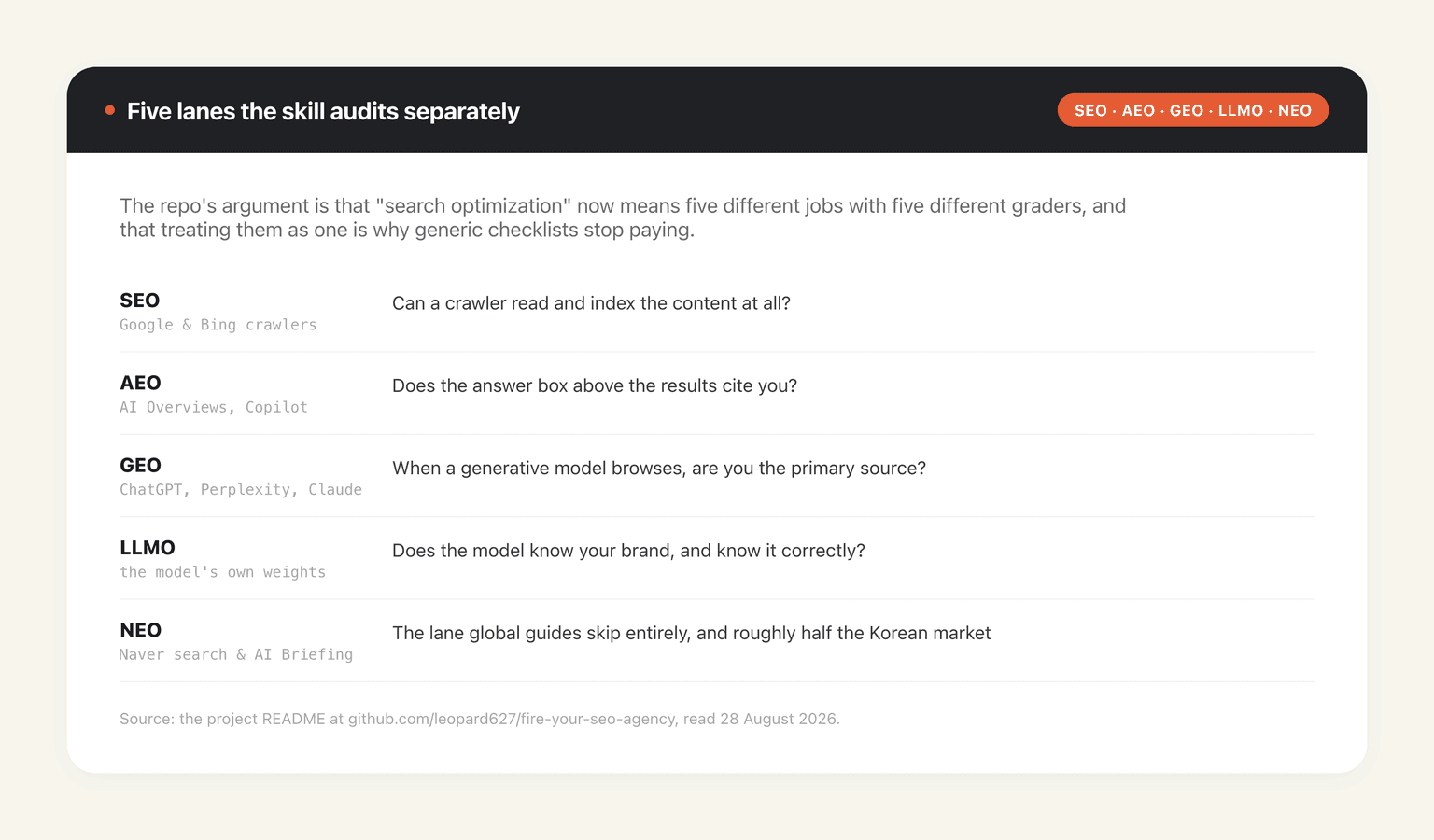
Most SEO checklists still assume one audience: a crawler that indexes pages and a ranking algorithm that orders them. This skill splits that into five jobs with five different graders. SEO is the old one, asking only whether a crawler can read and index you. AEO asks whether the answer box sitting above the results cites you. GEO asks whether you're the primary source when a generative model browses on someone's behalf. LLMO is the odd one out, because it targets nothing you can crawl: it asks whether the model's own weights know your brand, and know it correctly.
The fifth lane is NEO, for Naver, and it's where the repo has something nobody else does. Global answer-engine guides skip Korean search entirely; if you sell into Korea, that's half your market handled by a lane your checklist doesn't have. The reference doc walks from Naver Search Advisor registration through what Naver Search Advisor needs before AI Briefing will cite you.
Each lane gets its own reference file in the repo, plus one for the measurement loop, so the skill isn't a single prompt with delusions of grandeur. It's a procedure in SKILL.md reading from six documents.
LLMO is the lane that quietly breaks the one-shot audit model, and it's worth sitting with for a second. Whether a model knows your brand correctly isn't a property of your site, so you can't check it by crawling yourself; you check it by asking several models the same questions and comparing what comes back, then doing that again after the next training cut. One run tells you almost nothing, because a single answer from a single model on a single day is an anecdote. That shape of work argues for keeping the results somewhere durable rather than in a terminal buffer, which is one of the plainer arguments for running an agent on a machine you don't close: MoClaw gives the job a filesystem that outlives the session, so the answer you got in August is still sitting next to the one you get in October.
The refusals are the most credible part
Any tool selling itself on replacing an agency has an obvious failure mode, which is doing agency-shaped damage faster. This one lists what it won't do, in plain terms: no buying backlinks, no engagement pods, no content spam, no guaranteed-ranking promises, no keyword stuffing, hidden text or cloaking. The stated reason for the first group is that it isn't in the business of fighting the search engine; for the second, that a claim without measurement isn't a claim.
There's a practical wrinkle behind that first refusal, though. The crawler-eye pass has to fetch your site with JavaScript switched off, and the measurement half wants standing access to Search Console, Bing Webmaster Tools and, in the Korean lane, Naver Search Advisor. That is a small pile of credentials and a browser context that has to exist somewhere. On a laptop that means it exists until you reinstall; on a hosted machine like MoClaw it exists where the recurring job runs, which is the same place the last run's output is.
Its one-line philosophy is the sharpest sentence in the repository: AI doesn't cite good writing, it cites accurate data. Become the primary source for a number and the citations follow. Argue with the branding all you want, that line is correct, and it's a better description of how GEO actually works than most paid guidance manages.
The evidence, and how far you can check it
The README is built on one case: Chickenstock, a solo-built Korean stock research service the author also runs.
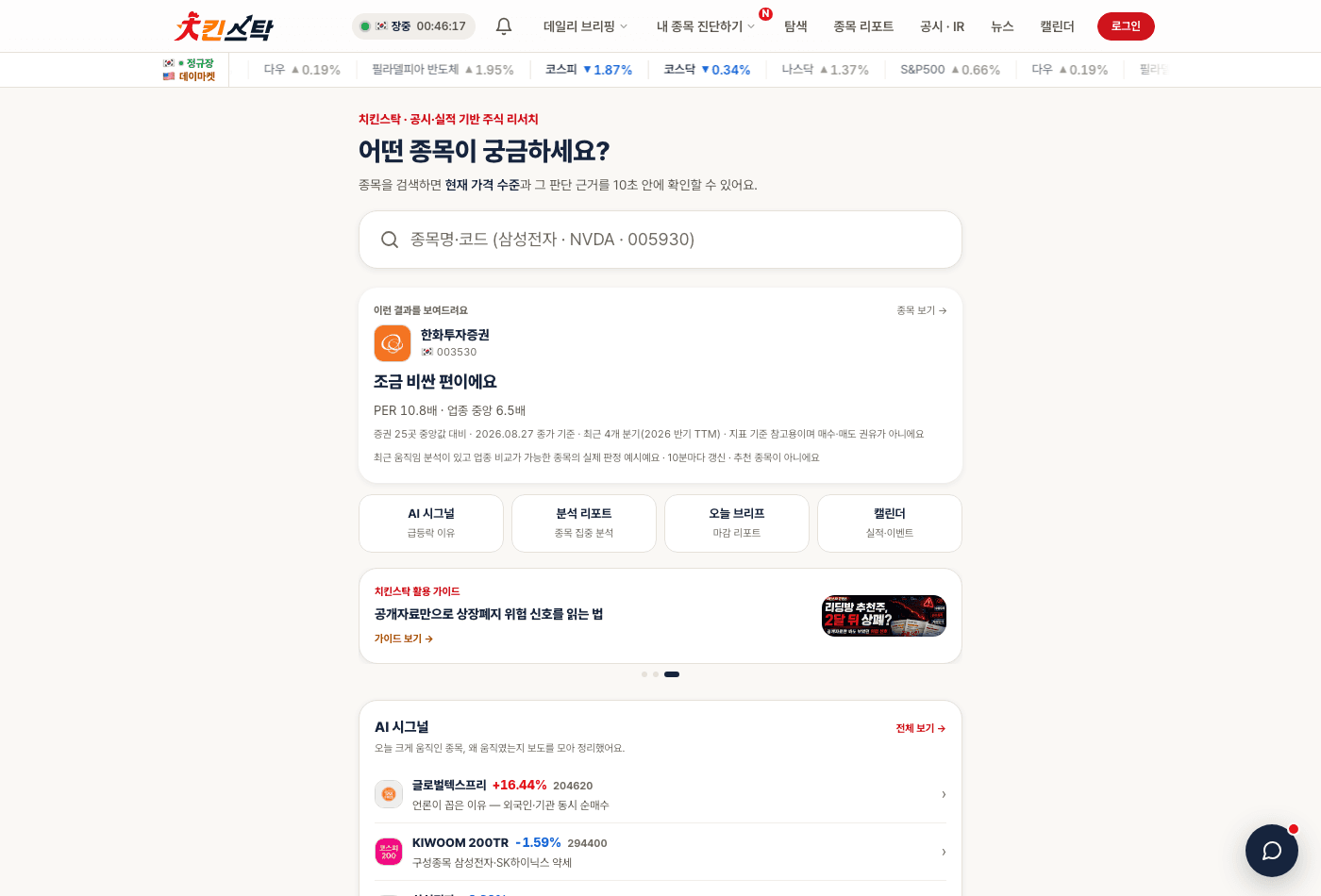
The site is real and it's live, which is more than many such claims survive. The numbers attached to it are not checkable by us: 1.54 million search impressions in thirty days, a month-on-month rise quoted as 85,578%, 7,400 clicks, paragraph-level citations in Naver's AI Briefing, no ad spend. All of that comes from a Search Console the author owns and we don't. Take it as a self-reported result, which is what it is, and note that a percentage that large usually means the previous month was close to zero.
What can be verified is the repository itself.
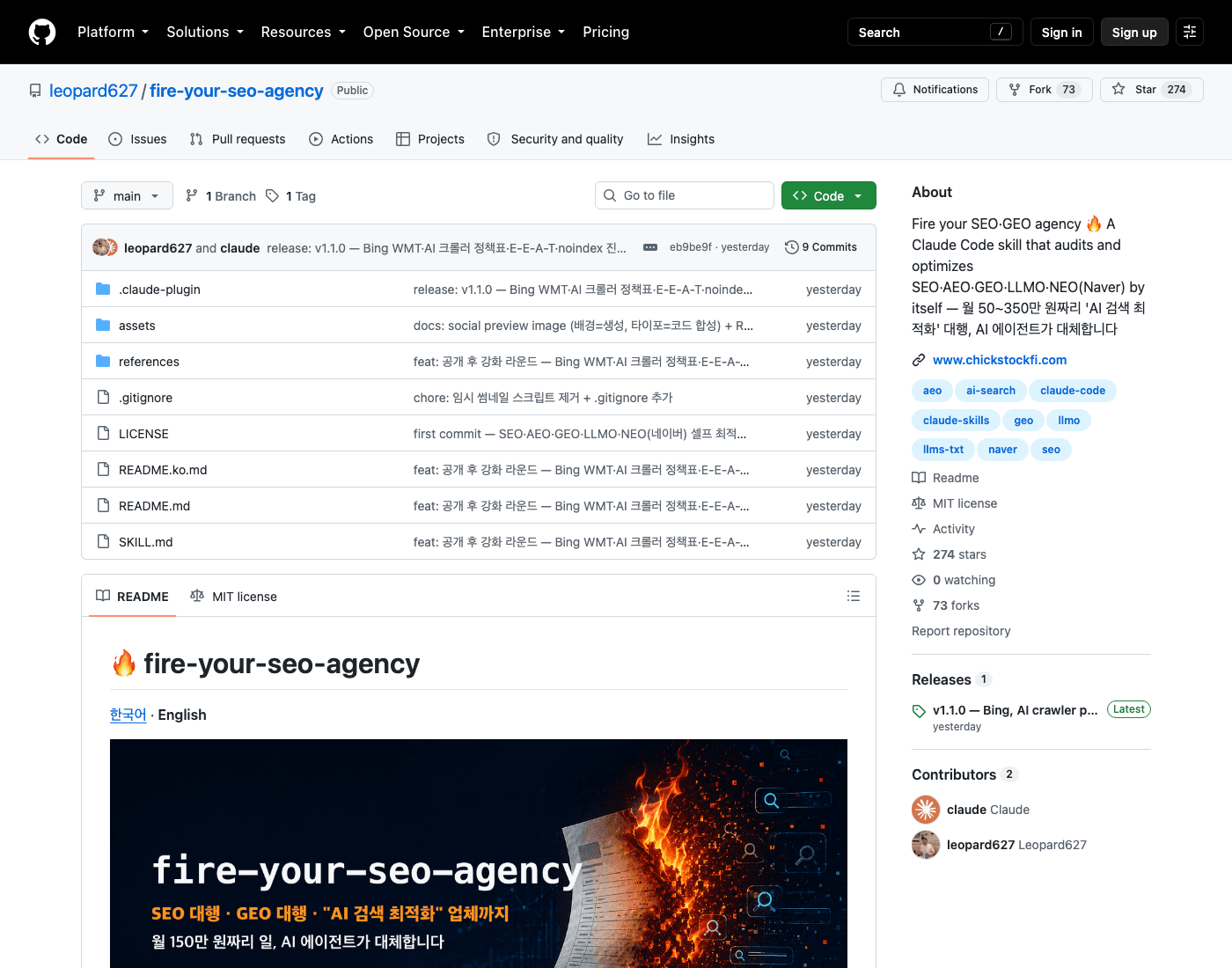
MIT licensed, nine commits, one tagged release at v1.1.0 dated 27 August 2026 that added Bing Webmaster Tools, AI crawler policy and E-E-A-T coverage. Two contributors, and the second is listed as "claude" — the skill's own documentation was partly written by the thing it configures, which is either a nice recursion or a reason to read the reference files before trusting them, depending on your mood.
The part that doesn't travel
Here's the caveat the README states once, plainly, and then moves past: the Korean documents under references/ are canonical, and the agent reads those. The English versions in references/en/ are mirrors, provided for human readers.
So the procedure your agent follows is written in Korean. Both sets exist and cover the same six areas, but they are not the same artifact, and the one that shapes the audit isn't the one an English reader would review. Nothing about that is hidden, and for four of the five lanes it probably doesn't matter much, since crawler policy and structured data don't change across languages. It does mean that if you want to know exactly what the skill will do to your site, reading the English mirror is reading a translation of the instructions rather than the instructions.
The NEO lane is a separate question of fit. Superb if you sell into Korea, dead weight if you don't, and it's roughly a fifth of the repository.
So can a Claude Code SEO skill replace a retainer?
Partly, and the honest split runs along a line the repo doesn't draw.
The audit half is genuinely commoditised. Checking whether 214 pages are missing from a sitemap, whether FAQ markup renders, whether llms.txt exists, whether robots.txt has an opinion about GPTBot: that's a checklist, an agent runs it faster than a human and doesn't get bored on page nine. Anyone billing a monthly retainer for that specific work should expect the ground to move. Our roundup of the best Claude skills is full of tools eating similarly checklist-shaped jobs, and the mechanics of how these procedures get built are covered in building Claude skills into agent workflows.
The half that doesn't commoditise is judgement about what to build, and the discipline to keep going. The skill's own step four is designing intent landing pages on a one-question-one-page principle, which is not a checklist item; it's a content strategy that needs somebody who knows the business. And step six is a measurement loop, described in the README as scheduling a re-measurement, because fixing something is not the finish line.
That scheduling word is where a laptop-resident skill runs out of road. Claude Code runs when you run it, on the machine in front of you, and a re-measurement due in thirty days is a calendar entry hoping you're still interested. MoClaw exists on the other side of that gap: a hosted cloud AI computer that stays up, so the follow-up pass happens whether or not you opened your laptop that morning. It's not a replacement for the skill; it's somewhere for a recurring job to actually live.
The reasonable move is to install it, run the audit, take the scorecard seriously, and treat the "fire your agency" framing as what it is. Nine commits and two days of history is not yet a track record. The five-lane model, though, is worth having in your head by Monday regardless of what you install.
FAQ
What is a Claude Code SEO skill?
A skill is a procedure file plus reference documents that Claude Code loads and follows. This one packages an audit-implement-measure routine across five search surfaces, installed either through the plugin marketplace or by cloning the repo into .claude/skills/. It runs locally in Claude Code rather than as a hosted service.
Can AI replace an SEO agency in 2026?
It can replace the audit and implementation checklist, which is a real share of what many retainers cover. It doesn't replace deciding what content should exist or keeping a measurement loop running for months. Treat "fire your agency" as the author's framing rather than a finding.
Does it support non-English search and Naver?
Naver is a first-class lane, covering Search Advisor registration and AI Briefing citation requirements, and the author says that's the deliberate differentiator. Be aware the canonical reference documents are Korean; English mirrors exist under references/en/ for human readers.
Is fire-your-seo-agency free?
Yes, MIT licensed as of 28 August 2026. You still pay for whatever Claude Code usage the audit consumes, and for any tools it recommends registering with, though Search Console, Bing Webmaster Tools and Naver Search Advisor are all free.
Are the traffic numbers in the README verified?
Not by us. The 1.54 million impressions and 7,400 clicks come from the author's own Search Console for chickstockfi.com, a site that does exist and is live. There's no third-party confirmation, and the month-on-month percentage is large enough to suggest a very small starting base.
Continue Reading
More Research
AI Agent Sandbox: What It Is and Isn't

Lindy AI Review: Does Editable Memory Help?

Caveman Skill: What the 65% Really Buys

Hermes Agent Desktop Review 2026: Worth It?

Agent Substrate: 250 Agents on 8 Pods

Cursor Origin Landed During a GitHub Outage

The MoClaw editorial team writes about workflow automation, AI agents, and the tools we build. Default byline for industry overviews, listicles, and collaborative pieces.
Turn insights into action.
MoClaw automates the recurring work your analysis points to. No engineering required.
References: https://github.com/leopard627/fire-your-seo-agency · https://www.chickstockfi.com · https://claude.com/claude-code · https://searchadvisor.naver.com/ · https://github.com/leopard627/fire-your-seo-agency/releases