Kimi K3 Free: Every Way to Try It Online (2026)

Can you use Kimi K3 for free? Mostly no. The open weights landed July 27 and every host still charges $3/$15. Here are the 4 real ways to try it.
Table of Contents
Is Kimi K3 free? Mostly no. There's a limited free tier in the Kimi app, but the full K3 model, the 1M-token context, and HighSpeed mode all sit behind a paid membership, and the open-weights release on July 27, 2026 did not change that. If you came here expecting the checkpoint drop to produce cheap hosted K3, skip to the pricing table further down; every provider landed on the same number.
Kimi K3 launched on July 16, 2026 from Moonshot AI as the largest open-weight model released to date (~2.8T parameters, MoE). The launch was API-first, the hosted app that most people reach for is deliberately capped, and eleven days later the weights went public without moving the price. So before you burn a $20 subscription on a single prompt (as one builder did during launch week), here's how each free-or-cheap route actually works.
Is Kimi K3 Free? What Access You Actually Get
The honest snippet answer: there's a limited free tier, but no fully free way to use Kimi K3 at full capability today. The Kimi app gives you some access without paying, then gates the K3 model itself, the 1M context window, and HighSpeed responses behind an entry subscription (¥199/mo). Everything else is pay-per-use.
Here's every path, what it costs, and where it stops:
| Access path | Cost | What you get | Where it stops |
|---|---|---|---|
| Kimi app free tier | Free | Chat access, some K3 requests | K3 model / 1M context / HighSpeed gated → HTTP 401 on wrong plan |
| Kimi entry subscription | ¥199/mo | K3, larger context, faster responses | Rate-limited; heavy use burns fast |
| API (kimi-k3) | $3.00 in / $15.00 out per 1M tokens | Full model, no membership needed | Pay-as-you-go; ~$0.94 per task in Moonshot's own figures |
| OpenRouter / third parties | Per-token, no membership | K3 via a single account | Same per-token economics; not free |
| Open weights (live since July 27) | Free to download | Self-host on your own cluster | 1.56 TB checkpoint; Moonshot's floor is 8x GB300 |
Two things to flag before you pick a lane. The "free" you get in the app is small; it's a taste, not a workspace. And the cheapest real usage is per-token via the API rather than a subscription, if you only run occasional tasks. One thing that is not on this list, despite what most write-ups predicted, is a cheap third-party host. The sections below walk each path, including why that one never showed up.
Kimi K3 Online: The Kimi App Free Tier
The fastest way to try Kimi K3 online is the Kimi app, and yes, you can open it without paying. What you won't get for free is the part everyone's excited about. K3 as a model, the full 1M-token context, and HighSpeed generation are all membership-gated, so a free account routes lighter requests through and blocks the premium ones.
The gotcha people hit in launch week: if your plan doesn't include the tier you're calling, the app returns an HTTP 401 rather than silently downgrading you. It reads like an auth bug, but it isn't. It's the membership gate telling you the request needs a plan you don't have. A quick check is to start a fresh session and confirm which model the app is actually routing to before you assume something broke.
If you just want to see whether K3's frontend and 3D output live up to the launch-week noise, the free tier is enough to form a first impression. If you want to run real work through it, you'll hit the ceiling quickly. For the full spec on what the model is and isn't, see what is Kimi K3.
What builders shipped in launch week
The reason the free tier is worth touching at all is what people did with paid access in the first few days. This is the appeal case: a wall of real, showcase builds from launch week (each links to the original post; view counts are the real numbers from those tweets). Read it as "here's what you'd be trying," not as verified benchmarks.
-
 @KimiDevsx.com/KimiDevs
"A Kimi staff member used K3 on Kimi Code to build a VR companion. She can listen, reply, show different expressions, and move between scenes like a café and a shop."
-
 @mikenevermissx.com/mikenevermiss
"This guy recorded a 13-minute tutorial showing how to create an award-winning website with the new Kimi K3. The web designs are insane."
-
 @dr_cintasx.com/dr_cintas
"Kimi K3 is insane at game development: you describe a game inside Higgsfield Supercomputer and it handles everything: code, 3D assets, characters, and the whole setup."
-
 @intheworldofaix.com/intheworldofai
"Kimi K3 just generated a Red Dead Redemption 2-style open-world game: terrain, gameplay systems, and impressive visual fidelity from a single prompt."
-
 @chetasluax.com/chetaslua
"Window Browser OS made by Kimi K3. Holy — one-shot prompt."
-
 @thealexkerx.com/thealexker
Underrated detail from the release: an early K3 wrote most of the kernels in late development and built MiniTriton, a Triton-class compiler from scratch, on par with or beating Triton and torch.compile on supported benchmarks.
-
 @bourneliu66x.com/bourneliu66
Paraphrase: A builder made a Slay the Spire-style card game themed on the Three Kingdoms in one 8-hour K3 run: 1,830 art assets, and K3 tuned the game's numbers itself by self-playing 10,000 rounds. (paraphrased from Chinese)
-
 @theox.com/theo
"Kimi K3 is really, really good."
Two honest caveats on that wall. These are self-selected showcase posts, not controlled head-to-heads, and independent evaluators don't fully agree on where K3 lands: Artificial Analysis places it fourth of 580 models (index 57.1) on its Intelligence Index v4.1, while it sits first of 99 on WebDev Arena at 1,678 Elo, the first open model to top that leaderboard. Treat the wall as proof the free tier is worth a look, then judge for yourself.
Kimi K3 Chat vs API: Which Cheap Path Fits You
If you've decided Kimi K3 free access won't stretch far enough, you've got two cheap routes, and they suit different people. The subscription is the "I want a chat window" path; the API is the "I run tasks and want to pay only for what I use" path.
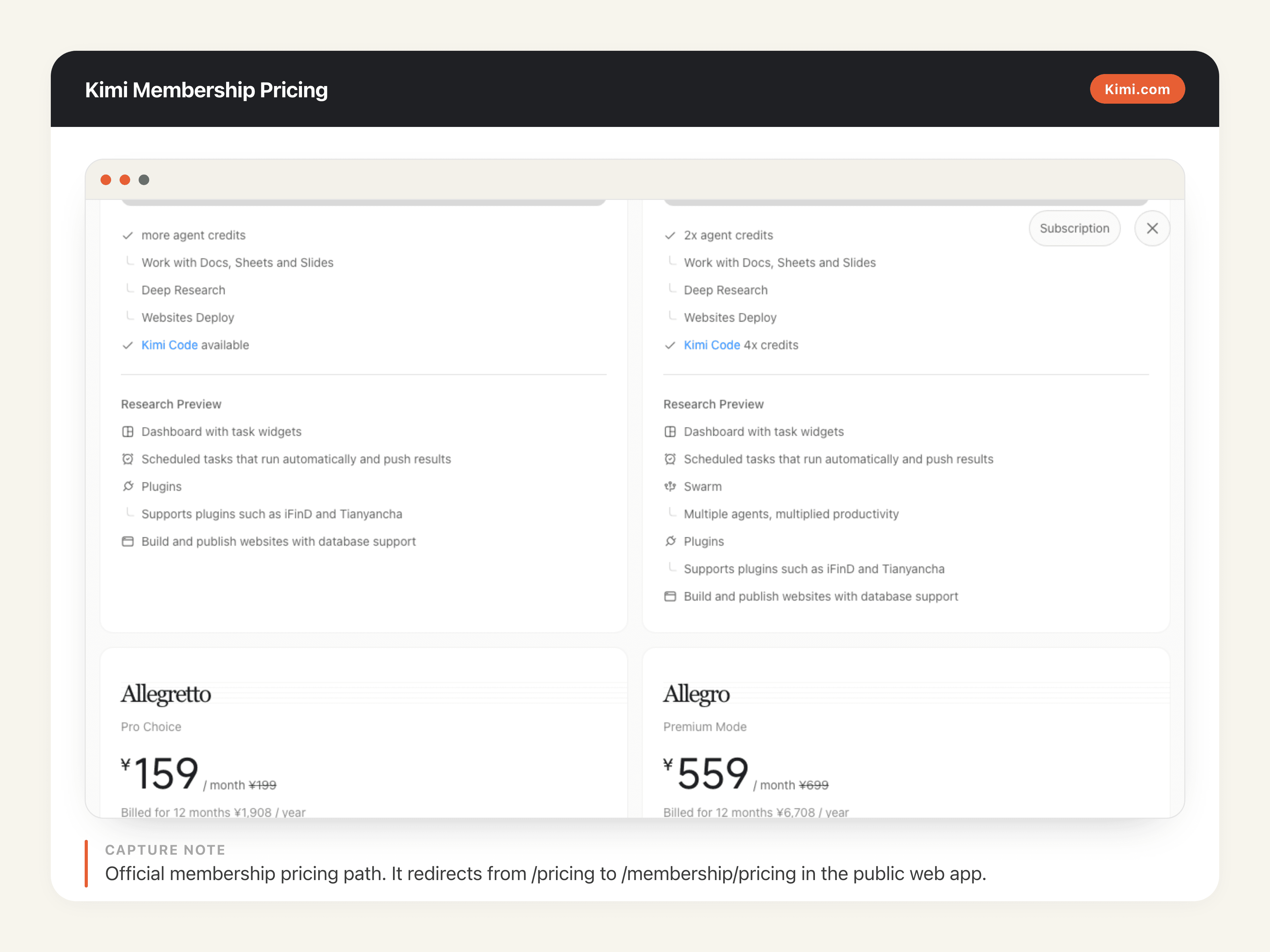
The Kimi entry subscription runs ¥199/mo and unlocks K3, a bigger context window, and faster responses in the app. It's the simplest Kimi K3 chat experience, with nothing to wire up. The catch is rate limits: heavy generation eats through the allowance fast, and one launch-week tester reported blowing through a $20-equivalent subscription on a single long game-build prompt. You'll find the tiers on the membership page (kimi.com/pricing redirects to kimi.com/membership/pricing).
The API (model ID kimi-k3) skips membership entirely. You pay per token — $3.00 per 1M input, $0.30 cached, $15.00 per 1M output, which Moonshot's own figures put at roughly $0.94 per task. That's not free, but for occasional runs it's often cheaper than committing to a monthly plan, and there's no 401 gate to trip over. Two timing notes on Kimi K3 price: there's a recharge promo running July 15–August 11, 2026 (a 10–30% bonus on top-ups), and versus Kimi K2.6's $0.60/$2.50 pricing, K3 is roughly a 5x jump per token, the trade-off for a much larger model.
Full API details, model IDs, and current rates are in Moonshot's platform docs. If you'd rather run K3 through a managed agent than manage keys, rate limits, and 401s yourself, you can use Kimi K3 through MoClaw's managed integration without standing up any infrastructure.
Kimi K3 Without Subscription: OpenRouter and Third Parties
You can use Kimi K3 without a subscription at all by going through an aggregator. OpenRouter exposes kimi-k3 on straight per-token pricing behind a single account, so there's no Kimi membership to buy and no plan tier to trip the 401 gate. You add credit, you call the model, you pay for the tokens you use.
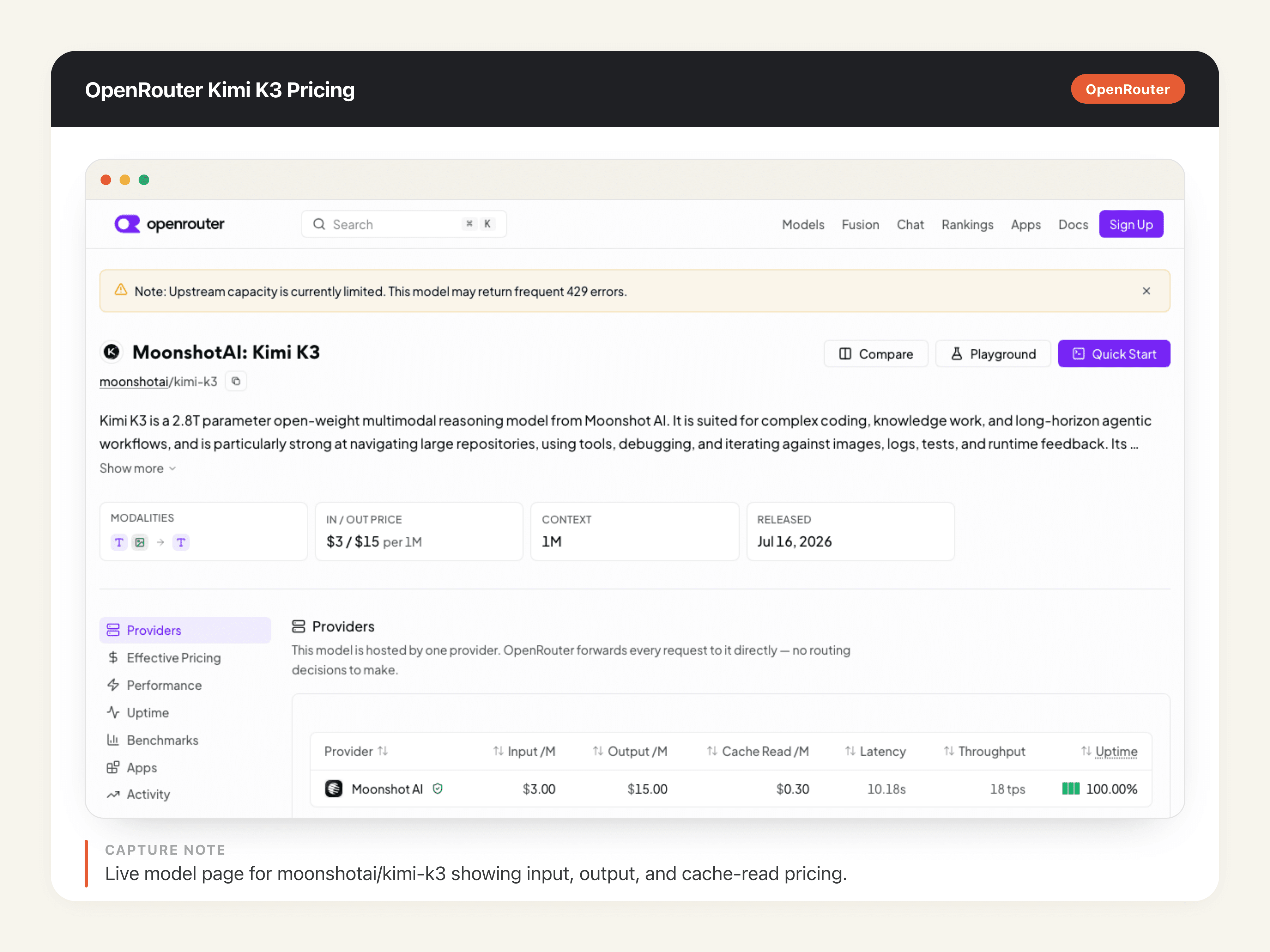
The economics are the same per-token math as the direct API. An aggregator doesn't make the model free; it just changes whose billing you're on and lets you keep one key across many models. That's genuinely useful if you're comparison-shopping models or already route everything through one provider. It's the right "Kimi K3 without a subscription" answer for developers; it's not a free-lunch answer. If you're weighing K3 against the previous generation on cost, our Kimi K3 vs K2.6 breakdown covers the price jump in detail.
Open Weights Landed, and Nothing Got Cheaper
The weights shipped on schedule. On July 27, 2026 Moonshot published the full checkpoint on Hugging Face together with the technical report: 1.56 TB across 96 safetensors shards, already quantized to MXFP4. An earlier version of this page predicted that open weights would drag hosted prices down, since that is what open weights have reliably done since 2023. That prediction was wrong, and the way it was wrong is the most useful thing on this page.
Six hosts went live the same day: Together AI, Fireworks, Baseten, Modal, Nebius, and DigitalOcean's Serverless Inference. Every one of them charges exactly $3.00 per million input tokens and $15.00 per million output, matching Moonshot's own API to the cent, with cache reads at $0.30 across the board. No provider undercut another. There is no :free endpoint anywhere, and the only tier that breaks from $3/$15 is Fireworks' faster variant, which costs more at $4.50 and $22.50.
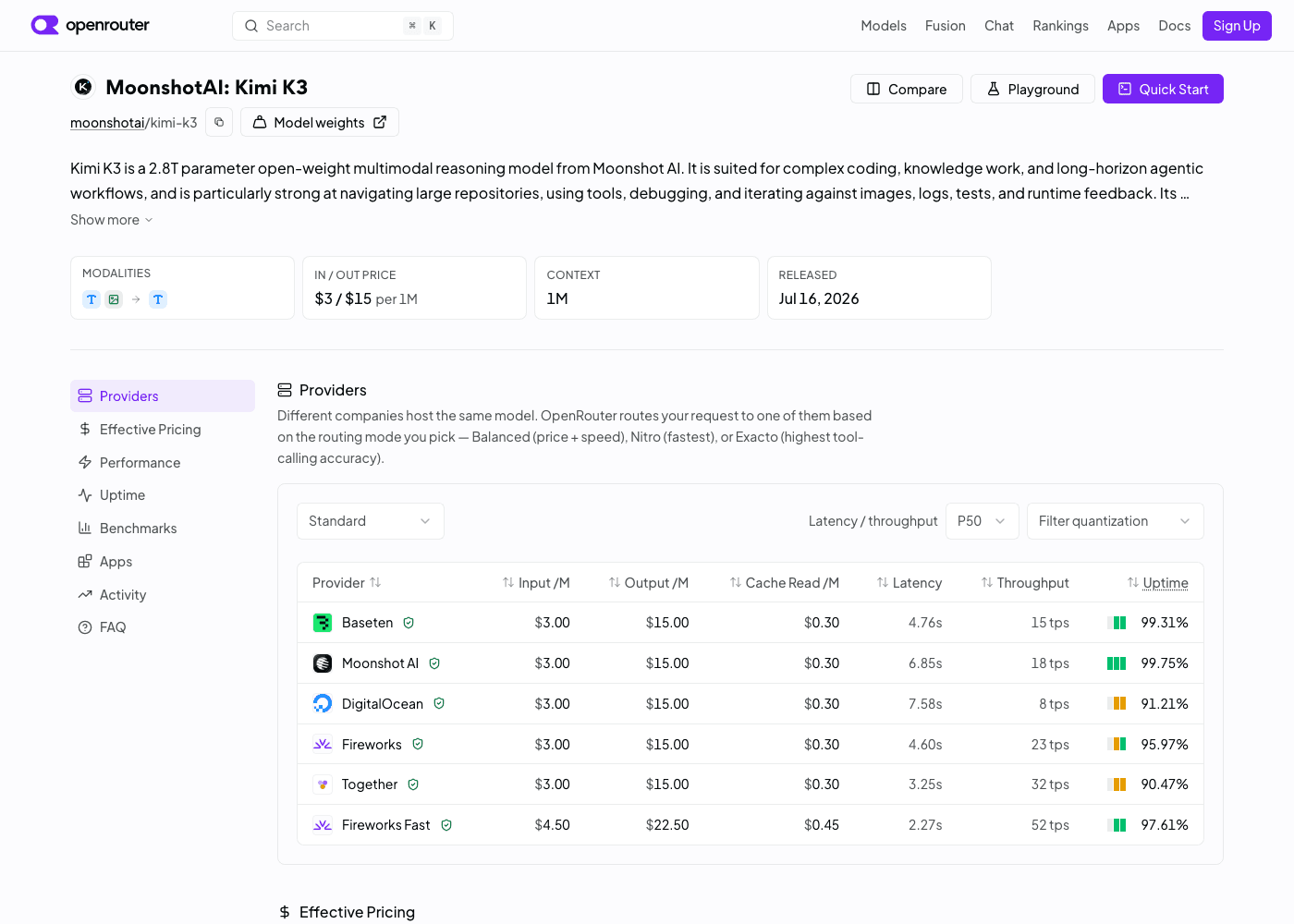
Nobody has confirmed why. The suspected reason is the license: the Kimi K3 License requires any Model-as-a-Service business past $20M in trailing-twelve-month revenue to sign a separate agreement with Moonshot before commercial use, which sweeps in every provider on that list. Developers on r/LocalLLaMA reached that conclusion within hours, one of them writing that "$15 per 1M tokens is a very large price to pay to use a model. That's closer to proprietary model api pricing, not open model pricing," and estimating K3 would sit nearer $5 in a genuinely open market. Another said GLM-5.2 stays their default because it's MIT and therefore "available everywhere."
Hold that causal claim loosely. The license sets no prices and mentions none, so the connection between the clause and the uniform price is an inference the community drew, not a fact Moonshot stated. The price table is the fact.
So what does free actually look like now?
Self-hosting, and only if you own the hardware. The license permits it without conditions for internal use, so the weights genuinely are yours to run. The floor is the problem: Moonshot's own vLLM recipe calls for eight GB300 accelerators on a single node, or eight MI355X/MI350X on ROCm, with vLLM 0.27.0 or newer, and recommends multi-node for anything resembling production traffic. Posts claiming 8x H100 will do are wrong by a factor of two; eight H100s give you 640 GB against a 1.56 TB checkpoint, before any KV cache for that million-token context.
Which leaves the practical answer unchanged from launch week, just better evidenced: the app's free tier for a taste, per-token API or an aggregator for real work, and self-hosting only if a GPU cluster is already a line item. The open-weights release changed what you're allowed to do, not what you'll pay.
FAQ
Is Kimi K3 free?
Partly. There's a limited free tier in the Kimi app, but the K3 model itself, the 1M-token context, and HighSpeed mode are gated behind a paid membership (¥199/mo entry). The open weights went public on July 27, 2026, which makes K3 free to download but not free to use unless you own a GPU cluster; no hosted provider offers a free tier.
How much does Kimi K3 cost?
Via API it's $3.00 per 1M input tokens, $0.30 cached, and $15.00 per 1M output, or about $0.94 per task in Moonshot's own figures. The Kimi app entry subscription is ¥199/mo. A recharge promo runs July 15–August 11, 2026. That's roughly a 5x per-token jump over Kimi K2.6.
Can I use Kimi K3 online without an account?
Not fully. You need an account to reach the model, whether that's the Kimi app, the API, or an aggregator like OpenRouter. There's no anonymous public playground for the full model as of July 2026. The app free tier is the closest to a no-cost try.
What license does Kimi K3 use?
The Kimi K3 License, published with the weights on July 27, 2026. It is not Modified MIT, despite widespread pre-release reporting that said so. Most of it reads like MIT, with two revenue-triggered conditions bolted on: a separate-agreement requirement for Model-as-a-Service businesses past $20M over any twelve months, and a UI attribution requirement past 100M monthly users or $20M monthly revenue. Ordinary commercial use clears both. Full breakdown in our Kimi K3 license explainer.
Did the open weights make Kimi K3 cheaper?
No. Every day-zero provider (Together, Fireworks, Baseten, DigitalOcean, plus Moonshot itself) prices K3 at $3.00 input and $15.00 output per million tokens, with no free tier and no discounting. Self-hosting is the only route to zero marginal cost, and the 1.56 TB checkpoint needs roughly eight GB300-class accelerators to serve.
Continue Reading
More Guide
What Is Kimi K3? Moonshot's 2.8T Model
What Is Hermes Bot Mode? Bots and Routines
OpenAI Assistants API Deprecated: What Broke
MCP Tools: What They Are and Which to Use

OpenAI Models Not Available in Cursor Nov 12

Coding Agent Security: When Your Tools Lie
The MoClaw editorial team writes about workflow automation, AI agents, and the tools we build. Default byline for industry overviews, listicles, and collaborative pieces.
Use Kimi K3 on MoClaw, without the setup
Run Kimi K3 as an always-on managed agent with memory, your tools, and scheduling. No API wiring, no plan gating, no self-hosting.
References: Moonshot AI platform docs (Kimi K3 API) · Kimi K3 on OpenRouter (per-token pricing) · Decrypt — Kimi K3 Modified MIT license report · Kimi K3 on Artificial Analysis (Intelligence Index v4.1) · Kimi K3 on Hugging Face · Kimi K3 technical report (PDF) · vLLM recipe for Kimi K3 · r/LocalLLaMA on the Kimi K3 license