Kimi K3 License: Terms & Commercial Use

Kimi K3 shipped under a bespoke license, not Modified MIT. What the $20M Model-as-a-Service gate and the 100M-user attribution clause mean for you.
Table of Contents
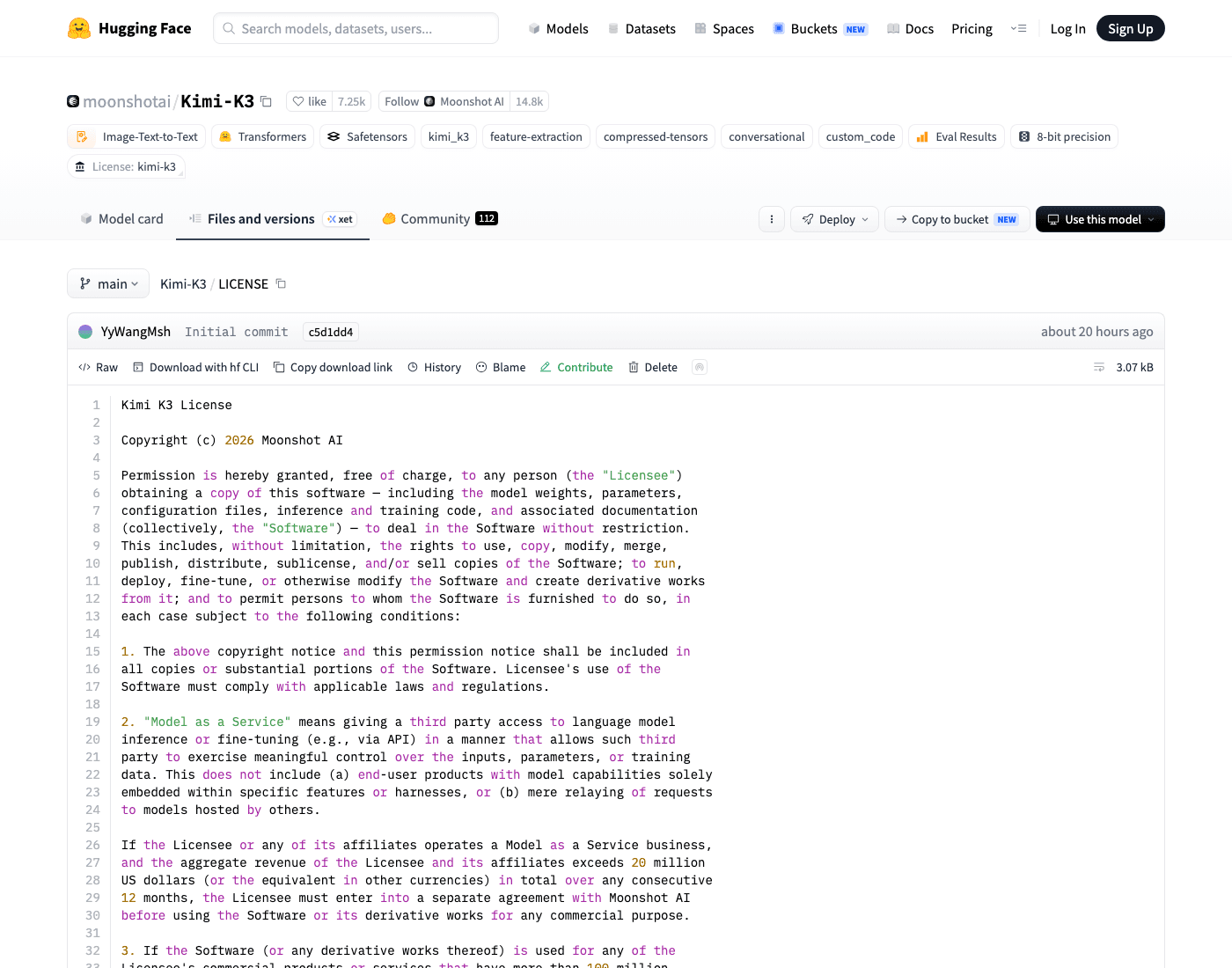
Moonshot published Kimi K3's weights on July 27, 2026, and the license that shipped with them is not the one the press had been reporting. Coverage from Decrypt and Yahoo Finance over the July 18–19 weekend called it Modified MIT. The file Moonshot actually posted is titled the Kimi K3 License, and it carries two revenue-triggered conditions that MIT has never contained. Hugging Face tags it license:other, not license:mit.
If you bookmarked this page in the week the weights were still pending, that was the right instinct: the terms are now readable, and they are stricter than the precedent everyone was projecting onto them.
Key Takeaways:
- The license is called the Kimi K3 License, not Modified MIT, and it is not OSI-approved.
- Most of the text reads like MIT: use, copy, modify, distribute, sublicense, sell.
- Run a Model-as-a-Service business past $20M in revenue over any consecutive 12 months and you must sign a separate agreement with Moonshot before any commercial use.
- Ship a product past 100M monthly active users or $20M in monthly revenue and you must display "Kimi K3" in your interface.
- Internal use is exempt, and so is building a product where the model sits behind your own features.
What Is the Kimi K3 License?
It's a bespoke license Moonshot wrote for this release, published in the model repository and on Hugging Face alongside the checkpoint. For most of its length it tracks MIT closely enough that a lawyer skimming it would nod along: permission to use, copy, modify, merge, publish, distribute, sublicense, and sell, with the copyright notice carried through.
Then it adds two conditions, both keyed to how big you are.
| Condition | Trigger | What you must do |
|---|---|---|
| Model-as-a-Service gate | You (plus affiliates) run a MaaS business and aggregate revenue passes $20M USD over any consecutive 12 months | Enter a separate agreement with Moonshot before any commercial use of the weights |
| Attribution gate | Your product or service exceeds 100M monthly active users or $20M in monthly revenue | Display "Kimi K3" prominently in the user interface |
Neither applies to internal use, and neither applies if you reach K3 through Moonshot's own products or through what the license calls certified inference partners.
The definition of "Model as a Service" is where the real work happens, and it's narrower than the phrase sounds. The license defines it as giving a third party access to inference or fine-tuning, via API or otherwise, in a way that lets that third party exercise meaningful control over inputs, parameters, or training data. Two things are explicitly carved out: end-user products where the model's capabilities sit embedded inside specific features or harnesses, and the mere relaying of requests to models somebody else hosts.
Read that carve-out twice if you build software. It's the difference between being regulated by this license and being ignored by it.
Kimi K3 Commercial Use: Can You Use It Commercially?
Yes, and for the overwhelming majority of companies there's nothing to negotiate and nobody to email.
Build a product with K3 running behind your own features, keep the copyright notice, stay under 100M monthly actives, and you have used the model exactly as the license intends. Fine-tune it on your own data for internal tooling: permitted, and internal use is exempt from both gates anyway. Sell that product: permitted. The permissive core of the license is doing what permissive licenses do.
The gates are aimed at a specific target, and it isn't you unless you're an inference provider. A MaaS business past $20M in trailing revenue is Together, Fireworks, Baseten, or someone at that weight class. The attribution gate at 100M MAU is aimed at consumer platforms of a scale you could count on one hand. If your legal team is asking whether the $20M number is a problem, the useful clarifying question is whether you're reselling raw model access or building features on top; only the first one is MaaS under this text.
One genuine ambiguity is worth flagging rather than papering over. The MaaS gate says revenue "of the Licensee and its affiliates," not revenue from the MaaS line specifically. A large company with a small hosted-inference product could read that as tripping the threshold on total corporate revenue. That reading may not be what Moonshot intends, but the sentence permits it, and if you're near that line it's a question for Moonshot rather than for a blog post.
The Clause That Changed What K3 Costs
Here's the consequence almost nobody predicted. Open weights normally push hosting prices down, because providers compete on margin over the same free checkpoint. That didn't happen.
Every day-zero provider serving Kimi K3 prices it at exactly $3.00 per million input tokens and $15.00 per million output, identical to Moonshot's own API, with no cheaper tier anywhere:
| Provider | Input / 1M | Output / 1M |
|---|---|---|
| Moonshot AI (official) | $3.00 | $15.00 |
| Together AI | $3.00 | $15.00 |
| Fireworks | $3.00 | $15.00 |
| Baseten | $3.00 | $15.00 |
| DigitalOcean | $3.00 | $15.00 |
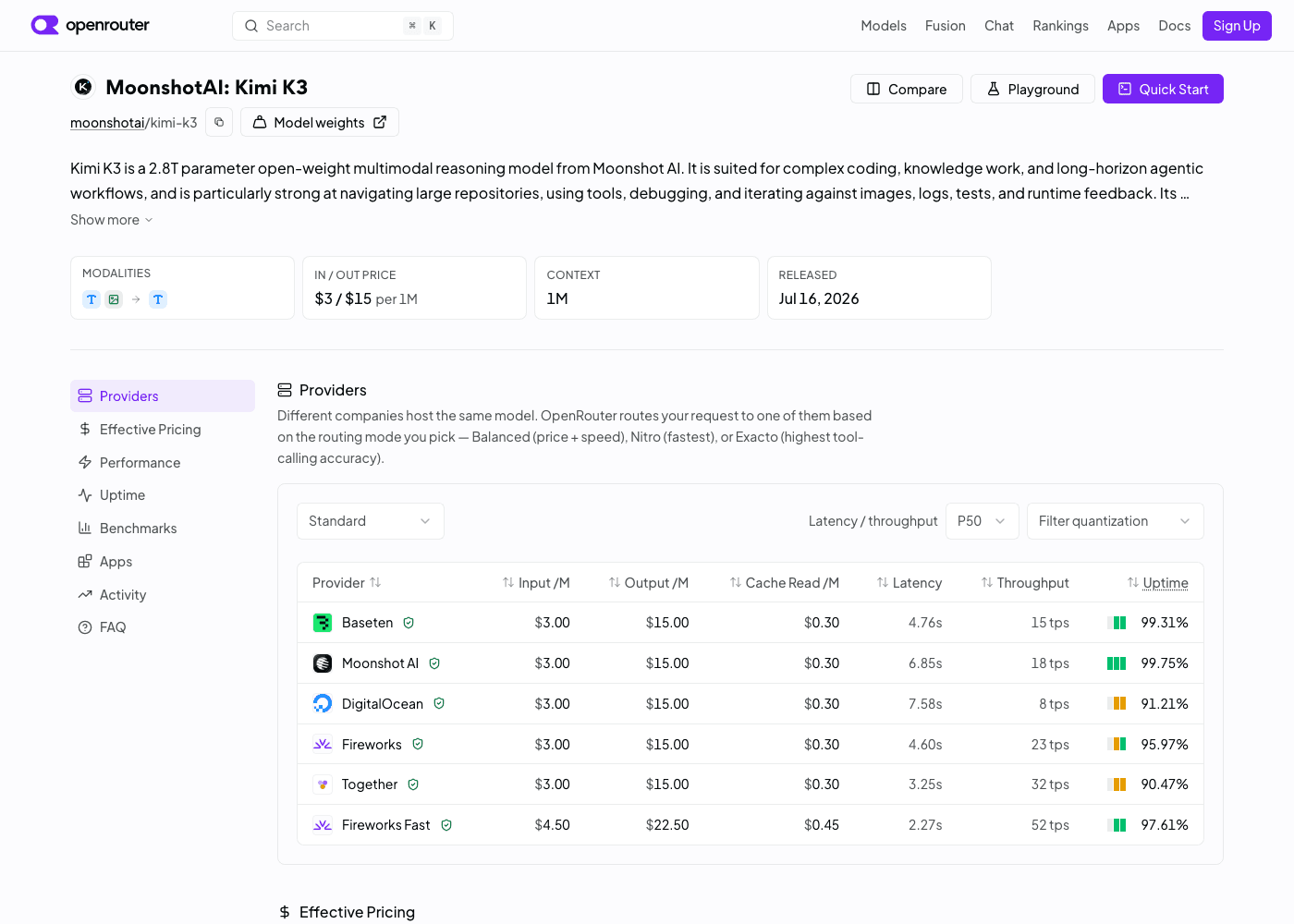
Whether the MaaS clause caused that is not something the license text answers; it sets no prices and mentions none. But developers on r/LocalLLaMA drew the obvious line the day the weights landed, reading the "separate agreement" requirement as a lever that lets Moonshot set terms for every provider large enough to matter. One commenter's verdict: "$15 per 1M tokens is a very large price to pay to use a model. That's closer to proprietary model api pricing, not open model pricing." Another wrote that GLM-5.2 would stay their default, because it's MIT and "available everywhere."
Treat the causation as an inference and the price table as fact. We walk through the access options in detail in Kimi K3 free access.
Kimi K3 Self-Hosting: What the License Enables
The license permits it cleanly. Download the weights, run them on hardware you control, fine-tune them, keep every token inside your own perimeter, and neither gate fires as long as you're not reselling raw access at scale. For teams that can't send prompts to a third-party API on compliance grounds, this is the entire reason to care about an open-weight release.
The hardware is the part that stops people. The published checkpoint runs 1.56 TB across 96 safetensors shards, and that's already the MXFP4-quantized version; Moonshot trained it quantization-aware from the supervised fine-tuning stage onward specifically so the released weights would be this small. Moonshot's own vLLM recipe puts the floor at eight GB300 accelerators for a single node, or eight MI355X/MI350X on ROCm, running vLLM 0.27.0 or newer. Multi-node is what they recommend for production traffic.
You'll see blog posts claiming 8× H100 is enough. Eight H100s give you 640 GB. The weights alone need 1.56 TB, before KV cache for a million-token context. The arithmetic doesn't work.
So the license grants a right most readers won't exercise, which is worth saying plainly rather than dressing up. If what you actually want is K3's behaviour without a datacenter, running it through a managed agent layer like MoClaw's Kimi K3 integration gets you there; the license governs your self-hosting rights either way, and they don't expire.
Is Kimi K3 Open Source? Open Weight Is Not the Same Thing
No, and Moonshot doesn't claim otherwise. The company's own framing is "open-weight," which is precise.
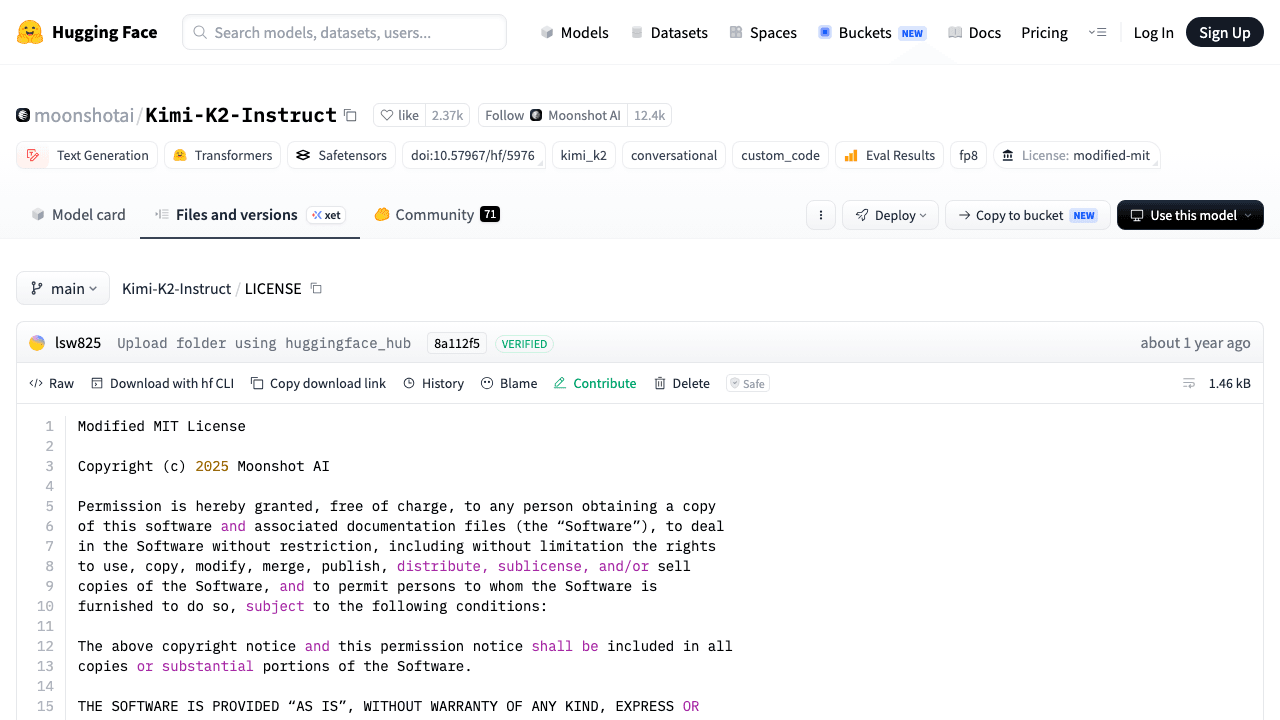
Open source, under the Open Source Initiative definition, means no field-of-use restrictions and no discrimination against fields of endeavour. A revenue-triggered obligation to sign a separate agreement is a field-of-use restriction. The Kimi K3 License wouldn't clear the OSI bar, which is presumably why Hugging Face carries it as license:other.
There's a second gap that matters more to researchers than to buyers: the technical report describes the pre-training corpus by domain (web text, code, mathematics, knowledge, plus a large vision corpus) but publishes neither the data nor the training code. Token counts and the knowledge cutoff are still undisclosed even after the report. You can run the model and you can modify it; you cannot reproduce it.
Here's where that leaves K3 against the field:
| Model | License | Commercial use | Rider |
|---|---|---|---|
| Kimi K3 | Kimi K3 License (bespoke) | Yes, below the gates | MaaS separate-agreement at $20M/12mo; UI attribution at 100M MAU or $20M/mo |
| Kimi K2 family | Modified MIT | Yes | Attribution at very large deployment scale |
| GLM-5.2 | MIT | Yes | None |
| DeepSeek V4 Pro | Permissive open-weight | Generally permitted | Terms vary by release; check the file |
| Llama family | Community license (source-available) | Permitted below a MAU threshold | MAU cap plus acceptable-use policy |
The interesting row is K2. Moonshot's previous family really did ship under Modified MIT, which is exactly why the pre-release reporting sounded credible and why so many writeups still repeat it. K3 moved away from that, and the move was deliberate.
FAQ
Is Kimi K3 open source?
It's open-weight, not open source. The weights are downloadable and modifiable, but the Kimi K3 License adds revenue-triggered conditions that disqualify it under the Open Source Initiative's definition, and Hugging Face lists it as license:other. Training data and training code were not released either, so the model can't be reproduced from what's public.
Is the Kimi K3 license Modified MIT?
No. That was pre-release reporting from Decrypt and Yahoo Finance, published before the license file existed, and it turned out to be wrong. Moonshot's K2 family used Modified MIT, which is where the expectation came from. K3 ships under a bespoke license called the Kimi K3 License.
Can I use Kimi K3 commercially?
Yes, in almost every ordinary case. Building a product where K3 powers your features, fine-tuning it internally, and selling that product are all permitted with no agreement required. The conditions only trigger if you resell raw model access as a business past $20M in trailing-twelve-month revenue, or if your product passes 100M monthly active users or $20M in monthly revenue.
What counts as Model as a Service under the license?
Giving a third party access to inference or fine-tuning in a way that lets them control inputs, parameters, or training data. The license explicitly excludes end-user products where model capabilities are embedded in specific features, and excludes simply relaying requests to models hosted elsewhere. Most software companies fall into the excluded categories.
Can I fine-tune Kimi K3?
Yes. Fine-tuning is permitted under the license, and internal use carries no conditions at all. If you plan to serve the fine-tuned model to third parties as an API, that's when the MaaS definition and its revenue threshold become your problem rather than a footnote.
For the rest of the picture: what is Kimi K3 covers the model and the benchmark results, Kimi K3 free access covers what it costs to actually use, Kimi K3 vs K2.6 covers the jump from the Modified MIT generation, and Kimi K3 limitations covers what the technical report admits.
Continue Reading
More Research
Claude Code SEO Skill: Fire Your SEO Agency
AI Agent Sandbox: What It Is and Isn't

Lindy AI Review: Does Editable Memory Help?

Caveman Skill: What the 65% Really Buys
Hermes Agent Desktop Review 2026: Worth It?

Agent Substrate: 250 Agents on 8 Pods
The MoClaw editorial team writes about workflow automation, AI agents, and the tools we build. Default byline for industry overviews, listicles, and collaborative pieces.
Use Kimi K3 on MoClaw, without the setup
Run Kimi K3 as an always-on managed agent with memory, your tools, and scheduling. No API wiring, no plan gating, no self-hosting.
References: Kimi K3 License (Hugging Face) · Kimi K3 repository (GitHub, MoonshotAI) · Kimi K3 technical report (PDF) · MIT License (Open Source Initiative) · vLLM recipe for Kimi K3 · r/LocalLLaMA discussion of the Kimi K3 license