Kimi K3 Limitations: 7 Real Issues to Know

Kimi K3 limitations no one covers: higher hallucination rate, conflicting benchmarks, a 5x price jump, gated access. Check these before you switch.
Table of Contents
The main Kimi K3 limitations are a hallucination rate that went up (not down) versus its predecessor, benchmark rankings that independent evaluators openly disagree on, a roughly 5x jump in API price over K2.6, and access that's gated behind membership tiers. None of these make it a bad model. They just mean you shouldn't switch a production workload on launch-week hype.
Moonshot launched Kimi K3 on July 16, 2026 and published the weights plus a 47-page technical report on July 27. Between those two dates the internet decided it was either the second coming of DeepSeek or a benchmark stunt. The truth is duller and more useful: a genuinely strong model with a specific set of trade-offs, several of which Moonshot now documents itself. Below are seven, each one sourced, each one paired with the counterpoint that keeps it honest.
Kimi K3 Limitations at a Glance
Here's the short version before we get into the evidence. Every row links to a real source or test lower in the piece, and every severity call is ours, not the vendor's.
| Issue | Evidence | Severity | Workaround |
|---|---|---|---|
| Hallucination rate rose vs predecessor | AA-Omniscience via the-decoder | High for knowledge work | Verify factual output; don't use ungrounded |
| Independent benchmarks disagree | AA #4/580 (index 57.1) vs #1/99 on WebDev Arena | Medium (evidence-base issue) | Run your own eval on your tasks |
| ~5x API price jump over K2.6 | $0.60/$2.50 → $3/$15 per 1M tokens | Medium | Budget per task, not per token |
| Membership gates and 401 errors | Kimi tiers; wrong plan → HTTP 401 | Low (annoyance) | Match the plan; open a new session |
| License carries revenue-triggered gates | Kimi K3 License, not Modified MIT; not OSI-approved | Medium for resellers and huge consumer apps | Check the MaaS definition against your model |
| Trails Fable 5 and GPT-5.6 Sol overall | Stated in Moonshot's own technical report | Medium | Fine for prototypes, pilot for prod |
| Slow, expensive long-run builds | Community tests: 10hr, 130+ min, $16.45 | Medium | Cap tool permissions; scope tasks |
For the head-to-head context behind these, our Kimi K3 vs Claude and Kimi K3 vs GPT-5.6 pieces go deeper on where each model actually wins.
Kimi K3 Hallucination Rate Went Up, Not Down
This is the one that gets buried under the game demos, and it's the most important. On AA-Omniscience, Kimi K3's accuracy improved sharply over its predecessor, from 33% to 46%, per Artificial Analysis. Good news. The catch, reported by the-decoder citing the same AA data, is that its hallucination rate increased at the same time. Both things are true at once, which is the part people keep getting wrong.
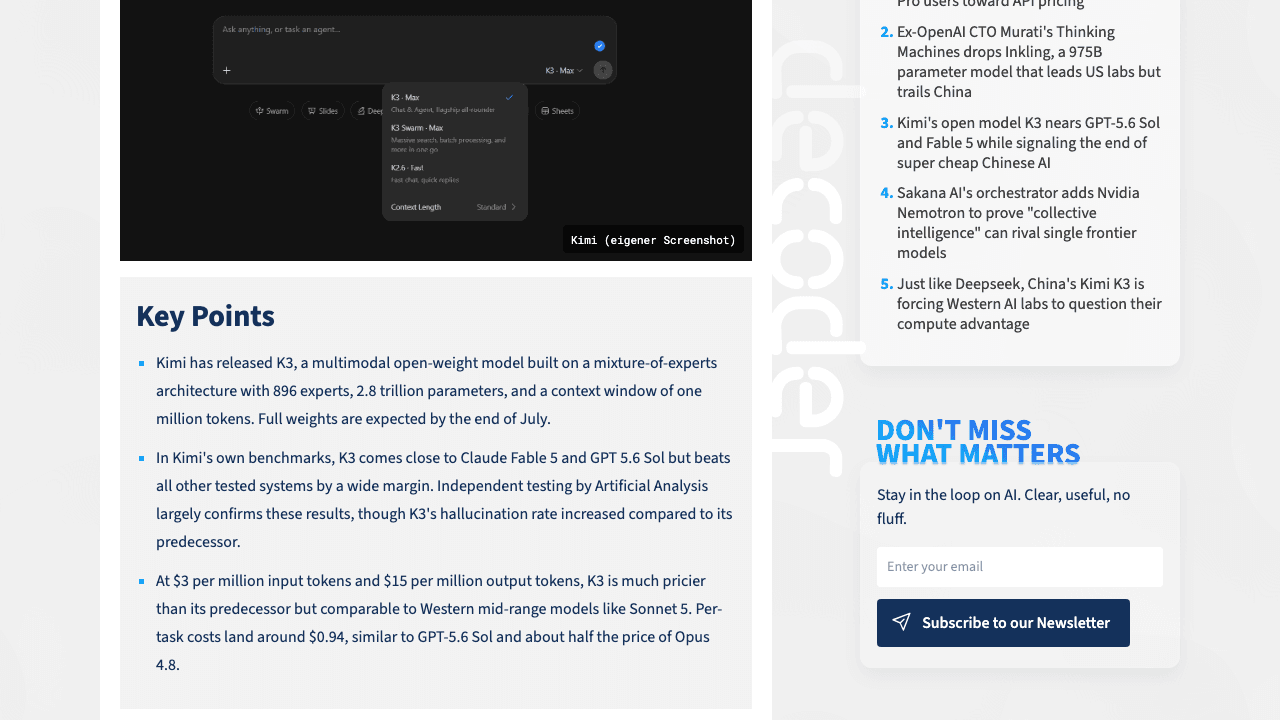
How does a model get more accurate and hallucinate more? Because those measure different behaviors. Accuracy is how often it's right when it answers; hallucination rate is how often it invents something confident and wrong instead of saying "I don't know." K3 answers more questions correctly and also declines to abstain more often, so it's both smarter and more willing to bluff. If your work depends on the model knowing when to stop, that trade is a step backward.
The gap shows up in head-to-heads too. Against GPT-5.6 Terra, hallucination is the single biggest metric where K3 falls behind, per BenchLM — Terra's knowledge score of 92.9 versus K3's 61.1 is largely a hallucination story, not a raw-capability one. So the kimi k3 hallucination concern isn't a vibe from one bad chat; it's visible in the numbers whichever independent source you pull.
Counterpoint, because fairness matters: this is a knowledge-retrieval and factuality weakness, not a coding or reasoning one. If you're grounding the model with retrieval, tools, or a verification step (which you should be doing with any model in production), the raw hallucination rate matters far less. The problem is real for open-ended factual Q&A; it's close to irrelevant for a well-scaffolded agent that checks its own work.
Kimi K3 Benchmarks Caveats: Even the Independents Disagree
Here's a limitation that isn't about the model at all. It's about the evidence you're being handed to judge it. This week, the two most-cited independent evaluators put Kimi K3 in different tiers. Artificial Analysis's Intelligence Index v4.1 ranks it #4 (index 57) overall, as of late July 2026, behind Fable 5 (59.9, with Opus 4.8 fallback) and GPT-5.6 Sol Max (58.9). Arena.ai, meanwhile, ranks K3 #1 in coding this week, and one Arena benchmark placed it best overall, ahead of Anthropic. Vals AI's independent analysis, cited by TechCrunch, found it competitive with flagship frontier models.
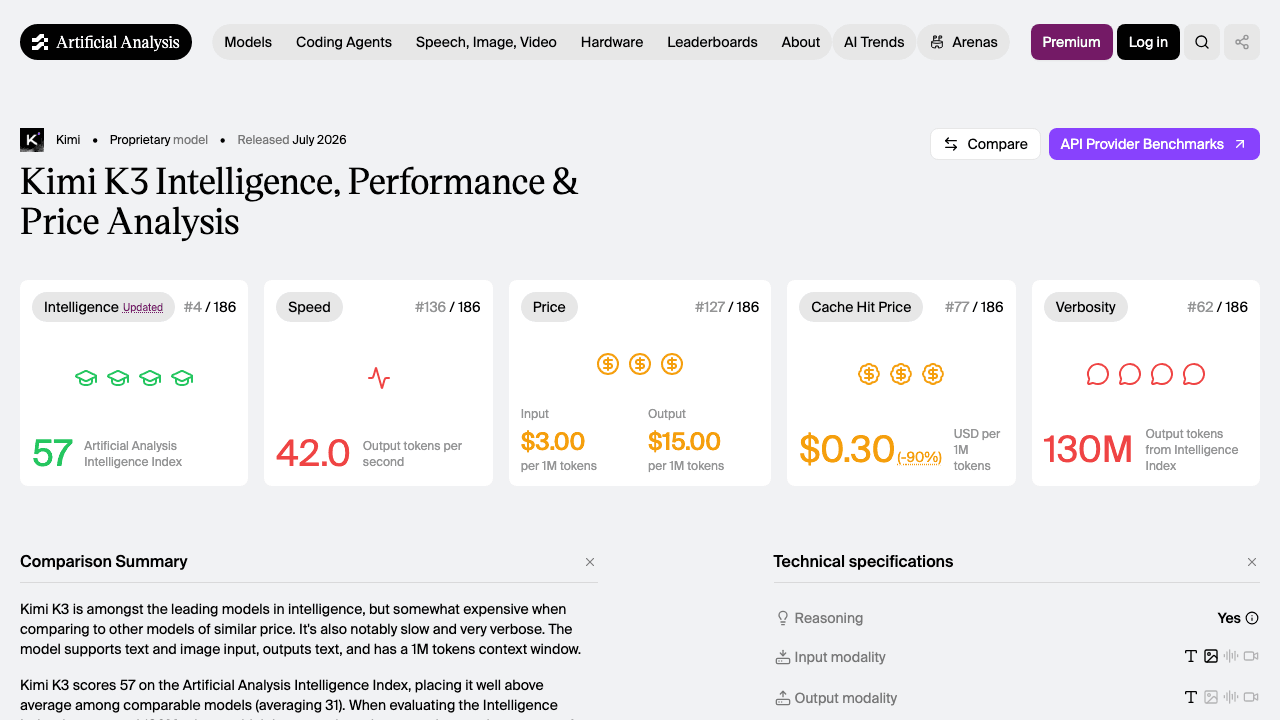
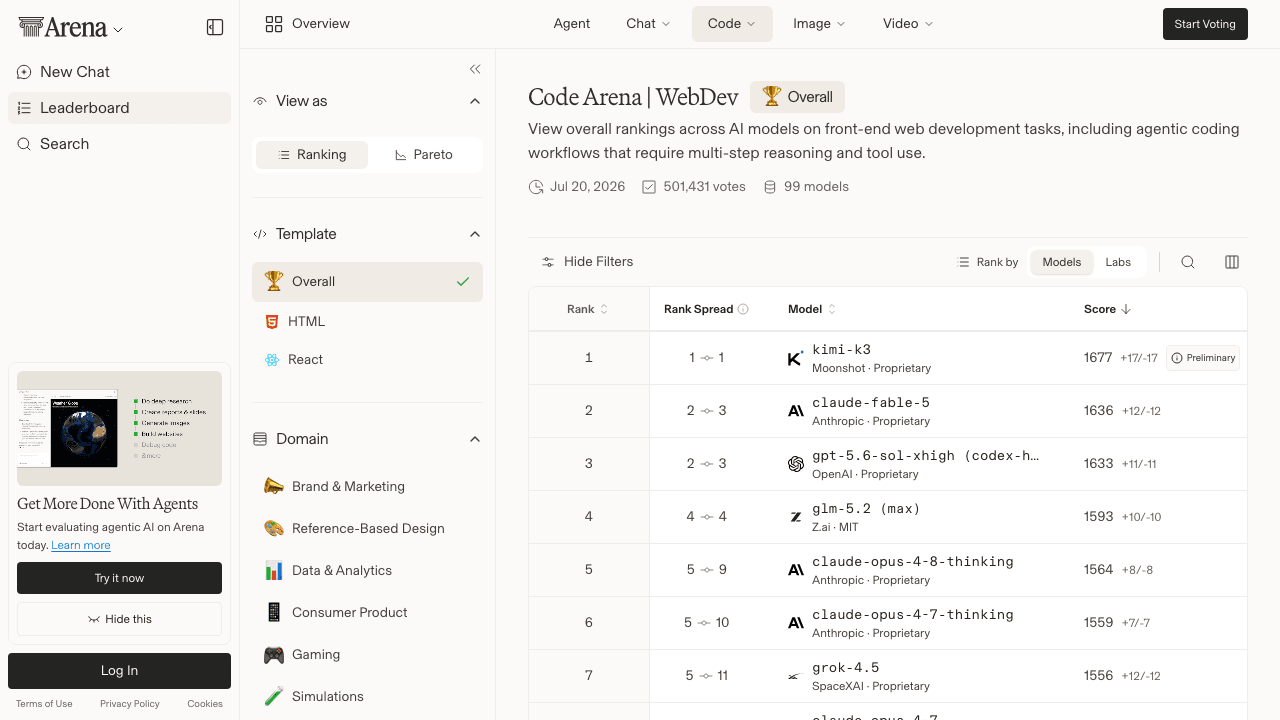
Same model. Three verdicts. That's not a rounding error, it's a real disagreement about what "best" means, and it's why you should treat any single ranking as directional rather than settled.
It gets murkier inside the official numbers. Moonshot's self-reported table mixes harnesses (some scores come from KimiCode, some from Claude Code, some from Codex), which means those aren't clean, controlled head-to-heads. A Terminal-Bench 2.1 of 88.3 run under KimiCode isn't directly comparable to a competitor's score under a different harness. And on the AA index, the 0.54-point gap between K3 and GPT-5.6 Sol xhigh sits inside AA's roughly 1-point 95% confidence interval, which cuts both ways: it means K3 isn't clearly behind, and it also means nobody can honestly claim it's clearly ahead.
So the kimi k3 benchmarks caveats takeaway is boring but correct: don't switch on a leaderboard. Pull the two or three tasks you actually care about, run K3 and your incumbent on them with the same harness, and score the outputs yourself. The leaderboards are a starting hypothesis, not a decision.
The 5x Price Problem
Kimi K3's per-token pricing is a real jump from the K2 line. K3 runs $3.00 in / $0.30 cached / $15.00 out per 1M tokens. K2.6 was $0.60 in / $2.50 out, so on input you're looking at roughly a 5x increase. If your mental model of "cheap Chinese open model" is calibrated to K2 pricing, K3 will surprise you on the invoice.
Per task, the picture softens. K3 lands around $0.94 per task on the fact base we're working from, which is roughly on par with GPT-5.6 Sol and about half the cost of Opus 4.8. So it's not expensive in absolute frontier terms; it's expensive relative to the K2 you remember. Both framings are fair, which is exactly why you should budget per task on your own workload instead of trusting any headline multiple. We deliberately won't tell you "K3 is X times cheaper": the number swings wildly with how output-heavy your work is, and community tests below show it ranging from a few cents to over sixteen dollars for a single job.
The benchmark disagreement is abstract; the cost and speed reality is not. During launch week, builders who ran K3 on real jobs kept reporting the same two frictions — it's slower than the closed leaders, and on long or output-heavy runs it can get expensive fast. This is the honest counterweight to the "Fable 5 quality at Sonnet prices" narrative. Below is a wall of real launch-week posts pulled specifically for the kimi k3 issues most demos skip: time-on-task, absolute cost, and polish.
-
 @KinasRemekx.com/KinasRemek
Paraphrase (orig. Polish): ran the same chain-reaction-machine build on Kimi K3 versus GPT-5.6 Sol. K3 took about 6 hours (est. $4.18); Sol finished in 25 minutes ($4.53). Near-identical cost, an order of magnitude slower.
-
 @_MaxBladex.com/_MaxBlade
"Kimi K3 is impressive but expensive and very slow. It took over 30 minutes and blew an entire $20 Kimi sub before finishing one game prompt. Too expensive to replace Fable 5."
-
 @cyrilXBTx.com/cyrilXBT
"Ran Kimi K3 and Claude Fable 5 through three real frontend builds: an e-commerce site, a 3D fighting game, a flight simulator. Fable 5 came out more polished every time."
-
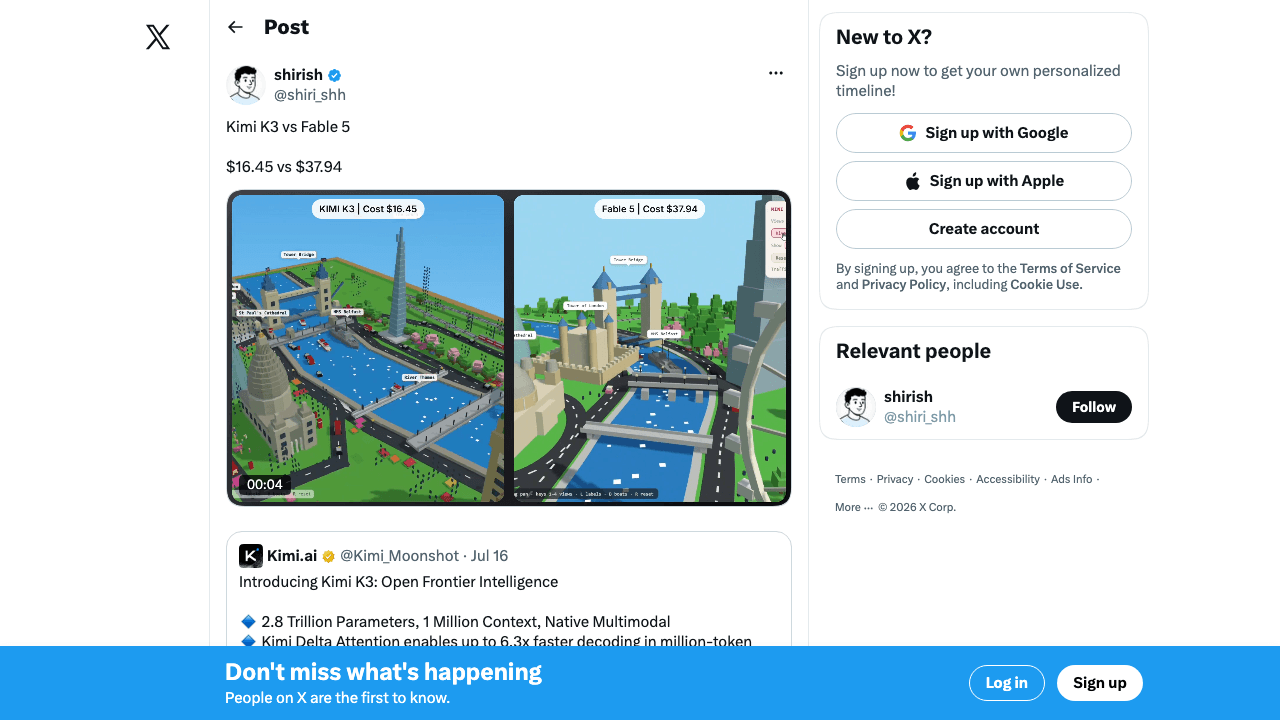
 @shiri_shhx.com/shiri_shh
"Kimi K3 vs Fable 5 on the same coding task: $16.45 vs $37.94. Cheaper than Fable, but $16.45 for one job is a real number when a demo made it look free."
-
 @Ananth7ex.com/Ananth7e
"Built the same battle royale game in both Kimi K3 and Qwen3.8 to compare, both on web. Kimi K3 took 130+ minutes."
-
 @AirdropAlchemisx.com/AirdropAlchemis
Paraphrase (orig. Chinese): put Kimi K3 to work on a web-based GTA-style game; it ran roughly 40 minutes autonomously and was still fixing its own bugs.
-
 @0xDepressionnx.com/0xDepressionn
"Rockstar spent 7 years on Red Dead Redemption 2. Kimi K3 rebuilt the same scene in 10 hours. One prompt, 4 million tokens. It sits on par with Fable 5 at Sonnet pricing."
-
 @gmi_cloudx.com/gmi_cloud
"Tested Kimi K3 against Fable 5 on 3D modeling. K3 took a bit longer than Fable 5 to generate, but came in about a third cheaper on the first test."
Read the wall together and a pattern falls out: K3 can absolutely match the closed leaders on output, but it often gets there slower, and the cost per finished job is unpredictable. That's fine for a weekend build. It's a planning problem for anything with a deadline or a budget cap.
Kimi K3 Issues With Access: Membership Gates and 401 Errors
Getting to K3 is gated in a way that trips people up. The model, the 1M-token context, and HighSpeed access are membership-gated; if you call the API on the wrong plan, you get an HTTP 401 rather than a clear "upgrade required" message. The entry subscription starts at ¥199/month, there's a limited free tier in the Kimi app, and a recharge promo running July 15–August 11 adds a 10–30% bonus on top-ups. It's navigable, but it's not the frictionless "paste a key and go" experience some launch posts implied.
The most common kimi k3 problems here are self-inflicted and fixable. A 401 usually means the plan doesn't include the endpoint you're hitting, not that your key is broken. And if the model seems to ignore a fresh instruction, starting a new session clears the cached context, worth trying before you conclude the model itself is failing.
The License Isn't Modified MIT, and It Isn't Open Source
This section used to say the license text was missing. It shipped on July 27 with the weights, and it says something different from what everyone reported.
The file is called the Kimi K3 License, not Modified MIT. Pre-release coverage from Decrypt and Yahoo Finance named it Modified MIT because that's what Moonshot's K2 family used; K3 moved off that. Hugging Face tags the repo license:other. Most of the text tracks MIT, then adds two conditions keyed to scale: run a Model-as-a-Service business past $20M in revenue over any consecutive twelve months and you must sign a separate agreement with Moonshot first, and ship a product past 100M monthly actives or $20M monthly revenue and you must display "Kimi K3" in your interface.
For most buyers that's a non-issue, since the license explicitly excludes products where the model sits behind your own features, and excludes internal use entirely. The limitation is narrower and worth naming precisely: K3 is not open source under the Open Source Initiative definition, because revenue-triggered obligations are field-of-use restrictions. If your procurement checklist has a literal "OSI-approved license" box, K3 doesn't tick it, and no amount of "open-weight" framing changes that.
The second gap survives the technical report. Moonshot describes the pre-training corpus by domain (web text, code, mathematics, knowledge, and a large vision corpus) but publishes neither the data nor the training code, and still discloses no token count and no knowledge cutoff. You can run the model, fine-tune it, and read how it was built; you cannot reproduce it or tell a regulator what it was trained on. For teams whose compliance posture depends on provenance, that's the limitation that didn't go away. Our Kimi K3 license explainer walks the clauses in detail.
Is Kimi K3 Reliable for Production Yet?
The most credible source on K3's rough edges is Moonshot itself, and the technical report is blunter than the launch materials were. The abstract states plainly that "its overall performance still trails the most powerful proprietary models, namely Claude Fable 5 and GPT-5.6 Sol," and the conclusion repeats it. Vendors rarely write that sentence about their own flagship. When one does, believe them; that's the answer to is kimi k3 reliable for production: not blindly, not yet, not without your own pilot.
One more thing enterprise buyers should read
The technical report includes a cybersecurity evaluation that cuts both ways, and it's the section most coverage skipped. On vulnerability discovery, roughly 70% of the model's human-reviewed findings were confirmed genuine, including 16 previously unknown vulnerabilities across six projects and two Linux kernel bugs (a remotely triggerable heap out-of-bounds write, and a Dirty-COW-class privilege-escalation primitive in the RDMA subsystem). That's real defensive-security capability, independently echoed by a joint assessment from the UK AI Security Institute and NIST's Center for AI Standards and Innovation.
On the offensive side, K3 solved 14 of 36 end-to-end exploit tasks against GLM-5.2's 8, but ten of those 14 wins came from the user-space track; on the Linux kernel track neither model cracked three-quarters of the problems, all of which human experts can solve. Moonshot attributes the gap to four failure modes, including getting stuck in unproductive debugging loops and failing to verify a deliverable before submitting it. Both patterns should sound familiar if you've watched any agent work a long task.
The part that matters for procurement isn't the score. Moonshot notes that frontier models from Anthropic and OpenAI refuse these tasks outright, which is why they're absent from the comparison. K3 does not refuse. If your security policy assumes the model will decline to write exploit code, K3 breaks that assumption, and you'll want your own guardrails rather than the vendor's.
So run one. A tight pilot protocol beats any leaderboard: take the same real tasks you run today, use the same harness for K3 and your incumbent so the comparison is clean, cap tool permissions so a long autonomous run can't rack up cost or do damage, and score completion quality by hand rather than trusting a self-reported number. Give it the jobs where hallucination or a blown budget would actually hurt, and watch what happens on the fifth run, not the demo-friendly first one.
If you want to try K3 on real work without standing up your own infrastructure or babysitting a 2.8T MoE, you can run it through a managed agent. MoClaw lets you point K3 at a task inside an always-on cloud agent, capped and observable, so a pilot doesn't mean a weekend of DevOps. That's the whole point of a pilot: get real signal cheaply before you commit a workload.
Kimi K3 Problems That Are NOT Real
A limitations piece that only lists the bad parts is just the mirror image of the hype, so here's the fairness section. Some of the loudest kimi k3 issues floating around this week don't hold up.
"It's just benchmark-maxing." This is the sharpest critique, and the evidence pushes back hard. Arena.ai ranked K3 #1 in coding on live head-to-heads, not a static test suite. It's #1 on the Frontend Code Arena. Vals AI's independent analysis found it competitive with frontier models. And the MiniTriton showcase, where K3 built a Triton-like compiler from scratch that matches or beats Triton and torch.compile on supported roofline benchmarks, and sustained nanoGPT training convergence, is not the kind of result you fake by overfitting to a leaderboard. The capability is real; the disagreement is about ranking, not existence.
"It's vaporware / a paper launch." No. The API is live, with a working kimi-k3 model ID, a Kimi Code k3 ID, an entry subscription, and OpenRouter access, plus a launch that coincided with Moonshot's WAIC Shanghai booth. Whatever else is true, you can call it today.
"The hype is entirely manufactured." Also no, and it's worth saying plainly. Independent testers with no incentive to flatter Moonshot, from the Flappy Bird and armory-bay comparisons to the "if I swapped the name people would trust it" taste tests, reported genuinely strong results. The correct read isn't "it's fake," it's "it's strong and it has the specific weaknesses listed above." Both, at once, same as the hallucination story.
FAQ
Does Kimi K3 hallucinate more than its predecessor?
Yes. On AA-Omniscience, its accuracy rose from 33% to 46%, but its hallucination rate increased at the same time, per Artificial Analysis via the-decoder. It's more accurate when it answers and more willing to answer when it shouldn't. Against GPT-5.6 Terra, hallucination is the single biggest gap metric, per BenchLM. Ground it with retrieval or verification and the risk drops sharply.
Why do Kimi K3 benchmark rankings disagree?
Because independent evaluators measure different things and weight them differently. Artificial Analysis ranks K3 #4 (index 57) overall, as of late July 2026, while Arena.ai ranks it #1 in coding and Vals AI calls it competitive with frontier models. On top of that, Moonshot's own table mixes harnesses (KimiCode, Claude Code, Codex), so those scores aren't clean head-to-heads. Treat every ranking as directional and run your own eval.
Why am I getting a 401 error with Kimi K3?
A 401 almost always means your membership plan doesn't include the endpoint you're calling; K3 itself, the 1M-token context, and HighSpeed access are gated to specific tiers. Match your plan to the feature. If the model is ignoring a fresh instruction, starting a new session clears cached context.
Is Kimi K3 production-ready?
Not without your own pilot. Moonshot's own technical report states that K3 trails Claude Fable 5 and GPT-5.6 Sol overall, and the model does not refuse cybersecurity tasks that frontier US models decline. Run the same real tasks through K3 and your incumbent on the same harness, cap tool permissions, and score the results by hand before you switch anything that matters. For the full head-to-heads, see our Kimi K3 vs GPT-5.6 comparison.
Continue Reading
More Guide
What Is Hermes Bot Mode? Bots and Routines
OpenAI Assistants API Deprecated: What Broke
MCP Tools: What They Are and Which to Use

OpenAI Models Not Available in Cursor Nov 12

Coding Agent Security: When Your Tools Lie
OpenAI Python HTTPX2: What Actually Breaks
The MoClaw editorial team writes about workflow automation, AI agents, and the tools we build. Default byline for industry overviews, listicles, and collaborative pieces.
Use Kimi K3 on MoClaw, without the setup
Run Kimi K3 as an always-on managed agent with memory, your tools, and scheduling. No API wiring, no plan gating, no self-hosting.
References: The Decoder · Artificial Analysis (Kimi K3) · Arena.ai · TechCrunch · Kimi K3 technical report (PDF) · Kimi K3 License (Hugging Face) · MIT License (Open Source Initiative)