Kimi K3 vs GPT-5.6: Benchmarks & Verdict

Kimi K3 vs GPT-5.6: Sol wins 6 of 9 shared benchmarks, K3 wins on agentic tasks and is 1.9x cheaper per token. Which one fits your work in 2026?
Table of Contents
The short version of Kimi K3 vs GPT-5.6: on the nine benchmarks the two share, GPT-5.6 Sol wins six and Moonshot's K3 wins three, but K3 is roughly 1.9x cheaper per input token and pulls ahead on agentic and browsing work. Which one you should run depends less on the leaderboard than on whether your job is knowledge-heavy or agent-heavy.
Most pages ranking for this query hand you a spec table and stop. A spec table won't tell you that the top-line intelligence gap sits inside the margin of error, that two independent evaluators can't agree on who's #1, or that the per-token price gap mostly evaporates once you measure per finished task. That's what the rest of this is for.
Kimi K3 vs GPT-5.6 at a Glance
Kimi K3 launched July 16, 2026 as an API-first, open-weight model (2.8T total parameters, MoE; see what is Kimi K3 for the full spec); GPT-5.6 ships in three tiers (Sol, Terra, and Luna), with Sol as the flagship. Here's the head-to-head on the numbers people actually compare, each labeled by source so you know which claim to trust and which to run yourself.
| Dimension | Kimi K3 | GPT-5.6 Sol |
|---|---|---|
| Intelligence Index (per Artificial Analysis v4.1) | 57 | 58.9 |
| Overall ranking | #4 index 57 (AA) / #1 in coding (Arena.ai) | frontier tier |
| Shared benchmark split (per llm-stats) | wins 3 of 9 | wins 6 of 9 |
| Agentic / browsing (per BenchLM) | 91.2 | 87.4 |
| Knowledge accuracy (per BenchLM, vs Terra) | 61.1 | 92.9 |
| Hallucination control | weaker (rate rose vs predecessor) | stronger |
| Context window | 1.0M tokens | 1.1M tokens |
| Input price | $3.00 / 1M tokens | $5.00 / 1M tokens |
| Per-task cost | ~$0.94 | ~$0.94 |
| Openness | open weights since July 27 (Kimi K3 License) | closed |
Read the Kimi K3 vs GPT-5.6 table as a split decision, not a knockout. GPT-5.6 Sol edges the aggregate intelligence score and dominates knowledge; K3 wins on agent workflows, browsing, and price, and it opens its weights later this month. The rest of this comparison unpacks each row and flags where the evidence itself is shaky.
Kimi K3 vs GPT-5.6 Sol: The Benchmark Split
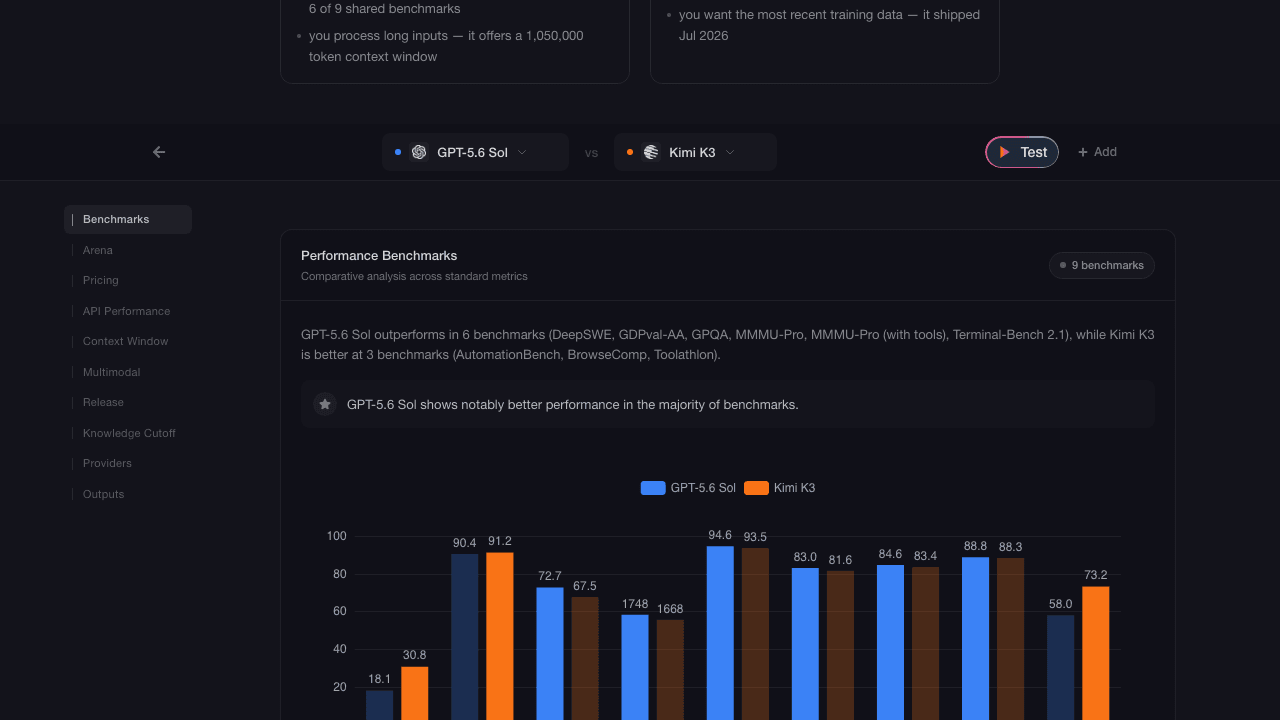
Start with the cleanest apples-to-apples data. Per llm-stats, across nine benchmarks both models were run on, GPT-5.6 Sol takes six and Kimi K3 takes three. Sol's six: DeepSWE, GDPval-AA, GPQA, MMMU-Pro (twice), and Terminal-Bench 2.1. K3's three: AutomationBench, BrowseComp (91.2 vs 87.5), and Toolathlon. So on a raw count Sol is ahead, but the three K3 wins cluster tightly around agent and tool-use tasks, which matters more than the tally if that's your workload.
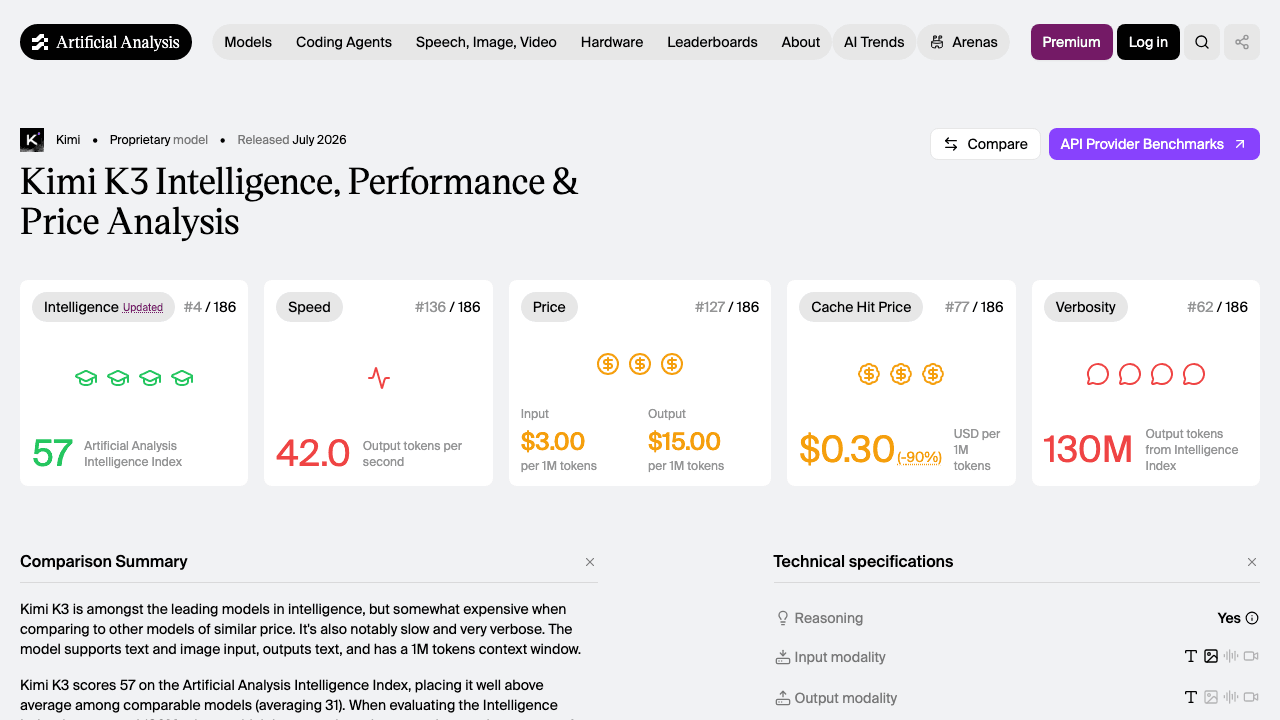
Now the top-line intelligence number, and here's where you should slow down. Per Artificial Analysis's Intelligence Index v4.1, Kimi K3 scores 57 (index 57, as of late July 2026) against GPT-5.6 Sol Max's 58.9 — inside AA's own roughly 1-point 95% confidence interval. In plain terms, AA can't statistically separate them at the top. Treating that headline gap as a real quality difference reads more into the chart than the chart supports.
One caveat runs under every official number here, so state it once and keep it in mind: Moonshot's self-reported results were produced across mixed harnesses (KimiCode for some tests, Claude Code for others, Codex elsewhere), which means they aren't controlled head-to-heads, and neither are most launch-week community runs. A harness change alone can swing an agentic score several points.
There's a second, newer caveat that most spec tables skip entirely. The independent evaluators now disagree with each other: AA #4 (index 57) vs Arena #1 coding. Artificial Analysis holds K3 at #4 overall (index 57, as of late July 2026). Arena.ai ranks K3 #1 in coding this week, with one Arena benchmark placing it best overall, ahead of Anthropic's flagship. Independent analysis reported by TechCrunch found K3 competitive with frontier closed models. Same model, three verdicts. When the institutions that grade these things can't converge, the honest takeaway isn't "K3 is #1" or "K3 is #4": it's that public rankings are directional, and the only benchmark that binds is your own eval on your own tasks.
Where Kimi K3 Wins: Agentic Work and Coding Arenas
If your work is agent-shaped (multi-step tool use, browsing, long autonomous runs), K3 is the more interesting side of this matchup. Its three shared-benchmark wins were AutomationBench, BrowseComp, and Toolathlon, all tool-and-agent tasks. On BenchLM's agentic measure K3 posts 91.2 against GPT-5.6's 87.4, and on BrowseComp specifically it's 91.2 vs 87.5 per llm-stats. Arena.ai's #1-in-coding placement (labeled as Arena's verdict, not settled fact) points the same direction.
The launch-week community builds tell a consistent story too, especially for frontend and 3D generation where several testers put K3 ahead of GPT-5.6 Sol. The wall below collects the real head-to-heads that involved GPT-5.6 during launch week: faithful quotes, real handles, real links. Treat each as a single anecdotal run, not a controlled benchmark; the value is in the pattern across many independent testers, not any one screenshot.
-
 @kirillk_web3x.com/kirillk_web3
"Kimi K3 3-shotted a walkable voxel town with drivable cars (Voxelville) for about $3.24 in API usage. The same token cost was $10.80 on Fable 5 and $6 on GPT-5.6 Sol."
-
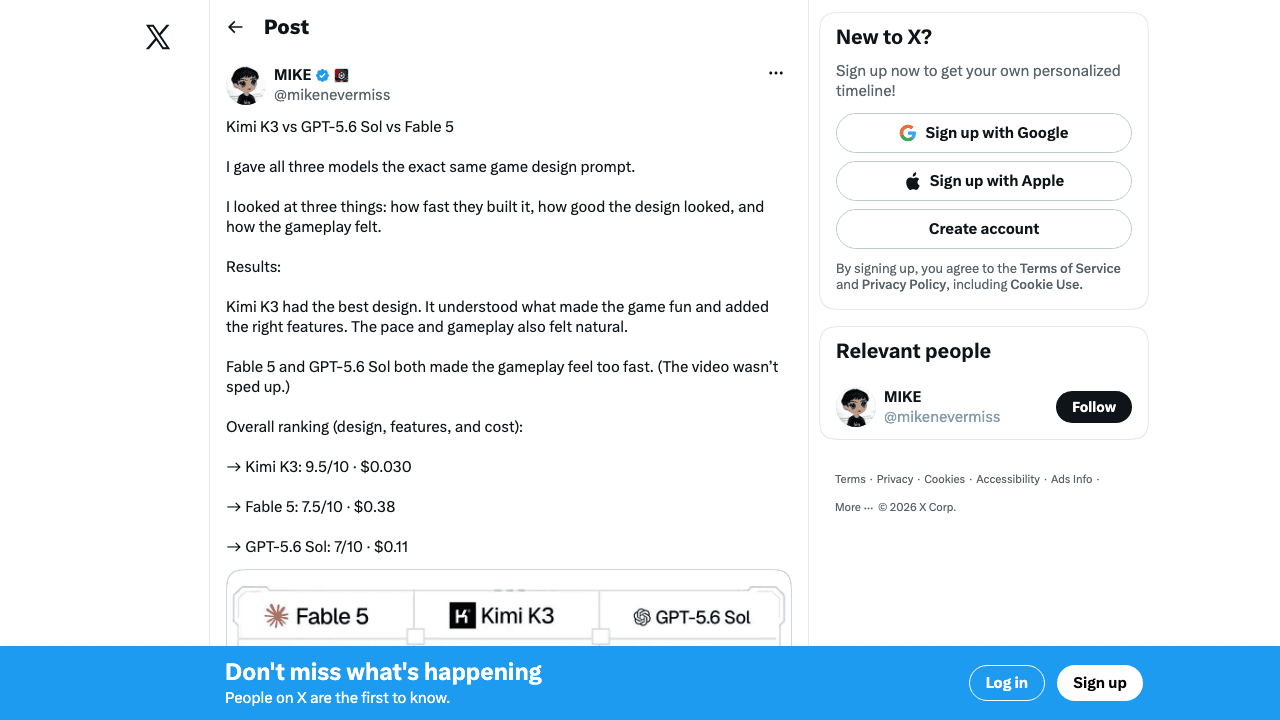
 @mikenevermissx.com/mikenevermiss
"Kimi K3 vs GPT-5.6 Sol vs Fable 5, same game design prompt to all three. Kimi K3 had the best design; it understood what made the game fun and the pacing felt natural."
-
 @chetasluax.com/chetaslua
"Kimi K3 vs GPT-5.6 Sol on a medieval ballista game. The difference in taste is stark: same result, but K3 gets there in a more creative way." (paraphrase)
-
 @filicrovalx.com/filicroval
"Kimi K3 mogs GPT-5.6 Sol on frontend design; features are similar but K3 has much better taste and 3D capabilities; the design is more elegant on K3's side." (luxury site build)
-
 @CommandCodeAIx.com/CommandCodeAI
"Three top-tier models, same /design prompt. Ratings on DX, features and cost: Kimi K3 9.5/10 at $0.030, Fable 5 7.5/10 at $0.38, GPT-5.6 Sol 7/10 at $0.11."
-
 @higgsfield_aix.com/higgsfield_ai
"Kimi K3 vs GPT-5.6 Sol on an ink-drop landing-and-diffusion animation, both outputs rendered with Seedance 2.0." (motion/design comparison)
-
 @fardeentwtx.com/fardeentwt
"I gave the same prompt to Kimi K3 Max and GPT-5.6 Sol Ultra to build a 3D castle. Sol Ultra is clearly better here, but I'm really impressed with K3 too."
-
 @_MaxBladex.com/_MaxBlade
"Kimi K3 is here. Slow and expensive (30+ minutes and a whole $20 sub on one prompt), but the output has Fable 5-level magic; this model falls between GPT-5.6 and Fable 5. Play it at kimisurfers.com." (paraphrase)
For long-horizon autonomy, K3's Swarm Max variant coordinates up to 300 sub-agents across as many as 4,000 steps, which is a different kind of capability than a single flagship chat model. We cover that in the Kimi K3 agent swarm breakdown.
Where GPT-5.6 Wins: Knowledge and Hallucination Control
Flip the workload and the verdict flips with it. On knowledge, GPT-5.6 is decisively ahead. Per BenchLM, GPT-5.6 Terra scores 92.9 on knowledge against K3's 61.1 — a gap large enough that no confidence-interval hand-waving explains it away, and it's driven by K3's hallucination behavior. Per Artificial Analysis, K3's accuracy improved over its predecessor (roughly 33% to 46% on AA-Omniscience) yet its hallucination rate went up, not down. Hold both facts at once: more capable, and more confidently wrong when it's wrong. Against GPT-5.6 Terra, hallucination is the single biggest gap metric per BenchLM.
GPT-5.6 also holds the edge on Terminal-Bench 2.1 among the shared benchmarks (per llm-stats), and its 1.1M-token context is marginally larger than K3's 1.0M. If your work is research, factual synthesis, compliance-sensitive drafting, or anything where a wrong answer stated confidently costs you, GPT-5.6's tighter hallucination control is the deciding factor, and no amount of K3's price advantage buys that back. This is the flip side of the agentic story; for the full catalog of K3's weak spots see Kimi K3 limitations.
Kimi K3 vs GPT-5.6 Terra: The Mid-Tier Matchup
Not everyone is choosing against Sol. If you're on a mid-tier plan, GPT-5.6 Terra is your real competitor, and the gap tightens considerably. Per BenchLM's provisional numbers, Terra scores 84 against K3's 82 overall, close enough that on any given task the winner may come down to the harness and the prompt rather than the model. Terra still keeps its knowledge and hallucination edge (the 92.9-vs-61.1 knowledge split above is a Terra number), but on agentic and coding work K3's 91.2-vs-87.4 lead carries over.
The practical read: if you were reaching for Terra to save money over Sol, K3 lands in the same performance neighborhood while opening its weights and undercutting on per-token price. Terra remains the safer pick when factual reliability is the whole point.
Pricing: 1.9x Cheaper Per Token, Same Per Task
Here's where the spec tables comparing Kimi K3 vs GPT-5.6 mislead. Kimi K3 lists at $3.00 input / $0.30 cache / $15.00 output per 1M tokens; GPT-5.6 Sol's input runs $5.00 per 1M, which makes K3 roughly 1.9x cheaper per input token. That's a real gap and it's the headline every comparison leads with.
But per token isn't per task. Both models land near ~$0.94 per task on the fact base we're working from; the token-price gap narrows because the two models spend tokens differently on the same job. The math that decides your bill is the input/output mix: K3's cheaper input helps most on input-heavy, long-context work, while its $15 output makes verbose, output-heavy generation less of a bargain than the input headline suggests. Community runs were all over the map on cost, which is exactly why you shouldn't trust any single "K3 is Nx cheaper" claim: in one community test a builder reported a K3 build at a fraction of the closed-model cost, in another the two came out close; the honest move is to price your own representative task rather than an average multiple.
| Cost basis | Kimi K3 | GPT-5.6 Sol |
|---|---|---|
| Input / 1M tokens | $3.00 | $5.00 |
| Output / 1M tokens | $15.00 | (higher tier) |
| Per-token advantage | ~1.9x cheaper input | — |
| Per finished task | ~$0.94 | ~$0.94 |
Is Kimi K3 Better Than GPT-5.6? Verdict by Use Case
There is no single "is Kimi K3 better than GPT-5.6" answer, and anyone giving you one is selling something. The honest verdict splits by workload.
Choose Kimi K3 if your work is agentic, browsing-heavy, or coding-arena shaped, where its BrowseComp and AutomationBench wins and Arena.ai's #1-in-coding placement (per Arena.ai) actually cash out, and if per-token price on input-heavy jobs matters. K3 also wins on control: its weights went public on July 27, 2026 under the Kimi K3 License, so self-hosting and data residency become options GPT-5.6 simply doesn't offer. On taste, @chetaslua's read after a same-prompt run captures the community mood: "Difference in taste is so stark, like if I swap Kimi K3's name with Fable 5 people will trust it": same result, more creative path.
Choose GPT-5.6 if your work is knowledge-heavy or hallucination-sensitive. The 92.9-vs-61.1 knowledge gap and K3's risen hallucination rate aren't close, and they're the metrics that matter for research, compliance, and factual drafting.
Whichever way you lean, notice that this is increasingly a decision you don't have to make once. CNBC and TechCrunch have covered a shift in how startups build: away from betting on one giant model and toward the harness/app layer that lets you swap models per task. The OpenClaw harness got popular for exactly that reason, and Perplexity's CEO has noted that startups now focus on methodologies for using models rather than on any single LLM. Models churn; workflows persist. If you'd rather run K3 through a managed agent than stand up your own infra to try it, MoClaw's Kimi K3 integration lets you route tasks to it without provisioning anything. For the same head-to-head against Anthropic's lineup, see Kimi K3 vs Claude.
So the verdict on Kimi K3 vs GPT-5.6 is a genuine split decision: K3 for agents, browsing, price, and openness; GPT-5.6 for knowledge and reliability. Your workload decides it, not the leaderboard.
FAQ
Is Kimi K3 better than GPT-5.6 for coding?
It depends on the coding task. Per Arena.ai, K3 ranked #1 in coding this launch week, and several community frontend and game builds put it ahead of GPT-5.6 Sol. But per llm-stats, GPT-5.6 Sol still wins the majority of shared coding-adjacent benchmarks (six of nine), and Artificial Analysis holds K3 at #4 overall (index 57). The evaluators disagree, so run your own eval before switching.
Is Kimi K3 cheaper than GPT-5.6?
Per token, yes: K3's $3.00 input is roughly 1.9x cheaper than GPT-5.6 Sol's $5.00. Per finished task both land near ~$0.94, because the models spend tokens differently; so the real answer depends on your input/output mix, and K3's cheaper input helps most on long-context, input-heavy work.
Kimi K3 vs ChatGPT: what's the difference?
Kimi K3 is a model (Moonshot's open-weight LLM); ChatGPT is OpenAI's consumer product that runs GPT-5.6 among other models. Comparing "Kimi K3 vs ChatGPT" really means comparing K3 the model to GPT-5.6 the model plus a chat interface; the benchmark and price splits above apply, and MoClaw is a separate managed agent product, not a model.
Which is better for agents?
Kimi K3, on current evidence. It wins the agent and tool-use benchmarks (AutomationBench, BrowseComp 91.2 vs 87.5, Toolathlon per llm-stats; agentic 91.2 vs 87.4 per BenchLM), and its Swarm Max variant is built for long multi-agent runs. GPT-5.6's advantage is knowledge and hallucination control, which matters more for research than for autonomous tool use.
Continue Reading
More Comparison
Lindy vs MoClaw: Teammate or Cloud Computer?
DeepSeek vs ChatGPT: Research, Code, Price

ChatGPT vs Microsoft Copilot: Which Fits You?

Gemini vs ChatGPT for Work: Which Is Better?

Cursor Cloud Agent vs Grok Bot

GPT-5.6 Sol vs Terra vs Luna: Pick One
The MoClaw editorial team writes about workflow automation, AI agents, and the tools we build. Default byline for industry overviews, listicles, and collaborative pieces.
Use Kimi K3 on MoClaw, without the setup
Run Kimi K3 as an always-on managed agent with memory, your tools, and scheduling. No API wiring, no plan gating, no self-hosting.
References: Kimi K3 on Artificial Analysis (Intelligence Index v4.1) · Arena.ai leaderboards · TechCrunch · CNBC