GPT-5.6 Sol vs Terra vs Luna: Pick One

GPT-5.6 Sol vs Terra vs Luna: Luna fell 80% and Terra 20%, so the middle tier now costs 10x the floor. Current list prices and how to pick a tier.
Table of Contents
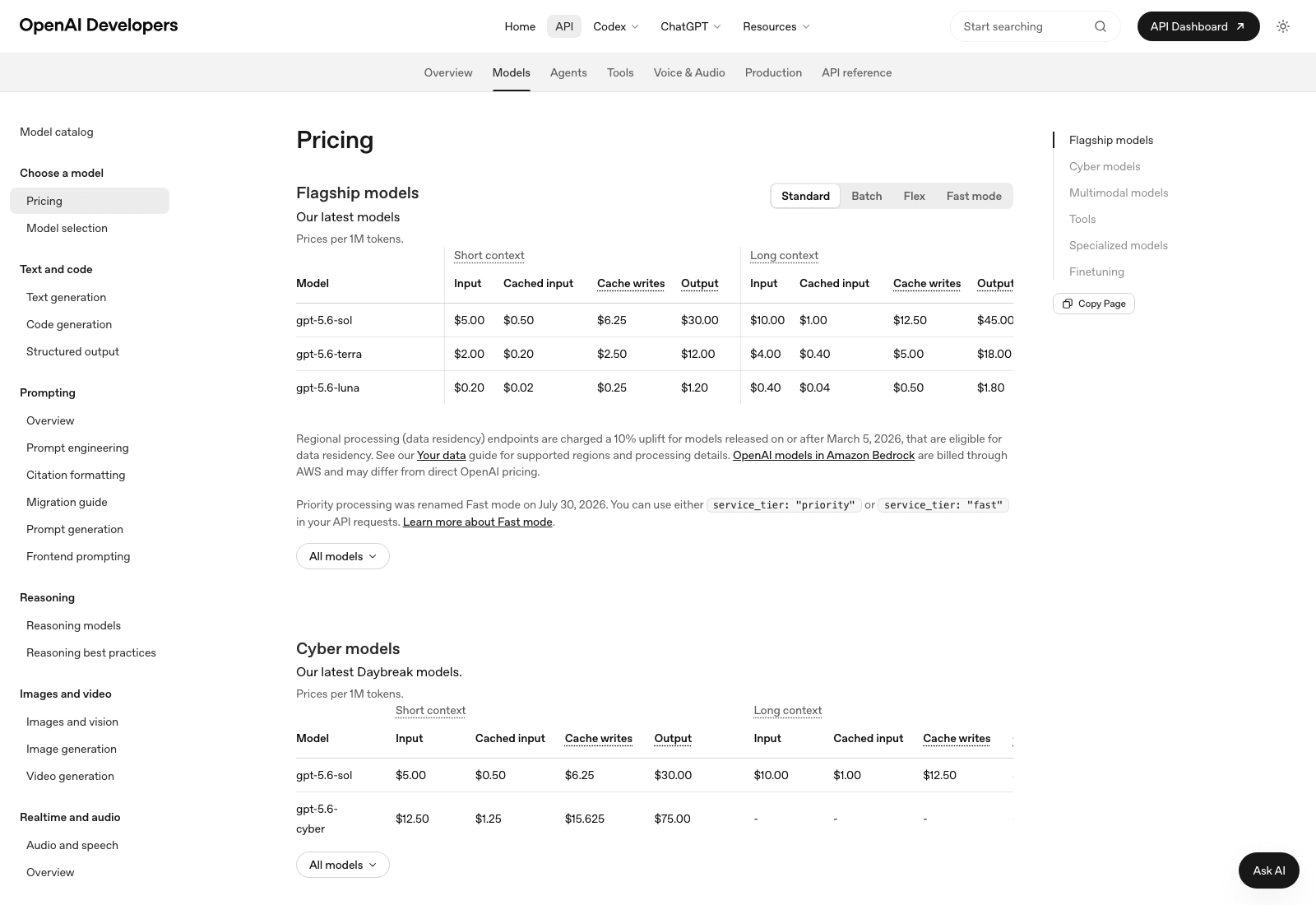
GPT-5.6 Sol vs Terra vs Luna is usually explained as a straight ladder: flagship, balanced, cheap. That framing held in June and doesn't now, because OpenAI's pricing table lists Luna at $0.20 per million input tokens against Terra's $2.00 and Sol's $5.00, which is a 10x step at the bottom of the ladder and only 2.5x at the top.
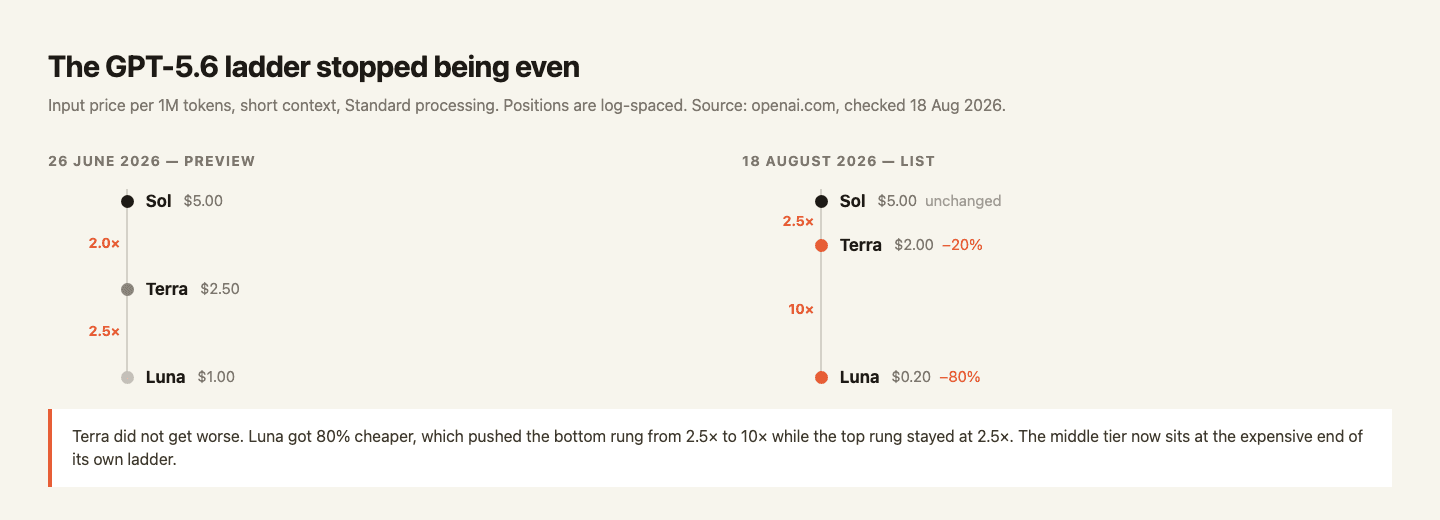
Luna's price came down 80% since the June preview while Terra's came down 20% and Sol's never moved, so the middle tier now sits much closer to the flagship than to the floor. That is the opposite of how a balanced option is supposed to work.
Key Takeaways:
- Short-context list prices per 1M tokens: Sol $5.00 in / $30.00 out, Terra $2.00 in / $12.00 out, Luna $0.20 in / $1.20 out
- Since the June preview, Sol held flat, Terra came down 20%, and Luna came down 80%, which stretched the Luna-to-Terra gap from 2.5x to 10x
- Anything above roughly 270K tokens of context is billed at 2x input and 1.5x output on every tier
- Sol's cached input costs $0.50, four times less than Terra's uncached input, so caching can matter more than the tier
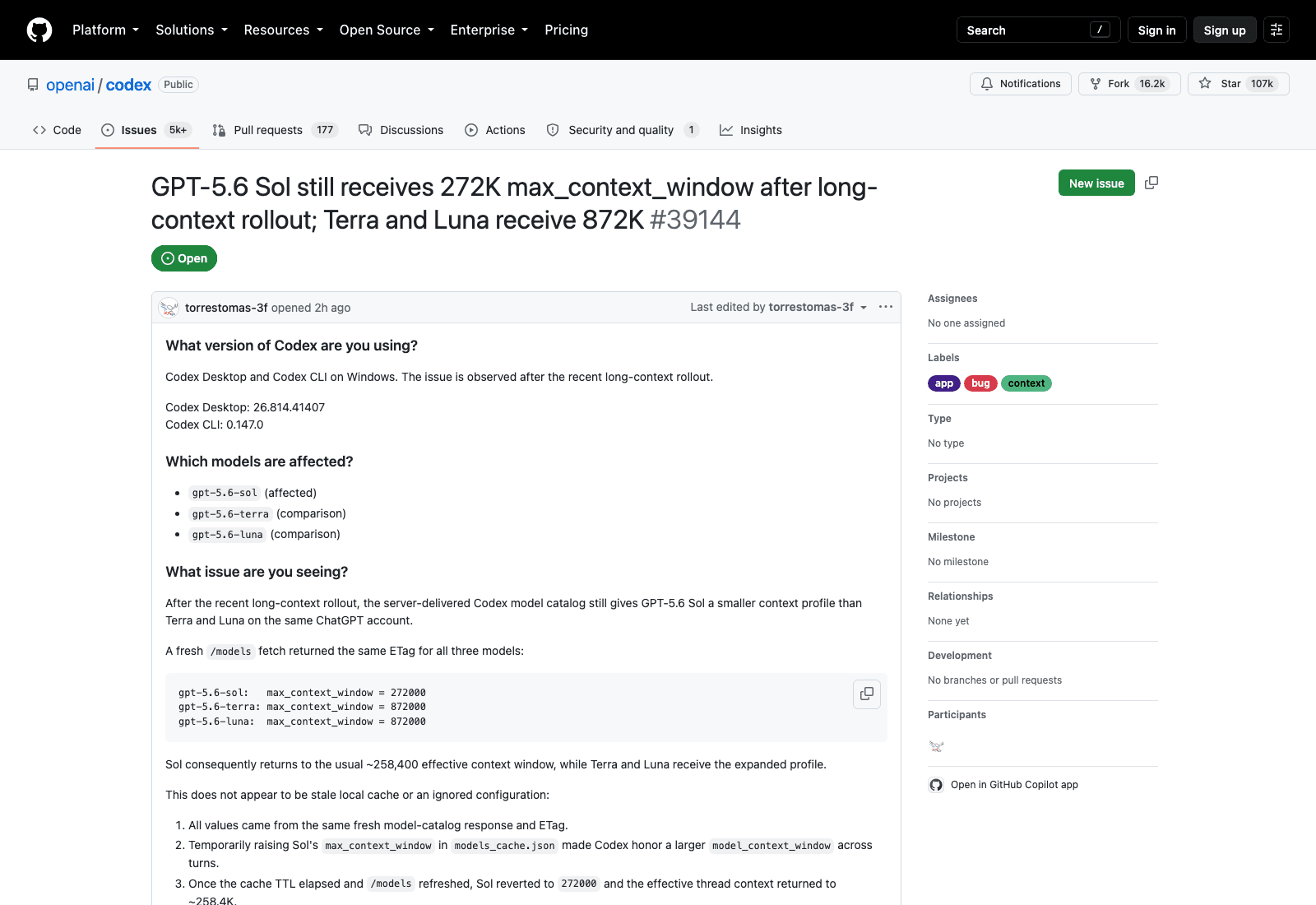
- Codex users are reporting Sol capped at 272K context while Terra and Luna get 872K; OpenAI has it open as a bug
GPT-5.6 Sol vs Terra vs Luna at OpenAI's List Prices
Everything here comes off OpenAI's Standard processing tier, checked August 18, 2026. Batch halves it, Fast mode (renamed from Priority on July 30) prices differently again, and regional data residency endpoints add 10%.
| Per 1M tokens, short context | Sol | Terra | Luna |
|---|---|---|---|
| Input | $5.00 | $2.00 | $0.20 |
| Cached input | $0.50 | $0.20 | $0.02 |
| Cache writes | $6.25 | $2.50 | $0.25 |
| Output | $30.00 | $12.00 | $1.20 |
| Long context input | $10.00 | $4.00 | $0.40 |
| Long context output | $45.00 | $18.00 | $1.80 |
The ratios are cleaner than the absolute numbers. Sol costs 2.5x Terra and 25x Luna, on input and output alike, in short context and long. OpenAI kept the multiples identical across every column, so whatever you conclude about one row holds for all of them.
The Repricing That Moved Terra to the Expensive End
Go back to the June 26 preview post and the original prices were Sol $5 in / $30 out, Terra $2.50 / $15, and Luna $1 / $6. Compare that against today and only two tiers moved: Terra came down 20%, Luna came down 80%, Sol didn't budge.
That is the whole story, and it changed the shape of the decision rather than just the size of the bill.
| Tier | June 26 preview | August 18 list | Change |
|---|---|---|---|
| Sol | $5.00 / $30.00 | $5.00 / $30.00 | flat |
| Terra | $2.50 / $15.00 | $2.00 / $12.00 | down 20% |
| Luna | $1.00 / $6.00 | $0.20 / $1.20 | down 80% |
In June the ladder was almost evenly spaced: Luna to Terra was 2.5x and Terra to Sol was 2x, so Terra genuinely sat in the middle. Today Luna to Terra is 10x and Terra to Sol is 2.5x. Terra kept its position in the product lineup and lost it in the price list.
Why the Middle Tier Is the Hardest One to Justify
Think about what you're actually deciding when you reach for Terra. You've concluded the job is worth 10x Luna's price. Having already accepted that, the remaining question is whether it's worth 2.5x more again for the flagship, and for most work that clears the first bar the answer is yes.
OpenAI's own framing doesn't help Terra either. The preview post describes it as competitive with GPT-5.5 at half the cost, which is a comparison against a previous generation rather than against its siblings. Luna gets described as strong capability at the lowest cost. Sol gets the ultra mode with subagents and the new max reasoning effort. Terra is the tier defined by what it isn't.
There is a real case for it, and it's narrower than the marketing suggests: high-volume work where Luna measurably fails on quality but the failure rate is low enough that Sol's 2.5x premium never pays for itself. That's a genuine shape. It's also a shape you can only identify by running your own evaluation, not by reading a tier description.
Watch out for one trap in particular. Plenty of the GPT-5.6 Sol vs Terra vs Luna comparisons currently ranking were published between July 5 and August 5, which puts them before or right around the repricing, and several still quote Luna at $1 per million input tokens. If you inherited a tier decision from a spreadsheet built on those numbers, the arithmetic behind it no longer holds; Luna is five times cheaper than whatever that spreadsheet assumed.
What Sol Actually Buys, and When 25x Is Cheap
Sol is the only tier with max reasoning effort and ultra mode, which spawns subagents rather than working as a single model. Since August 13 there's also an Ultrafast preview running Sol at up to 14x the usual speed, and OpenAI has been serving it on Cerebras at up to 750 tokens per second.
Twenty-five times Luna's price sounds indefensible until you count differently. If a Sol run finishes a task that Luna attempts four times and gets wrong, Luna's cheapness bought you nothing except four rounds of your own review time. Tokens are the cheapest input in most of these workflows; the expensive one is a person reading output to decide whether it's usable.
So the honest rule is about failure rates, not price. Below a few hundred runs a month, pick the tier that fails least and stop optimising. Above that, the arithmetic reverses and every 10x starts to matter, which is the same split-by-task logic we worked through in the multi-model agent guide.
Long Context Reprices Everything Above 270K
OpenAI's pricing table carries two full sets of columns, short context and long, and the switch happens around 270K tokens. Long-context input costs exactly 2x the short-context rate and long-context output costs 1.5x, on all three tiers.
Sol at long context runs $10.00 in and $45.00 out. Luna at long context runs $0.40 and $1.80, which is still less than Terra's short-context rate.
This is the part that catches people. A codebase audit or a long document review doesn't feel like a different pricing tier, but it is one, and the surcharge lands whether you meant to cross the line or not. Worth adding a token count check before the call rather than discovering it on the invoice, which is easier when every run goes through one place. Spread the same workflow across three laptops and a cron job and nobody owns the number; run it on a hosted cloud AI computer like MoClaw and the token budget is observable where the work happens rather than reconstructed from a bill.
There's a related wrinkle worth watching rather than acting on. Codex users have reported that after the long-context rollout their model catalog gives Sol a 272K context window while Terra and Luna get 872K, and OpenAI now has that filed as an open bug labelled context and app. If it holds, the cheaper tiers would carry more usable context than the flagship. Check your own catalog before you plan around it.
Caching Is a Bigger Lever Than the Tier You Picked
One number reorders the whole comparison: Sol's cached input costs $0.50 per million tokens against Terra's $2.00 uncached, so on a workload whose prompts repeat, the flagship's input side runs four times cheaper than the middle tier's.
Output pricing doesn't move, so this isn't a free upgrade. But most agent workloads are input-heavy on the repeated part, a system prompt, a schema, a policy document, a chunk of codebase that never changes between runs, and that's precisely what caches well. GPT-5.6 added explicit cache breakpoints and a 30-minute minimum cache life, with cache writes billed at 1.25x the uncached rate, so you pay a little up front to save 90% on reads.
Teams that skip caching and then agonise over tiers are optimising the smaller number. Work out your cache hit rate first, then revisit the tier, because a workload that caches at 80% is a materially different pricing problem from one that caches at zero.
The 30-minute cache life has an awkward implication, though: the discount only lands if your runs cluster inside that window, and work you kick off by hand when you happen to be at your desk almost never does. Scheduled runs do. That is the quieter reason to put recurring work on something hosted, MoClaw included, where the job fires on a clock rather than whenever the laptop is open, so consecutive runs land inside each other's cache window instead of each paying full price.
Picking a Tier by Job, Not by Benchmark
GPT-5.6 Sol vs Terra vs Luna is a question about your failure rate, and you cannot read your failure rate off a pricing page. Start on Luna and make it break. Run your real prompts rather than a benchmark suite, and record where the output stops being good enough. The failure zone is usually narrower than expected: one document type, or the summarisation step but not the extraction step.
Route that step up and leave the rest. Google's line has the same shape and a different deadline, which we worked through in Gemini 3.7 Flash vs 3.1 Pro. Most workloads end up mostly Luna with a thin slice of Sol, and Terra never enters the picture, which is the same conclusion we reached comparing tiers across vendors in Kimi K3 vs GPT-5.6.
The harder half is operational. A tier choice that lives in nine scripts on three machines has to be changed nine times, and OpenAI has now repriced two of three tiers inside seven weeks, which is the recurring-workflow problem rather than a modelling one. MoClaw handles the hosted side of that problem, keeping the workflow and its schedule in one place off your machine, so the next repricing costs you one edit instead of an afternoon of grep. The free trial is three days and 1,000 credits, and the $20 plan carries 1,000 credits a month.
FAQ
Which GPT-5.6 model should I use without wasting my limits?
Luna for anything high-volume or repetitive, Sol for work where a wrong answer costs more than the tokens. Luna is 25x cheaper than Sol on both input and output, so the cheap tier absorbs a lot of retries before it stops being the cheap option.
Is Sol better than Terra for coding?
Sol is the only tier with max reasoning effort and ultra mode, which uses subagents for complex work, so it has capabilities Terra doesn't. Whether that's worth 2.5x depends on how often Terra fails on your codebase, and that's an evaluation you have to run yourself.
How much cheaper is Luna than Sol?
Exactly 25x on input ($0.20 against $5.00) and 25x on output ($1.20 against $30.00), at short context on Standard processing. The same multiple holds at long context and on cached input.
What is the difference between GPT-5.6 Sol, Terra and Luna?
They're capability tiers inside one generation. OpenAI's naming puts the generation in the number and uses Sol, Terra and Luna for tiers that can advance on their own schedule, so a future Luna could outrun today's Terra.
Did OpenAI cut GPT-5.6 prices?
Two of the three tiers, yes. Against the June 26 preview prices, Terra is down 20% and Luna is down 80%, while Sol is unchanged. Prices quoted in articles written in July are out of date for the two cheaper tiers.
Choosing Between Sol, Terra and Luna Once the Ladder Stopped Being Even
The tier comparison most articles ran in early August described a product line that has since been repriced underneath them. Terra didn't get worse. Luna got 80% cheaper, and that alone moved Terra from the middle of the ladder to the expensive end of it.
If you're picking today, the defensible starting positions are Luna and Sol. Pick Terra when you've measured a specific gap that Luna can't close and Sol overpays for, and write down what that gap was, because the next repricing will make you re-check it anyway.
Continue Reading
More Comparison
Gemini 3.7 Flash vs 3.1 Pro: Is Pro Over?
Qwen 3.8 vs Kimi K3: Cheaper Isn't Simpler
DeepSeek Harness Plugins vs Skills
DeepSeek Harness vs MoClaw (2026)

Grok Bot vs Claude Cowork vs ChatGPT Work
Business Travel App vs AI Travel Agent Workflow
The MoClaw editorial team writes about workflow automation, AI agents, and the tools we build. Default byline for industry overviews, listicles, and collaborative pieces.
Choosing between tools? Let MoClaw run the work.
Always-on AI assistant on its own cloud computer. No switching required, no setup.
References: OpenAI API pricing · Previewing GPT-5.6 Sol · openai/codex issue 39144, Sol context window · Sol capped at 272K, r/codex · Artificial Analysis model comparisons