Qwen 3.8 vs Kimi K3: Cheaper Isn't Simpler
Qwen 3.8 vs Kimi K3, priced and routed: Qwen 3.8 Max is 2.5x cheaper on output but runs on one host, while Kimi K3 spreads across 13 providers.
Table of Contents
Qwen 3.8 vs Kimi K3 comes down to two numbers pointing in opposite directions. Qwen 3.8 Max costs $2.00 per million input tokens and $6.00 per million output, against Kimi K3 at $3.00 and $15.00, which makes Kimi 2.5 times more expensive on the side of the meter that agent work actually burns. Then you check where each one is hosted, and the cheap model turns out to run on exactly one company's hardware: Qwen 3.8 Max has a single endpoint on OpenRouter, Alibaba's own, while Kimi K3 is served by thirteen providers. Every figure in this article was read from OpenRouter's public models API on 17 August 2026.
Key Takeaways:
- Qwen 3.8 Max is $2.00 in and $6.00 out per million tokens with a 1,000,000 token context. Kimi K3 is $3.00 and $15.00 with 1,048,576. The gap is on output, not input.
- Qwen 3.8 Max has one OpenRouter endpoint, Alibaba's own. Kimi K3 has thirteen, from Sail Research at $2.60 / $13.00 up to Morph Fast at $6.00 / $22.50.
- Qwen ships an open-weight twin of the flagship, Qwen3.8 2.4T A95B, at the same $2 / $6 with 95B active parameters out of 2.4T total and seven providers.
- That 1M context is provider dependent. Three of the seven hosts serve the open twin at 262,144 tokens while the rest serve between 1,000,000 and 1,048,576.
- Qwen 3.8 27B is the budget tier at $0.45 / $3.20 with 262,144 tokens, open weights, and image plus video input.
Qwen 3.8 vs Kimi K3 on price, context, and modality
Both of these are frontier-class open-weight models from Chinese labs, both landed within a month of each other, and both accept text, images, and video. That is where the symmetry ends.
| Qwen 3.8 Max | Qwen3.8 2.4T A95B | Qwen 3.8 27B | Kimi K3 | |
|---|---|---|---|---|
| Input / 1M | $2.00 | $2.00 | $0.45 | $3.00 |
| Output / 1M | $6.00 | $6.00 | $3.20 | $15.00 |
| Context | 1,000,000 | 1,000,000 | 262,144 | 1,048,576 |
| Max completion | 131,072 | 262,144 | 131,072 | not published |
| Weights | closed | open | open | open |
| Providers | 1 | 7 | varies | 13 |
| Input types | text, image, video | text | text, image, video | text, image, video |
| Listed on OpenRouter | 2026-08-03 | 2026-08-12 | 2026-08-14 | 2026-07-16 |
The input prices are close enough that they will not decide anything. $2.00 against $3.00 on the prompt side is a rounding error next to the context you are shipping. The output column is where the two models separate, and output is what a coding agent produces all day: diffs, tool calls, file writes, its own reasoning traces. A model that writes more expensively costs more precisely when it is being useful.
Kimi K3 is a 2.8 trillion parameter model and it was first out, listed a month before Qwen's flagship. We have written about how it behaves against Western frontier models in Kimi K3 vs Claude, and about the swarm pattern it is built around in Kimi K3 agent swarm.
The routing difference: one endpoint against thirteen
This is the part that does not show up in a benchmark table, and it is the one I would weigh hardest.
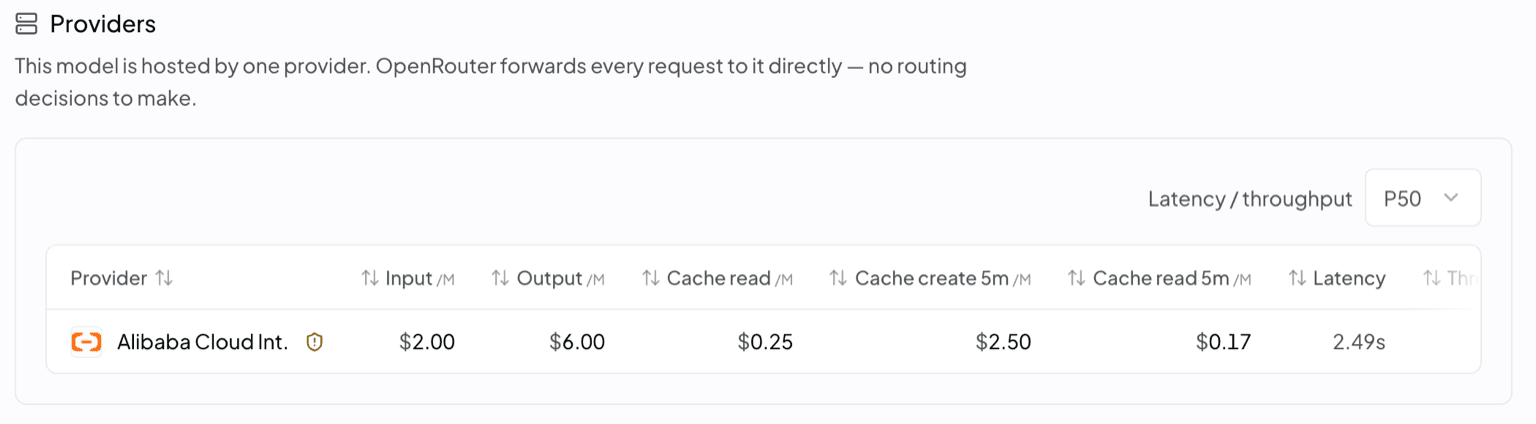
Ask OpenRouter for Qwen 3.8 Max's endpoint list and you get back a single entry: Alibaba, at $2.00 / $6.00. That is the whole list, and OpenRouter says so in its own words on the page: this model is hosted by one provider, so there are no routing decisions to make. Nobody else hosts the flagship, because the flagship's weights are not public.
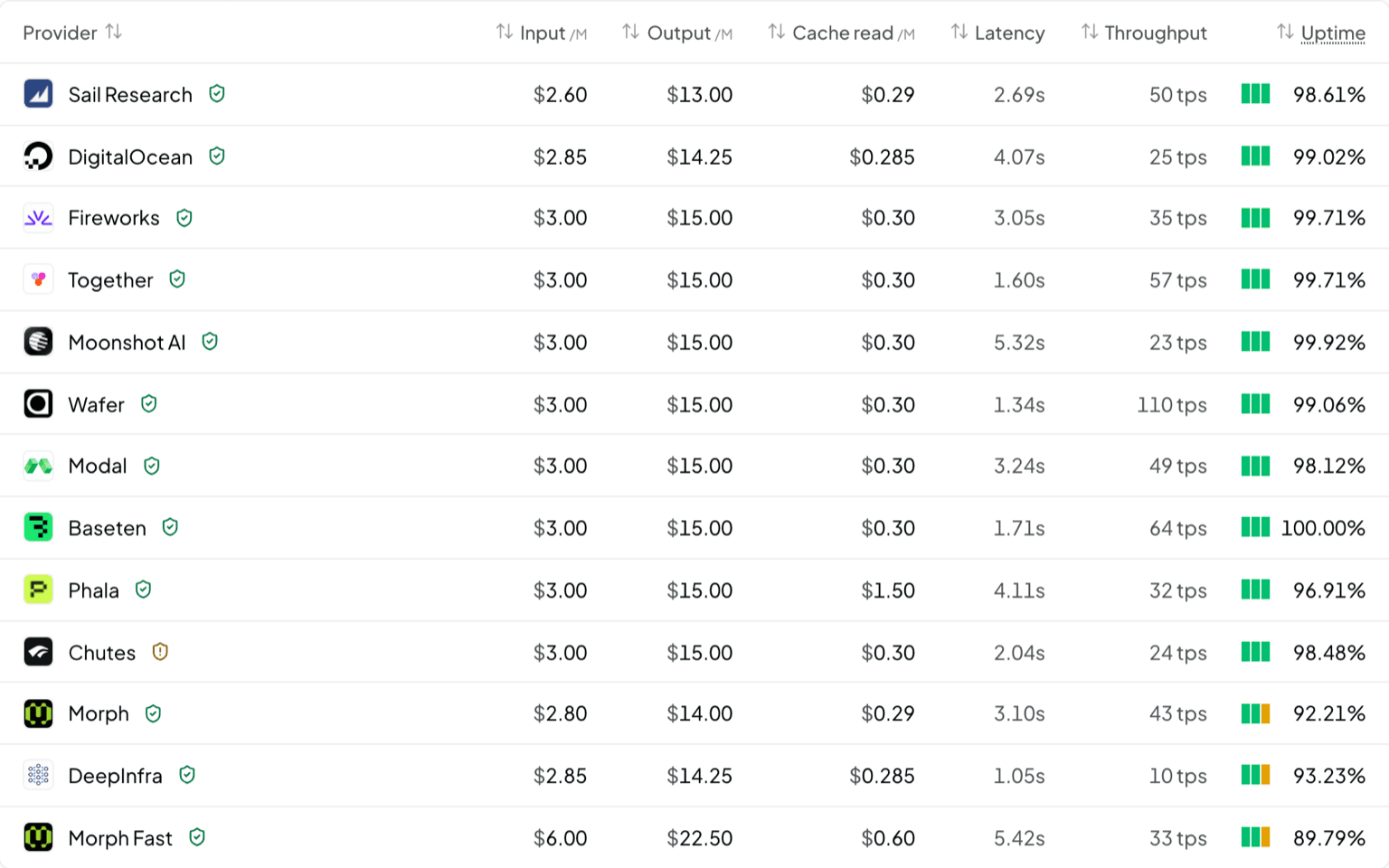
Kimi K3 returns thirteen. Sail Research is cheapest at $2.60 / $13.00, DeepInfra and DigitalOcean both sit at $2.85 / $14.25, and Fireworks charges full list at $3.00 / $15.00. Moonshot AI hosts its own model at list price, and at the far end Morph Fast charges $6.00 / $22.50, which is more than double list for a model anyone can serve. The uptime column those rows carry is a 30-minute rolling window rather than a track record, so read it as a live health check and not as a reliability rating. You can pin any of them with OpenRouter's provider routing block, or let the platform pick and accept the variance.
What that difference buys you is not obvious until something breaks. With thirteen hosts, a bad hour at one provider is a routing decision. With one host, it is your outage too, and the only fallback is a different model with a different tokenizer, different tool-calling quirks, and prompts you have not revalidated. Whatever uptime figure Alibaba's endpoint is showing when you look, it is a 30-minute reading rather than a promise about the quarter.
This does not disqualify single-endpoint models. It moves the resilience work out of your router config and into your incident plan, which is worth knowing before the invoice makes the choice look easy.
Qwen 3.8 2.4T A95B, the open-weight twin of Max
Here is the detail most Qwen 3.8 vs Kimi K3 comparisons skip, because it arrived nine days after the flagship. Qwen published Qwen3.8 2.4T A95B, a sparse mixture-of-experts model with 95 billion active parameters out of 2.4 trillion total, described on its own model page as the open-weight variant of Qwen 3.8 Max.
It lists at the same $2.00 / $6.00, carries the same 1,000,000 token ceiling, and allows a larger single completion than Max does: 262,144 tokens against 131,072. Seven providers serve it. Five hold the list price, which is Alibaba itself, SiliconFlow, Modal, DigitalOcean, and DeepInfra. The other two charge above it: Together at $2.50 / $6.25 and Venice at $2.50 / $7.50.
So the routing problem in the previous section has an escape hatch, with one real trade. The open twin is text only. Max takes text, images, and video; A95B takes text. If your agent reads screenshots, parses a PDF page as an image, or watches a screen recording, the open twin cannot stand in for the closed flagship no matter how the prices line up.
That is a cleaner split than it first appears. Multimodal agent work goes to Max and accepts the single host. Text-only agent work, which is most coding and most document pipelines, goes to A95B and gets seven routes at the same price.
The 1M context window that is not always 1M
Read the model card for the open twin and you see 1,000,000 tokens. Read the endpoint list and the number moves.
Modal and Alibaba serve it at 1,000,000. Together runs 1,010,000 and SiliconFlow goes higher again at 1,048,576. Then three of the seven, DigitalOcean, DeepInfra and Venice, cap at 262,144, which is roughly a quarter of the advertised figure.
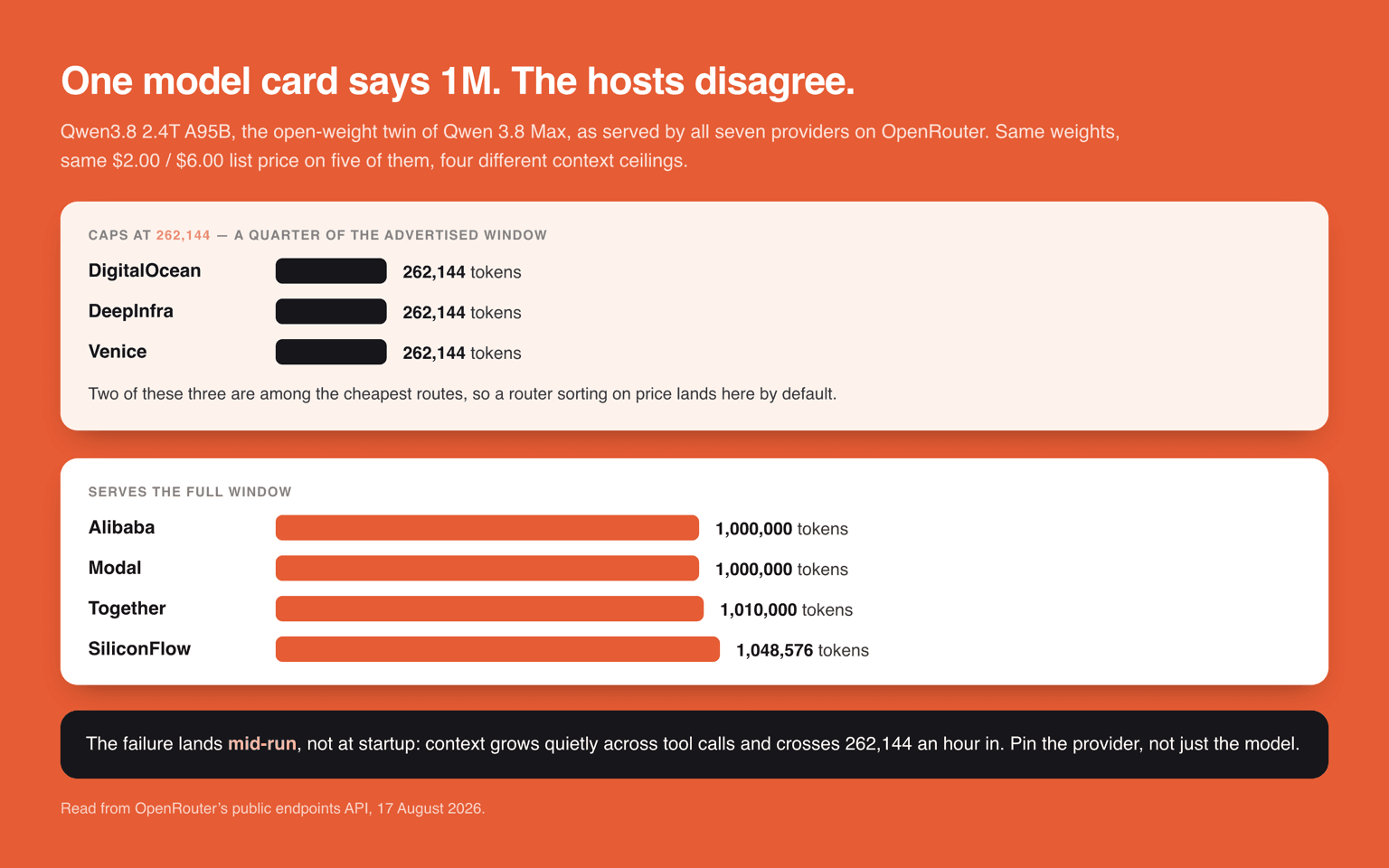
The model did not change. The serving configuration did, and OpenRouter reports what each host actually runs rather than what the lab published. If your router sorts by price, two of the three capped hosts are sitting right at the list rate, so that is where it lands by default. You meet the ceiling the first time a long agent session crosses it, and the error arrives mid-run rather than at startup.
You can picture how that goes. The context grows quietly across forty tool calls, the run has been going for an hour, and the failure lands on the turn where the agent finally had enough information to be useful. Nothing in your code changed. The route did.
Pinning the provider, not just the model, is the fix, and it costs one JSON block. Kimi K3 is tidier here: its hosts cluster at 1,048,576 with Sail Research the outlier at 974,842, so the spread is narrow enough to ignore. Qwen's spread is not.
Where Qwen 3.8 27B fits, and where it stops
Qwen 3.8 27B is the newest of the three, listed on 14 August 2026, and it is priced for a different job entirely: $0.45 in and $3.20 out, with 262,144 tokens of context. It is a dense vision-language model with open weights, and it takes image and video input that the much larger A95B does not.
Against Kimi K3 that is 6.7 times cheaper on input and 4.7 times cheaper on output. Against Qwen 3.8 Max it is 4.4 times cheaper on input while giving up three quarters of the context window.
27B is not competing with Kimi K3 for the same work. It is the model you route the classification step to, the one that decides whether an issue is actionable before a bigger model plans it, or reads a screenshot and reports what is on it. Sending every step of an agent loop to a frontier model is the most common way to build an expensive pipeline that is no more correct than a cheap one.
What it will not do is hold a long horizon. A 262,144 token ceiling is roughly a quarter of the flagship tier, and agent runs eat context faster than anyone estimates on the first attempt.
What a month of agent work costs on each
Take an agent loop that burns 10 million input and 2 million output tokens a day, which is unremarkable for a coding agent grinding an issue queue.
| Per day | Per 30 days | |
|---|---|---|
| Qwen 3.8 Max / A95B | $32.00 | $960 |
| Kimi K3 (list) | $60.00 | $1,800 |
| Kimi K3 (Sail Research) | $52.00 | $1,560 |
| Qwen 3.8 27B | $10.90 | $327 |
Nothing in that table involves changing prompts or workloads. It is the same requests, priced by four different meters.
Now shift the ratio. Agents that write files and produce long tool-call chains often run closer to 2 million input against 2 million output. On that shape, Qwen 3.8 Max costs $16.00 a day and Kimi K3 costs $36.00, and the gap widens from 1.9x to 2.3x, because output is where they actually differ. The more useful your agent is, the more the output column decides your bill.
One thing the table cannot price is the retest. Swapping model families means revalidating tool-calling behaviour, and an eval sweep is awkward to run on the machine you are also working on, since it wants to keep going after you close the lid. That is the shape of work MoClaw is built for, as a hosted cloud AI computer where the sweep and its output sit in one place you can check from a phone.
Choosing between Qwen 3.8 and Kimi K3 for long-running agents
The decision splits cleanly on three questions, and none of them is which model is smarter.
Does your agent need to see things? If yes, Qwen 3.8 Max or 27B, and Kimi K3 stays in the running. The open twin drops out.
Do you need more than one route to the same weights? If yes, Kimi K3 with thirteen hosts, or Qwen's open twin with seven. Qwen 3.8 Max is out, whatever its price says.
Is your context genuinely long? If yes, pin the provider explicitly rather than sorting by price, because two of the cheap Qwen hosts will hand you 262K when you asked for a million.
Benchmarks are the obvious missing input, and I have deliberately not quoted any. Both labs publish their own, neither set is independently reproduced for these specific checkpoints, and a self-reported score nine days after launch tells you what the lab measured rather than what your workload will do. Run your own eval on the twenty tasks you actually care about. If you want the wider view of where these models sit in an agent stack, what Kimi K3 is covers the Moonshot side in detail.
FAQ
Is Qwen 3.8 cheaper than Kimi K3?
Yes, on both sides of the meter, and dramatically so on output. Qwen 3.8 Max is $2.00 input and $6.00 output per million tokens against Kimi K3's $3.00 and $15.00, as listed on OpenRouter on 17 August 2026. Qwen 3.8 27B goes lower still at $0.45 and $3.20, with a smaller context window.
Is Qwen 3.8 Max open source?
No. Qwen 3.8 Max is closed and served by Alibaba alone. Qwen publishes an open-weight variant of it, Qwen3.8 2.4T A95B, at the same price with 95B active parameters out of 2.4T total, but that version is text only while Max also takes images and video.
Which has the bigger context window, Qwen 3.8 or Kimi K3?
Kimi K3 lists 1,048,576 tokens against Qwen 3.8 Max's 1,000,000, so Kimi is marginally larger. In practice the number that matters is what your provider serves: two hosts of Qwen's open twin cap at 262,144, while Kimi's hosts cluster near the full figure.
How many providers serve each model?
On OpenRouter as of 17 August 2026, Kimi K3 has 13 endpoints, Qwen3.8 2.4T A95B has 7, and Qwen 3.8 Max has exactly 1, which is Alibaba's own. Provider count decides whether a bad hour at one host is a config change or an outage.
Can I run Qwen 3.8 or Kimi K3 locally?
The open-weight versions, yes, subject to hardware. Qwen 3.8 27B is the only one in this comparison a single workstation has any chance with. Kimi K3 at 2.8T parameters and Qwen's 2.4T A95B are server-class models, and renting them by the token is cheaper than owning the machines for all but the largest deployments.
Decide on the output line, then go check the route
If you only take one number from this comparison, take the output price, because that is the column that scales with how much work you are getting done. Qwen 3.8 at $6.00 against Kimi K3 at $15.00 is a real gap that compounds across a month of agent runs.
Then spend ten minutes on the part the price does not show. Pull the endpoint list for whichever model you picked, look at how many hosts serve it and what context each one actually runs, and pin your route deliberately instead of inheriting whatever sorted cheapest this morning. The Qwen family rewards that check more than most, because its flagship has one host and its open twin has hosts that disagree about what a million tokens means.
Whichever you land on, the run itself has to live somewhere that is awake at three in the morning, and a laptop that closed at six is not that place. MoClaw exists for that half of the problem, running alongside your existing setup rather than replacing it.
Continue Reading
More Comparison
GPT-5.6 Sol vs Terra vs Luna: Pick One

Gemini 3.7 Flash vs 3.1 Pro: Is Pro Over?
DeepSeek Harness Plugins vs Skills
DeepSeek Harness vs MoClaw (2026)

Grok Bot vs Claude Cowork vs ChatGPT Work
Business Travel App vs AI Travel Agent Workflow
The MoClaw editorial team writes about workflow automation, AI agents, and the tools we build. Default byline for industry overviews, listicles, and collaborative pieces.
Use Kimi K3 on MoClaw, without the setup
Run Kimi K3 as an always-on managed agent with memory, your tools, and scheduling. No API wiring, no plan gating, no self-hosting.
References: Qwen3.8 Max on OpenRouter · Kimi K3 on OpenRouter · Qwen3.8 2.4T A95B on OpenRouter · Qwen3.8 27B on OpenRouter · OpenRouter provider routing documentation · Qwen on Hugging Face · Moonshot AI on Hugging Face