Gemini 3.7 Flash vs 3.1 Pro: Is Pro Over?

Gemini 3.7 Flash lists at $0.75/$3.75 per 1M tokens against 3.1 Pro's $2/$12, but that Flash rate doubles on January 1, 2027. Here's when Pro wins.
Table of Contents
Gemini 3.7 Flash vs 3.1 Pro turns on a number that changes at the start of next year. Flash lists at $0.75 per million input tokens and $3.75 per million output tokens right now, against $2.00 and $12.00 for Gemini 3.1 Pro Preview, and Google's own pricing page says the Flash side doubles on January 1, 2027.
That single line rewrites the comparison. A gap of roughly 3x today lands closer to 1.5x in January, which matters a lot if you are sizing a budget that runs past December.
Key Takeaways:
- Gemini 3.7 Flash lists at $0.75 in and $3.75 out per 1M tokens on Standard processing; Gemini 3.1 Pro Preview lists at $2.00 in and $12.00 out for prompts up to 200K
- Those Flash rates carry an expiry. Google's pricing page shows $1.50 in and $7.50 out starting January 1, 2027
- Gemini 3.6 Flash carries identical pricing and the identical January step, so moving up a generation costs nothing today
- Pro doubles again above 200K tokens, to $4.00 in and $18.00 out, where the Flash listing has no equivalent cliff
- 3.7 Flash ships as Stable while 3.1 Pro is still Preview, and preview models get two weeks of deprecation notice
Gemini 3.7 Flash vs 3.1 Pro at Google's List Prices
Everything below comes off Google's Standard processing tier, checked on August 18, 2026. Batch cuts these roughly in half and Flex and Priority move them again, which is why third-party trackers so often disagree with each other.
| Per 1M tokens (Standard) | Gemini 3.7 Flash | Gemini 3.1 Pro Preview |
|---|---|---|
| Input | $0.75 | $2.00 (up to 200K), $4.00 above |
| Output, thinking included | $3.75 | $12.00 (up to 200K), $18.00 above |
| Context caching | $0.075 | $0.20 (up to 200K), $0.40 above |
| Cache storage, per 1M per hour | $0.50 | $4.50 |
| From January 1, 2027 | $1.50 in, $7.50 out | unchanged |
| Release status | Stable | Preview |
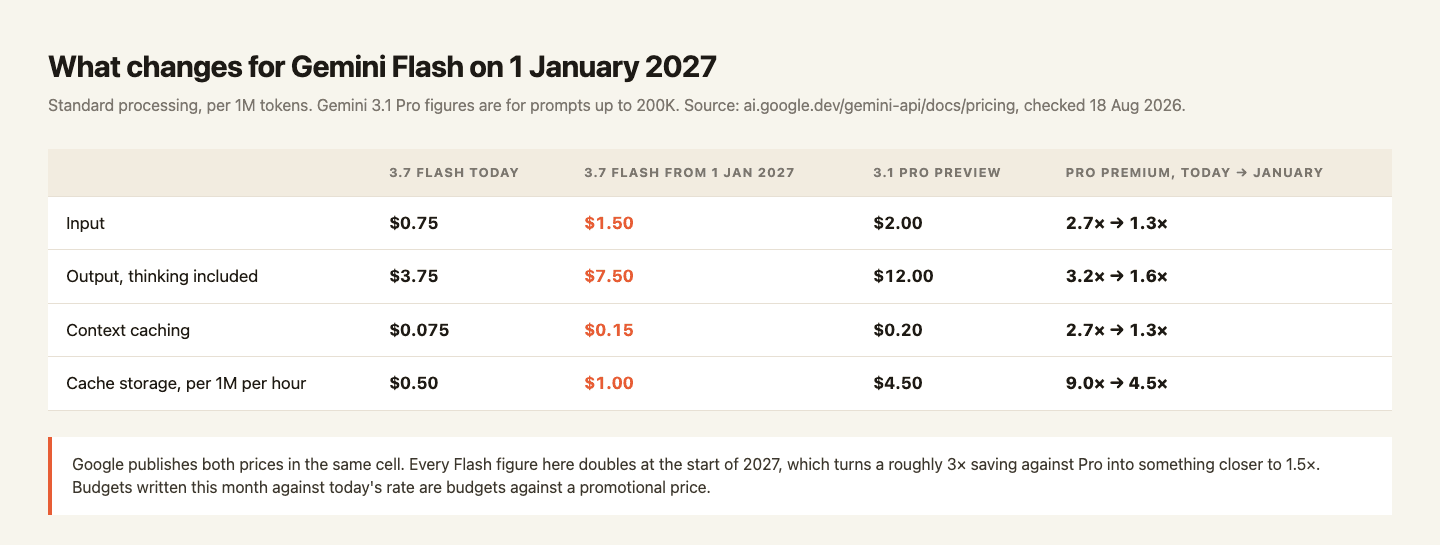
Read across that table and the interesting row is not the headline price, it's the last two. Pro costs 2.7x more on input and 3.2x more on output today, but nine times as much to hold a cache warm, and it is the one still labelled Preview.
The January 1 Price Step Nobody Is Quoting
Google publishes both numbers in the same cell: "$0.75 through December 31, 2026. $1.50 starting January 1, 2027." Output follows the same pattern, $3.75 now and $7.50 later, and context caching goes from $0.075 to $0.15 with cache storage doubling from $0.50 to $1.00 per million tokens per hour.
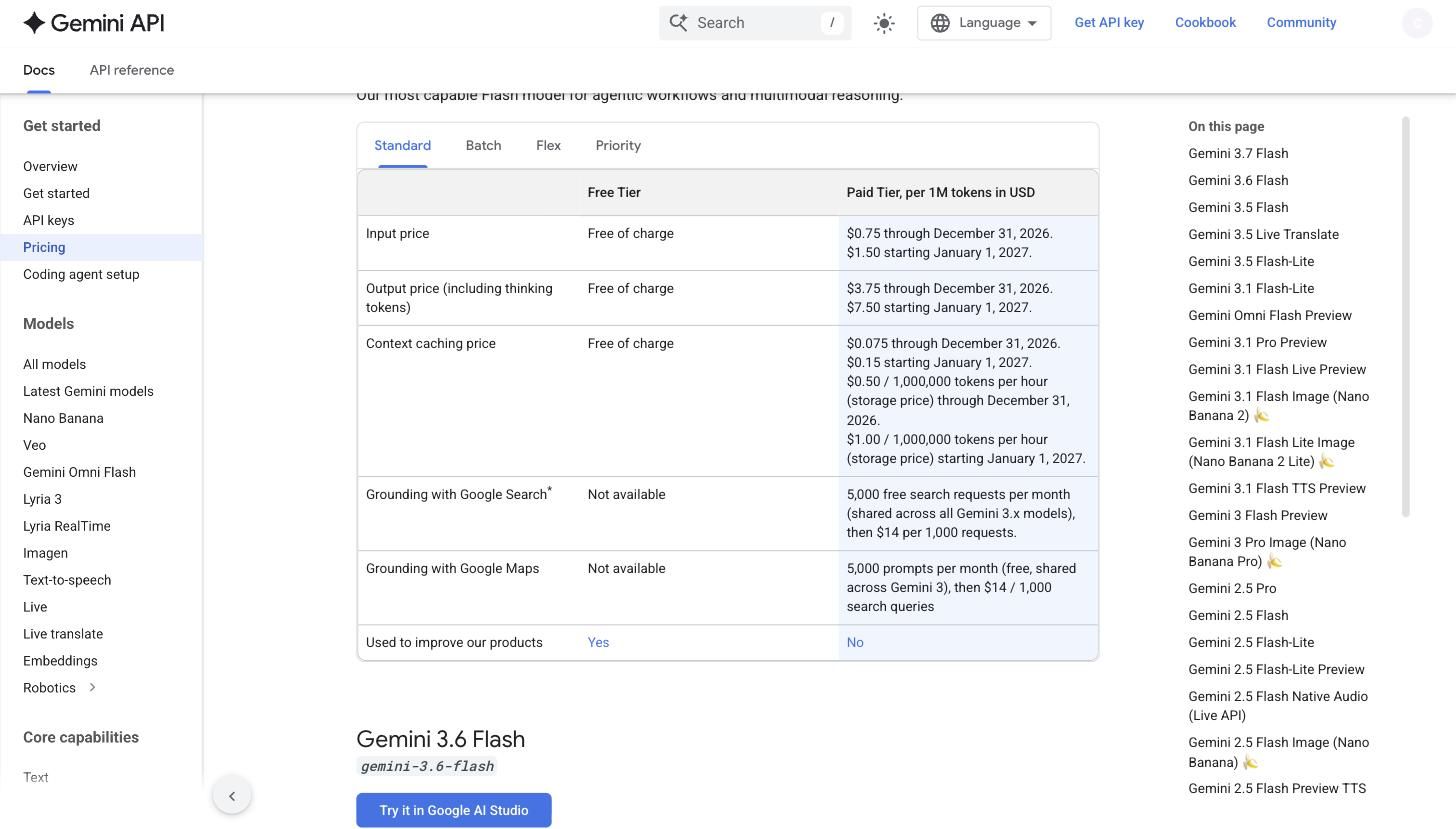
None of the comparison pages currently ranking for this query mention it. They quote today's rate as though it were the rate.
If you are running a pilot in September and signing off on a number for the year, you are budgeting against a promotional price. The honest version of Gemini 3.7 Flash vs 3.1 Pro for a 2027 workload is $1.50 against $2.00 on input and $7.50 against $12.00 on output, which is a real discount but not the order-of-magnitude story the current listing suggests.
Worth checking who owns that renewal date on your side. Model prices are one of the few line items that move without anyone filing a ticket, and the calendar entry is cheaper than the surprise. That is also the argument for keeping recurring work inside something like MoClaw, a hosted cloud AI computer that runs the job on a schedule instead of on whichever laptop happened to be open, because then the thing you have to re-point in January is one workflow rather than a spread of local scripts.
Where Gemini 3.1 Pro Still Earns the Difference
Pro is the only model in the Gemini 3 family Google still positions on advanced reasoning and what its models page calls complex problem-solving and vibe coding. Flash gets the workhorse label. Those are marketing words, but they track a real split, and Google has not shipped a Flash model that takes over the positioning.
Community testing is messier than the marketing. The most-read post on this question right now is a four-domain comparison on r/GeminiAI with 65 points and 30 comments, and its author concludes that Flash 3.7 with extended thinking swept every category against 3.1 Pro, including compound-interest arithmetic that Pro got wrong by tens of units.
Read the comments before you act on that. The author says the prompts were written with help from Gemini, one reader points out the whole exercise is a model writing the test, taking it, and grading it, and the sharpest objection is about task shape: the four tasks are long chat questions, and Pro is aimed at work you hand off and check on two hours later. Another commenter reports 3.1 Pro Extended still beating 3.7 Flash Extended by a wide margin on competitive programming, and a third notes Pro still leads on SciCode with Flash about a percentage point behind at a fraction of the price.
None of that settles anything, which is the point. It does map the cases where Pro is worth paying for, and they look alike: one long chain of reasoning where an early error poisons everything downstream, a task you run a few hundred times a month rather than a few hundred thousand, or anything where a human reviews the output and review time costs more than the tokens did.
Where 3.7 Flash Wins Outright
Volume, and it is not close. At $0.75 in and $3.75 out you can run roughly two and a half times the traffic for the same spend, and DeepMind pitches 3.7 Flash as "our most intelligent workhorse model yet for coding and agents", which is the profile agent loops actually need.
Agent loops are where the arithmetic compounds. A single agent run is rarely one call; it's a plan, several tool calls, a couple of retries when a tool returns something unexpected, then a summary. Output tokens dominate, thinking tokens bill as output, and a 3.2x output gap multiplied across every retry in a loop stops being a rounding error somewhere around the third week of production traffic.
Caching pushes it further. Holding a million tokens of context warm for an hour costs $0.50 on Flash and $4.50 on Pro. If your agent re-reads the same codebase or the same policy document on every run, that 9x sits underneath every single invocation.
The 200K Context Cliff That Flips the Arithmetic
Pro's pricing has a step the Flash listing does not. Above 200K tokens in the prompt, input goes from $2.00 to $4.00 and output from $12.00 to $18.00, so a long-context Pro call costs 5.3x the Flash input rate rather than 2.7x.
This is the part most comparisons skip, and it inverts the usual advice. Long-context work is exactly what people reach for Pro to do, and it is exactly where Pro gets most expensive relative to Flash. If your workload is "read this entire repository and answer questions about it," you are standing on the wrong side of the cliff.
Stable Versus Preview Is a Scheduling Risk, Not a Quality One
3.7 Flash is marked Stable on Google's models page. 3.1 Pro is still Preview, six months after it appeared, and Gemini 3 Pro Preview before it is already listed under shut-down models.
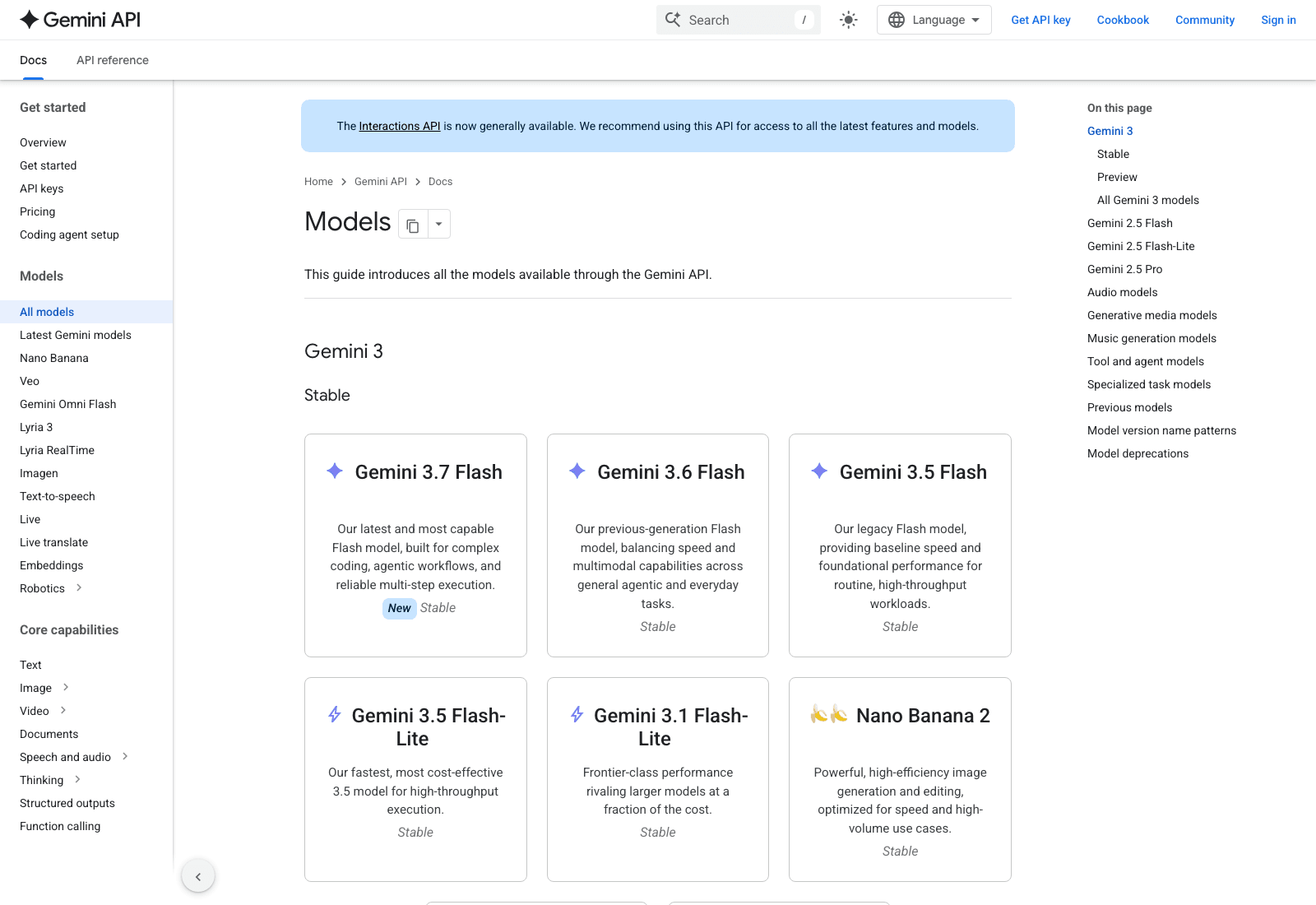
Google's own version naming documentation is blunt about what that means. Stable models "usually don't change" and are what production apps should pin to. Preview models "will be deprecated with at least 2 weeks notice." Two weeks is enough time to swap a model id in a script. It is not much time if the model sits behind a workflow that finance signed off on and three teams depend on.
So the tier question has a second axis nobody prices in. Flash is cheaper and it is also the one Google has committed to keeping still. If you build on 3.1 Pro you are building on a preview endpoint, and you should assume you will migrate. We wrote about that pattern in the context of Anthropic's releases in our piece on model upgrades breaking recurring workflows, and the shape is identical here.
Choosing a Tier for Work That Runs Every Day
Recurring work changes the calculation, because the cost is not one invoice, it's a rate multiplied by a schedule.
Start with Flash and force it to fail. Run your actual prompts, not a benchmark, and look at where the output stops being good enough. Most teams find the failure mode is narrower than they expected, something like one report type out of nine, or the summarisation step but not the extraction step. Then route that one step to Pro and leave everything else on Flash, which is the same split-by-task logic we used in the multi-model agent guide and in Kimi K3 vs GPT-5.6. OpenAI's three tiers pose the identical question with an uglier price ladder, covered in GPT-5.6 Sol vs Terra vs Luna.
The operational half is harder than the model choice. A schedule needs something awake to run on, and a laptop that closes at 6pm is not that. MoClaw exists for the hosted side of this: the agent, its tools, and its memory live in the cloud and the run fires whether or not your machine is on, alongside whatever you already have rather than in place of it. Free trial is three days and 1,000 credits, and the $20 plan carries 1,000 credits a month, which is enough to see whether the recurring version of your workflow behaves differently from the one you ran by hand.
One caveat worth stating plainly: MoClaw does not currently offer Gemini models. The point above is about where the schedule lives, not about running 3.7 Flash on our infrastructure.
FAQ
Which is better, Gemini 3.1 Pro or Gemini Flash?
Pro is positioned for advanced reasoning and complex problem-solving; 3.7 Flash is positioned as the workhorse for coding and agents. For most production traffic Flash is the better default because it costs 2.7x less on input and 3.2x less on output, and you escalate the specific steps where it measurably fails.
Is Gemini Pro better or Gemini Flash?
On Google's own product framing, Pro leads on hard reasoning and Flash leads on throughput and cost. The honest answer depends on how many times a day you run the task. Below a few hundred calls the price gap rarely justifies the extra engineering; above that it dominates everything else.
Is Gemini 3.5 Flash cheaper than 3.1 Pro?
Yes, but it is no longer the cheap option in its own family. Gemini 3.5 Flash lists at $1.50 in and $9.00 out, which is double the current 3.7 Flash rate. Unless you have a reason to pin to 3.5, moving to 3.7 Flash halves the bill.
How much does Gemini 3.7 Flash cost?
$0.75 per million input tokens and $3.75 per million output tokens on Standard processing, with thinking tokens billed as output. Both figures double on January 1, 2027. Batch processing runs at roughly half these rates.
Is Gemini 3.7 Flash cheaper than 3.6 Flash?
No. They list identically, at $0.75 in and $3.75 out, and both carry the same January 1 step to $1.50 and $7.50. Third-party trackers sometimes show a difference because they are quoting different processing tiers.
Deciding Between Gemini 3.7 Flash and 3.1 Pro Before the January Reprice
The comparison people are having in public is about benchmarks. The comparison that will actually show up on your invoice is about a date.
Between now and December 31, Flash is roughly a third the price of Pro on Standard rates and considerably less than that once caching enters the picture. From January 1 the gap narrows to something closer to 1.3x on input. If you are picking a tier this month, pick Flash, write down what it fails at, and put a reminder in the calendar for the first week of December to re-run the arithmetic. That is a smaller commitment than it sounds, and it is the only version of this comparison that stays true past the new year.
Continue Reading
More Comparison
GPT-5.6 Sol vs Terra vs Luna: Pick One

Qwen 3.8 vs Kimi K3: Cheaper Isn't Simpler

DeepSeek Harness Plugins vs Skills

DeepSeek Harness vs MoClaw (2026)

Grok Bot vs Claude Cowork vs ChatGPT Work

Business Travel App vs AI Travel Agent Workflow
The MoClaw editorial team writes about workflow automation, AI agents, and the tools we build. Default byline for industry overviews, listicles, and collaborative pieces.
Choosing between tools? Let MoClaw run the work.
Always-on AI assistant on its own cloud computer. No switching required, no setup.
References: Gemini Developer API pricing · Gemini API models and version naming · Gemini 3.7 Flash, Google DeepMind · Is Pro Obsolete? community comparison, r/GeminiAI · What's new in Gemini 3.7 Flash