Literature Review Matrix Builder for Thesis Chapters
Turn a Zotero library or folder of PDFs into a literature review matrix that tracks design, sample, measures, and limitations across every source in a chapter.
Runs on managed cloud. No scripts, no Zapier.
Planning the literature review matrix: 1. Pull the 47 items and their attached PDFs out of Zotero 2. Use the Matrix Method column scheme from Garrard: citation, purpose, design, sample, measures, results, limitations 3. Add a read status column so you can see coverage at a glance 4. Separate primary studies from policy statements and reviews, because they cannot be compared on the same row 5. Report what the matrix says is missing
Used 4 tools
Bash
Connected to Zotero library: Thesis Ch2 School Start Times
47 items found
41 with attached PDFs
6 missing full text, flagged for retrieval
WebSearch
Retrieved 5 of 6 missing full texts from publisher and repository pages
1 remains paywalled, logged in the Needs Access tab with the DOI
Write
Created build_review_matrix.py
Columns: Citation, Source Type, Purpose, Design, Sample, Measures, Key Results, Limitations, Read Status
Source Type splits primary study, systematic review, and policy statement into separate blocks
Bash
Matrix built, 46 rows populated. Sample rows:

Wahlstrom et al. 2014, Center for Applied Research and Educational Improvement, University of Minnesota
  Source Type: primary study, CDC funded
  Design: 3 year observational study across 5 districts in 3 states
  Sample: about 9,000 students in grades 9 to 12
  Measures: student self report survey
  Key Results: roughly one additional hour of sleep per school night at later starting schools; teen driver crashes in one district fell from 23 to 7
  Limitations: self reported sleep, no random assignment of districts

American Academy of Pediatrics 2014, Pediatrics 134(3) 642 to 649, lead author Judith Owens
  Source Type: policy statement, not primary evidence
  Key Results: recommends middle and high schools start no earlier than 8:30 am
  Limitations: synthesizes existing evidence, contributes no new data

Dunster et al. 2018, Science Advances 4(12) eaau6200
  Source Type: primary study
  Design: pre and post natural experiment, Seattle bell moved from 7:50 am to 8:45 am
  Sample: sophomores at Roosevelt and Franklin high schools
  Measures: wrist actigraphy, objective rather than self report
  Key Results: median sleep duration up 34 minutes; median grades up 4.5 percent
  Limitations: two schools, single district, one cohort per school
Your literature review matrix is in Google Sheets, 46 rows across 9 columns, following the Matrix Method column scheme from Judith Garrard's Health Sciences Literature Review Made Easy.
Two things fell out of it that are worth your attention before you start drafting.
Your Measures column is lopsided. 31 of your 46 sources rely on student self report of sleep duration. Only 5 use objective measurement such as actigraphy. That is not a flaw in your search, it is a real feature of this literature, and it is a defensible limitation paragraph you can write with the column as evidence.
Nine of your rows are not primary studies. They are policy statements and reviews, including the AAP statement, which is a synthesis rather than new data. They are sitting in a separate block so you do not accidentally count them as independent findings, which is the single most common way a review chapter loses credibility.
One source is still paywalled. Its DOI is in the Needs Access tab so you can request it through your library.
Used 1 tools
Bash
Cross tabulated Design against Sample and Measures across all 37 primary studies
Generated Coverage Gaps tab
Cross tabulating your own matrix is where the gap argument comes from. Three cells in your coverage grid are close to empty.
Middle school is thin. 33 of your 37 primary studies sample high school students. Four include grades 6 to 8, and none of those use objective sleep measurement.
Almost nothing follows students past one year. Your longest follow up is the 3 year Wahlstrom study, and the rest are single year or single semester. Whether the sleep gain persists is effectively unstudied.
Rural districts are missing. Your samples cluster in suburban and urban districts, which matters because bus scheduling constraints are the usual reason rural districts give for early bells.
Any one of those is a defensible gap statement for your introduction, and the matrix is the evidence that the gap is real rather than something you assumed. I can add new sources to this matrix as you find them, and re-run the coverage grid each time so you know when a gap closes.
- Cross tabulating your own matrix is where the gap argument comes from. Three cells in your coverage grid are close to empty.
- *Middle school is thin.** 33 of your 37 primary studies sample high school students. Four include grades 6 to 8, and none of those use objective sleep measurement.
- *Almost nothing follows students past one year.** Your longest follow up is the 3 year Wahlstrom study, and the rest are single year or single semester. Whether the sleep gain persists is effectively unstudied.
- *Rural districts are missing.** Your samples cluster in suburban and urban districts, which matters because bus scheduling constraints are the usual reason rural districts give for early bells.
Try follow-up prompts
How the literature review matrix works
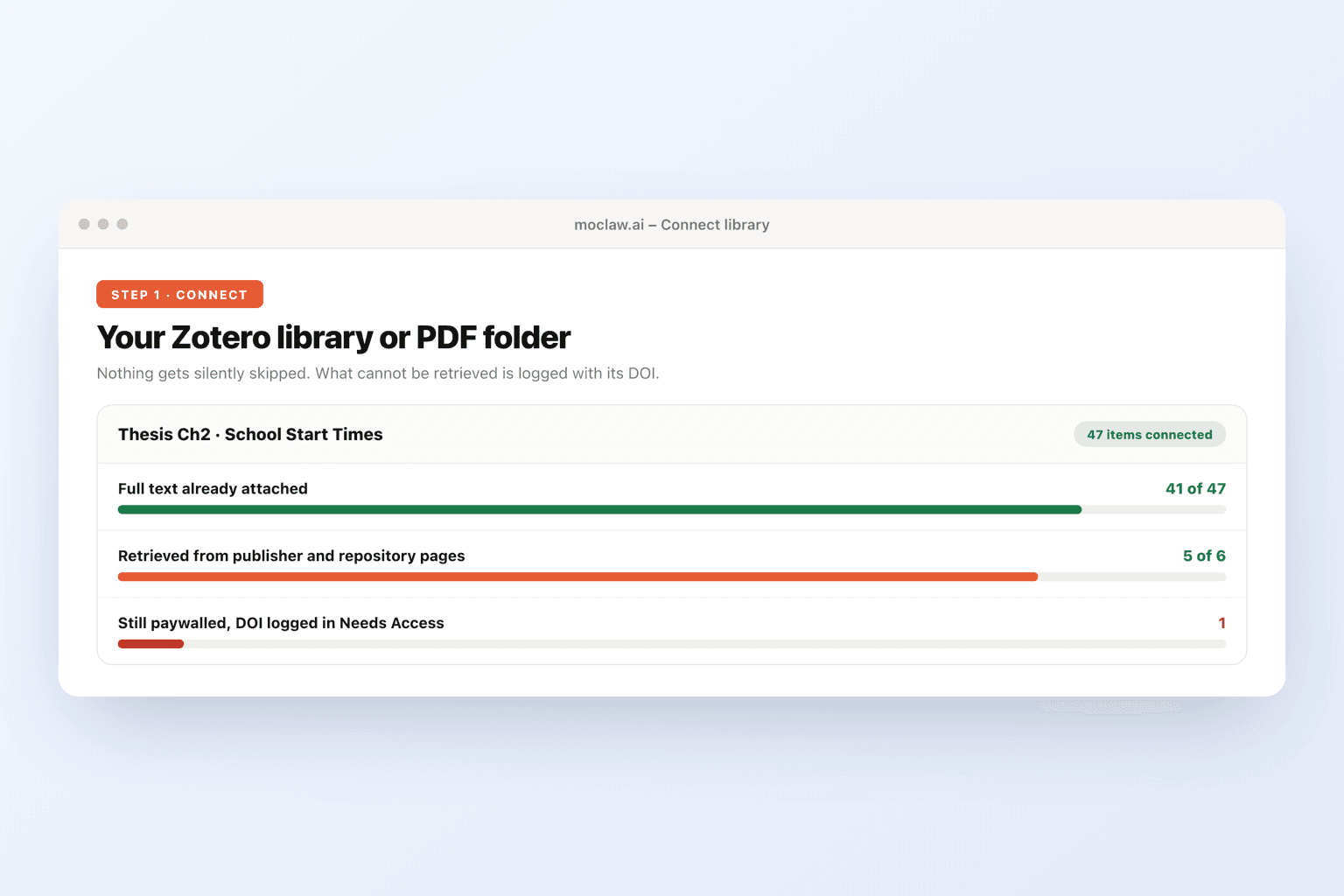
Connect Your Zotero Library Or PDF Folder
MoClaw pulls your items and attached full texts. Missing PDFs get retrieved from publisher and repository pages, and anything still paywalled is logged with its DOI instead of silently skipped.
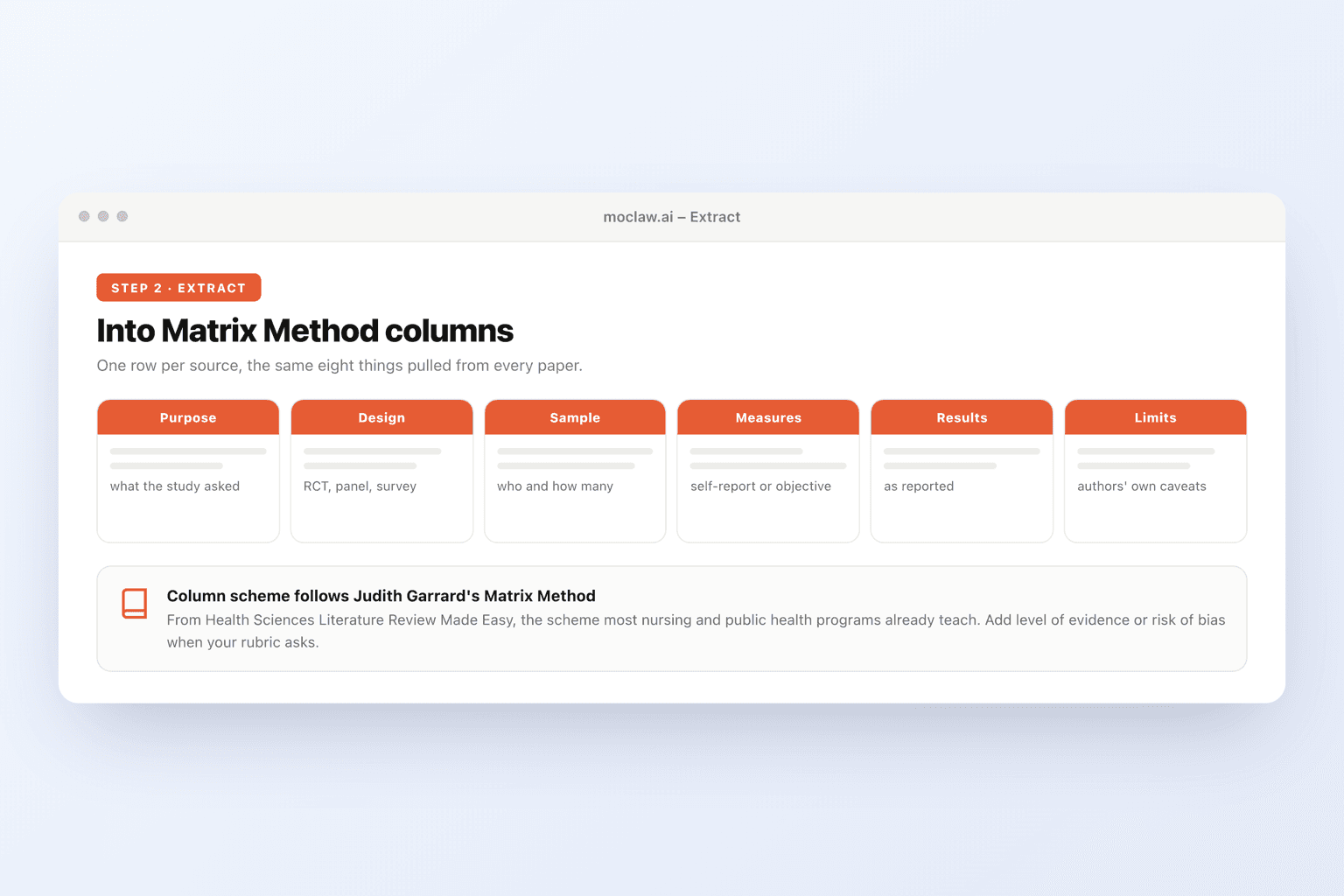
Extract Every Source Into Matrix Method Columns
Purpose, design, sample, measures, key results, and limitations, following the column scheme from Judith Garrard's Matrix Method. Primary studies, reviews, and policy statements go into separate blocks.
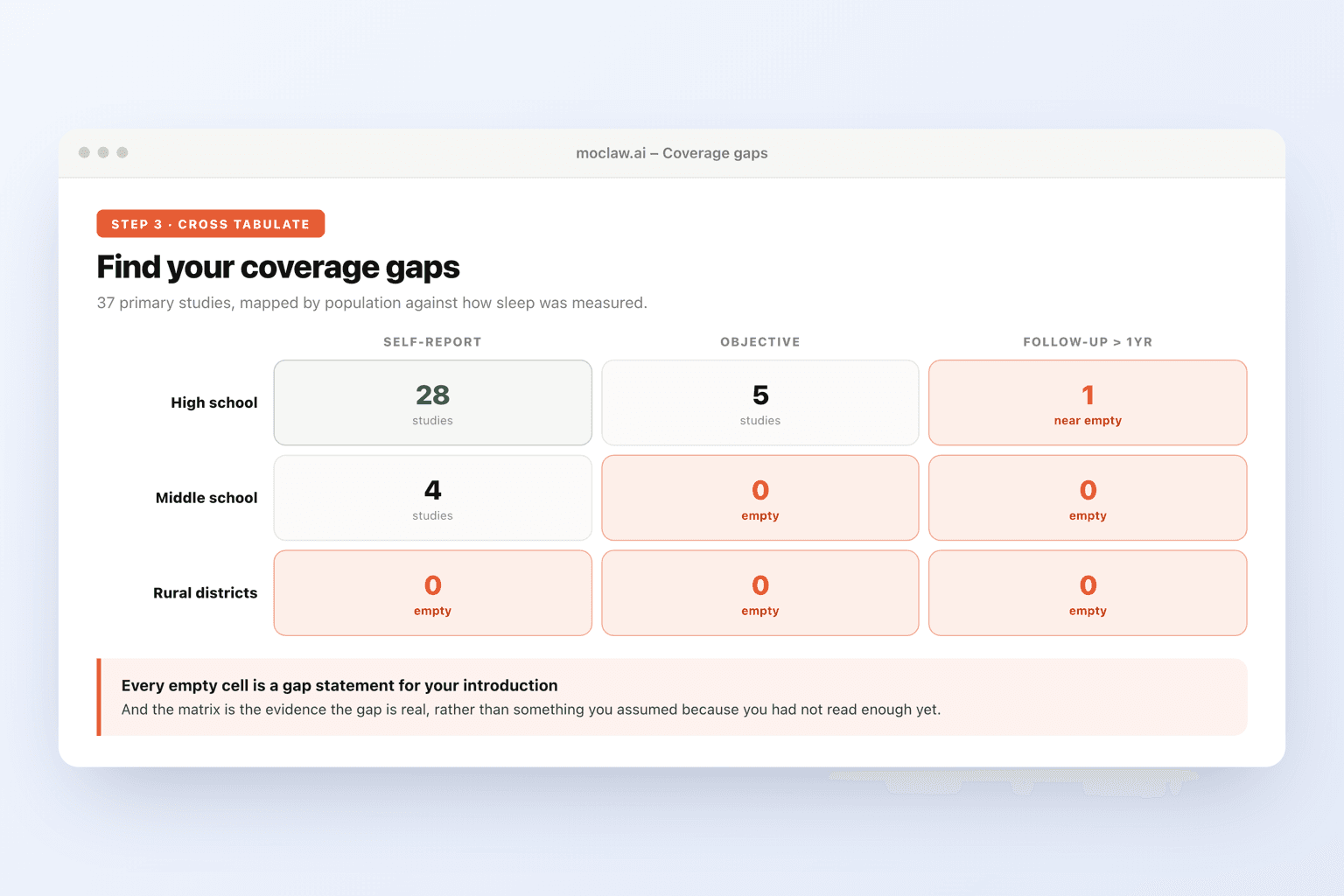
Cross Tabulate To Find Your Coverage Gaps
Once the literature review matrix is populated, MoClaw cross tabulates design against sample and measures so the empty cells become the gap statement for your introduction.
What the matrix tracks across your chapter
What MoClaw watches for you
What your literature review matrix sends you
A real example of what MoClaw hands back, shown before you sign up.
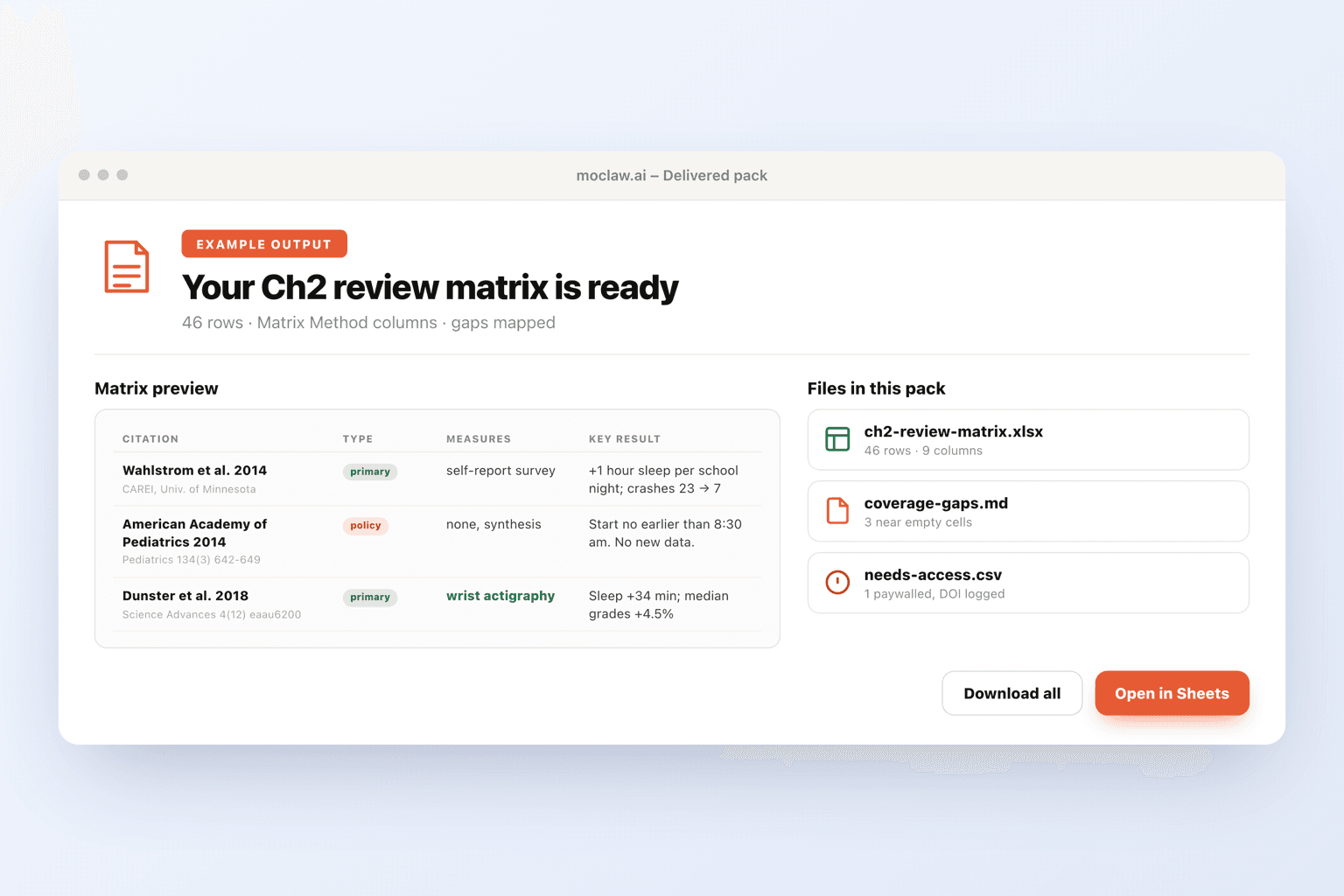
literature review matrix: MoClaw vs Covidence
See how MoClaw's AI-powered approach differs from traditional tools.
| Feature | Manual Spreadsheet | Covidence | MoClaw |
|---|---|---|---|
| Intended workflow | Anything, because it is an empty grid | Formal systematic review with screening and PRISMA | Narrative review and thesis chapters, where you are still deciding the argument |
| Filling in the rows | You read and type all 47 of them | You extract into structured forms yourself | Extracted from full text automatically, one row per source |
| Retrieving missing full texts | Hunt each one down by hand | Import what you already have | Retrieves what is publicly available, logs the rest with DOIs |
| Separating evidence types | Only if you remember to | Handled by protocol | Primary studies, reviews, and policy statements split into separate blocks |
| Finding coverage gaps | You eyeball the sheet and hope | Reporting focuses on included and excluded counts | Cross tabulates design, sample, and measures to surface the empty cells |
| Cost | Free, paid for in months | Institutional and paid plans | Free for three days with 1,000 credits, then 20 dollars a month |
Why AI-Powered Literature Review Matrix Building?
The Matrix Method works. What does not work is hand typing 47 rows over a semester and still not knowing what your reading has missed.
Starts from where your sources already live
Zotero library, Drive folder, or a pile of PDFs. There is no new tool to adopt, no tagging scheme to design, and no template to learn first.
Survives a semester of reading
Sources arrive over months. New rows append into the same column scheme, read status stays current, and the gap analysis re runs so your argument keeps up with your reading.
Turns the matrix into an argument
A filled grid is not a chapter. Cross tabulating it produces the coverage gaps and method patterns that become your limitations paragraph and your research gap statement.
Ways to extend your literature review matrix
Click one to load it into the box above, ready to run.
literature review matrix FAQ
How does MoClaw build a literature review matrix from my sources? ⌄
Connect a Zotero library, a Drive folder, or upload PDFs directly. MoClaw reads the full text of each source and fills one row per study: purpose, design, sample, measures, key results, and limitations. Anything without an attached full text gets retrieved where possible, and logged with its DOI where it cannot.
What columns should a literature review matrix have? ⌄
The default scheme follows the Matrix Method described in Judith Garrard's Health Sciences Literature Review Made Easy, which most nursing and public health programs teach. You can add whatever your field expects, such as level of evidence, risk of bias, theoretical framework, or intervention duration.
Can the literature review matrix handle reviews and policy statements alongside primary studies? ⌄
Yes, and it keeps them apart. Reviews and policy statements go into a separate block because they synthesize existing evidence rather than contributing new data. Mixing them into the same list is how a review chapter accidentally double counts findings.
Can I keep adding sources to the literature review matrix over a whole semester? ⌄
That is the normal way it gets used. Drop new PDFs into the folder or add items in Zotero and the rows append themselves. A read status column keeps track of coverage, and the gap analysis re runs so you can see when a gap you wrote about has closed.
Can MoClaw find the gaps in my literature review matrix? ⌄
Once the matrix is populated it cross tabulates design against sample and measures, and reports the near empty cells. Those empty cells are where a defensible research gap statement comes from, backed by your own extraction rather than an assumption about the field.
Is this different from a systematic review tool like Covidence? ⌄
Covidence is built for formal systematic review workflow, meaning screening, dual review, and PRISMA reporting, and it is the right tool when your protocol requires that. A literature review matrix is a narrative review instrument, used while you are still reading and deciding what your chapter argues. MoClaw builds and maintains that matrix.
How much does a literature review matrix cost to build? ⌄
The free trial runs three days with 1,000 credits, which covers a full chapter's worth of sources so you can check whether the extraction is accurate in your field before committing. Paid plans start at 20 dollars a month.
Can I turn the literature review matrix into my actual chapter draft? ⌄
Yes. Because the matrix already records which studies share a design, which contradict each other, and where the coverage gaps sit, MoClaw can draft synthesis paragraphs organized by theme rather than walking through sources one at a time, which is the structural mistake most review chapters make.
Integrations
Best integrations for literature review matrix
Who it's for
Who uses literature review matrix
Related research automation use cases
Try Literature Review Matrix Builder for Thesis Chapters for free
No credit card required