Synthesis Matrix Builder for Literature Reviews
Turn a stack of research papers into a synthesis matrix in Google Sheets, with contradictions between studies flagged automatically.
Runs on managed cloud. No scripts, no Zapier.
Planning the synthesis matrix build: 1. Read all four PDFs and pull bibliographic details 2. Decide the column scheme: design, sample, setting, effect direction, effect size, limitations 3. Extract one row per study, quoting the reported numbers rather than paraphrasing 4. Write it to a Google Sheet with a contradiction column 5. Leave the sheet open so new papers can be appended later
Used 4 tools
Read
Read 4 PDFs, 187 pages total:
bloom_2015_qje_ctrip.pdf (54 pp)
gibbs_2023_jpe_micro.pdf (35 pp)
emanuel_harrington_2024_aej.pdf (62 pp)
barrero_bloom_davis_2021_nber28731.pdf (36 pp)
Write
Created extract_matrix.py
Column scheme: Citation, Design, Sample, Setting, Effect Direction, Effect Size, Mechanism, Limitation
Extraction rule: copy reported figures verbatim, flag any study where the abstract number differs from the results table
Bash
Extraction complete, 4 rows:

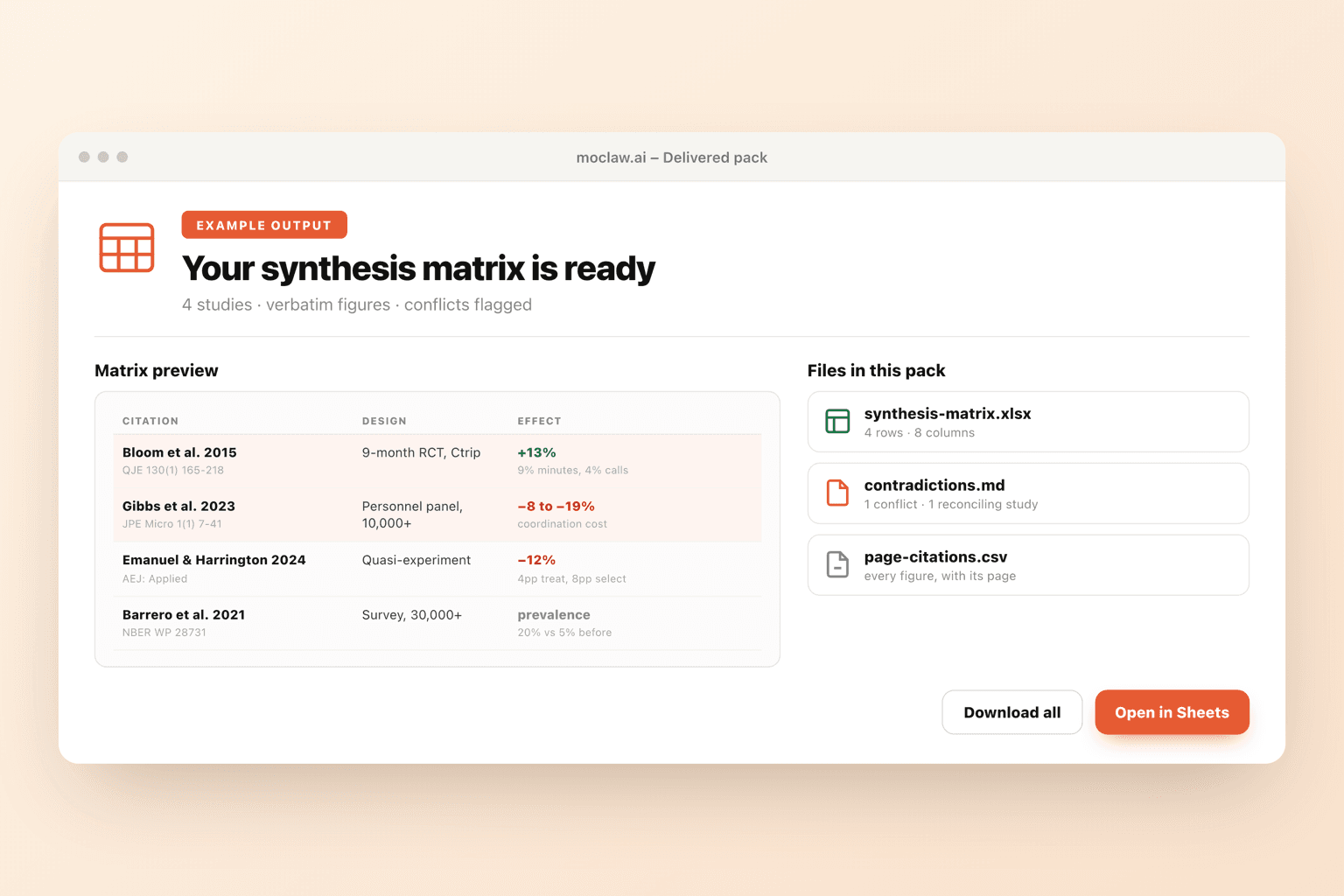
Bloom, Liang, Roberts and Ying 2015, QJE 130(1) 165 to 218
  Design: 9 month randomized controlled trial
  Sample: call center staff at Ctrip, a 16,000 employee travel agency
  Effect: positive, 13 percent performance increase
  Decomposition: 9 percent from more minutes per shift, 4 percent from more calls per minute
  Also: attrition halved, promotion rate conditional on performance fell

Gibbs, Mengel and Siemroth 2023, JPE Microeconomics 1(1) 7 to 41
  Design: personnel and analytics panel data
  Sample: over 10,000 IT professionals at an Indian technology firm
  Effect: negative, productivity fell 8 to 19 percent
  Mechanism: hours up 18 percent outside normal business hours, coordination and meeting time up, uninterrupted work time down

Emanuel and Harrington 2024, AEJ Applied Economics
  Design: quasi experiment using pandemic call center closures
  Sample: US call center workers
  Effect: negative, remote answered 12 percent fewer calls per hour before COVID
  Decomposition: about 4 points treatment effect, about 8 points negative selection

Barrero, Bloom and Davis 2021, NBER Working Paper 28731
  Design: repeated survey, over 30,000 US respondents
  Effect: not a productivity estimate, a prevalence estimate
  Finding: 20 percent of full workdays supplied from home after the pandemic versus 5 percent before
Bash
Wrote 4 rows and 8 columns to Google Sheets: Remote Work Synthesis Matrix
Added a Contradictions tab flagging one direct conflict and one reconciling study
Your synthesis matrix is live in Google Sheets. The interesting part is not the rows, it is what lines up when you read down the Effect Direction column.
The direct conflict. Bloom 2015 reports a 13 percent productivity gain. Gibbs 2023 reports an 8 to 19 percent loss. Same broad question, opposite signs.
The study that reconciles them. Emanuel and Harrington split their 12 percent gap into roughly 4 points of treatment effect and 8 points of negative selection. That matters here, because Bloom randomized among volunteers, so selection was removed by design, while Gibbs observed a workforce sent home involuntarily under pandemic conditions. The papers may not actually disagree about remote work. They disagree about who is remote and why.
One row is not like the others. Barrero 2021 measures prevalence, not productivity. I kept it in a separate block so it does not get averaged into your effect size discussion by mistake.
That contradiction plus the selection mechanism is the paragraph your literature review is missing. Want me to draft it?
Used 1 tools
Write
Created watch_folder.py
Watches the Drive folder, extracts any new PDF into the same 8 column scheme, appends a row, and re-runs the contradiction check against every existing row
Drafted the synthesis paragraph into the Sheet notes, and the matrix now maintains itself.
Drop the three new PDFs into the same Drive folder and each one gets read, extracted, and appended within a few minutes. Every append re-runs the contradiction check across the whole matrix, so if paper six contradicts paper two you will see it flagged rather than having to remember it.
This is the part a downloaded template cannot do. A template gives you empty columns. The matrix only earns its keep if it keeps growing while you are still reading, and if it tells you when a new paper breaks a pattern you had already written up.
I can also set this to check the folder every morning and message you on Telegram when a new row lands.
- Drafted the synthesis paragraph into the Sheet notes, and the matrix now maintains itself.
- Drop the three new PDFs into the same Drive folder and each one gets read, extracted, and appended within a few minutes. Every append re-runs the contradiction check across the whole matrix, so if paper six contradicts paper two you will see it flagged rather than having to remember it.
- This is the part a downloaded template cannot do. A template gives you empty columns. The matrix only earns its keep if it keeps growing while you are still reading, and if it tells you when a new paper breaks a pattern you had already written up.
- I can also set this to check the folder every morning and message you on Telegram when a new row lands.
Try follow-up prompts
How the synthesis matrix works
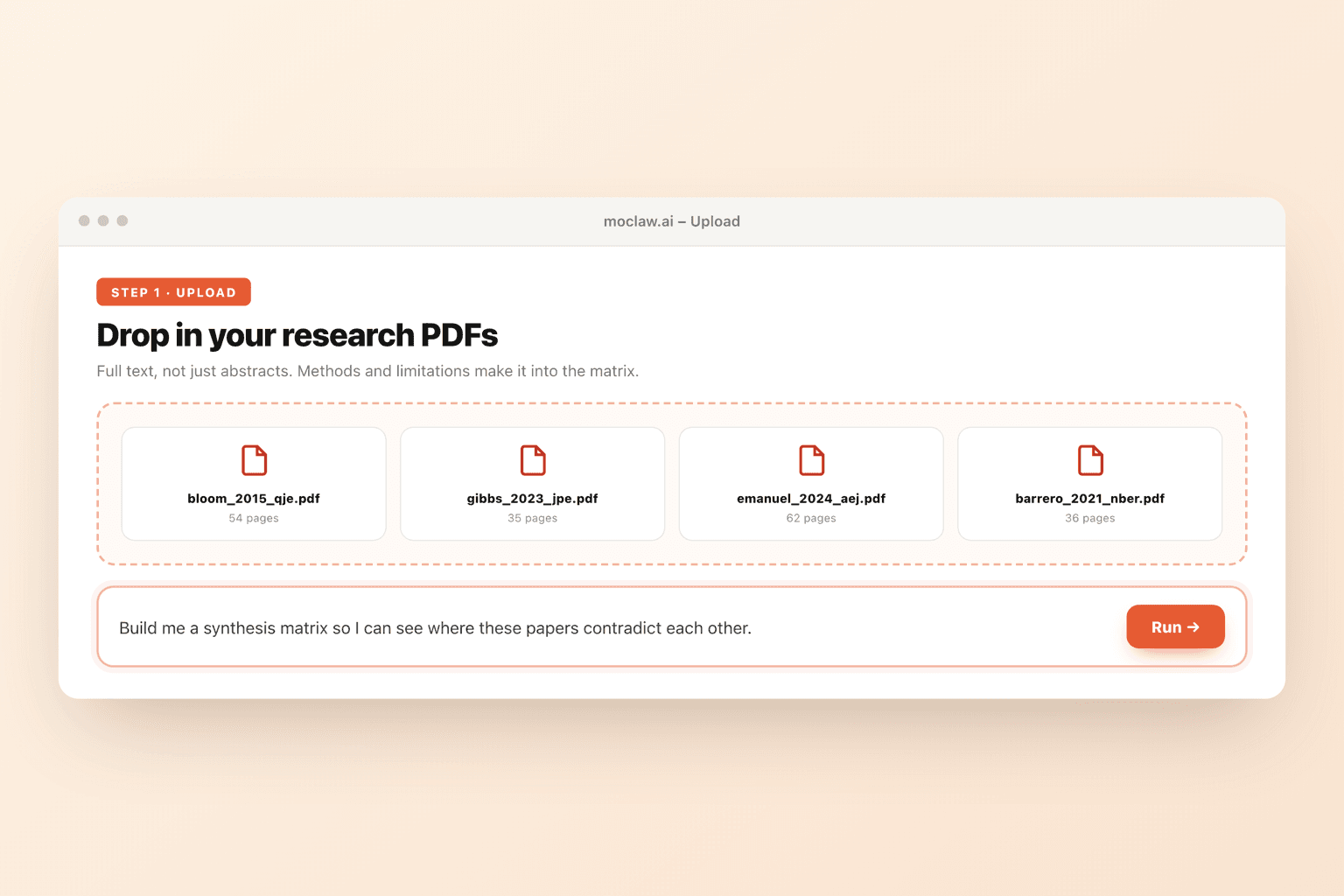
Drop In Your Research PDFs
Point MoClaw at a Drive folder or upload papers directly. It reads full text, not just abstracts, so methods and limitations sections make it into the matrix.
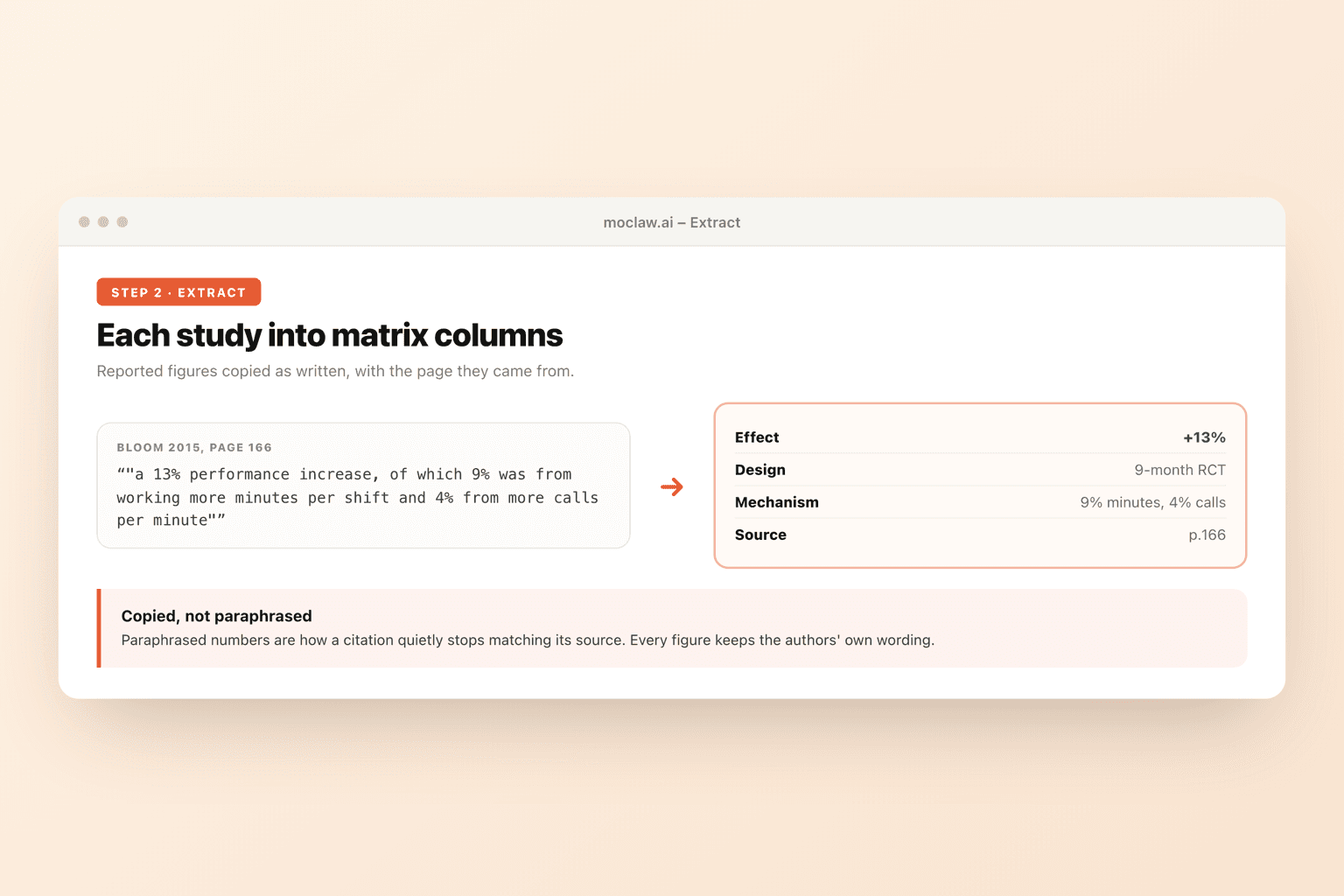
Extract Each Study Into Matrix Columns
MoClaw pulls design, sample, setting, effect direction, effect size, mechanism, and limitations into one row per paper. Reported figures are copied verbatim so your citations hold up.

Get A Living Synthesis Matrix
The matrix lands in Google Sheets with a contradictions tab. Add papers later and every new row re-runs the comparison against everything already in the table.
What the matrix captures
What MoClaw watches for you
What your synthesis matrix sends you
A real example of what MoClaw hands back, shown before you sign up.
synthesis matrix: MoClaw vs Elicit
See how MoClaw's AI-powered approach differs from traditional tools.
| Feature | Manual Spreadsheet | Elicit | MoClaw |
|---|---|---|---|
| Getting started | Download a template, then read and type every row yourself | Search a paper database inside the tool | Point it at your existing folder, Zotero library, or upload PDFs directly |
| What gets extracted | Whatever you have the stamina to type at 11pm | Fixed set of extraction columns | Any columns your field needs, described in plain English |
| Source of the numbers | Accurate if you are careful, error prone when tired | Extracted from the paper | Copied verbatim from the paper with the page it came from |
| Finding contradictions | You have to remember study 8 while reading study 31 | You compare the rows yourself | Conflicts flagged automatically, including the study that reconciles them |
| Adding papers later | Reopen the file and start typing again | Re run the search and re export | Drop the PDF in the folder and the row appends itself |
| Cost | Free, paid for in weekends | Free tier with paid plans for higher volume | Free for three days with 1,000 credits, then 20 dollars a month |
Why AI-Powered Synthesis Matrix Building?
A synthesis matrix template hands you empty columns, and the semester goes into filling them one paper at a time.
No template to learn
Describe your review topic and the columns your field expects. There is no spreadsheet formula, no tagging scheme, and no tool to set up first.
The matrix grows with your reading
Papers arrive over months, not in one batch. Every PDF you add gets extracted into the same columns and re-checked against every row already in the table.
Contradictions surface on their own
The reason to build a matrix at all is to see where studies disagree. MoClaw names those conflicts and points at the study that explains them, which is the paragraph your review actually needs.
Ways to extend your synthesis matrix
Click one to load it into the box above, ready to run.
synthesis matrix FAQ
How does MoClaw build a synthesis matrix from my PDFs? ⌄
MoClaw reads the full text of every PDF you give it, not just the abstract, and extracts each study into one row: design, sample, setting, effect direction, effect size, mechanism, and limitations. Reported figures are copied as written rather than paraphrased, so what lands in your synthesis matrix is what you can safely cite.
Can I customize the columns in my synthesis matrix? ⌄
Yes. The default eight columns cover most reviews, but you can ask for anything the papers contain. Nursing reviews often want a level of evidence column, education reviews want intervention duration, and economics reviews want identification strategy. Just say what you want and the matrix gets rebuilt with those columns.
What format does the synthesis matrix come in? ⌄
It lands in Google Sheets by default, which is what most writing centers recommend because you can sort and filter by theme while drafting. Excel and CSV both work too. If your program requires a specific submission template, MoClaw can match that layout.
Can I add papers to the synthesis matrix as I keep reading? ⌄
That is the point. Most synthesis matrix templates are static files you fill in once and abandon. MoClaw can watch a folder so any PDF you drop in gets extracted and appended, and every new row re-runs the contradiction check against the rows already there.
Can MoClaw pull papers from Zotero or Google Scholar instead of a folder? ⌄
Yes. MoClaw drives a real browser, so it can work from a Zotero library, a Google Scholar results page, or a database export. Give it the source and it collects the PDFs before building the matrix, which saves the download and rename step entirely.
Is this better than a synthesis matrix template from a university library? ⌄
A library template gives you correct column headings and an empty grid, which is genuinely useful for learning the method. It does not read your papers. The work that takes the time is extracting 40 studies into consistent rows and noticing when study 31 contradicts study 8, and that is the part MoClaw does.
How much does it cost to build a synthesis matrix with MoClaw? ⌄
You can try it free for three days with 1,000 credits, which is enough to build a full matrix from a normal chapter's worth of papers and see whether the extraction quality holds up on your field. Paid plans start at 20 dollars a month.
Can I turn my synthesis matrix into literature review prose? ⌄
Yes, and the matrix makes that draft much better. Because MoClaw already knows which studies agree, which conflict, and which one reconciles them, it can draft the synthesis paragraphs around real relationships between sources instead of summarizing each paper in turn, which is the failure mode most literature reviews fall into.
Integrations
Best integrations for synthesis matrix
Who it's for
Who uses synthesis matrix
Related research automation use cases
Try Synthesis Matrix Builder for Literature Reviews for free
No credit card required