AI Agent Video Editors: The MCP Takeover

An AI agent video editor lets you co-edit a timeline by chat, not mouse. See how MCP became the shared interface behind ChatCut, OpenCut, and Palmier Pro.
Table of Contents
An AI agent video editor is a timeline you operate by conversation instead of by cursor: you tell an agent to cut the filler, add captions, drop in music, and export, and it hands back a real, editable cut you can still adjust by hand. The clearest sign this stopped being a demo landed on July 9, 2026, when ChatCut opened access to its Codex plugin and, a day later, took the top Product of the Day spot on Product Hunt.
That is not an editor with an AI button bolted on. It is a change in who drives the timeline, from you dragging clips with a mouse to you and an agent co-editing the same sequence. The interface making it possible is a protocol most editors have never heard of: MCP.
Key Takeaways:
- An AI agent video editor exposes its timeline to an agent through MCP, so plain-language instructions become real editable cuts, not black-box renders.
- Three live products show three routes to the same place: ChatCut bolts a hosted interface onto a closed editor, OpenCut is rewriting an open-source editor from scratch, and Palmier Pro is open-source native with MCP already shipped.
- MCP is the common thread. It turns a timeline into an object an agent can call.
- The technology is early. No agent replaces an editor's taste yet, and every option carries a real catch.
- For the rest of 2026, whose MCP interface becomes the default matters more than whether agents edit at all.
What Is an AI Agent Video Editor?
An AI agent video editor is an editor whose timeline is exposed to an AI agent so the agent can import media, cut, caption, score, reframe, and export from natural-language instructions. The mouse does not go away. It gains a partner that understands "cut the rambling, add a bed of music, and give me a 1080p version plus a vertical short." It is the same move toward AI agents that take real action rather than just chat, now reaching the timeline.
The distinction worth holding onto is the one working editors keep drawing: a video editing agent is a tool, not an editor. When a launch thread for a chat-based editor hit r/GrowthHacking this month, the top reply was blunt: "I don't want AI making creative decisions for me, I just want it to save me from doing the boring stuff over and over." That is the honest job description. The agent earns its place on the boring pass (the transcript scrub, the silence removal, the first rough assembly) and leaves the taste calls to a person.
Marcus, a freelance editor who ships a weekly interview show, is a good example. He wired up a small helper that reads the transcript Premiere generates from his clips, then takes a prompt like "a twelve-minute cut that keeps the three strongest stories." A 45-minute raw interview that used to eat three hours of scrubbing now comes back as a rough assembly in about 40 minutes, which he shapes by hand. The agent did not edit the show. It did the part of editing nobody misses.
What this resolves: a clean line between an editor (the person and their judgment) and a video editing agent (the tool that clears the tedious pass).
What it leaves unsolved: marketing will keep slapping "AI editor" on anything with a text box.
MCP: The Handshake That Turns a Timeline Into Something an Agent Can Call
Agentic video editing only works if the agent can actually operate the timeline, and that is what the Model Context Protocol provides. MCP is an open standard that lets an application expose its functions to an AI agent as callable tools. Think of it as a universal socket: instead of every editor inventing a private way for an agent to talk to it, they share one handshake.
Applied to editing, MCP turns a timeline from a thing you click into an object an agent can query and change. "List the clips on track two," "trim the gap after the second speaker," "render a caption pass," each becomes a tool call the agent can make and check. This is the load-bearing idea behind the whole trend. Whoever wires MCP into their editor, and how deeply, decides where they stand.
That also separates a real ai agent for video editing from a wrapper. A wrapper sends your prompt to a model and pastes back a rendered clip you cannot open. An MCP-wired editor lets the agent make edits that land as adjustable timeline objects, which is why the export still opens cleanly in the tools editors already trust.
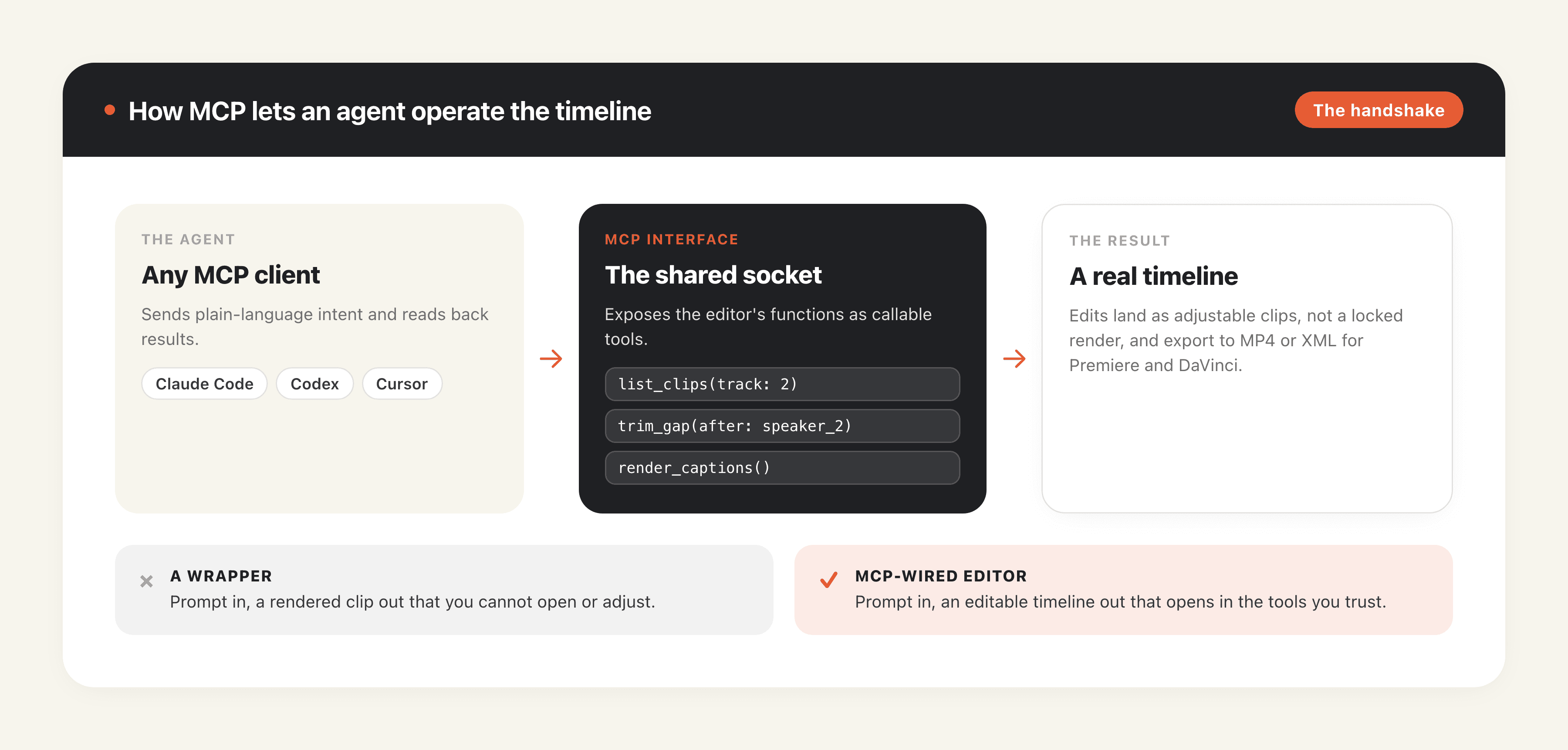
What this resolves: why "the agent edits my video" and "the agent hands me an editable cut" are different products.
What it leaves unsolved: MCP standardizes the plumbing, not the quality. A clean interface to a mediocre edit is still a mediocre edit.
Three Paths to an Agent-Native Editor
Over about a month, three products reached the agent-native editor from three directions. The cleanest way to see them is a two-by-two: open source or not, and agent live today or not. Each one is missing exactly one square.
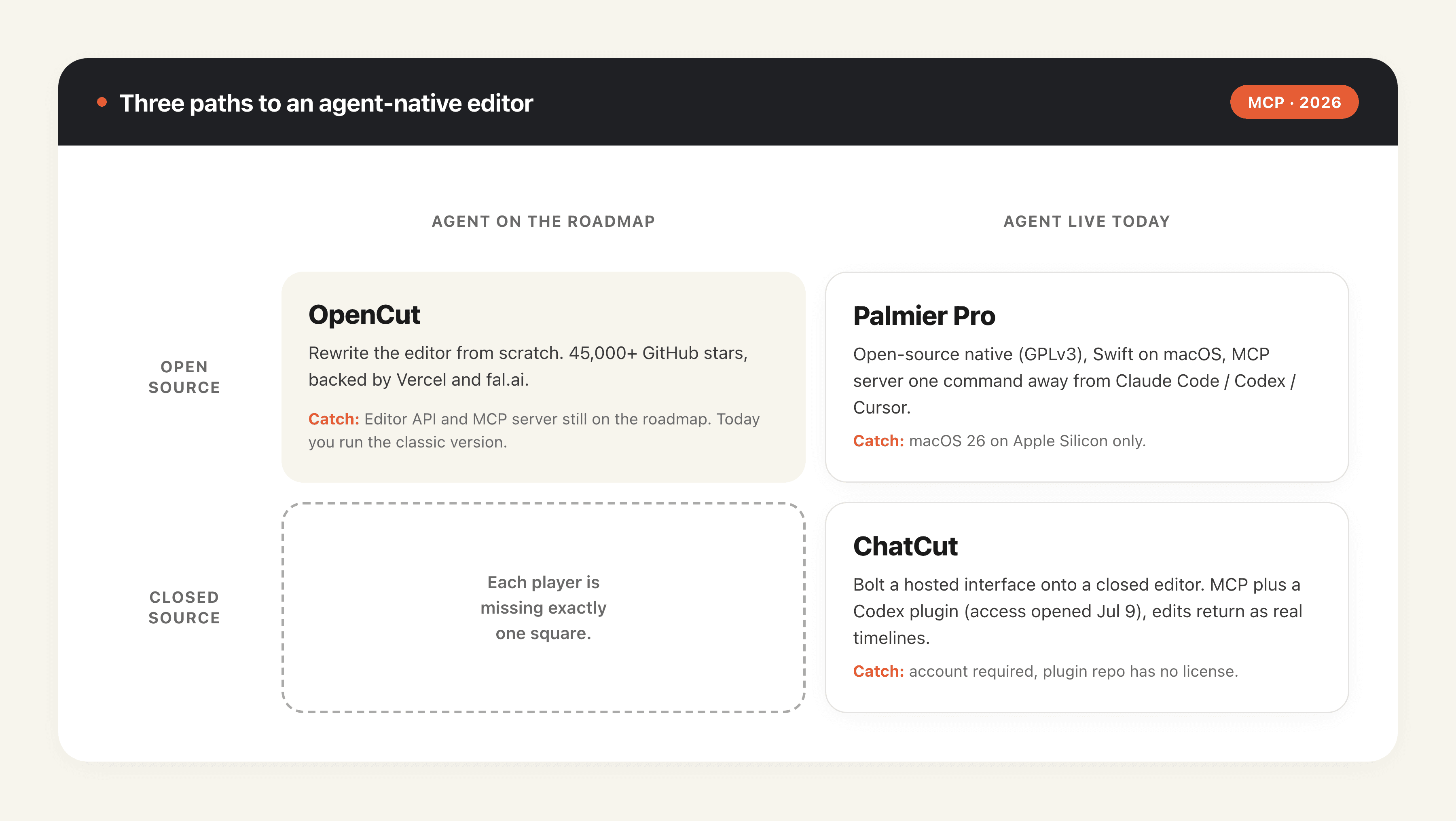
| Editor | Open source | Agent live today |
|---|---|---|
| ChatCut | No (account required; plugin repo has no license) | Yes (hosted MCP plus Codex plugin, July 9) |
| OpenCut | Yes (north of 45,000 GitHub stars) | No (Editor API and MCP still on the roadmap) |
| Palmier Pro | Yes (GPLv3 editor and MCP server) | Yes (but macOS 26 and Apple Silicon only) |
ChatCut: bolt a hosted interface onto a closed editor
ChatCut is not a mere bolt-on, and that is the common misread. It is a full closed-source editor whose timeline is reachable through a hosted interface, so a Codex plugin can drive it from a chat window. Every edit comes back as a real, editable timeline, and you can export MP4 or XML back into Premiere Pro or DaVinci Resolve, per ChatCut's own plugin docs. Its generation stack leans on models like Seedance 2 and GPT Image 2, the free tier ships with no watermark on any plan, and Pro adds credits plus ProRes 4444 alpha export.
The catch is ownership. You need a ChatCut account, and the public agent-plugin repository carries no license and only a few hundred stars. This path suits the editor who says "I am not switching editors, I just want to point an agent at the one I have."
OpenCut: rewrite an open-source editor from scratch
OpenCut is the open-source CapCut alternative, one of the most-starred editors on GitHub (north of 45,000 stars) with backing that includes Vercel and fal.ai. It has the most thorough rewrite plan of the three: an Editor API, an MCP server, headless batch rendering, and a Rust core meant to run across web, desktop, and mobile from one codebase.
The honest part is that this is mostly roadmap. The agent layer is listed as coming, not shipped, and the version you can use today is the classic editor. As one r/singularity commenter said of the whole wave of quickly-built tools, "who is going to support these vibe coded solutions with two users?" OpenCut has the opposite problem, real community and momentum, but the agent-native version people want is not out yet.
Palmier Pro: open-source native with MCP already shipped
Palmier Pro is the most complete of the three on paper: a Swift-native macOS editor built with Premiere Pro as its north star, open-sourced under GPLv3 (the editor, MCP server, and in-app chat; the generative models stay a paid service), out of Y Combinator's Summer 2024 batch. Its MCP server runs today. With the app open, it exposes an endpoint at 127.0.0.1:19789 that one command connects to Claude Code, Codex, or Cursor, per its README. You can generate inside the timeline with models like Seedance and Kling, and because there is an in-app agent, a human and an agent literally work the same project at once.
The catch is reach. Palmier Pro requires macOS 26 on Apple Silicon. No Intel Mac, no Windows, no Linux. It is the fullest expression of the idea, available to the narrowest slice of users.
What this resolves: there is no single "AI agent video editor." There are three trade-off shapes, and you pick by what you refuse to give up: your current editor, an open license, or working today.
What it leaves unsolved: all three are missing a square. None is the finished thing yet.
What Is Actually Changing: Interface, Interaction, and the Open-Core Business Model
Stack the three paths together and the same three shifts show through.
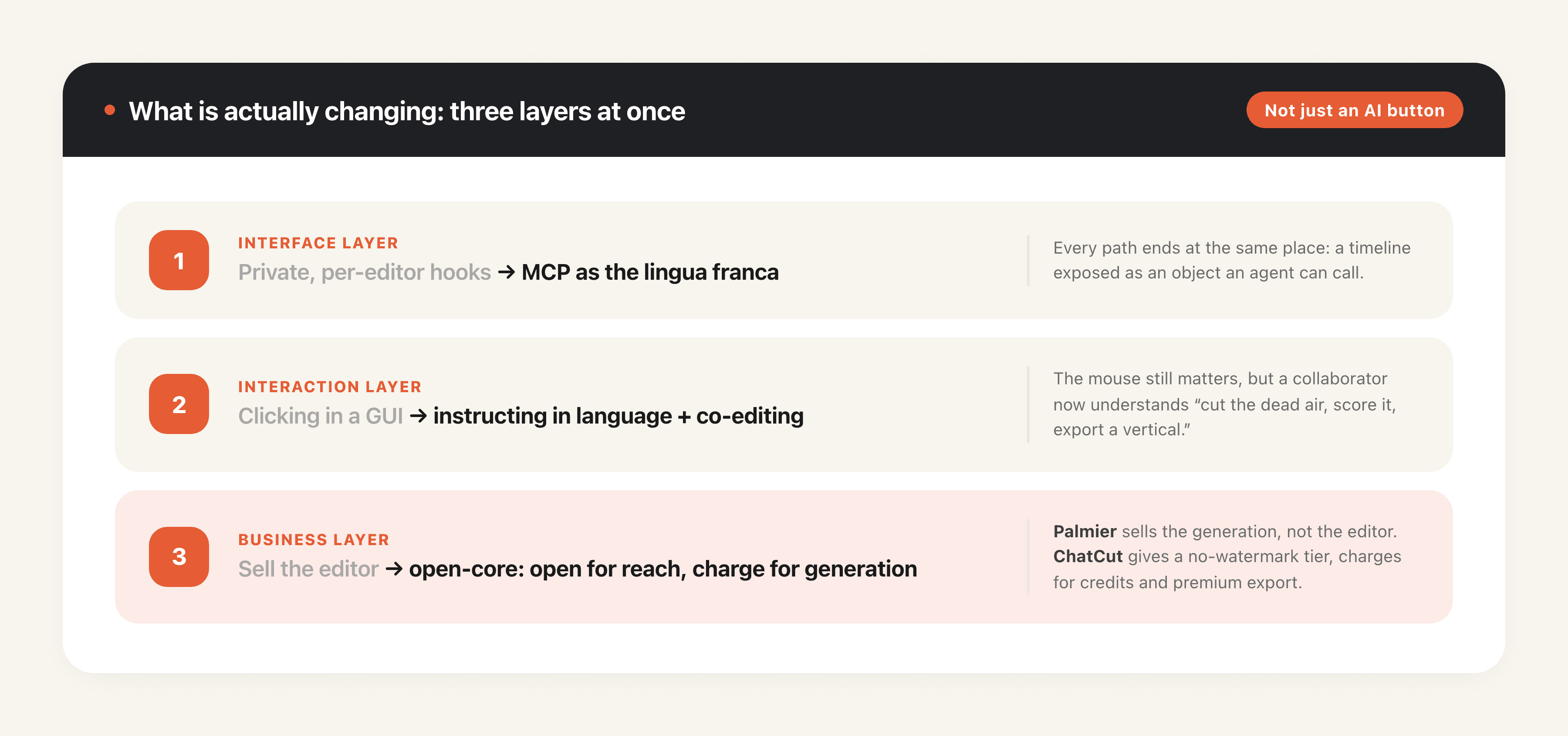
The interface layer. MCP is becoming the lingua franca between editors and agents. Bolt-on, rewrite, or native, every path ends at the same place: a timeline exposed as an object an agent can call. The players differ on how deep they wire it, not on whether they do.
The interaction layer. Editing is moving from clicking in a GUI to instructing in language, plus human-and-agent co-editing. The mouse still matters, but it now sits beside a collaborator that understands "cut the dead air, score it, and export a vertical version." That is the video editor ai agent pattern in one sentence.
The business layer. Everyone is converging on open-core: editors and interfaces go open for reach, while generation compute stays a closed subscription. Palmier makes it clearest, selling the generation rather than the editor. ChatCut runs the same logic from the closed side, giving away a no-watermark tier and charging for credits and premium export.
What this resolves: the trend is not "AI is in editors now." It is three specific layers moving at once, and the business model is the tell.
What it leaves unsolved: open-core only pays if the closed generation layer stays worth paying for. If open models catch up, the revenue side wobbles.
Editing Is One Link in a Chain That Is Being Agent-ified
Zoom out and video editing is just the fastest-moving link in a longer chain: understand a video, edit it, generate new footage, and eventually model a whole scene. Every link is sliding from human labor to an agent-callable step, and editing moved first this half of the year because a timeline is unusually easy to expose as tools.
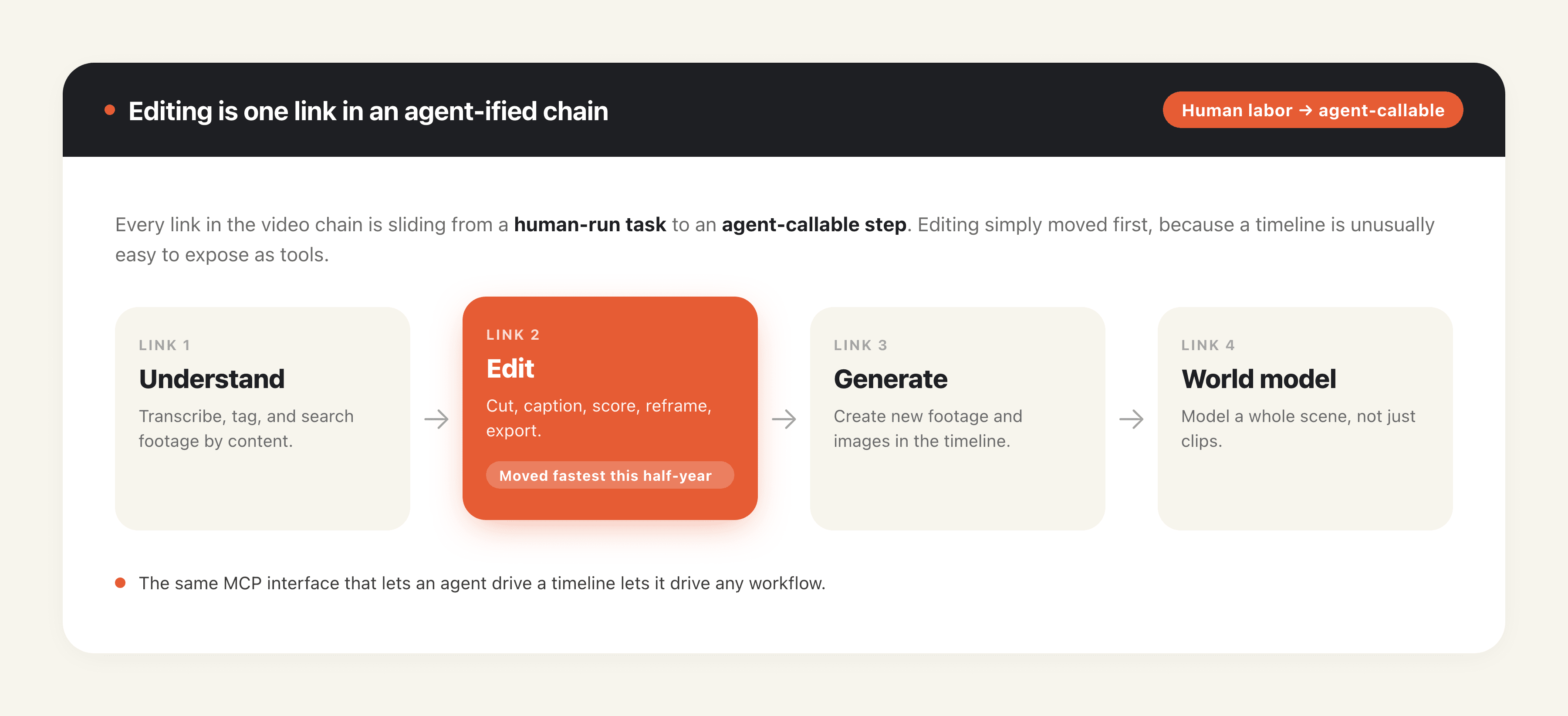
The same MCP-as-universal-interface logic that lets an agent drive a timeline lets it drive any workflow. That is the pattern MoClaw is built on: expose the steps of a real job as things an agent can call, then let a person supervise instead of clicking through each one. Editing is a vivid version because the output is visual, but the shape matches the agent workflows teams already run for research, monitoring, and messaging.
What this resolves: why an editing story belongs in an agent conversation at all. Same interface pattern, applied to pixels.
What it leaves unsolved: not every workflow is as tidy as a timeline. The messier the job, the harder the tool boundary is to draw.
The Skeptics Have a Point: Where Agent Editing Still Breaks
Before anyone declares editors obsolete, a reality check: all three products are early. ChatCut has a few hundred stars and no license on its plugin repo. OpenCut's agent layer is still roadmap. Palmier Pro runs only on the newest macOS. "Takeover" is a direction, not the current state.
Working editors are blunter than the launch posts. The recurring line on r/generativeAI is some version of "there is no AI video editor, just features," and the load-bearing complaint is taste: "AI has no taste and people notice." On review sites, ChatCut's early feedback skews toward the ordinary failure modes of a young product, a limited interface, uneven support, and generations that miss. That is not a hit piece, it is what an early category looks like.
The sharpest pain is the handoff. Dana, who cuts corporate case-study videos, once spent a weekend rebuilding a project after an AI helper's XML export mangled her nested sequences. The lesson generalizes: an agent that produces a clean handoff back to Premiere or DaVinci is worth ten that produce a slick preview and a broken export. That is exactly why the editable-timeline-plus-XML approach ChatCut and Palmier take matters more than any single generation feature. If the cut does not open cleanly in the tools a professional trusts, the agent made work instead of saving it.
What this resolves: where to be skeptical, specifically. Taste, support, and the export handoff, not vague "AI is not ready" hand-waving.
What it leaves unsolved: these are early-product problems, not laws of physics. Most get better with the next release, which is why the standard is still up for grabs.
See it play out in real time. Here is the launch, the demos, and the doubts, straight from X in July 2026.
Our new plugin opens a full built-in NLE right inside the Codex app, where you and your agent can edit together, effortlessly.
If you're already paying for Codex, you get this one for FREE.
It's a…
the most counterintuitive part: editing real footage is harder than generating it. generation is unconstrained.
editing means actually understanding real…
completely FREE. runs locally. requires no API keys or usage limits.
just give the repo to claude code or codex,…
That's why ChatCut is different. It combines a professional timeline with an AI editing agent that understands your footage and helps with the editing process—not…
Real, unedited posts pulled from X in July 2026; non-English posts machine-translated. Tap any card to open the original.
FAQ
What is an AI agent video editor?
It is an editor whose timeline is exposed to an AI agent, usually through MCP, so you can import media, cut, caption, score, and export by giving natural-language instructions. The agent's edits come back as a real, editable timeline rather than a locked render, so a person can still take over the cut by hand.
What is ChatCut and how does the Codex plugin work?
ChatCut is a full closed-source AI video editor whose timeline is reachable through a hosted interface. Its Codex plugin, which opened access on July 9, 2026, lets you edit from a Codex chat by describing what you want. Every edit returns as an editable timeline, with MP4 or XML export back to Premiere Pro or DaVinci Resolve.
Is there an open-source alternative to ChatCut?
Yes, with trade-offs. OpenCut is an open-source CapCut alternative with a large following, but its agent and MCP layer is still on the roadmap. Palmier Pro is open-source under GPLv3 with an MCP server live today, but it runs only on macOS 26 and Apple Silicon. ChatCut itself is closed, and its plugin repository carries no license.
Do I need to switch editors to use a video editing agent?
No. There are three paths: bolt a hosted interface onto a closed editor (ChatCut), wait for an open-source rewrite to ship its agent layer (OpenCut), or adopt an open-source native editor with MCP today (Palmier Pro). The same interface pattern also applies well beyond video, to any workflow an agent can be handed.
Whose MCP Interface Becomes the Standard Is the Real 2026 Question
Between ChatCut's hosted plugin, OpenCut's open rewrite, and Palmier Pro's native MCP server, the direction is already set. What is not settled is whose MCP interface becomes the one everyone builds against, because that winner gets to define how agents and timelines talk for years.
So the real question for the rest of 2026 is no longer whether agents take over the editor. It is whose MCP interface becomes the standard. The editor's next power user may not be a human at all. It may be the protocol.
Continue Reading
More Research
Claude Code SEO Skill: Fire Your SEO Agency

AI Agent Sandbox: What It Is and Isn't

Lindy AI Review: Does Editable Memory Help?

Caveman Skill: What the 65% Really Buys

Hermes Agent Desktop Review 2026: Worth It?

Agent Substrate: 250 Agents on 8 Pods
The MoClaw editorial team writes about workflow automation, AI agents, and the tools we build. Default byline for industry overviews, listicles, and collaborative pieces.
Turn insights into action.
MoClaw automates the recurring work your analysis points to. No engineering required.
References: ChatCut ChatGPT/Codex Plugin · ChatCut on Product Hunt · ChatCut Launches Codex Plugin (MarTech Series) · ChatCut agent-plugin (GitHub) · OpenCut: The open-source CapCut alternative (GitHub) · Palmier Pro: The video editor built for AI · Palmier Pro (GitHub) · Model Context Protocol