GLM 5.2 Pricing Moved Four Times in Two Days

GLM 5.2 pricing on OpenRouter changed four times in 39 hours. The live rates as of 15 August 2026, the 33 endpoints behind them, and how to pin one.
Table of Contents
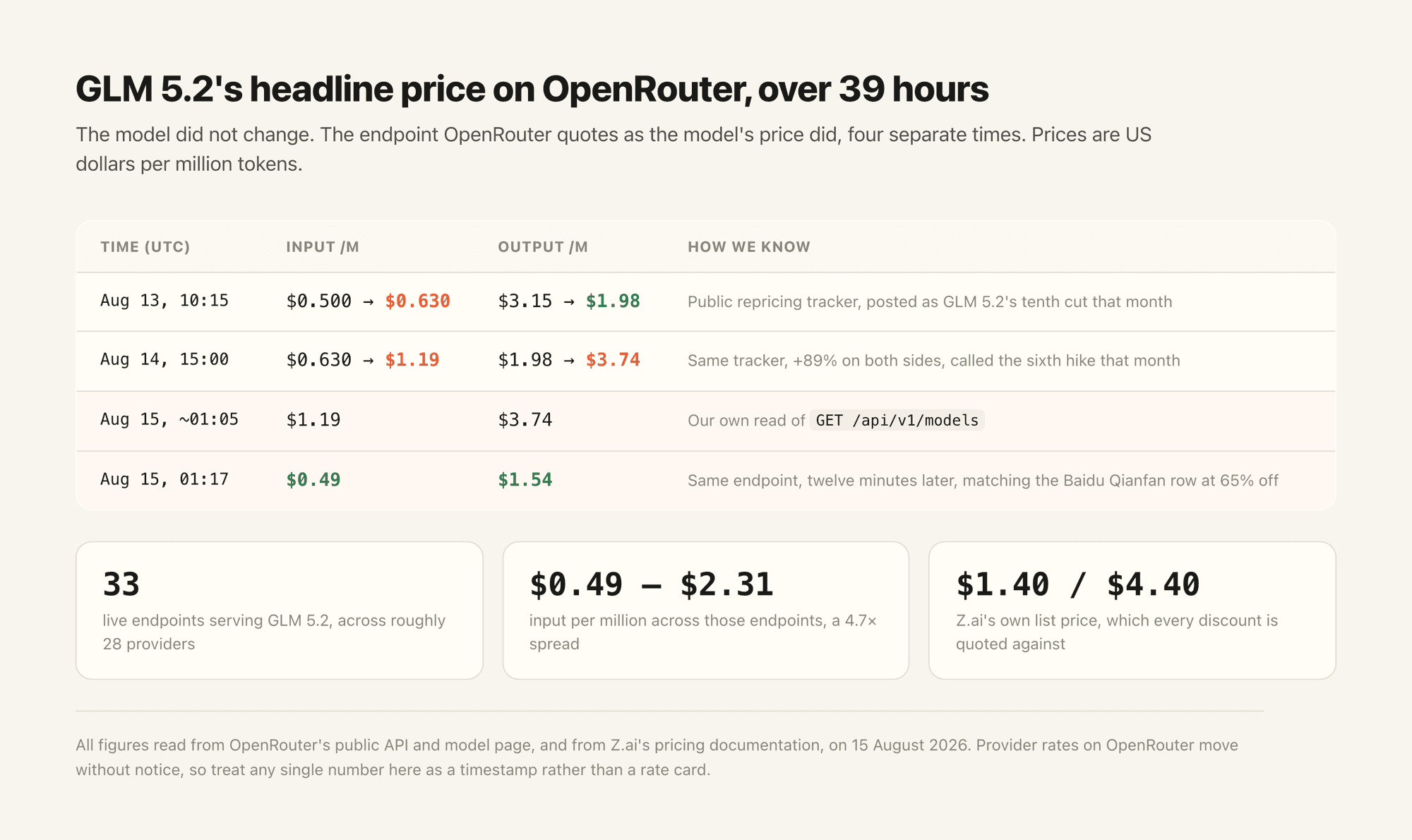
GLM 5.2 pricing is a moving target, and not in the gentle way vendors usually mean it. Between 10:15 UTC on 13 August 2026 and 01:17 UTC on 15 August, the headline rate OpenRouter quotes for z-ai/glm-5.2 changed four times: $0.500 per million input tokens, then $0.630, then $1.19, then $0.49. The weights didn't change. What changed was which of the model's 33 live endpoints the platform happened to be quoting at the second you looked.
That matters more than a normal price story, because GLM 5.2's whole appeal to people running long agent sessions was that it was cheap. When "cheap" has a 4.7x spread inside one product page, the number you budgeted against isn't a rate; it's a timestamp.
Key Takeaways
- As of 15 August 2026, GLM 5.2 on OpenRouter runs from $0.49 per million input tokens (Baidu Qianfan, 65% off) to $2.31 (Alibaba Cloud International), with output from $1.54 to $7.26.
- Z.ai's own list price is $1.40 input / $4.40 output, and every discount badge on OpenRouter is quoted against those two numbers.
- The model-level price returned by
GET /api/v1/modelsis whichever endpoint is being surfaced, so a script that reads it nightly will record swings the model never had. - You can stop the swinging:
provider.max_priceandprovider.onlylet you cap or fix which host serves the request. - GLM-5.2 isn't in the GLM Coding Plan, and requests for it get routed to GLM-5.3 instead, so a flat subscription doesn't get you out of per-token billing for this specific model.
What GLM 5.2 Pricing Looks Like Right Now
Everything below was read from OpenRouter's public API and model page at 01:17 UTC on 15 August 2026. Expect it to have drifted by the time you check.
The cheapest endpoint is Baidu Qianfan at $0.49 in and $1.54 out per million tokens, carrying a 65% off badge, 1.44s median latency, 48 tokens per second, 99.99% uptime. Sail Research sits at $0.50 / $3.15 with no discount attached, which makes it the cheapest input rate but a pricey output rate. DigitalOcean quietly offers $0.63 / $1.98 at 0.61s latency, the fastest first token in the top ten and no promotional badge propping it up. Z.ai's own endpoint charges $1.40 / $4.40. At the top, Alibaba Cloud International's premium tier asks $2.31 / $7.26.
Same model, same weights, 4.71x between the floor and the ceiling on both sides of the meter.
Why the Number Moved Four Times in Thirty-Nine Hours
OpenRouter isn't one seller. It's a routing layer over many companies hosting the same open weights, and the price shown at the top of a model page is the price of whichever endpoint is currently being quoted, not a rate the platform sets. When a host launches a promotion or lets one expire, the headline number jumps even though nobody raised or cut anything you were actually paying.
On 14 August, OpenRouter co-founder Alex Atallah posted that you can watch dynamic pricing in action today for open-weight models, and said to expect other models to adjust their pricing structure over the coming months. So this isn't a glitch anyone plans to smooth over; it's the mechanism working as designed.
A repricing tracker that watches the same feed logged the 13 August move as GLM 5.2's tenth cut that month, and the 14 August move as its sixth hike. Both in August. Our own two reads of GET /api/v1/models, twelve minutes apart on the morning of the 15th, returned $1.19 / $3.74 and then $0.49 / $1.54.
The 33 Endpoints Hiding Behind One Price
OpenRouter's own explanation on the providers tab is admirably blunt: different companies host the same model, and the platform routes your request to one of them based on the routing mode you pick, which is Balanced for price plus speed, Nitro for fastest, or Exacto for highest tool-calling accuracy. Pick nothing and you get Balanced, which means the cheapest endpoint that's performing acceptably at that moment.
Thirty-three endpoints across roughly 28 providers currently serve GLM 5.2, at twenty distinct input prices. Price is not the only thing that varies between them, and this is where the cheap-is-cheap reasoning falls over. Ambient charges $1.05 per million input, more than double Baidu's rate, at 6.01s latency, 7 tokens per second and 62.67% uptime. Quantization differs too: some endpoints serve fp8, others fp4, and OpenRouter exposes a filter for exactly that reason. A route chosen purely on headline price can hand you a slower, more heavily quantized copy of the model for more money.
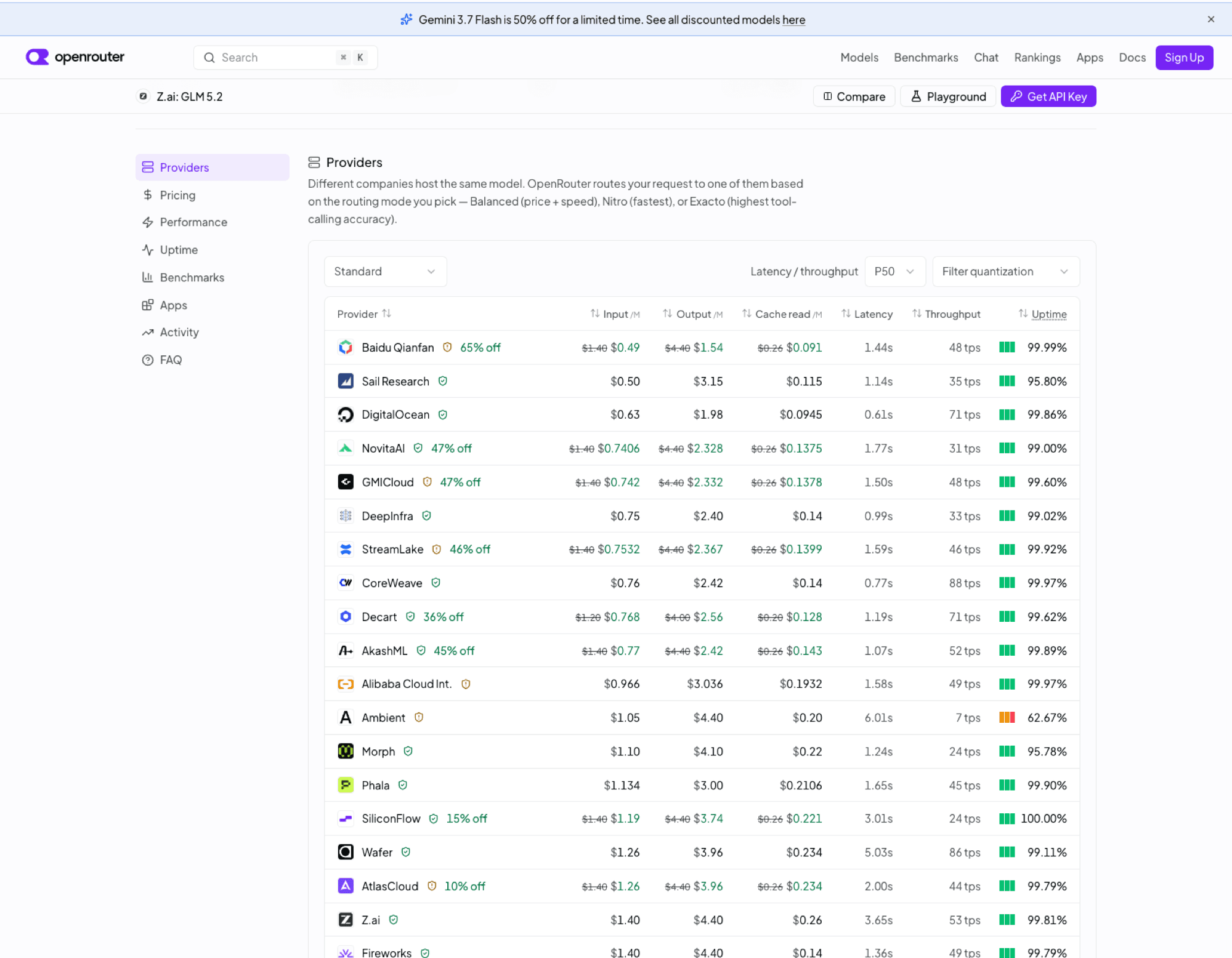
Notice the strikethroughs in that table. Baidu's $0.49 is struck through from $1.40; SiliconFlow's $1.19 is struck through from the same $1.40 at 15% off. Every discount on the page is measured against one anchor.
Z.ai's List Price Is the Only Fixed Point
That anchor comes from Z.ai's own pricing documentation, which lists GLM-5.2 at $1.4 input, $0.26 cached input and $4.4 output per million tokens, with cached input storage marked limited-time free. Nine of the 33 OpenRouter endpoints, including Z.ai's own, sit exactly on those numbers with no discount at all.
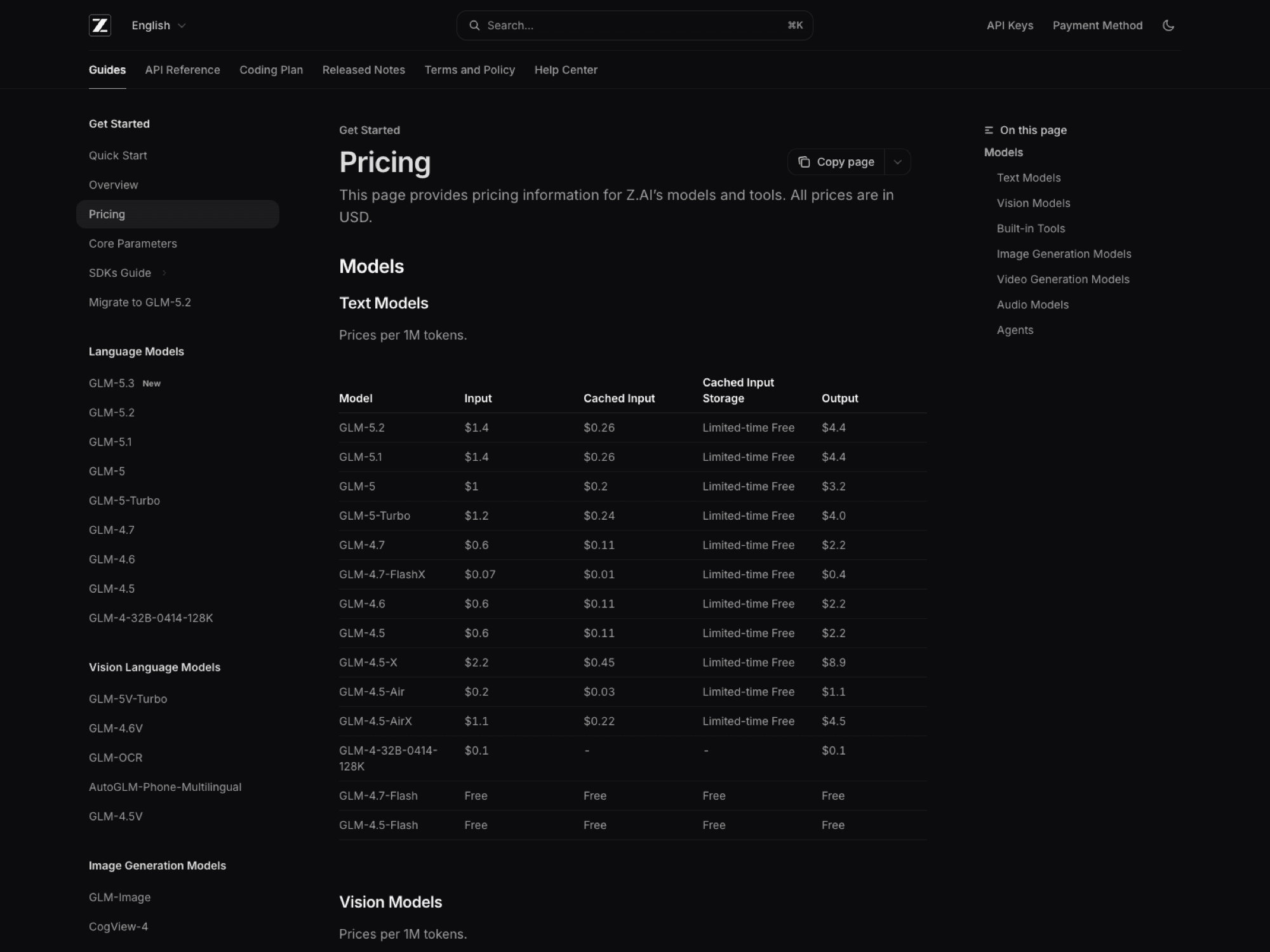
So the honest version of "what does GLM 5.2 cost" is two numbers, not one. The list price is $1.40 / $4.40 and has been stable. The effective price is whatever discount a host is running today, which is where all the volatility lives.
What a 4.7x Spread Does to a Bill You Already Budgeted
Suppose an agent workflow burns 20 million input and 4 million output tokens a day, which is unremarkable for a long-horizon coding loop against a million-token context window. At the floor, that's $9.80 plus $6.16, or $15.96 a day. At the ceiling it's $46.20 plus $29.04, so $75.24. Over a thirty-day month: roughly $479 against roughly $2,257.
Nothing in that comparison involves changing model, prompt or workload. It's the same request, routed differently. If your invoice moved and you went looking for what you changed, the answer may genuinely be nothing.
A loop that chews through 20 million input tokens a day also runs for hours, and hours of it on a work laptop means hours of a fan, a hot lap and an editor you can't use for anything else. That's the second reason people move this class of job onto a hosted cloud AI computer such as MoClaw: the run stops competing with the machine you're trying to work on, and it doesn't stop when you need that machine back.
Pinning a Rate Instead of Chasing One
The fix is unglamorous and takes one JSON object. OpenRouter's provider routing lets you send a provider block with your request:
provider.max_pricetakes{"prompt": X, "completion": Y}and refuses to run the request rather than serve it above your cap.provider.onlyrestricts routing to a named list of provider slugs;provider.ignoredoes the inverse.provider.ordergives an ordered preference list, andprovider.allow_fallbacks: falsestops the platform quietly reaching past it.provider.sortaccepts"price","throughput"or"latency"when you want a rule instead of a fixed list.
Setting max_price is the single highest-value line here, because it converts an unpredictable bill into a predictable failure you can see and handle. A capped request that errors is cheaper to deal with than a month of silently expensive ones.
The catch is that a pin only helps if it's actually in the code path that runs. Route configuration that lives in a shell profile on one laptop drifts the moment you pick the work up on a different machine, and long agent runs have a habit of starting on the machine you then close. Keeping that configuration on a hosted cloud AI computer like MoClaw, which stays powered on and holds the same environment whichever device you connect from, is the difference between a pin you set once and a pin you keep re-setting.
Why a Flat Plan Does Not Solve Per-Token GLM 5.2 Pricing
The obvious escape from per-token GLM 5.2 pricing is Z.ai's subscription, and for this model it doesn't work. The GLM Coding Plan covers GLM-5.3, GLM-5-Turbo and GLM-4.7. GLM-5.2 is not on that list, and Z.ai's documentation says requests for previous models including 5.2 are automatically routed to GLM-5.3.
Read that carefully if you have version-sensitive evaluations. Buying the plan to control cost also changes which model answers you, silently. If you want 5.2 specifically, you're paying per token, and the routing controls above are the only lever you have. If 5.3 is fine, the plan's own quota mechanics are a separate subject, and we've written up how the GLM Coding Plan's rate limits and points quota actually behave and what changed in GLM-5.3's API availability.
Getting a GLM 5.2 Price You Can Budget Against
Four things are worth doing before your next invoice.
Read the current rate from the API rather than a blog post, including this one, since GET /api/v1/models is the only source that's correct at the moment you call it. Then set provider.max_price at whatever number your budget actually tolerates, not at today's floor, because today's floor is a promotion. Check quantization and uptime on any endpoint you pin to, since the cheapest row is sometimes cheap for a reason. And if GLM 5.2 is one of several models you route between, decide the switching rule once and write it down; the operators who handle this well treat model choice as a routing question, which is the same argument behind running a multi-model agent setup rather than betting a workflow on one vendor's price list.
The last of those is where a hosted machine earns its keep. Watching a price that reprices several times a week is a scheduled job, and a scheduled job on a laptop runs when the laptop is open, which is not the same thing as running. MoClaw exists to give that job somewhere to land: the same environment, always on, running next to whatever you already use rather than in place of it.
FAQ
How much does GLM 5.2 cost per million tokens?
As of 15 August 2026, Z.ai's list price is $1.40 input and $4.40 output, with cached input at $0.26. On OpenRouter the effective rate ranged from $0.49 / $1.54 to $2.31 / $7.26 across 33 endpoints on that date. Check the API before relying on any of those figures.
Why did GLM 5.2 pricing go up?
In most cases it didn't, in the sense of a vendor raising a rate. OpenRouter's headline number reflects whichever endpoint is being quoted, and hosts add or drop promotions independently. A jump from $0.630 to $1.19 on 14 August 2026 was followed by a drop to $0.49 the next morning, with no announcement in either direction.
Which provider is cheapest for GLM 5.2?
On 15 August 2026 it was Baidu Qianfan at $0.49 / $1.54, running a 65% discount against Z.ai's list price. Discounts expire, so treat "cheapest" as a query to run rather than an answer to memorise. Sorting with provider.sort: "price" asks the platform that question on every request.
Is GLM-5.2 included in the GLM Coding Plan?
No. The plan covers GLM-5.3, GLM-5-Turbo and GLM-4.7, and Z.ai's documentation states that requests for earlier models such as GLM-5.2 are routed to GLM-5.3 automatically.
Does OpenRouter's API return the same GLM 5.2 price the website shows?
It should, and both track the same underlying endpoint data. We read $1.19 / $3.74 and then $0.49 / $1.54 from GET /api/v1/models twelve minutes apart on 15 August 2026, which is the volatility rather than a mismatch. If a cached page and a fresh API call disagree, trust the API call.
Continue Reading
More Guide
Claude Model Upgrades: Protect Recurring AI Workflows

Relay.app Alternative: Move Before Sep 14

What Is pgbot? Read-Only Postgres Checkups

What Is Cumora? AI Agents as Teammates

Mistral OCR: Your Version Gates Features

Kimi K2.6 Pricing Hides a Precision Trade
The MoClaw editorial team writes about workflow automation, AI agents, and the tools we build. Default byline for industry overviews, listicles, and collaborative pieces.
Ready to put this into practice?
MoClaw runs browser tasks, research, and schedules automatically. Try it free.
References: GLM 5.2 providers and live pricing, OpenRouter · OpenRouter provider routing documentation · Z.ai model pricing, developer documentation · Z.ai DevPack overview: models covered by the GLM Coding Plan · Alex Atallah on dynamic pricing for open-weight models · OpenRouter API reference overview