Inkling AI for Coding: Benchmarks, Agents, and Setup

How good is Inkling AI at coding? Terminal Bench results, agentic coding demos, token efficiency vs other open models, and how to wire it into your stack.
Table of Contents
For coding, Inkling AI sits in the top tier of open-weight models without claiming to beat the closed flagships, and its real edge isn't a benchmark score, it's how few tokens it burns to get there. Thinking Machines' Inkling posts solid numbers on the standard coding evals, holds up across long agentic coding sessions, and was trained specifically to run inside coding harnesses. If you're choosing a model to write and fix code, the question isn't whether it tops a leaderboard, because it doesn't; it's whether open weights, low token cost, and a real fine-tuning path beat a closed API for your work. For the full model overview, start with our complete Inkling AI guide.
Key Takeaways:
- Inkling is a top-tier open-weight coding model, though Thinking Machines doesn't claim it beats closed flagships.
- Self-reported scores: 77.6 on SWE-bench Verified, 63.8 on Terminal Bench 2.1, plus strong agentic tool-use (MCP Atlas 74.1, BrowseComp 77.1).
- The real edge is token efficiency: about a third of Nemotron 3 Ultra's tokens for the same result, which is what cuts agent bills at scale.
- It was trained across coding harnesses with a randomized tool set, and its Apache 2.0 license lets you fine-tune it on your own codebase and keep the result.
Coding Benchmarks: Terminal Bench and SWE-bench
Start with the scores Thinking Machines reported on its own model card, and hold onto one caveat: these are the lab's self-reported results, not third-party-verified numbers. Inkling AI posts 63.8% on Terminal Bench 2.1, 77.6% on SWE-bench Verified, and 54.3% on the harder SWE-bench Pro (public split). Those are strong figures for an open-weight model and roughly what a serious coding release should land in 2026.
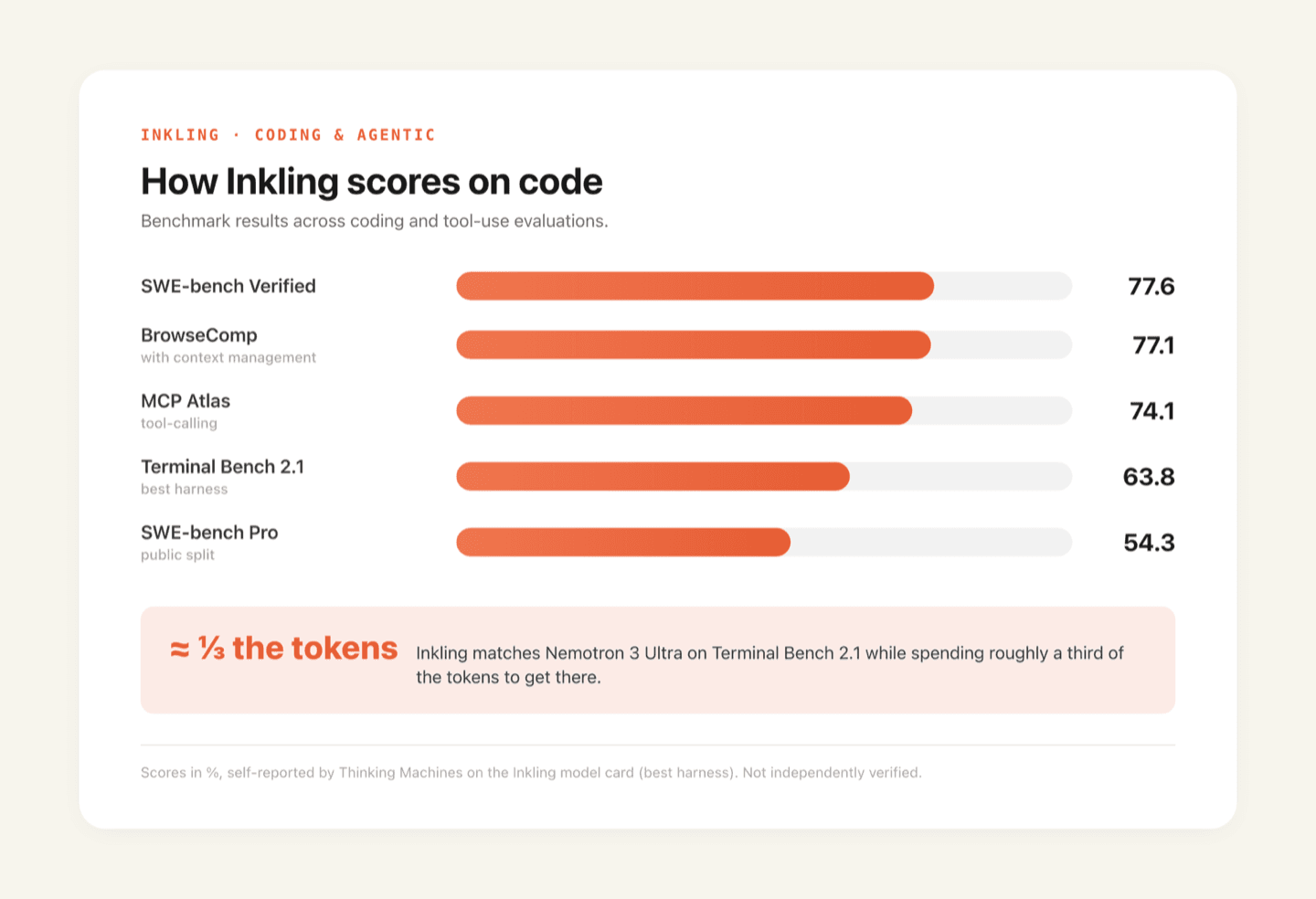
The headline isn't any single score, though. It's efficiency: on Terminal Bench 2.1, Inkling matches Nvidia's Nemotron 3 Ultra while spending about a third of the tokens to reach the same result. For code work, that ratio is the number that changes your bill.
Two agentic evals round out the picture. Inkling hits 74.1% on MCP Atlas, which probes tool-calling, and 77.1% on BrowseComp with context management, both of which matter if your agent leans on tools and long context. Thinking Machines also published its eval settings, reasoning effort at 0.99, temperature 1.0, and a 256K-token cap per coding trajectory, which makes the results easier to trust and reproduce. On Design Arena's Agentic Web Dev leaderboard, a blinded human evaluation of generated web apps, Inkling ranks among the strongest open-weight models.
None of this puts Inkling ahead of the best closed coding models on raw capability, and Thinking Machines doesn't pretend it does. What the numbers show is a model that's genuinely competitive inside the open-weight tier and unusually cheap to run at the same quality. For a team already committed to open weights, that combination, competitive results at a fraction of the token cost, is the whole pitch.
Agentic Coding in Practice
Benchmarks tell you a model can code; the demos Thinking Machines shipped for Inkling AI tell you how it codes. Three are worth walking through.
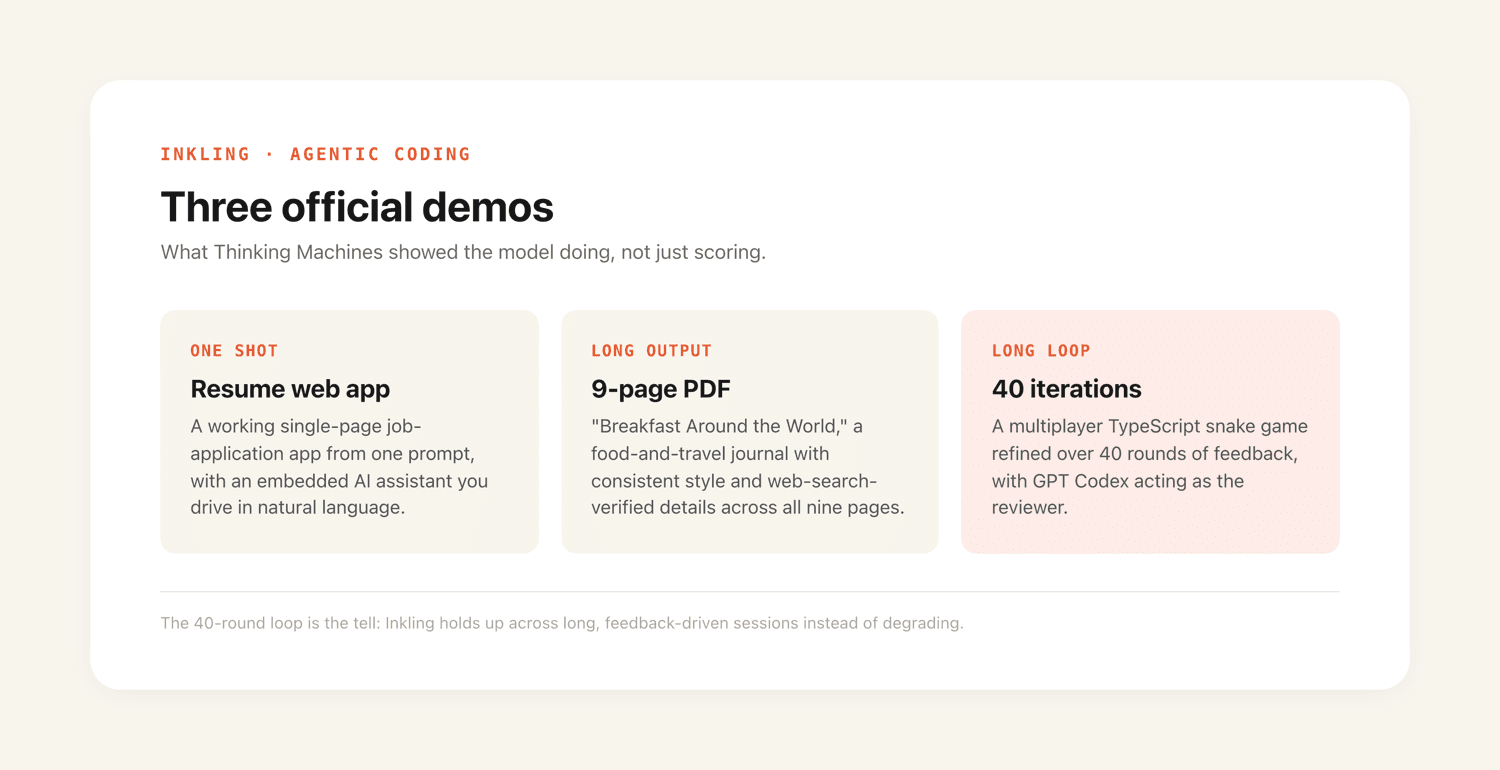
The first is a job-application web app built in a single shot: one prompt, one working single-page application, with an embedded AI assistant you drive by typing natural-language instructions to operate the interface. No iteration loop, no hand-holding, a usable app on the first pass.
The second isn't a web app at all. Inkling generated a nine-page PDF publication, a food-and-travel journal titled "Breakfast Around the World," following instructions precisely, holding one consistent visual style across all nine pages, and checking the culinary and cultural details with web search as it wrote. It's a stress test for instruction-following and consistency over a long output, not raw code, and it's the kind of task where most models drift halfway through.
The third is the one agent builders should care about. Inkling refined a multiplayer TypeScript snake game across 40 rounds of feedback, with GPT Codex acting as the reviewer. Forty iterations. The model didn't generate code once and stop; it absorbed external critique, applied it, and kept improving through a long loop, which is precisely the behavior an autonomous coding agent needs and precisely where most models come apart after a handful of turns.
What ties the three together is duration. A one-shot app is a nice trick, but the snake-game loop is the real tell: Inkling holds together across long, iterative, feedback-driven sessions instead of degrading. Thinking Machines frames all three as evidence the model was built for agent harnesses, not just single completions.
Why Token Efficiency Matters for Coding Agents
Token efficiency reads like an accounting footnote until you run an agent, and then it's the whole game. A coding agent doesn't make one call; it makes hundreds, chaining tool use, reading files, running tests, and retrying, across trajectories that can each run tens of thousands of tokens. Cost scales almost linearly with tokens, so a model that reaches the same result on a third of them doesn't trim your bill by a rounding error, it trims it by roughly that third, every run, indefinitely.
Put rough numbers on it: an agent burning 40,000 tokens per task across 2,000 tasks a day, at a representative few dollars per million tokens, runs a bill in the low hundreds daily; Inkling, on about a third of the tokens, runs closer to a third of that. The open models a couple of points above it on SWE-bench Verified don't come with that discount, so for high-volume agent work the cheaper-per-result model often wins the total-cost math even when it loses the benchmark.
Adjustable reasoning effort compounds the savings. Because you set effort through a system message tied to per-token cost, one Inkling AI deployment can run cheap on the easy steps and think hard only where it counts. A formatting pass doesn't deserve deep reasoning; a subtle concurrency bug does. Same model, dialed up or down per task, instead of paying premium reasoning cost on every trivial step or juggling two separate models for two tiers of difficulty.
For anyone building coding agents at volume, those two properties, cheap tokens and controllable depth, weigh more than a couple of points on a benchmark. They decide whether the agent is economical once you're past the demo and into production traffic. That economic layer, how you route and orchestrate agent work to keep it affordable, is where a model like Inkling becomes one component of a larger system; see AI agent use cases.
Framework Compatibility: Cursor, OpenCode, and Agent Harnesses
Inkling AI wasn't tied to one agent framework, and that's a deliberate training choice rather than luck. During post-training Thinking Machines randomized the tool set and the tool schemas the model saw, so it doesn't overfit to the exact function-calling format of any single harness. The upshot: Inkling behaves across different agent setups instead of only performing in the one it was demoed with, and Thinking Machines has shown it running inside the OpenCode harness.
For self-hosting, the model runs on the major open inference stacks, SGLang, vLLM, and llama.cpp among them, so whatever your team already deploys most likely supports it. The self-hosting section of our complete Inkling AI guide covers the runtimes and the hardware reality in more detail.
On editor integrations like Cursor, there's no special native connector, and you don't need one. Because Inkling is served by standard hosted providers, any tool that lets you point at a custom model endpoint can use it. Together, Fireworks, and the other launch providers each expose an endpoint you drop into that slot, and the editor then talks to Inkling the same way it talks to any other model.
Fine-Tuning Inkling on Your Codebase
The strongest reason to pick Inkling AI for code isn't a benchmark, it's that you can fine-tune it on your own codebase and keep the result. Open weights mean the model can learn your internal conventions, your framework choices, and the patterns your team actually writes, instead of guessing from public GitHub. A closed API can't offer that; the weights never leave the vendor.
Thinking Machines built Tinker for exactly this. It's their managed fine-tuning platform, it supports Inkling natively, and the cookbook ships recipes to get you moving, including newer audio examples. You bring your code and your task; Tinker handles the training machinery, whether that's supervised fine-tuning, distillation, or reinforcement learning, and the tuned weights are yours to deploy. Because Inkling ships under a permissive Apache 2.0 license, "yours" is literal: you can run and even sell what you build on top of it without a special license grant.
Databricks made the same case in its own launch coverage: for enterprise code work, the value of an open model is context and control, keeping your proprietary code and the model that learned from it inside your own environment. In practice that's a model that stops suggesting the deprecated internal helper, writes tests in your house style, and already knows the shape of your monorepo without being re-told every session. For plenty of teams, that's worth more than a few points of raw capability from a closed model they can't touch or inspect.
FAQ
Is Inkling better than GPT or Claude at coding?
No, and Thinking Machines doesn't claim it is. The top closed models still set the ceiling on raw coding capability. Inkling's advantage is different: open weights you can fine-tune on your own code, strong token efficiency, and adjustable reasoning effort, which together can make it the better practical choice for high-volume or private-codebase work even when it isn't the single most capable model available.
Can I use Inkling with Cursor?
There's no native Cursor integration, but you can still use it. Inkling is served by hosted providers like Together AI and Fireworks, so any tool that lets you set a custom model endpoint can point at Inkling, Cursor included when it's configured for a custom endpoint.
What's the maximum context for coding tasks?
Inkling supports up to 1 million tokens of context natively. On Thinking Machines' Tinker platform it's served in 64K and 256K configurations, and its published coding benchmarks ran with a 256K-token cap per trajectory, so 256K is a realistic working ceiling for long coding sessions today.
Continue Reading
More Guide
What Is Hermes Bot Mode? Bots and Routines

OpenAI Assistants API Deprecated: What Broke

MCP Tools: What They Are and Which to Use

OpenAI Models Not Available in Cursor Nov 12

Coding Agent Security: When Your Tools Lie

OpenAI Python HTTPX2: What Actually Breaks
The MoClaw editorial team writes about workflow automation, AI agents, and the tools we build. Default byline for industry overviews, listicles, and collaborative pieces.
Ready to put this into practice?
MoClaw runs browser tasks, research, and schedules automatically. Try it free.
References: Thinking Machines — Introducing Inkling · Inkling model card · Inkling on Hugging Face · Welcome Inkling — Hugging Face blog · Artificial Analysis · Tinker — Thinking Machines