Inkling AI Limitations: What It Can't Do (Yet)
Inkling AI is impressive but not magic. Text-only output, hardware limits, missing video input: an honest look at where Thinking Machines falls short.
Table of Contents
Key Takeaways:
- Inkling's "not the strongest" positioning is a deliberate trade: customization over raw benchmark wins.
- Output is text only, with no image, audio, or video generation, and no video input despite video sitting in the training data.
- At 975B parameters, self-hosting is datacenter-only; the lighter Inkling-Small is still in preview.
- It's open-weight, not open source: the training data and code are not released.
"Not the Strongest Model," By Design
Thinking Machines' Inkling opens its own launch by admitting it's "not the strongest overall model available today, open or closed." That isn't false modesty, it's the strategy. The lab optimized Inkling AI for the things you can't buy from a closed API, open weights, customization, and token efficiency, and accepted that it wouldn't top the raw-capability charts in exchange. That framing runs through everything below, because nearly every limitation here is a trade Thinking Machines made deliberately. A chosen trade is still a limitation, though, if it blocks what you need. If you just want the single best answer to a hard problem, a model that's engineered to not be the strongest is, for you, a genuine constraint rather than a footnote. The rest of this page is what that decision costs in practice. For the full picture of what Inkling is and does, see our complete Inkling AI guide.
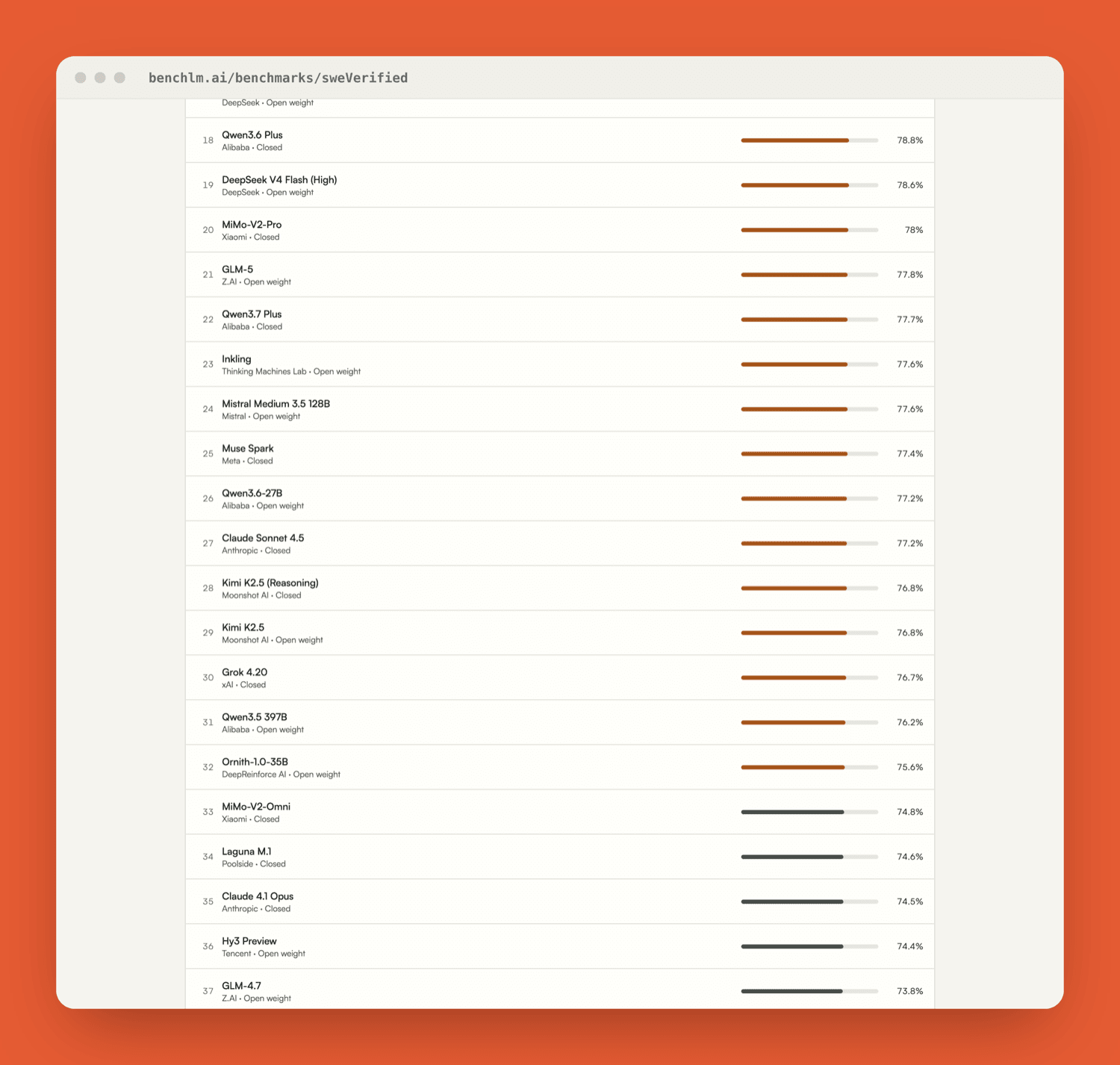
Now there's a number to put on the positioning. On SWE-bench Verified, the coding benchmark most labs report, Inkling scores 77.6, which lands it mid-pack among open-weight models: level with GLM-5 at 77.8 and a few points behind the current front-runners, Kimi K2.6 and DeepSeek V4, both near 80. Not last, not first, and short of the models it gets compared to most. That is the limitation hiding inside the modest framing: if raw capability is what you're paying for, several open models, never mind the closed ones, currently edge Inkling out.
Inkling's Limitations and Weaknesses
Here's where Inkling AI actually runs into walls, ordered roughly by how many people each one will affect.
Text-only output
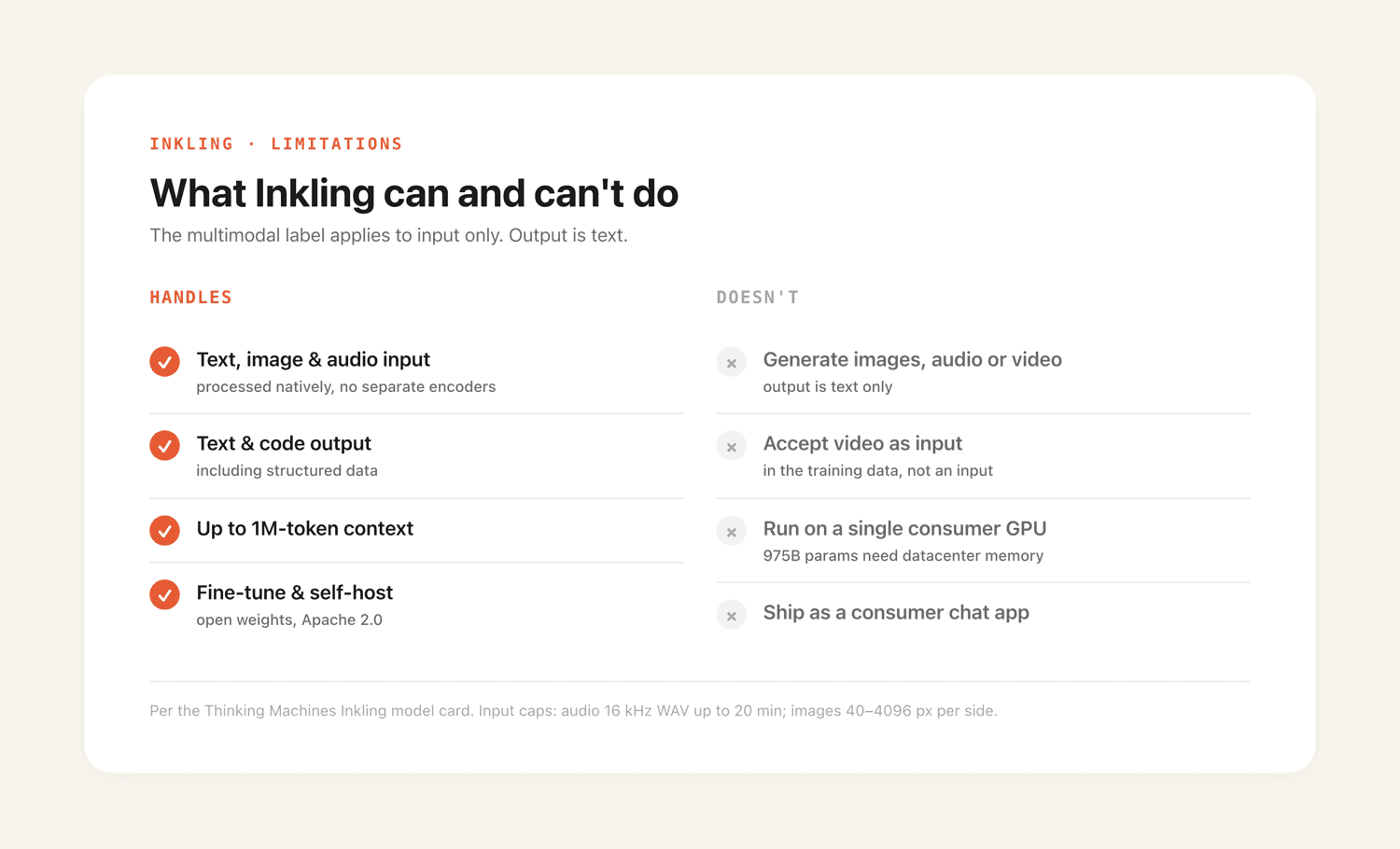
Inkling reads text, images, and audio, but it only writes text. No image generation, no audio synthesis, no video, so the "multimodal" label applies entirely to the input side. You can show it a screenshot and ask what's broken in your layout; you can't ask it to produce the fixed graphic. For plenty of workflows that's a non-issue, since code and structured text are the output you wanted anyway. For anyone hoping for one model that both understands and creates across media, this is the first wall, and it's a solid one. Inkling analyzes media; it doesn't make it.
No video input
This one's a genuine oddity. Inkling was pretrained on video among its other data, yet video isn't an accepted input at inference time; you get text, image, and audio only. The model learned from video and then won't take one from you. If your use case is feeding clips in for analysis or summarization, Inkling can't do it today, and the fact that video sat in the training mix makes the missing input path more surprising, not less.
Hard input caps
The inputs it does accept arrive with firm limits. Audio has to be 16 kHz WAV and twenty minutes or shorter; images have to land between 40 and 4,096 pixels on a side. Neither limit is exotic, but both will catch you out if you assumed you could throw an hour-long recording or a giant poster scan straight in. You chunk long audio and downsample oversized images before sending, or the request just won't process. Budget for that preprocessing step in any pipeline you build.
It's heavy to self-host
Inkling is 975 billion parameters. Even in the compact NVFP4 format that's an enormous model, and while only 41 billion activate per token, you still have to hold the entire set in memory to run it at all. A back-of-the-envelope estimate puts the weights alone in the hundreds of gigabytes, which pushes real local hosting well out of reach for consumer hardware and most single-GPU boxes. This is a cluster-or-cloud model for the moment, full stop. The self-hosting section of our complete Inkling AI guide runs through the hardware math in more detail.
Open-weight, not open source
Open weights are not open source, and the gap is a limitation if you need full transparency. Thinking Machines released the weights but not the training data or the training code. You can run the model, fine-tune it, and inspect its parameters; you cannot fully reproduce it or audit exactly what went into it. For most builders that line is perfectly acceptable. For researchers who need reproducibility, or teams under strict data-provenance rules, the closed data and code are a real shortfall worth naming up front.
Inkling-Small isn't out yet
The lighter model that would ease the hardware problem isn't here. Inkling-Small, a 276B model with 12B active parameters, is still in preview, with weights coming soon rather than downloadable today. So if you're cost- or hardware-constrained and holding out for the affordable tier, you're holding out; the only weights you can actually run right now are the full 975B ones, and they demand the hardware described above.
It's a new lab's first model
Inkling is Thinking Machines' first model, and first releases carry unknowns that have nothing to do with the weights themselves. The tooling ecosystem around it is days old, the long-term maintenance cadence is unproven, and nobody yet knows how this model family will be supported a year from now. That doesn't make the model weak; it means the ecosystem around it hasn't been stress-tested by time. If you're placing a multi-year bet, price in that you'd be an early adopter, not a late one.
What These Limitations Mean for You
Whether any of this actually matters comes down to what you're building, so here's the blunt version, sorted by who you are.
If you want the single most capable model for hard reasoning or code and open weights don't matter to you, Inkling AI isn't your pick. A closed flagship still sets the capability ceiling, and Inkling doesn't try to clear it. Buy the best closed model and move on with your day.
If you plan to fine-tune on private data, control your own deployment, or run high-volume agents cheaply, most of these limitations are acceptable costs rather than deal-breakers. Text-only output and heavy hardware are real, but open weights, token efficiency, and Tinker are precisely what you came for, and the trade tilts in your favor.
If you wanted a consumer chatbot to use the way you use ChatGPT, this isn't that product in the first place. Inkling is a developer model, not an app with a login. The closest thing is the free Playground, and that's a testing surface, not a daily assistant, as our complete Inkling AI guide lays out. There's no universal verdict to hand you here, only the question of whether the trades Thinking Machines chose match the ones you would.
FAQ
Is Inkling AI worth using?
For the right use case, yes. If you need open weights, want to fine-tune on your own data, or run agents where token cost is the constraint, Inkling is worth it. If you only want the single most capable model and don't care about openness, a closed flagship is the better choice. It's a strong model built for a specific purpose, not a universal best pick.
Can Inkling generate images?
No. Inkling accepts images as input, but it only outputs text, including code and structured data. It can analyze or describe an image you give it; it can't create one. There is no image, audio, or video generation.
Will these limitations be fixed?
Some might be. Thinking Machines has said Inkling is the first in a model family, so more versions are coming, and Inkling-Small's weights are expected after testing wraps up. The lab has also noted that multimodal ability tends to improve with scale. But no specific capability, video input or image generation included, has been promised, so treat future features as possible rather than planned.
Can Inkling run on a gaming PC or a laptop?
No. At 975 billion parameters it needs datacenter-class memory even in the compact NVFP4 format, so consumer hardware can't hold the full-quality model. The lighter Inkling-Small, still in preview, is the version aimed at smaller setups.
Does Inkling have a knowledge cutoff?
Yes, like any model its training data has a cutoff, so it won't know about events after it. In the Playground it can run an agentic web search to pull in current information, but the base weights themselves are fixed at release.
Continue Reading
More Guide
What Is Hermes Bot Mode? Bots and Routines
OpenAI Assistants API Deprecated: What Broke
MCP Tools: What They Are and Which to Use

OpenAI Models Not Available in Cursor Nov 12

Coding Agent Security: When Your Tools Lie

OpenAI Python HTTPX2: What Actually Breaks
The MoClaw editorial team writes about workflow automation, AI agents, and the tools we build. Default byline for industry overviews, listicles, and collaborative pieces.
Ready to put this into practice?
MoClaw runs browser tasks, research, and schedules automatically. Try it free.
References: Thinking Machines — Introducing Inkling · Inkling model card · Inkling on Hugging Face · Welcome Inkling — Hugging Face blog · Artificial Analysis · Tinker — Thinking Machines