Inkling AI: Thinking Machines' First Open-Weight Model

Thinking Machines just released Inkling, a 975B open-weight multimodal model with a 1M context window. Full specs, benchmarks, and how to run it.
Table of Contents
Thinking Machines' Inkling is the lab's first model, released July 15, 2026, and it's open-weight: you can download the full weights today. It reads text, images, and audio, runs on a mixture-of-experts design with 975 billion parameters, and handles up to a million tokens of context. Thinking Machines is upfront about the ceiling: Inkling is, in its own words, "not the strongest overall model available today, open or closed."
So why care? Because the lab didn't build it to top a leaderboard. It built a model you can host on your own hardware, fine-tune on your own data, and inspect, then dropped it into an open ecosystem that DeepSeek, Kimi, and Qwen have run for two years. Inkling AI is the most credible Western open-weight release aimed squarely at that gap.
Key Takeaways:
- Inkling is Thinking Machines' first model: a 975B-parameter open-weight mixture-of-experts with 41B active per token, released July 15, 2026 under Apache 2.0.
- It takes text, image, and audio as input but outputs text only, with a native context window of up to 1 million tokens.
- The pitch is efficiency, not top scores: it matches Nemotron 3 Ultra on Terminal Bench 2.1 while spending roughly a third of the tokens.
- It's the West's most serious open-weight answer to Chinese models like DeepSeek and Kimi, and Kimi K2.5 even helped generate its cold-start training data.
- Three ways in: call a hosted API, fine-tune on Tinker, or self-host the weights from Hugging Face.
Inkling Specs at a Glance
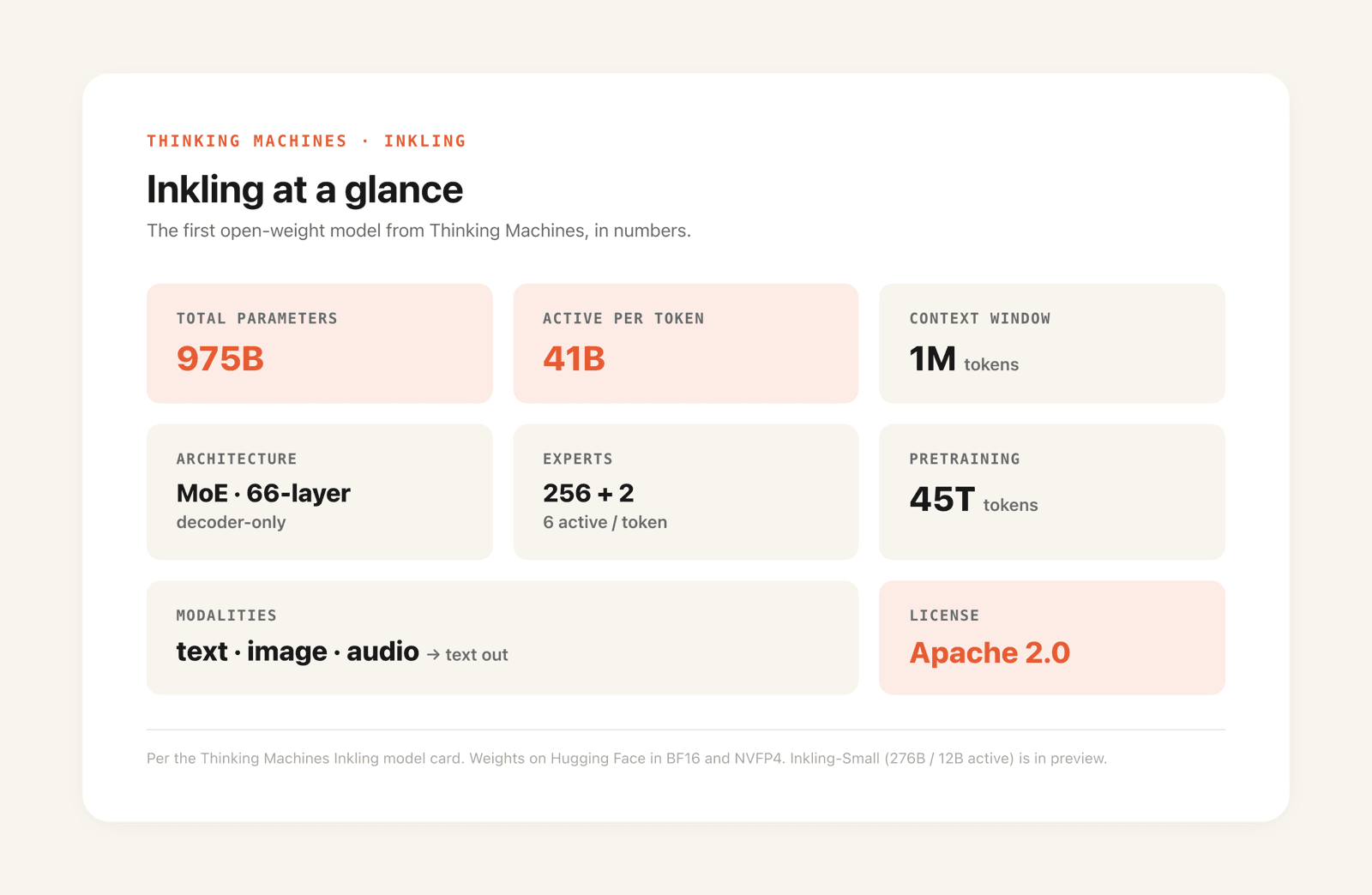
Inkling AI is a sparse model: 975 billion parameters sit in the network, but only 41 billion activate on any given token. That gap is the whole design.
| Inkling | Inkling-Small | |
|---|---|---|
| Total parameters | 975B | 276B |
| Active per token | 41B | 12B |
| Architecture | MoE transformer, 66-layer decoder-only | Same |
| Experts | 256 routed + 2 shared; 6 routed active per token | , |
| Context | Up to 1M native; 64K / 256K on Tinker | , |
| Modalities | text + image + audio in → text out | Same |
| Pretraining data | 45T tokens (text/image/audio/video) | Refined data and recipe |
| Training hardware | NVIDIA GB300 NVL72 | Same |
| Weights | HF: BF16 + NVFP4 (Blackwell), incl. speculative MTP layers | Weights coming soon |
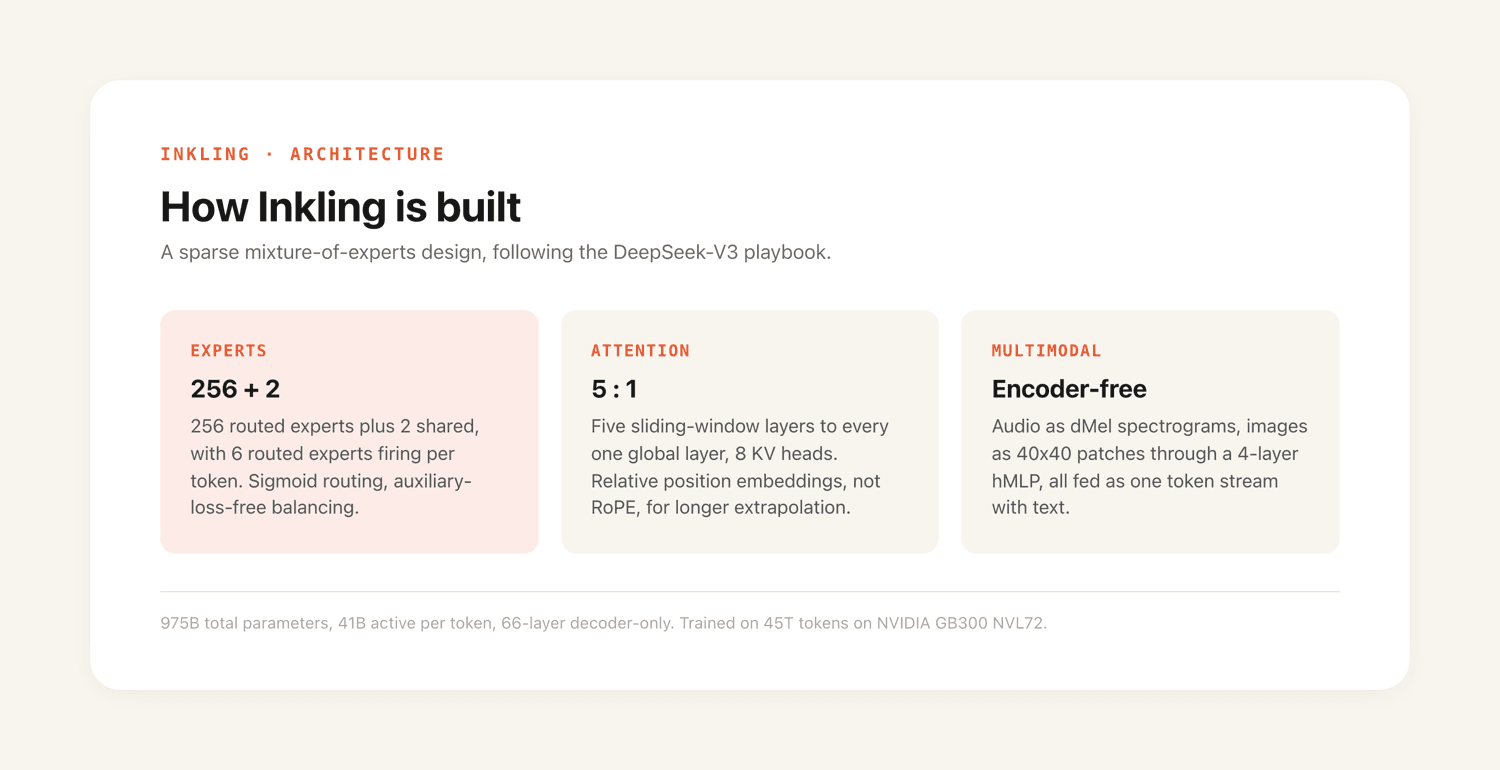
The mixture-of-experts layout follows the path DeepSeek-V3 laid down. Each layer holds 256 routed experts plus 2 shared ones, and every token lights up 6 of the routed set. Routing runs through a sigmoid gate, load balancing comes from an auxiliary-loss-free bias rather than an extra training penalty, and the routed and shared expert scores get normalized together instead of separately.
Attention alternates five sliding-window layers to every one global layer, with 8 key-value heads throughout. Thinking Machines skipped RoPE here; positions use relative position embeddings, which the model card says extrapolate better past the training length. Two short convolutions sit in unusual spots: one right after the key/value projection, another just before the attention and MLP branch outputs fold back into the residual stream.
The multimodal side has no separate encoder tower. Audio becomes a dMel spectrogram, images get sliced into 40×40-pixel patches and pushed through a four-layer hMLP, and both flow through the same lightweight embedding as text so the transformer sees one unified token stream. Inputs have hard limits: image sides run 40 to 4,096 pixels, and audio has to be 16 kHz WAV, twenty minutes or less.
Inkling AI Benchmarks: How Good Is It Actually?
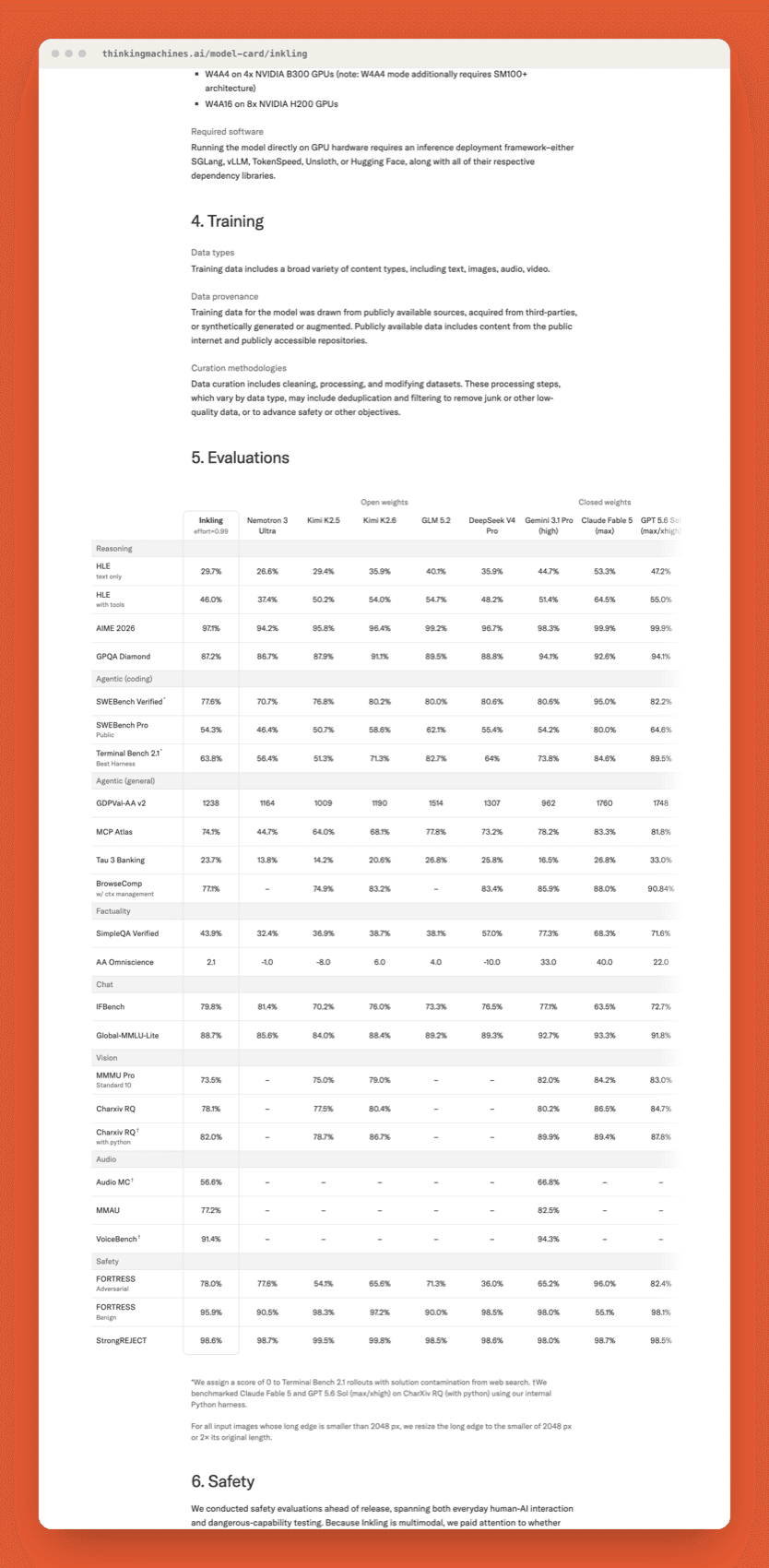
Thinking Machines doesn't claim Inkling AI beats the field, which is rare for a launch. Developers caught it right away; the replies under the announcement filled with people asking why a model this big doesn't top anything. Fair question, dull answer: the lab optimized for a different axis. The pitch is efficiency, and one number carries it: on Terminal Bench 2.1, Inkling matches Nvidia's Nemotron 3 Ultra while spending roughly a third of the tokens to get there.
That ratio matters more than a leaderboard spot if you're running agents. Agent workloads rack up cost token by token, across long tool-use trajectories and constant retries, so a model that hits the same quality on a third of the tokens cuts the bill by a similar margin at scale. For a coding agent chewing through a repo overnight, that's the difference between a rounding error and a real line item.
Reasoning effort is a dial, not a fixed trait. You set it through a system message tied to a per-token cost, and the model learned during training to control how long it thinks: drop the effort for cheap CI checks, crank it for a gnarly bug. Agent builders have spent the past year faking this with prompt tricks and separate model tiers; here it's one model with an actual knob. Same weights, different depth.
For the headline capability scores, Thinking Machines leaned on a third party. Artificial Analysis ran HLE, GPQA Diamond, GDPVal, Tau 3 Banking, AA Omniscience, and MMMU Pro, which lets the numbers stand on someone else's testing rather than the lab's. The published eval settings help too: reasoning effort at 0.99, temperature 1.0, coding runs capped at 256K tokens per trajectory. Without putting scores on it, Inkling lands among the strongest open-weight models in blinded human web-dev evals on Design Arena, in audio across VoiceBench, MMAU, and AudioMC, and on the FORTRESS safety set, where it refused more genuinely harmful prompts while wrongly blocking fewer harmless ones; our safety and privacy breakdown covers what that means in production.
Inkling vs Kimi K2.5, DeepSeek, and Other Open Models
Comparing Inkling AI to the Chinese open-weight leaders finally has real numbers behind it. On SWE-bench Verified, the coding benchmark most labs report, here's where Inkling lands against the current open and closed field, per the BenchLM leaderboard snapshot from mid-July 2026:
| Model | SWE-bench Verified | Type |
|---|---|---|
| DeepSeek V4 Pro (Max) | 80.6 | Open weight |
| Qwen3.7 Max | 80.4 | Open weight |
| Kimi K2.6 | 80.2 | Open weight |
| GPT-5.2 | 80.0 | Closed |
| Claude Sonnet 4.6 | 79.6 | Closed |
| GLM-5 | 77.8 | Open weight |
| Inkling | 77.6 | Open weight |
| Kimi K2.5 | 76.8 | Open weight |
Read that honestly and "not the strongest" stops being modesty and starts being accurate. Inkling isn't leading the open-weight pack on raw coding score; it sits mid-table, level with GLM-5 and a few points behind front-runners like Kimi K2.6 and DeepSeek V4. One caveat: Inkling's number is self-reported on a best harness, so treat the ranking as ballpark, not a photo finish.
So if it isn't winning on score, why does Inkling matter? Two things a leaderboard can't show. First, the lineage undercuts the whole "West vs China" framing: the synthetic data that cold-started Inkling's post-training was generated by open-weight models, Kimi K2.5 among them, so a Chinese model literally helped teach the West's answer to Chinese models. Second, Inkling's mixture-of-experts architecture is built on the design DeepSeek-V3 popularized. This isn't a rival ecosystem; it's the same one, with a new lab pushing from a different direction. Fortune reported the lab doesn't even plan to profit directly from the model; the play is the ecosystem, not the benchmark.
Where Inkling actually pulls ahead is efficiency and the stack around the weights. Kimi and DeepSeek hand you strong weights and a growing set of endpoints. Inkling hands you weights that reach the same rough quality tier on roughly a third of the tokens, plus Tinker, a managed fine-tuning platform built specifically to customize this model: supervised fine-tuning, distillation, and reinforcement learning, with cookbook recipes ready to go.
Here's the call, and it's not a hedge: the question isn't which model scores highest, because Inkling doesn't. It's whether you're going to fine-tune or run at volume. If you are, Inkling's full stack (open weights, a purpose-built training platform, controllable reasoning cost, and real token savings) is the more complete package and worth committing to. If you only ever call an API and never touch the weights, the top Chinese open models score a couple of points higher and are often the better value; Inkling's edge does nothing for you if you never customize or scale. Pick on that, not on the leaderboard alone. For the deeper coding view see Inkling for coding, and for where it falls short, Inkling's limitations.
How to Use Inkling: API, Fine-Tuning, Self-Hosting
Inkling AI shipped with three ways in on day one, and which one fits depends on how much control you want.
Call It Through a Hosted API
Five providers had Inkling live on launch day: Together AI, Fireworks, Modal, Databricks through its Unity AI Gateway, and Baseten. This is the zero-setup route, with no weights to download and no GPUs to rent, just an endpoint. That makes it the fastest path from nothing to a working call, and the one most teams should start with. If you're wiring Inkling into an existing product or agent, the API providers are also where it slots into the tools you already run; see MoClaw integrations for the connectors.
Fine-Tune It on Tinker
Tinker is Thinking Machines' managed fine-tuning platform, and it's the reason to pick Inkling over a pure API model. It's running a limited-time 50% off promotion, the cookbook supports Inkling natively with three new audio fine-tuning examples added for launch, and a companion tool called tml-renderer handles sampling and post-training for tool-calling, reasoning traces, and multimodal cases. Supervised fine-tuning, distillation, RL: all supported, all on weights you can then take with you.
Run It Yourself
The weights live on Hugging Face in two formats, BF16 and Blackwell-optimized NVFP4, under a permissive Apache 2.0 license that lets you run, modify, and ship them commercially without a special grant, and six inference stacks supported Inkling on day zero: Transformers, SGLang, vLLM, llama.cpp, TokenSpeed, and Miles. Running it locally isn't a laptop project, though. 975 billion total parameters means the weights are enormous even in NVFP4, and while only 41 billion activate per token, you still hold the full set in memory, so most teams run it on a multi-GPU cluster or fall back to the hosted APIs, a path our guide to running Inkling locally walks through in detail. If you want something lighter, Inkling-Small is out. Thinking Machines released the full weights on 2026-07-30 under Apache 2.0: 276B total, 12B active, and a context window of up to 1M tokens. The weights sit ungated on Hugging Face and had passed 167,000 downloads as of 2026-08-23. Before committing hardware, try the free option first: the Inkling Playground inside the Tinker console is free for a limited time, with a chat interface and built-in agentic web search, walked through step by step in how to try Inkling free online.
How Inkling Was Trained
Inkling AI's training split into a conventional pretraining stage and a much heavier reinforcement-learning phase, and the second is where the interesting choices show up. Pretraining ran on 45 trillion tokens spanning text, image, audio, and video, on NVIDIA GB300 NVL72 hardware. The optimizer setup is unusual: Muon for the large matrices, Adam for everything else, with weight decay tied to the square of the learning rate and hyperparameters scheduled off the lab's modular manifold research.
Post-training started small, a supervised fine-tuning cold start on synthetic data (generated by open-weight models, Kimi K2.5 included), then the bulk of the compute went into large-scale asynchronous RL. Over 30 million rollouts. Performance on held-out sets like AIME, HLE, and GPQA climbed log-linearly as the lab poured in more RL compute, the kind of clean scaling curve labs like to show off.
One result they didn't engineer showed up on its own. As RL ran, Inkling's chains of thought got shorter without anyone rewarding brevity; the model taught itself to reason more concisely. Cognition saw the same thing training SWE-1.7. When two labs stumble into the same emergent behavior independently, it stops looking like a fluke and starts looking like a property of the method.
What Inkling Means for AI Agents
Agents are the workload Inkling AI was built for, and the design shows it. During training the lab randomized the tool set and the tool schemas, so the model doesn't overfit to one agent framework and should behave whether you drive it through a hosted harness, a custom one, or something you haven't written yet. The two knobs it exposes, token efficiency and adjustable reasoning effort, are exactly the variables that decide whether an agent is affordable at scale: how many tokens each step burns, and how hard the model thinks on steps that don't need it.
A capable model is one layer, though. Getting real work out of an agent still comes down to orchestration: routing tasks, managing tools and permissions, holding state across long runs, and that's where a model like Inkling becomes a component rather than the whole system. If you're building on it, the orchestration layer is where the real work sits, and the model is the easy part to swap. See AI agent use cases for how that layer comes together.
FAQ
How many parameters does Inkling have?
Inkling has 975 billion total parameters in a mixture-of-experts design, with about 41 billion active per token. Inkling-Small has 276B total and 12B active, and its weights have been public since 2026-07-30.
Is Inkling open source?
It's open-weight, not open source. The model weights are downloadable on Hugging Face in BF16 and NVFP4 formats, but the training data and code are not released.
What is Inkling's context window?
Up to 1 million tokens natively. On Tinker, the fine-tuning platform, it's served in 64K and 256K configurations.
What modalities does Inkling support?
Text, image, and audio inputs, processed natively without separate encoders. Output is text only, including code and structured data.
Is Inkling better than DeepSeek or Kimi?
Thinking Machines doesn't claim it's the strongest model, open or closed. Its differentiation is customization: token efficiency, adjustable reasoning effort, and a full fine-tuning stack via Tinker.
How can I try Inkling for free?
The Inkling Playground in the Tinker console is free for a limited time, with a chat interface and built-in agentic web search.
What is Tinker?
Thinking Machines' managed fine-tuning platform for open-weight models. Inkling is available there for supervised fine-tuning, distillation, and reinforcement learning, with cookbook examples included.
Continue Reading
More Guide
What Is Hermes Bot Mode? Bots and Routines
OpenAI Assistants API Deprecated: What Broke
MCP Tools: What They Are and Which to Use

OpenAI Models Not Available in Cursor Nov 12

Coding Agent Security: When Your Tools Lie
OpenAI Python HTTPX2: What Actually Breaks
The MoClaw editorial team writes about workflow automation, AI agents, and the tools we build. Default byline for industry overviews, listicles, and collaborative pieces.
Ready to put this into practice?
MoClaw runs browser tasks, research, and schedules automatically. Try it free.
References: Thinking Machines — Introducing Inkling · Inkling model card · Inkling on Hugging Face · Welcome Inkling — Hugging Face blog · Artificial Analysis · Tinker — Thinking Machines