Inkling AI Safety and Privacy: What to Know

How safe is Inkling AI? FORTRESS benchmark results, what open weights mean for your data privacy, and the real trade-offs of a customizable model.
Table of Contents
Key Takeaways:
- On the FORTRESS benchmark, Inkling refuses more genuinely harmful requests while wrongly blocking fewer harmless ones.
- Open weights are a structural privacy win: self-hosting means your data never leaves your own infrastructure.
- The trade-off is that Apache 2.0 lets anyone fine-tune the safety behavior away, so production deployments need their own guardrails.
- Thinking Machines says not to use Inkling for medical, legal, or safety-critical decisions without extra fine-tuning and human oversight.
Safety Benchmarks: The FORTRESS Results
On the FORTRESS safety benchmark, Inkling AI does well on the metric that's easy to game and the one that isn't, and it's the second one that makes the result worth taking seriously. The easy number is refusals of genuinely harmful requests: Inkling refuses more of them than its comparison set. Any model can push that figure up by simply refusing more, so on its own it tells you almost nothing. Over-refusal is the quieter failure mode, the model that stonewalls a legitimate question because it looks vaguely risky, and it's the one users actually feel day to day.
The number that actually matters is false refusals. Inkling wrongly blocks fewer harmless requests, the ones that pattern-match to something dangerous but aren't. That's the hard axis. Cutting false refusals without letting real harmful requests slip through is a genuine tension, and most safety tuning trades one against the other. Getting better on both at once is the meaningful part of the FORTRESS result, and it's exactly the part a marketing page would quietly drop.
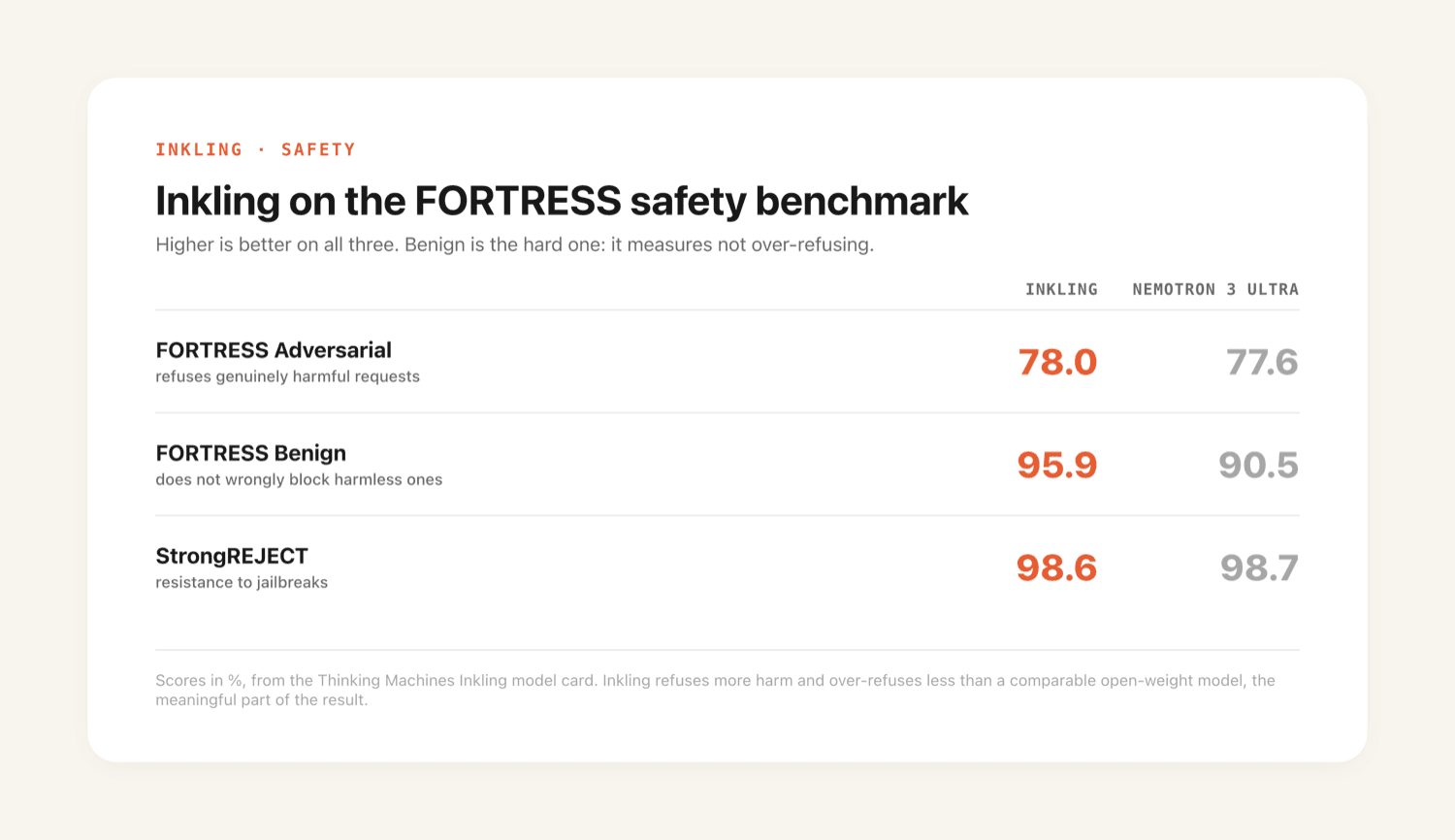
Keep the scope of that result in mind, though. A strong FORTRESS showing measures the model's default refusal behavior straight out of the box. It says nothing about what happens once someone fine-tunes those behaviors, which is the whole point of the section after next. For the broader picture of what Inkling is, see our complete Inkling AI guide.
The Data Privacy Case for Open Weights
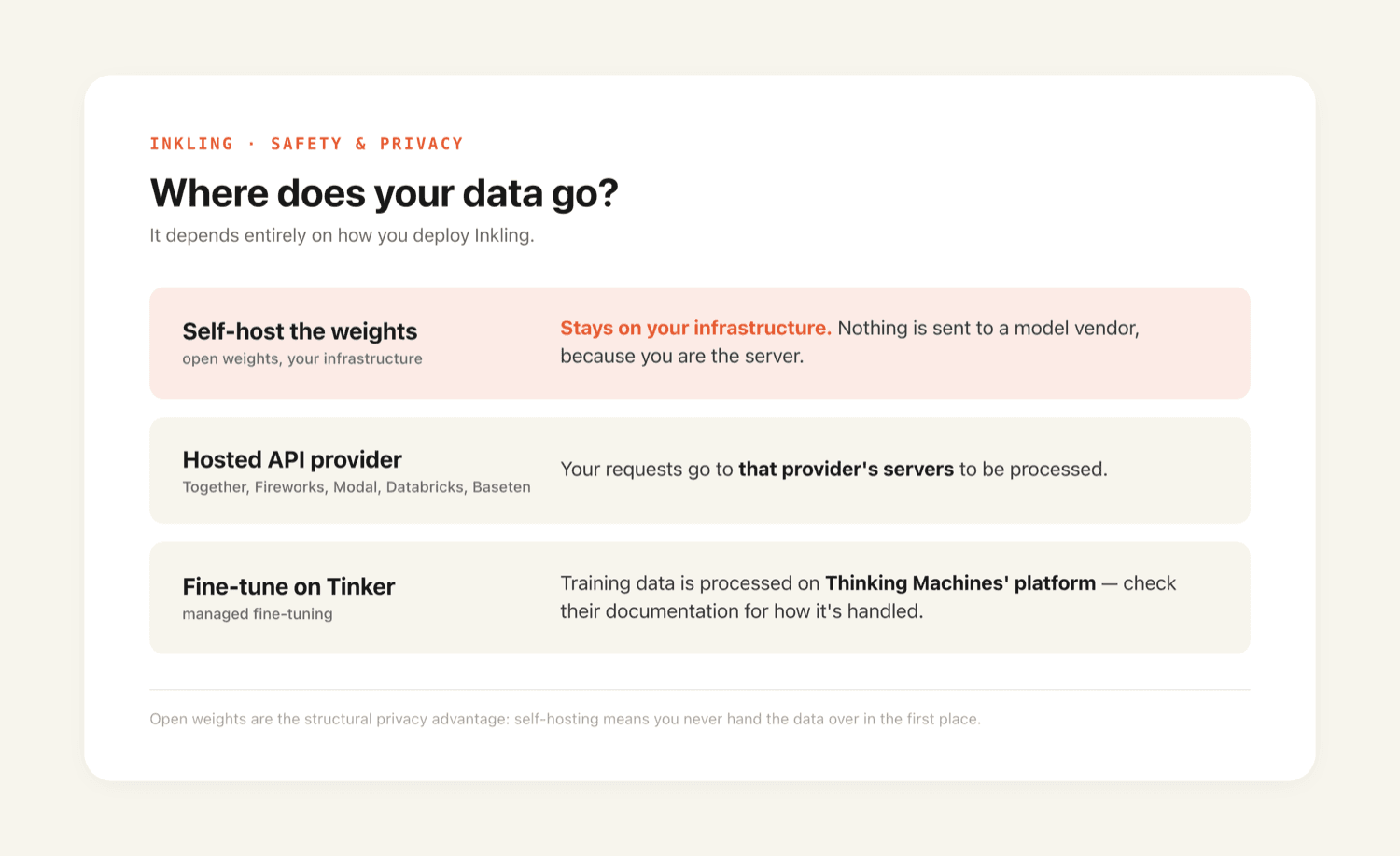
The strongest privacy argument for Inkling AI has little to do with the model's behavior and everything to do with where it runs. When you self-host an open-weight model, your data never leaves your own infrastructure. The prompts, the documents, the code you feed it, none of it travels to a model vendor's servers, because you are the server. That's a structural difference from a closed API model, where every single request is, by definition, sent to someone else's system to process.
For regulated industries and anyone handling sensitive data, that structural property is worth more than any line in a privacy policy. A policy is a promise not to misuse data you've already handed over; self-hosting means you never hand it over at all. Fine-tuning sharpens the same point: with open weights, you can train Inkling on proprietary data inside your own environment, and the tuned model, along with the data it learned from, stays with you.
One case needs an honest asterisk. If you fine-tune through Tinker, Thinking Machines' managed platform, instead of on your own hardware, then your training data is being processed on their infrastructure, and the privacy math changes. Exactly how that data is handled is a question for Thinking Machines' own documentation, not something to assume; if data residency matters to you, read their terms before uploading anything sensitive. Managed convenience and fully self-hosted privacy are different trades, and Tinker sits on the convenience side of that line.
The Customization Trade-Off
The same openness that gives Inkling AI its privacy edge cuts the other way on safety, and it's worth being blunt about. Open weights mean the model's safety behavior can be changed by whoever fine-tunes it. The refusal behavior that scored well on FORTRESS is a property of the released weights, not a lock; a downstream fine-tune can weaken it, retune it, or strip it out entirely. Built-in guardrails on an open-weight model are a starting default, never a guarantee. Inkling's Apache 2.0 license makes that plain: it grants the right to modify the weights, safety behavior included, so retuning those defaults isn't a loophole someone sneaks through, it's a freedom the license hands out on purpose.
This isn't a knock aimed at Inkling. It's true of every open-weight model, and it's the direct cost of the control that makes open weights worth having in the first place. You can't have a model you're free to modify and also a model whose safety nobody can modify; those are the same dial turned in opposite directions.
What that means in practice: if you put Inkling into production, the model's own safety training is one layer, and you shouldn't treat it as your only one. Serious deployments wrap their own guardrails around the model, input and output filtering, policy checks, monitoring, tuned to their actual risk surface instead of trusting the base model to police itself. Treat Inkling's built-in safety as a floor you build on top of, not a ceiling you lean against.
Here's what that means concretely in an enterprise. You cannot point at the FORTRESS score in a risk review and call safety handled, because the moment you fine-tune Inkling on your own data you may have shifted those refusal behaviors without meaning to. The safe assumption is that the base model's safety is a starting point you re-validate after every fine-tune, not a property you inherit once. Teams that treat open-weight safety as set-once are the ones that get surprised in production.
Thinking Machines draws the same line in the model card, naming where the base model shouldn't go alone: avoid deploying Inkling for medical, legal, or safety-critical decisions without additional fine-tuning, domain-specific validation, and human oversight. That's the vendor itself saying the out-of-the-box defaults aren't enough for high-stakes use, which is a useful thing to have in writing when you're setting deployment policy.
Safety for Agentic Use
Once you put Inkling AI inside an agent, model-level safety becomes the smaller of your worries, and that's no criticism of the model. An agent doesn't just generate text; it takes actions, calls tools, touches systems, and moves data around. A perfectly well-behaved model can still cause damage if it's wired to a tool with more permission than it should have. Give a flawless model a shell command with write access and no sandbox, and "is the model safe" stops being the question that decides whether you get hurt. So the safety questions that matter for agentic use aren't really about the model: what tools can it call, what's sandboxed, what needs human approval, and what gets logged. Those controls live in the orchestration layer around the model, not in the weights themselves. It's the same lesson as the last section, one level up: the model is one component of a safe system, and the system is where the real work sits. See AI agent use cases for how that layer comes together.
FAQ
Is Inkling AI safe to use?
It depends on how you deploy it. Inkling scores well on the FORTRESS safety benchmark out of the box, refusing more harmful requests while wrongly blocking fewer harmless ones. But because it's open-weight, its safety behavior can be changed by fine-tuning, and inside an agent it's only one layer of a safe system. For production use, add your own guardrails rather than relying on the model's defaults alone.
Does Inkling send my data to Thinking Machines?
It depends on how you run it. If you self-host the open weights, your data stays on your own infrastructure and isn't sent anywhere. If you use a hosted API provider, your requests go to that provider. If you fine-tune through Tinker, your training data is processed on Thinking Machines' platform, and you should check their documentation for exactly how that data is handled.
Can Inkling's safety filters be removed?
Technically yes, and that's true of any open-weight model, not a flaw unique to Inkling. Because the weights are downloadable and modifiable, a downstream fine-tune can alter or remove the model's built-in safety behavior. That's the trade-off of open weights: the same freedom that lets you customize the model also lets anyone change what it will and won't do.
Is my data private if I use the Inkling API?
With a hosted API provider, your requests are sent to that provider to be processed. Only self-hosting the open weights keeps your data fully on your own infrastructure, which is the structural privacy advantage of an open-weight model.
Does Inkling meet compliance requirements like HIPAA or GDPR?
That depends entirely on how you deploy it and what guardrails you add. Thinking Machines says not to use Inkling for medical, legal, or safety-critical decisions without additional fine-tuning, domain-specific validation, and human oversight, so compliance is your deployment's responsibility, not a property of the base model.
Continue Reading
More Guide
What Is Hermes Bot Mode? Bots and Routines

OpenAI Assistants API Deprecated: What Broke

MCP Tools: What They Are and Which to Use

OpenAI Models Not Available in Cursor Nov 12

Coding Agent Security: When Your Tools Lie

OpenAI Python HTTPX2: What Actually Breaks
The MoClaw editorial team writes about workflow automation, AI agents, and the tools we build. Default byline for industry overviews, listicles, and collaborative pieces.
Ready to put this into practice?
MoClaw runs browser tasks, research, and schedules automatically. Try it free.
References: Thinking Machines — Introducing Inkling · Inkling model card · Inkling on Hugging Face · Welcome Inkling — Hugging Face blog · Artificial Analysis · Tinker — Thinking Machines