MathModelAgent Ships a Desktop App and a Catch

MathModelAgent turns one prompt into a full math modeling paper and now ships a desktop app. Its licence is not open source. Checked September 2026.
Table of Contents
MathModelAgent takes a mathematical modeling problem, analyses it, builds the model, writes and runs the code, produces the figures, and hands back a paper formatted to submit. The project has been on GitHub since 30 January 2025 and reached 4,881 stars by 12 September 2026, and the reason it's worth a look this month rather than last is a desktop build that bundles Claude Code and the whole skill set, so nobody has to install Python, Node or Redis first. The reason to read the rest of this is the licence, which is not what the pricing page implies.
Key Takeaways:
- The desktop app ships the agent plus Claude Code and its skills as one installer; you add a single model API key and start
- macOS builds are signed with a Developer ID and notarized; the Windows installer is not code-signed yet, so Defender SmartScreen will warn on first run
- There is no LICENSE file in the repository root. The terms live in
docs/md/License.mdand are three lines of Chinese: personal use free, commercial use prohibited without contacting the author, closed-source redistribution prohibited - The official site sells a ¥99 lifetime desktop tier alongside a "¥0 open source edition", and that free tier is governed by the non-commercial terms above
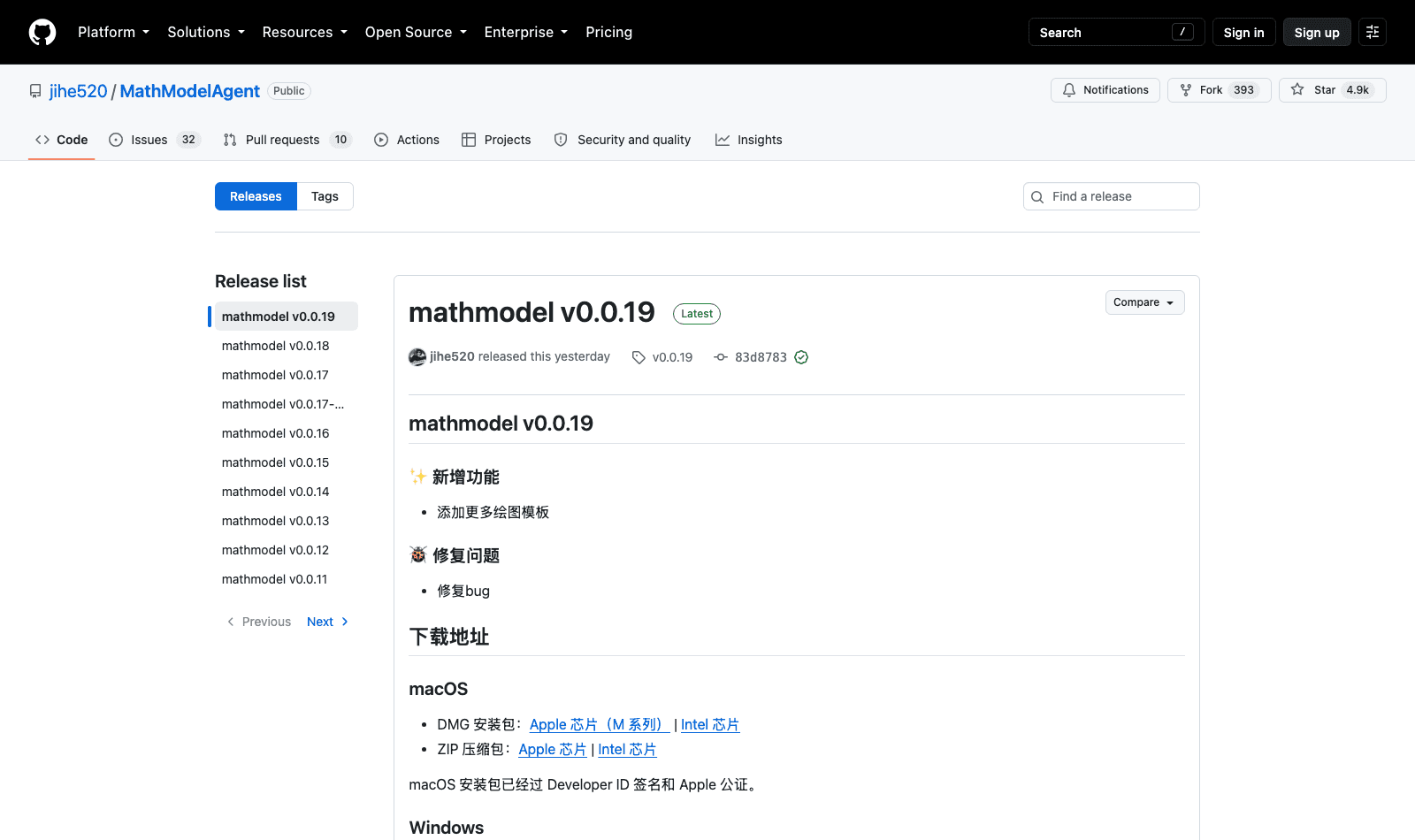
- Four releases landed between 7 and 10 September 2026, v0.0.16 through v0.0.19; the version numbers are honest about the maturity
What MathModelAgent actually produces
The pitch on the project's own site is "turn three days of competition into one hour", and the deliverable is a full paper rather than a notebook. MathModelAgent decomposes the problem statement, proposes an approach, writes code, corrects its own errors when the code fails, generates charts and tables, and assembles the writing around them. Code execution runs through a local Jupyter interpreter that saves everything as a notebook you can edit afterwards, or through a cloud interpreter on E2B or Daytona if you'd rather not run it on your machine.
That local notebook detail matters more than it sounds. A modeling paper is only defensible if you can show the work, and an agent that leaves behind an editable notebook is a different proposition from one that emits a PDF and discards the intermediate steps. The figures come from a sister project, sci-box, which was split out of MathModelAgent into its own repository and installs on its own through npx skills add. It carries runnable Matplotlib templates for SHAP, ROC, Taylor, raincloud, chord and circular heatmap plots exporting to PNG, PDF and SVG, plus editable draw.io diagrams for roadmaps, research frameworks and process flows. Splitting the plotting out is the sort of decision a maintainer makes when they expect other people to use half the toolchain without the other half.
The desktop app removed the setup, not the cost
Until recently, running MathModelAgent meant standing up Python, Node and Redis, then wiring the skills yourself. The desktop build collapses that into an installer: it carries Claude Code and the full skill set inside, you supply one model API key, and it runs. macOS gets separate Apple Silicon and Intel disk images, both signed with a Developer ID and notarized by Apple, with auto-update live. Windows gets a 64-bit executable that is, as the README says in a warning callout, not code-signed yet — Microsoft Defender SmartScreen will interrupt the first launch, and auto-update on Windows waits on a certificate.
Bundling an agent runtime inside a desktop app is a pattern worth watching, because it inverts the usual order. Normally you install the agent and then teach it a domain; here the domain tool arrives with the agent already inside it, configured. If you're new to how that layer works, our explainer on AI agent skills covers the mechanics, and the roundup of Claude skills worth installing shows how varied the packaging has become.
Four specialists, and any model you like behind each one
MathModelAgent splits the job across roles rather than running one long prompt: a modeling expert, a coding expert, a paper expert and others alongside them. Each role can sit behind a different model, which is a more useful knob than it first appears — the reasoning-heavy modeling step and the formatting-heavy writing step have genuinely different cost profiles, and paying flagship prices for both is waste.
Provider coverage goes through litellm, so the practical answer to "which models does it support" is "most of them". The project describes its own orchestration as workflow-agentless with no dependency on an agent framework, and that choice is the reason the cost claim is plausible: fewer speculative calls, less scaffolding, a fixed pipeline. Custom templates let you inject requirements per subtask, so if your department wants a particular structure in the results section, you set it once.
One entry in the public roadmap deserves more attention than it gets. "English support (MCM/ICM)" sits there unchecked, alongside LaTeX template integration, a web search tool, R and Matlab support, and a benchmark. The author's own caution at the bottom of the README calls the project experimental and says he updates it when time permits. Take both at face value.
Read the licence before the pricing page
Here is where MathModelAgent needs care. The repository has no LICENSE file at its root, which is why GitHub's API reports no licence and why the badge you'd normally check isn't there. The README links instead to docs/md/License.md, and that file, in full, is three lines of Chinese that translate to: free for personal use, no commercial use without contacting the author, closed-source redistribution prohibited, and you may not build a commercial service on top of it.
None of those terms is unreasonable for a solo project. But a restriction on the field of use means this is not open source under the definition the term normally carries, whatever the site's "open source edition" card says. The practical consequences are specific. A consultancy cannot run MathModelAgent for a client. A university cannot bundle it into a paid course. A startup cannot wrap it in a product. A student doing coursework or entering a competition on their own account is squarely inside what the terms allow.
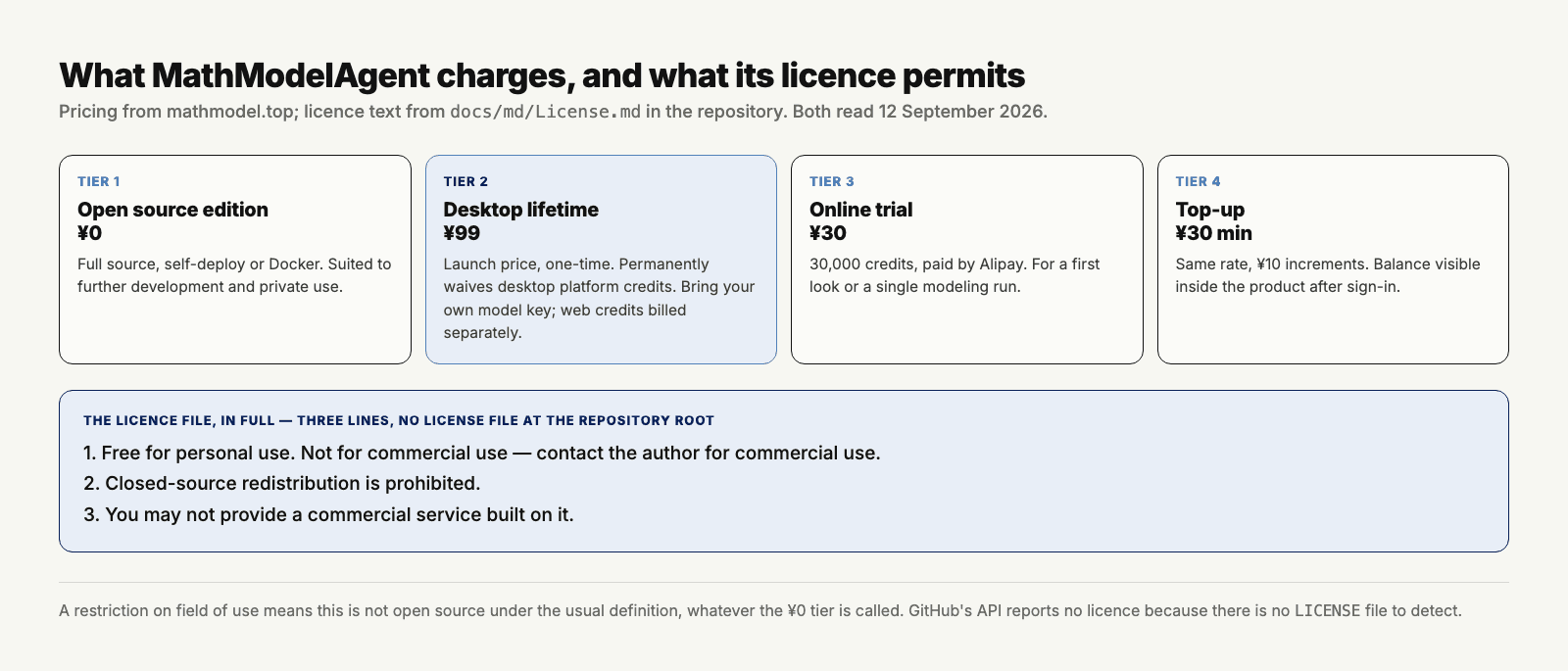
Absent a standard licence, the default in most jurisdictions is that the author retains all rights and grants only what the notice grants. If your institution has a policy about third-party tooling, that three-line file is the document it will be evaluated against, not the GitHub page.
What it costs
Four tiers sit on the site. The open source edition is ¥0 and points at the repository, described as suited to self-deployment, further development and reading the full source. A desktop lifetime tier is ¥99 at a launch price, a one-time payment that permanently waives the platform service credits for desktop conversations, and it expects you to bring your own model key; web credits and cloud features bill separately. An online trial tier is ¥30 for 30,000 credits, and a top-up tier is the same rate with a ¥30 minimum in ¥10 increments, paid through Alipay.
So the honest answer to "is MathModelAgent free" is: the code is free to run for personal use, your model API usage is not, and the hosted conveniences are priced in yuan through a Chinese payment rail. Budget accordingly if you're outside China.
The language gate is real, and it's narrower than it looks
The official site at mathmodel.top is Chinese throughout, with no language toggle. The repository is the opposite: README_EN.md is a complete English document, not a machine dump, covering installation, the desktop app, the interpreter options and the licence pointer.

What that means in practice: an English-speaking user can install and run MathModelAgent from the repository without ever touching the Chinese site, and will hit Chinese at the moment they want to buy credits or read the update log. The agent's own output language follows your prompt, so a paper drafted in English comes back in English. This is a documentation gate, not a product gate.
MCM, ICM and the question nobody wants to ask
MathModelAgent is built for modeling competitions, and the flagship ones are international and English-language — which is precisely the gap its roadmap still has open. Every one of them has rules about outside assistance, and those rules are currently being rewritten across the sector faster than any article can track.
We are not going to tell you whether using it is allowed, because that depends on which competition, which year and which institution, and the answer changes. What we will say is that the tool makes the question unavoidable rather than academic: a system that writes the model, the code and the paper is not a spell checker, and treating it as one is a decision with consequences you'll own. Read your competition's current rules and your university's policy before you install, not after. Verified as of September 2026, the project's own documentation makes no claim about competition eligibility either way.
The related question is quieter and more useful: what do you do with a modeling run that takes hours? Long agent jobs want a machine that stays awake, and a laptop closing on the train is a poor host for one. Zentor is a hosted cloud AI computer that keeps the run alive in the environment rather than on the machine in front of you, which means you start a job at the library and read the result from your phone. It sits alongside a local install rather than replacing it, and for a three-day competition that distinction is the whole game.
FAQ
Is MathModelAgent free?
The code costs nothing and the licence permits personal use. It is not open source in the usual sense: commercial use requires the author's permission, closed-source redistribution is prohibited, and you may not sell a service built on it. You also pay your own model API costs, and the hosted tiers are ¥99 one-time for desktop or ¥30 for 30,000 credits.
Which models does it use?
Whichever you point it at. Provider access runs through litellm, so the supported list is effectively litellm's, and different agents in the pipeline can run on different models. The desktop build ships Claude Code inside it and asks for one model API key at setup. You pay that usage directly.
Can I submit its output to a competition?
That depends entirely on the competition's rules and your institution's policy, and MathModelAgent's documentation makes no claim either way. A system that writes the model, runs the code and drafts the paper is far past what most "permitted tools" clauses were written to cover. Check the current rules first.
Do I need to install Python and Node?
Not with the desktop build, which is the whole point of it. The installer carries the runtime and the skills. The self-hosted route still wants Python, Node, Redis and Docker, and stays available for anyone who wants to modify the thing.
One installer, one licence file, and only one of them is loud
MathModelAgent is a genuinely capable piece of engineering wrapped in a distribution story that has moved faster than its paperwork. The desktop build is the right call, the sister project sci-box for scientific figures suggests a maintainer thinking about a toolchain rather than a demo, and the four releases in four days say somebody is working hard. The three-line licence file is the part that will matter to you six months from now, and it's the one nobody links to.
Continue Reading
More Guide
Best Claude Skills to Install in 2026

HyperFrames Workflow: Video Rules as Skills

Claude Anthropic Skills, Explained

Content Creation Workflow: Brief to Publish

Rune IDE: Keyboard-Driven and Agent-Optional

Browser Use Life Recorder: A Local Audio Diary
The Zentor editorial team writes about workflow automation, AI agents, and the tools we build. Default byline for industry overviews, listicles, and collaborative pieces.
Ready to put this into practice?
MoClaw runs browser tasks, research, and schedules automatically. Try it free.
References: https://github.com/jihe520/MathModelAgent · https://mathmodel.top/home · https://github.com/jihe520/MathModelAgent/releases · https://github.com/jihe520/sci-box · https://e2b.dev/ · https://docs.litellm.ai/docs/providers