Rune IDE: Keyboard-Driven and Agent-Optional

Rune is a GPU-rendered, keyboard-driven IDE in Go where the AI agent ships as an extension. What it is, the GPLv3 terms, and what the $10 tier sells.
Table of Contents
The Rune IDE is a GPU-rendered, keyboard-driven editor written in Go that went open source and hit 396 GitHub stars three days after its first public commit on 10 September 2026. Its one-line pitch, "the development environment for pros," tells you nothing, and the phrase most write-ups have attached to it, that it's a terminal environment built for AI coding agents, gets the design backwards. The agent in Rune ships as an extension on purpose, and the reasoning behind that choice is the most interesting thing in the repository.
What the Rune IDE is
Start from the homepage, which is honest about its own genre: "A new IDE, from first principles." Rune bundles code editing, terminals, CLI tools, language intelligence, debugging and AI agents into one composable multi-workspace environment, all rendered on the GPU and driven from the keyboard.
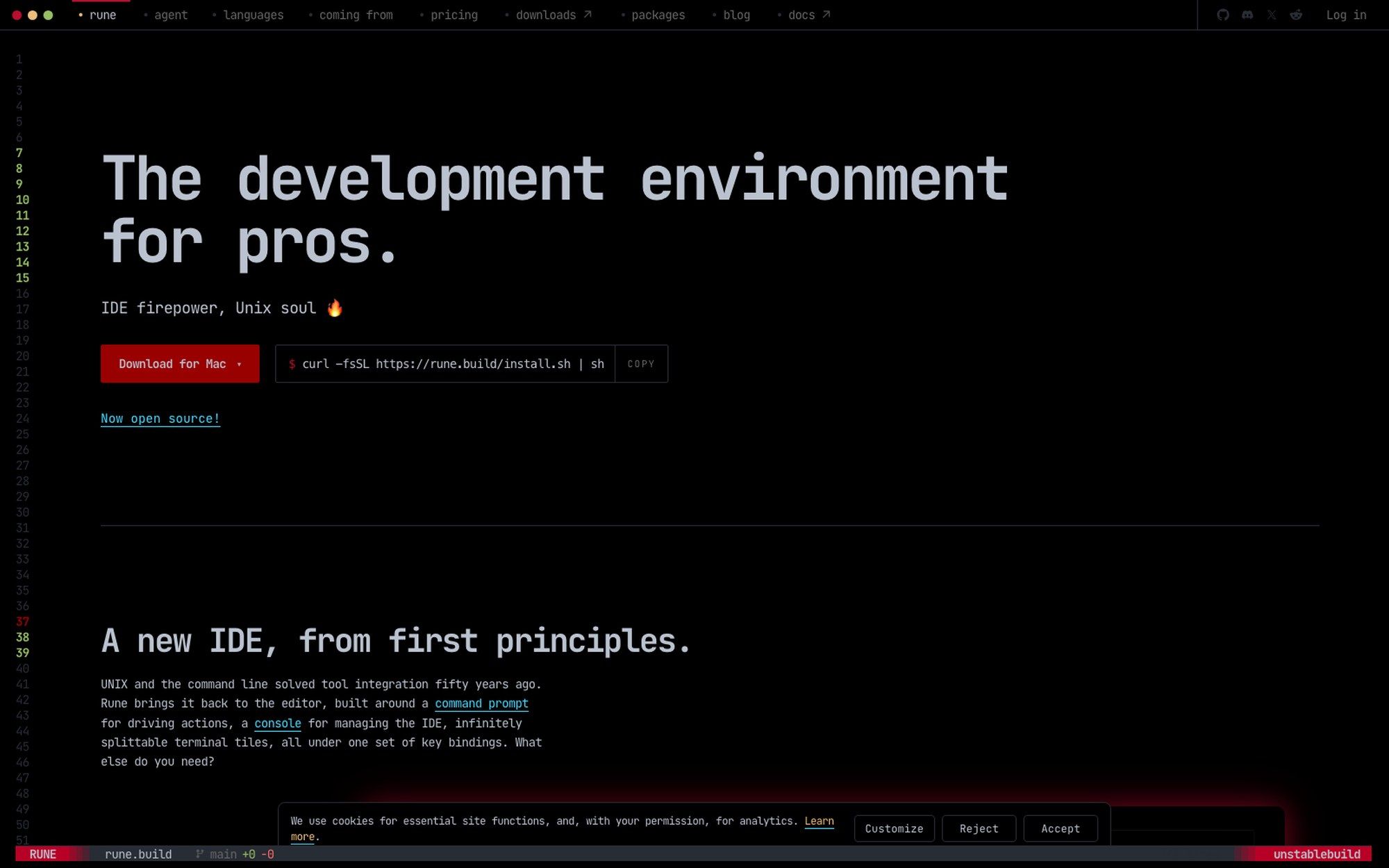
The stated influence is Unix. The site's argument is that the command line solved tool integration fifty years ago and editors then forgot, so Rune puts a command prompt at the centre for driving actions, a console for managing the IDE itself, and infinitely splittable terminal tiles, all under one set of key bindings. There are three built-in editing modes, standard, vim and emacs, and the one you pick applies everywhere, including inside terminals, input boxes and the file explorer.
That last detail is a better summary of the product than any feature list. Consistent modal editing in every text surface is the kind of thing you only build if you've been annoyed by its absence for years.
The agent is an extension, and that's the argument
Every other editor spent 2026 welding an agent into its core. Rune went the other way, and the README states the reason without hedging: Rune Agent lives in cmd/rune-agent and ships as an extension rather than as part of the editor, which keeps Rune suitable for automatic programming while still allowing uncorrupted manual programming.
That phrase, uncorrupted manual programming, is doing real work. It's a position on a live argument, which is whether an editor that assumes an agent is always present can still be a good editor for the hours you're typing yourself. Rune's answer is to make the agent removable, so that neither mode is a degraded version of the other.
There's a second motive stated alongside the first: building the agent as an extension pushes the extension system to support complex applications. If your plugin API can host a full coding agent, it can host almost anything, and you find out early instead of after third-party developers hit the walls.
Worth noting what this is not. Rune isn't an orchestration layer for running several agent CLIs side by side; if that's what you're after, we covered running Claude Code agents in parallel and it's a different shape of tool entirely.
Open source under GPLv3, with an Apache-2.0 escape hatch
The main repository is GPL-3.0, which the homepage announces with a "Now open source!" link, and that matters more here than on a typical developer tool because GPLv3 is a copyleft licence with real obligations for anyone shipping derivatives.
The subtlety sits one layer down. Rune is an application, not a library, and the README says packages inside the repository carry no compatibility guarantees and get refactored freely. The supported, semver-stable API for writing extensions is rune-go-sdk, which is a separate module under Apache-2.0.
So the practical read is that building an extension against the SDK does not pull you into GPLv3, while forking the editor itself does. That split is deliberate and it's easy to miss if you only check the licence badge on the main repository.
The part nobody mentions: Rune has a price list
Rune's pricing page is the fact most coverage skips, and it reframes what the project is.
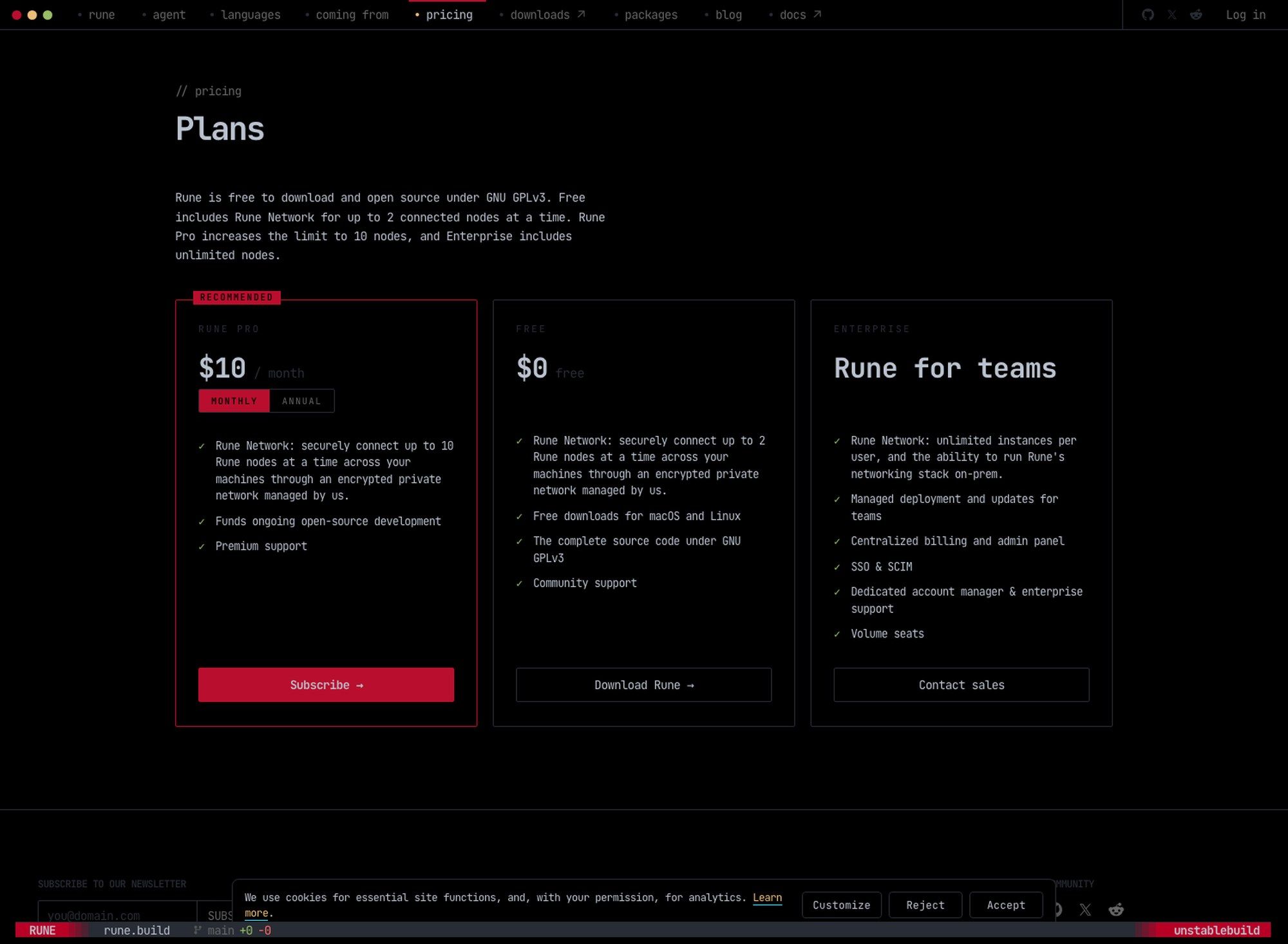
Free is $0 and includes the editor downloads for macOS and Linux, the complete source under GPLv3, community support, and Rune Network for up to 2 connected nodes at a time. Rune Pro is $10 a month, raises that to 10 nodes, adds premium support and, in the page's own words, funds ongoing open-source development. Enterprise adds unlimited instances per user, the ability to run the networking stack on-premises, managed deployment, centralised billing, SSO and SCIM.
Read what's actually metered. It isn't the editor, which is free and always will be under that licence. It's Rune Network: an encrypted private network, managed by them, that securely connects Rune nodes across your machines. The editor is the open-source part; the paid product is a hosted service that makes several machines behave like one workspace.
Which tells you the team reached the same conclusion a lot of us did this year. Development stopped fitting on a single computer, and the money is in whatever glues the computers together. Zentor attacks that from the other end: instead of networking your laptops together, it gives you a hosted cloud AI computer that's already always-on, so the machine doing the long work isn't one you have to keep awake.
Where the Rune IDE sits against what you're already using
The comparison people reach for first is a terminal multiplexer plus a modal editor, because that stack already gives you panes, keyboard control and a shared session. What it doesn't give you is one key map. Your multiplexer has its prefix, your editor has its modes, your file picker has its own keys, and every boundary between them is a small tax you've stopped noticing. Rune's pitch is to erase those boundaries, which is why the built-in editing mode applying inside terminals and input boxes is the feature to test first.
Against a GPU-rendered editor that already exists, the difference isn't rendering speed; it's the console and command prompt for driving the IDE itself, and the decision to keep the agent outside the core. Against VS Code, the whole thing is a rejection: no Electron, no mouse-first affordances, and an extension system deliberately stress-tested by hosting a coding agent rather than by hosting theme packs. The packaged-capability pattern it borrows from is the same one the agent skills ecosystem settled on.
None of that makes it better, and three days of public history is not enough to claim it is. It does make the Rune IDE a coherent position rather than another editor with a chat panel bolted on, and coherent positions are rarer than they should be right now.
What it costs you to try
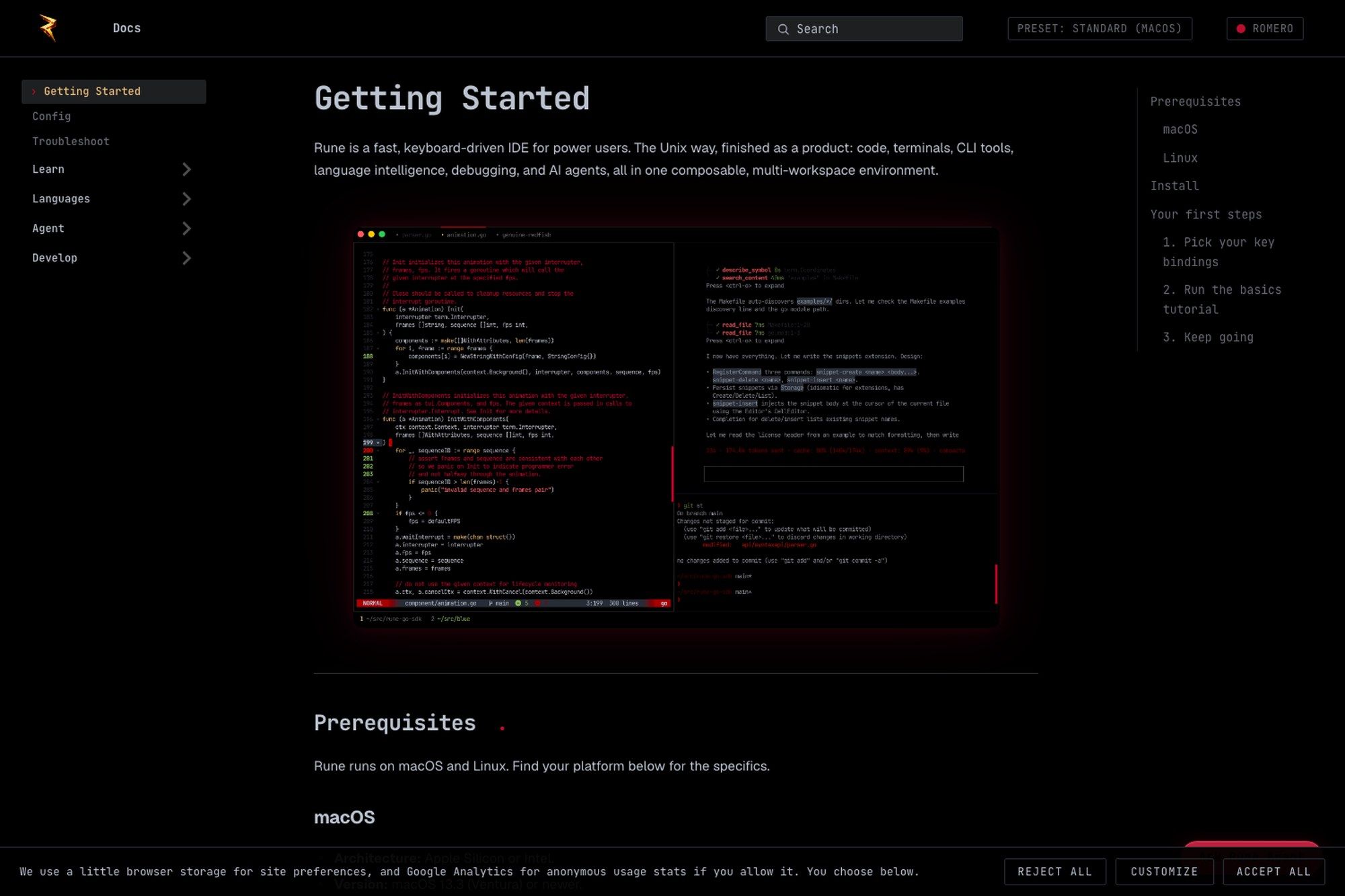
macOS is easy. There are signed .dmg builds for Apple Silicon and Intel on the releases page, a Download for Mac button, and a shell install one-liner on the homepage. Rune needs macOS 13.3 Ventura or newer.
Linux is where it gets involved. The v1.2.1 release from 11 September 2026 publishes DMGs for darwin and manifest files for linux amd64 and arm64, but no Linux binary. Because Rune links a GPU renderer through cgo, building needs a C toolchain, and on Linux that means X11, OpenGL, ALSA, Wayland and xkbcommon development headers, whose package names differ by distribution. The docs carry verified package lists for Debian and Ubuntu, Fedora and RHEL, Arch, openSUSE, Alpine and Void.
The version numbers deserve a second look. Rune shipped v1.2.0 and v1.2.1 within about fourteen hours of each other on 10 and 11 September, and the README says the project has been developed slowly over the last few years. So the repository is three days old and the software is not. The 1.x version is a claim about maturity that the commit history can't yet corroborate, because the history only starts when they opened it.
Who the Rune IDE is for
The Rune IDE is aimed at a specific person. If you live in vim or emacs bindings, resent leaving the keyboard, and want terminals and a debugger under the same key map as your editor, this is aimed squarely at you. It's also aimed at people who want an agent available without an agent assumed, which is a smaller group than the market currently behaves as though it is.
If you're on Linux and not willing to install GPU development headers to get an editor running, wait for binaries. If you want an agent-first environment where the AI drives, Rune is explicitly the opposite design. And if your bottleneck is that your machine can't stay up long enough for a long-running task, an editor doesn't fix that. Zentor does, by putting the work on a hosted computer that keeps going after you close the lid.
FAQ
Is Rune free and open source?
The editor is free to download and open source under GNU GPLv3, and the free tier includes macOS and Linux downloads plus Rune Network for up to 2 connected nodes. GPLv3 is copyleft, so distributing a modified version carries source obligations. The extension SDK, rune-go-sdk, is a separate module under Apache-2.0, which is the permissive path if you're building extensions rather than forking.
What does the Rune IDE do that a normal terminal doesn't?
It puts the editor, terminals, language intelligence, a debugger and agents in one multi-workspace environment under a single key map, with the same editing mode applying inside terminals and input boxes. A terminal multiplexer gives you panes; Rune gives you panes that share the editor's bindings and tooling.
Does Rune work with existing coding agents?
Rune ships its own agent as an extension in cmd/rune-agent. Its extension system is the documented route for adding others, through the Apache-2.0 rune-go-sdk. We didn't find first-party integrations with other agent CLIs in the repository as of 13 September 2026.
Is the Rune IDE a terminal or an editor?
Both, by design. It's a full IDE with editing, language intelligence and debugging, and it treats terminals as first-class splittable tiles inside the same window under the same key bindings. The "development environment for pros" framing on rune.build refers to that combination rather than to a terminal-only tool.
What is Rune Network and do I need it?
An encrypted private network, operated by the Rune team, that connects your Rune instances across machines. Two nodes are free, ten come with Rune Pro at $10 a month, and Enterprise removes the limit and allows on-premises operation. You don't need it to use the editor on one machine.
Can I run Rune on Linux?
Yes, by building from source. The current release publishes DMGs for macOS but no Linux binary, and the GPU renderer's cgo dependency means you'll need a C toolchain plus X11, OpenGL, ALSA, Wayland and xkbcommon headers.
The honest read
Rune is a serious editor that quietly disagrees with the year's dominant assumption, and it's worth installing for that reason if you're a keyboard person on a Mac. The GPU rendering and the unified key map are the parts you'll notice in the first hour; the extension-shaped agent is the part you'll appreciate in the first month.
Go in knowing two things the announcements left out. The paid product is a hosted network, not the editor. And the public repository is days old even though the software isn't, so there's no track record yet for how this team handles issues, regressions or the GPLv3 questions that will arrive the moment someone forks it.
Checked against the repository, the releases API, the documentation and the pricing page on 13 September 2026.
Continue Reading
More Guide
TRAE Work Guardrails: Permissions and Review

OpenTag Workflow: Slack Threads to Approval Trails

Claude Tag Guardrails for Workspace AI Access

Claude Tag Workflows for Shared Slack Context

What to Use Instead of Manus in 2026

Grok 4.5 API Europe: Access and Setup
The Zentor editorial team writes about workflow automation, AI agents, and the tools we build. Default byline for industry overviews, listicles, and collaborative pieces.
Ready to put this into practice?
MoClaw runs browser tasks, research, and schedules automatically. Try it free.
References: https://github.com/unstablebuild/rune · https://rune.build/ · https://docs.rune.build/ · https://rune.build/pricing · https://github.com/unstablebuild/rune-go-sdk