Ponytail Claude Code Plugin: What It Does

Ponytail makes your coding agent write the least code that works. What the ruleset actually installs, the benchmark it corrected, and where it fits.
Table of Contents
A repository that tells your coding agent to write less code has 115,443 stars, which is more than Django. If you install ponytail on Claude Code expecting a tool, you'll be confused for about a minute: nothing runs, no binary lands, and your agent looks exactly the same. Ponytail isn't software that does work. It's a set of rules about what your agent shouldn't build, and the ponytail Claude Code plugin is a two-command install that changes the agent's judgment rather than its capabilities.
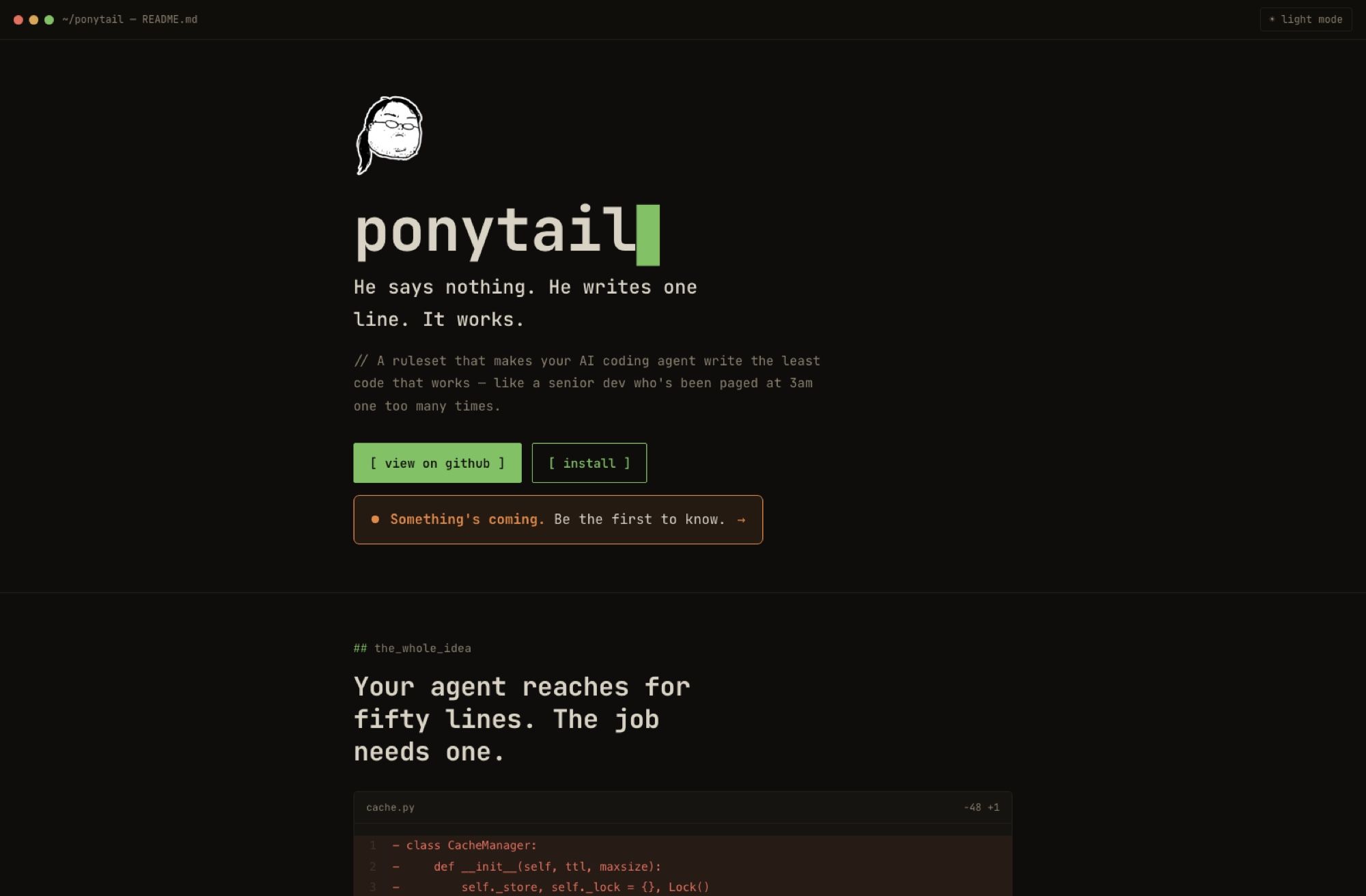
The pitch is a person you've met. Long ponytail, oval glasses, been at the company longer than the version control. You show him fifty lines; he says nothing and replaces them with one.
Key Takeaways:
- Ponytail is a ruleset, not a tool. Nothing runs; your existing agent just picks smaller solutions.
- A seven-rung ladder stops the agent at the first option that already exists, from "skip it" through to "write the minimum."
- The corrected benchmark shows 54% less code, 22% fewer tokens and 27% less time against a real FastAPI and React repo.
- Validation, data-loss handling, security and accessibility are explicitly protected. A bare "write one-liners" prompt loses one of those guards.
- The project published a correction to its own viral 80-94% figure after issue #126 challenged the baseline.
What ponytail actually installs
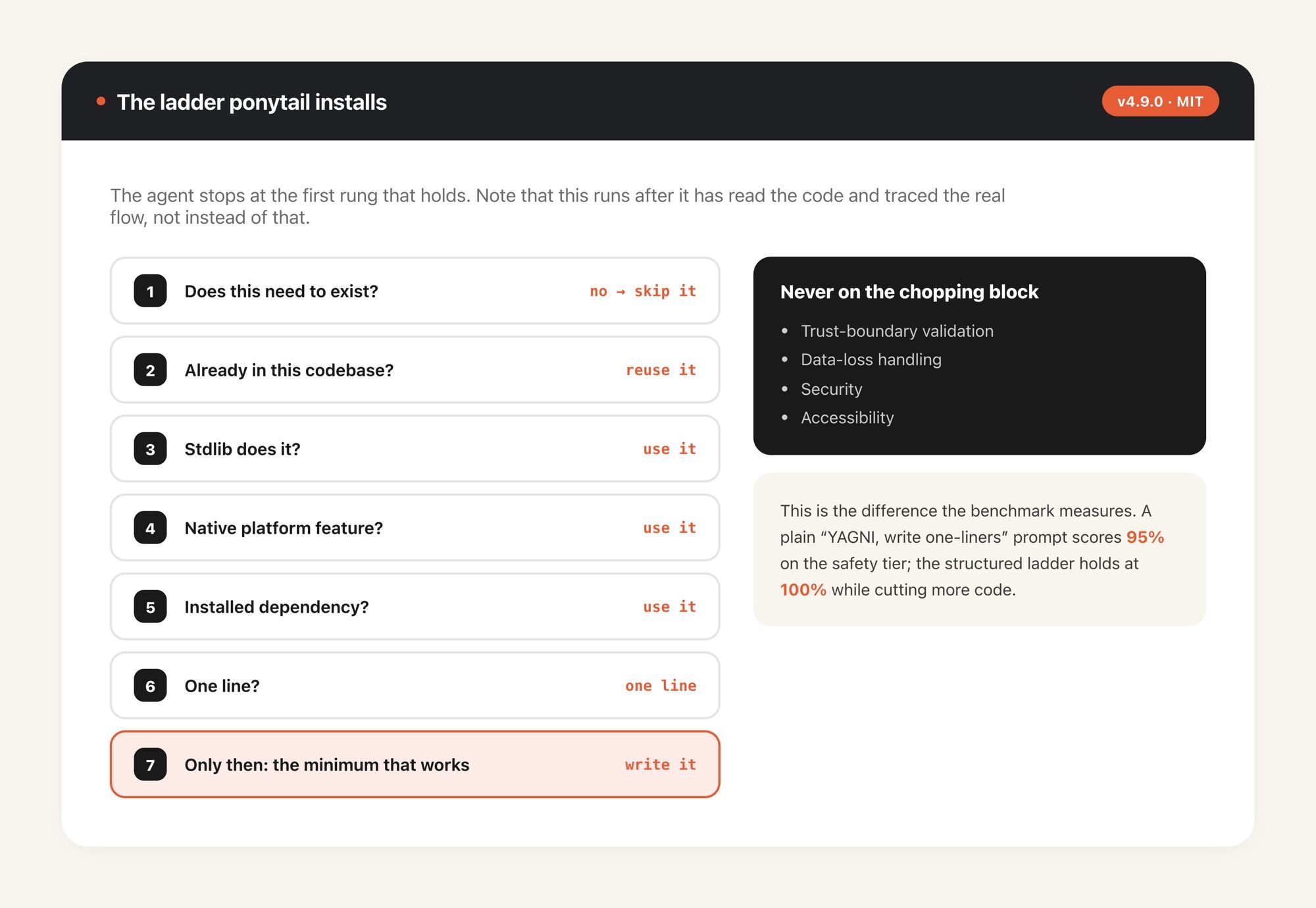
A ladder. Before writing code, the agent stops at the first rung that holds:
1. Does this need to exist?   → no: skip it (YAGNI)
2. Already in this codebase?  → reuse it, don't rewrite
3. Stdlib does it?            → use it
4. Native platform feature?   → use it
5. Installed dependency?      → use it
6. One line?                  → one line
7. Only then: the minimum that works
The canonical example in the README is a date picker. You ask for one; your agent installs flatpickr, writes a wrapper component, adds a stylesheet, and opens a discussion about timezones. With ponytail loaded it writes <input type="date"> and a comment saying the browser already has one.
What keeps this from being a "write shorter code" prompt is the order of operations. The ladder runs after the agent understands the problem, not instead of understanding it, and the README is blunt that trust-boundary validation, data-loss handling, security and accessibility are never on the chopping block. Lazy about the solution, never about reading the code. That distinction turns out to be measurable, which we'll get to.
Installing the ponytail Claude Code plugin
Two prompts, sent separately, and the README is emphatic about the "separately" part because sending them together doesn't work:
/plugin marketplace add DietrichGebert/ponytail
/plugin install ponytail@ponytail
Note what that first line is doing. Ponytail ships as its own Claude Code plugin marketplace, using the same /plugin marketplace add mechanism that Anthropic's own official plugin directory uses. Anyone can stand up a marketplace pointing at their own repo, which is how a project with no company behind it distributes through first-party channels.
The ponytail Claude Code plugin and its Codex twin run two small Node.js lifecycle hooks, so node has to be on your PATH, and for nvm or Nix users specifically it needs to be on the non-interactive shell's PATH. If it isn't, the skills still load; you just lose the always-on activation and get quiet behaviour instead of an error on every prompt. In the desktop app the same two slash commands work in the Code tab.
Codex takes codex plugin marketplace add DietrichGebert/ponytail then codex plugin add ponytail@ponytail, after which you open /hooks, review and trust the two lifecycle hooks, and start a new thread.
Which agents it works with
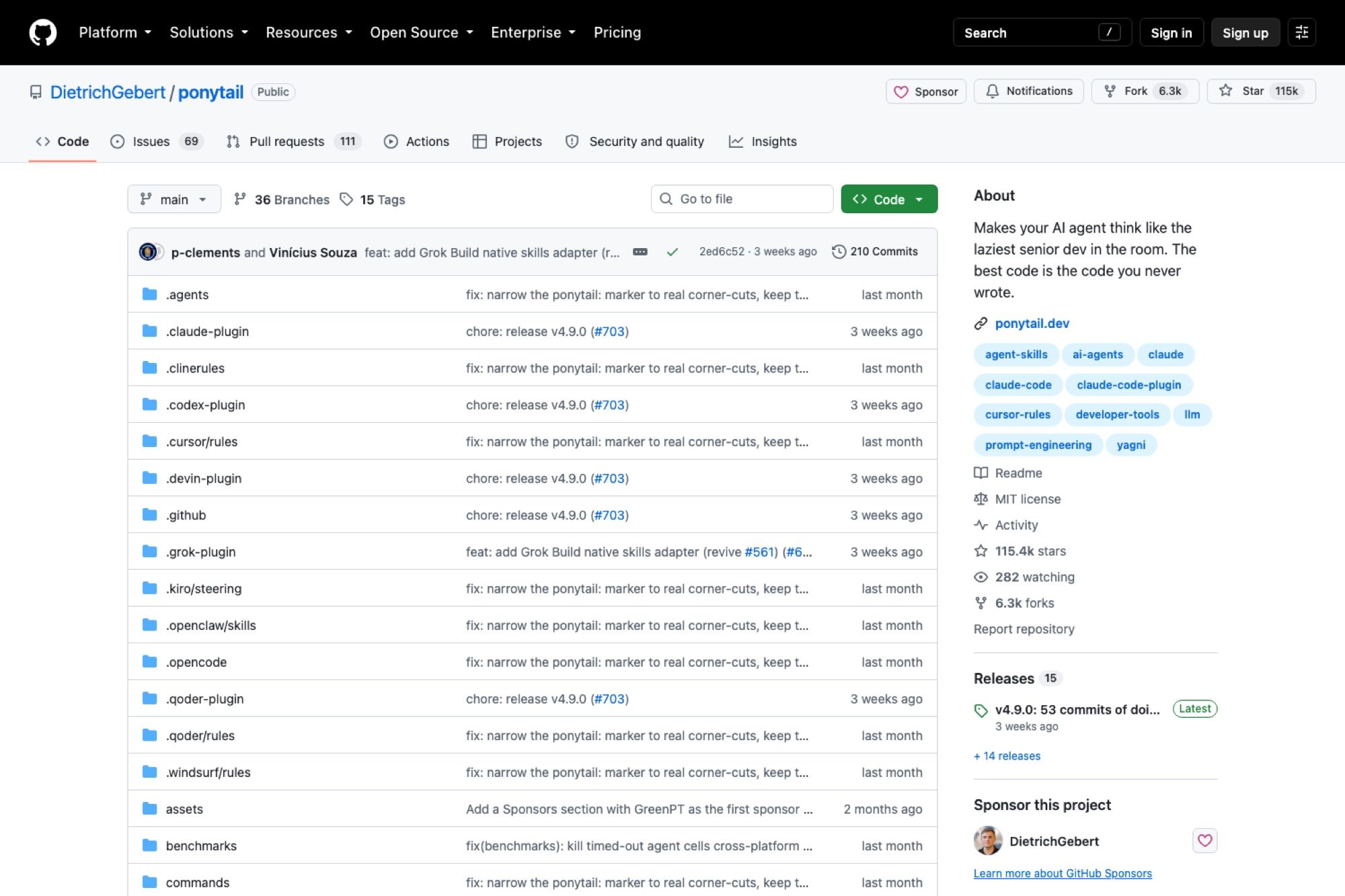
The badge says 20 agents. The README documents installation for 14 by name: Claude Code, Codex, GitHub Copilot CLI, the Pi agent harness, OpenCode, Gemini CLI, Qoder, Antigravity CLI, Hermes Agent, CodeWhale, Swival, Devin CLI, OpenClaw and Grok Build. The gap between those numbers is probably rules-file formats that need no separate instructions rather than any exaggeration, since a look at the repo root shows how the trick works: .cursor/rules, .clinerules, .kiro/steering, .windsurf/rules, .qoder/rules, .openclaw/skills and a plugin folder each for Claude, Codex, Devin, Grok and Qoder. One set of rules, rewritten into every convention that exists.
That's the actual product. Not a model, not a harness, not an orchestration layer: a document, translated into fifteen dialects of "here are your instructions." If you want the taxonomy of where this sits, our guide to agent harnesses draws the line between the thing that runs the agent and the thing that tells it how to behave, and ponytail is squarely the second.
Where this gets awkward is that a rules layer only helps while the agent is running. Ponytail makes a session produce less code; it can't make a session happen. A scheduled refactor that fires at 04:00 needs a machine that's awake at 04:00, and that's the requirement a laptop is structurally unable to meet. MoClaw covers that half: a hosted cloud AI computer stays up so the scheduled run has somewhere to land, with your ruleset already loaded, alongside your local install rather than instead of it.
What ponytail is not
Worth being explicit, because the star count attracts the wrong expectation. Ponytail doesn't write your application. It doesn't plan, it doesn't run tests, it doesn't touch your repository on its own, and it has no model behind it. Uninstall it and your agent keeps working exactly as before, just chattier in its output.
It also isn't an execution environment, which is the confusion I'd expect from anyone arriving via a "115k stars" headline. The rules describe how to decide; something still has to provide the machine, the filesystem, the credentials and the uptime that turn a decision into a change on disk. Those are separate problems, and conflating them is how people end up disappointed by a rules file. A MoClaw instance is one answer to the second half: a hosted cloud AI computer supplying the environment, with ponytail or any other ruleset governing what the agent does once it's there.
And it isn't a linter. A linter checks code after it exists; ponytail intervenes at the point where the agent is choosing an approach, which is why the biggest wins in the benchmark come from tasks where the correct output was a native HTML element nobody needed to write at all.
The numbers, including the ones they walked back
This is the part that made me trust the project, and it isn't the headline figure.
Ponytail's first benchmark reported 80–94% less code. Issue #126 pointed out that this was measured against a bare model answering a prompt in a chat window, and a bare model pads its answer with prose and alternatives. So the comparison was partly measuring "chat response versus code" rather than the skill doing anything.
They redid it properly. The current numbers come from headless Claude Code sessions editing tiangolo's full-stack-fastapi-template, a real FastAPI and React repository, scored on the git diff left behind. Twelve feature tickets, same agent with and without the skill, n=4, Haiku 4.5:
| vs no-skill baseline | LOC | tokens | cost | time | safe |
|---|---|---|---|---|---|
| ponytail | −54% | −22% | −20% | −27% | 100% |
| caveman (terse-prose control) | −20% | +7% | +3% | +2% | 100% |
| "YAGNI + one-liners" prompt | −33% | −14% | −21% | −30% | 95% |
The caveman row is worth a footnote of its own, since we looked at that skill separately in what caveman actually saves: used here as a control, it cuts lines but costs more tokens and time than doing nothing, which is a useful reminder that "terser output" and "less work" are different claims.
Two things stand out. Ponytail is the only arm that improves every column, and the naive version of the same idea (a prompt saying "YAGNI, write one-liners") drops to 95% on the safety tier while ponytail holds at 100%. The bare instruction cuts a guard the structured ladder keeps, which is the clearest evidence that the seven rungs are doing something a slogan doesn't.
The 54% is a mean across twelve tasks, not a flat rate. It reaches 94% where the agent was over-building anyway (the date picker goes from 404 lines to 23; a colour picker from 287 to 23, both by reaching for a native <input>) and lands near zero where the code was already minimal. The README also flags that lower cost and latency are a side effect rather than the goal, and that on GPT-5.5 the effect can invert because a terse reasoning model spends thinking tokens deliberating the rungs.
A project that publishes a correction to its own viral number, keeps the old figure in a collapsed section, and names the model where its approach backfires is doing something most repos with six-figure star counts don't.
Is a rules file worth 115,000 stars?
Honestly, the star count is the least informative thing here. Ponytail went from nothing to 115,443 stars in 78 days, sits on Trendshift's daily and weekly boards, and has a waitlist banner for an unannounced product at the top of its README. Some of that curve is a great logo and a slogan that fits in a tweet.
The substance underneath is real regardless: 210 commits, 15 releases, MIT licensed, npm at @dietrichgebert/ponytail v4.9.0 published 7 August 2026, 69 open issues and 111 open pull requests, which is a maintained project rather than a viral README. Take the stars as a measure of how badly people wanted permission to tell their agent to stop over-engineering, not as a quality score.
What the popularity does tell you is where the frustration is. Nobody starred this because their agent writes bad code; they starred it because their agent writes too much code, confidently, and reviewing 400 lines that should have been 23 costs more attention than writing the 23 would have. There's a related shift in how teams are handling that review load in our piece on self-improving coding agents.
One more practical note before you install the ponytail Claude Code plugin. Because ponytail is a rules layer and not a service, whichever machine holds your agent config is where the behaviour lives, and rebuilding that setup on a second computer is the tax nobody mentions. Keeping the agent on a MoClaw instance means the ruleset, the plugins and the working files stay put when you pick the work up from a different device.
Details here reflect the repository as of August 2026; a project moving at this speed will have shifted by the time you read it.
FAQ
Is ponytail free?
Yes, MIT licensed, with the npm package published as @dietrichgebert/ponytail. The project site at ponytail.dev carries a waitlist banner for something unannounced, so a paid product may be coming, but the skill itself carries no cost or account requirement.
Does the ponytail Claude Code plugin work with Cursor as well?
Both are covered. Claude Code installs through /plugin marketplace add DietrichGebert/ponytail followed by /plugin install ponytail@ponytail as two separate prompts, and Cursor picks it up through a .cursor/rules file in the repository. The README documents fourteen agents by name and the badge claims twenty.
Is ponytail a coding agent or just rules?
Just rules. It doesn't generate code, call a model, or run anything beyond two small Node.js lifecycle hooks that handle activation. Your existing agent does all the work; ponytail changes which solution that agent reaches for first.
Does writing less code make the agent less safe?
By the project's own adversarial testing, no. Ponytail scores 100% on the safety tier, matching the untouched baseline, while a plain "YAGNI plus one-liners" instruction drops to 95%. The ladder explicitly protects validation, error handling, security and accessibility, which a bare terseness instruction does not.
Continue Reading
More Guide
OpenAI Assistants API Deprecated: What Broke

MCP Tools: What They Are and Which to Use

OpenAI Models Not Available in Cursor Nov 12

Coding Agent Security: When Your Tools Lie

OpenAI Python HTTPX2: What Actually Breaks

Goldie: App Store Screenshots, Automated

The MoClaw editorial team writes about workflow automation, AI agents, and the tools we build. Default byline for industry overviews, listicles, and collaborative pieces.
Ready to put this into practice?
MoClaw runs browser tasks, research, and schedules automatically. Try it free.
References: DietrichGebert/ponytail (GitHub) · ponytail.dev · Issue #126: benchmark baseline critique · tiangolo full-stack-fastapi-template (benchmark subject) · npm @dietrichgebert/ponytail v4.9.0