Praxist License: Fair Source, Not Open Source

Praxist is Fair Source 1.0, not open source. What the licence allows under $1M revenue, what changes above it, and what the research system does.
Table of Contents
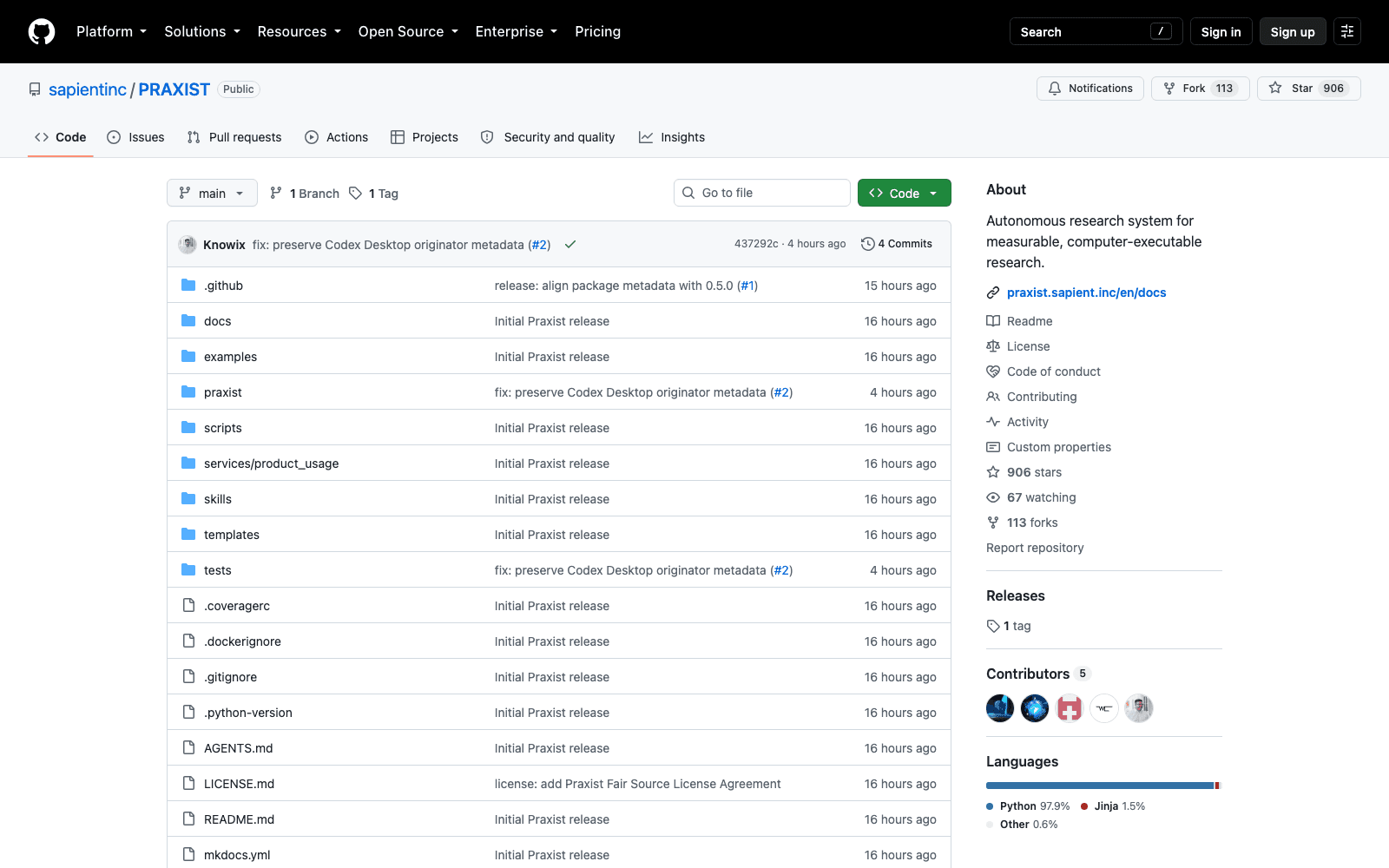
Sapient Intelligence pushed PRAXIST to GitHub on 27 August 2026. Twenty-four hours later it had 906 stars, 113 forks and four commits, which is the shape of curve that lands a repo on everyone's Monday reading list. The About panel says "License" and then stops: no SPDX name, no Apache badge, nothing. The GitHub API is no better; it returns NOASSERTION. So if you want to know whether you can put this in front of your team, the Praxist license is the file to open, and hardly anyone will open it.
It's a Fair Source License Agreement, version 1.0, from Sapient Intelligence Pte Ltd, and it is not an open source license. Sapient doesn't pretend otherwise. The README uses the words "source-available", accurately, inside a FAQ that GitHub renders collapsed by default, which means the honest answer is sitting one click away from every reader who never clicks.
Key Takeaways:
- Praxist is source-available under the Fair Source License Agreement 1.0, not open source. GitHub shows no licence name on the repo page and its API reports
NOASSERTION. - It's free if your company's worldwide gross revenue, affiliates included, came in under US$1 million in your last completed fiscal year.
- Cross that line and the free grant lapses by itself: thirty days to notify Sapient, ninety before you have to delete every copy.
- Building Praxist into your own product is allowed. Reselling Praxist itself is not, and any output you publish externally has to keep its attribution line.
- It only works on a project that already runs and already has a metric separating better from worse. As of 28 August 2026 the repo is one day old: 906 stars, four commits.
What Praxist actually is
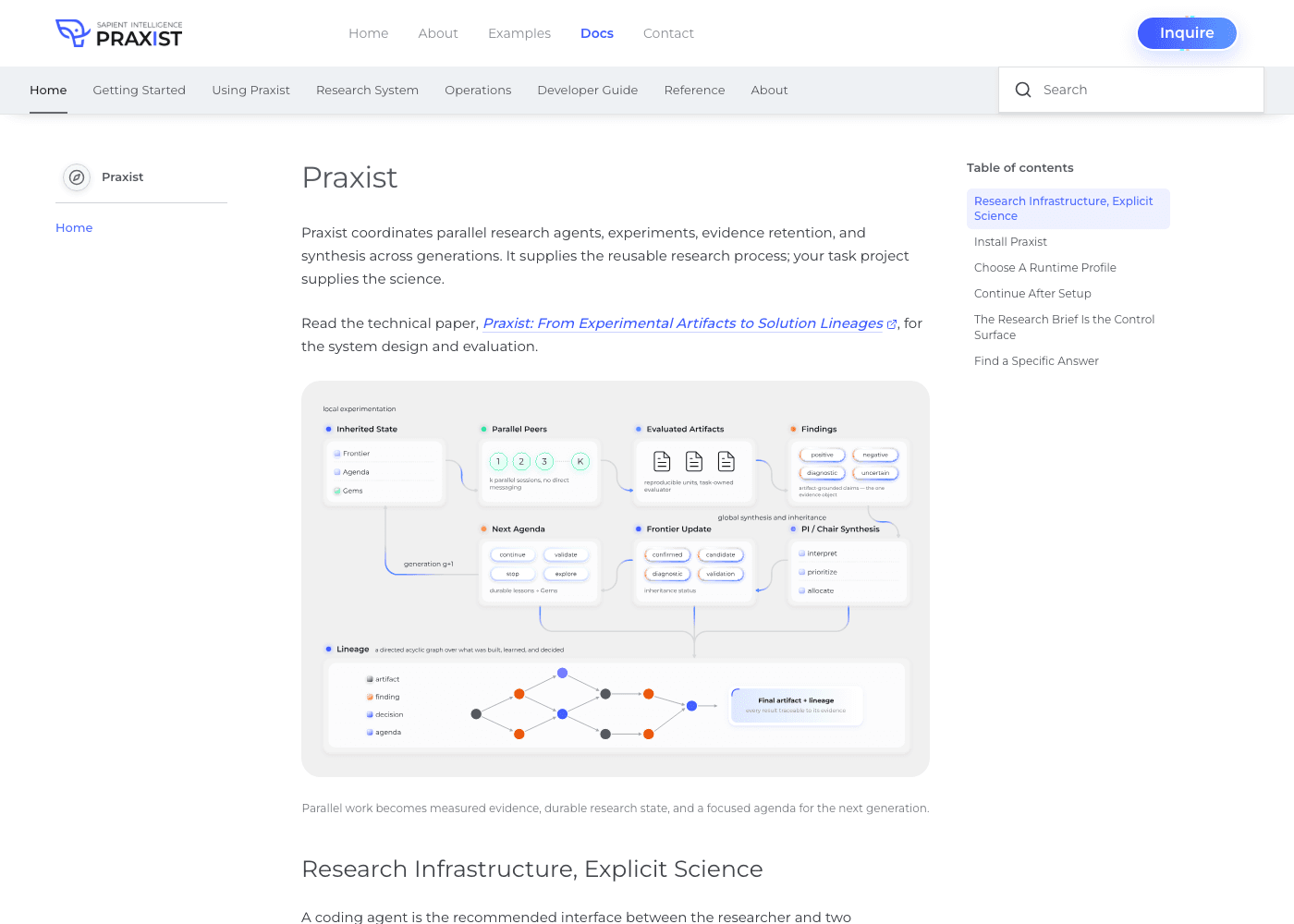
Praxist takes over a research loop you're already running by hand. You give it a project that executes today and a metric that separates better from worse; it spawns parallel research agents, called peers, that pursue competing changes, scores each result through an evaluator your project owns, and then hands the accumulated evidence to a planning panel that writes the agenda for the next generation. Then it runs the next generation. It keeps going until the search converges or the budget is gone. That places it at the far end of the spectrum we mapped in what autonomous AI agents should actually handle: not a tool you supervise turn by turn, but a process you authorise and then read the audit trail from.
The division of labour is the design. Praxist owns orchestration, resource scheduling, evidence transport, durable state, replay and lifecycle. Your task project owns the objective, the evaluator, the metrics, the baseline, the prompts and every domain constraint. Sapient says Praxist contains no task-specific scientific assumptions, and it backs that up with a refusal: no silently downloading a dataset you didn't specify, no inventing a simulator, no fabricating a baseline number. If a prerequisite is missing, the run stops and names what's missing. For a category of tool that usually optimises for looking productive, that is an unusual thing to build in on purpose.
Why the Praxist license isn't an open source one
An open source licence, in the sense the OSI has defended since 1998, has to allow redistribution and can't restrict who uses the software or what field they use it in. Fair Source 1.0 restricts both. It's a bilateral agreement between you and Sapient rather than a public grant, it ties your rights to your company's revenue, and it forbids you from handing Praxist onward as a product. Those aren't small print; they're clauses 1.2.3 and 1.3.
Under the Praxist license you get a worldwide, non-exclusive, non-sublicensable and non-transferable right to use, copy and modify the software for internal business purposes, to build derivative works for internal business purposes, and to deploy and run it inside your own organisation, on-premises or as an online service. That covers a great deal of ordinary work. It does not cover reselling, and it does not cover you forever.
The $1 million line
Section 1.3.1 of the Praxist license sets a Revenue Threshold of one million US dollars. Read the definition carefully, because it's broader than most people will assume: worldwide aggregate gross revenue, not profit and not revenue after costs, counting you and every affiliate under common control, measured across your most recently completed fiscal year. If you haven't been trading a full year, you annualise your average monthly revenue by twelve. Non-USD revenue converts at the Reuters closing mid-rate.
Below that line, the licence is free. At or above it, the free grant lapses automatically. You then have thirty days to notify Sapient in writing, sixty days for both sides to negotiate a commercial licence in good faith, and ninety days total before the free licence terminates and you have to stop using Praxist and delete every copy from your systems. Failing to send that notice is defined as an incurable material breach, which lets Sapient terminate immediately.
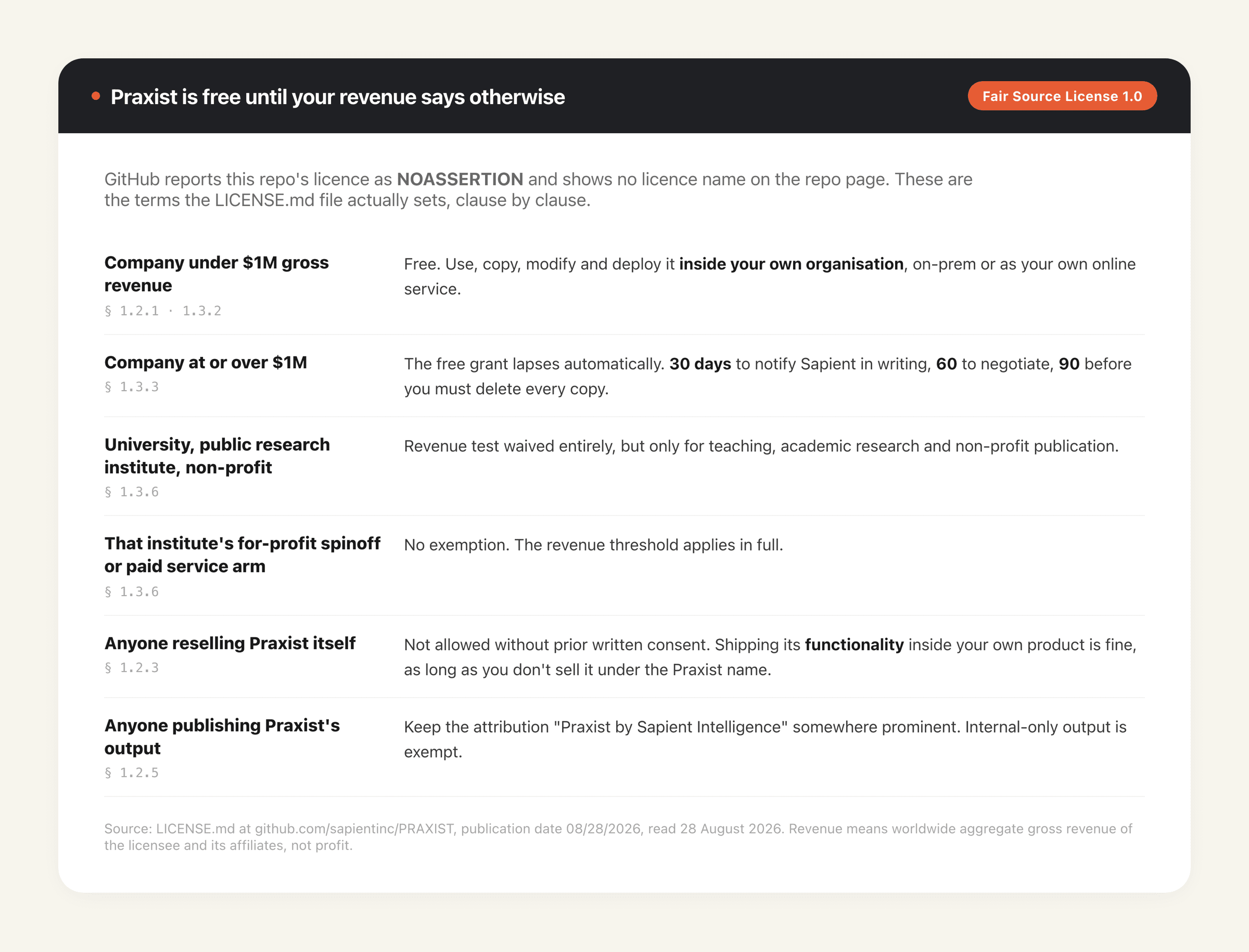
There's an audit hook attached. Once every twelve months Sapient can ask you for a revenue statement signed by an authorised representative confirming you're still under the threshold; refuse or miss the thirty-day window and they can terminate the licence. Universities, public research institutes and non-profit academic bodies skip the revenue test entirely, but only for teaching, research and non-profit publication. Route the work through a for-profit spinoff or a tech-transfer arm selling services, and the threshold applies in full.
What you can ship, and what you can't sell
You may not distribute, sublicense, sell, rent, lease or transfer Praxist or your modified version of it to a third party as a standalone product or service without written consent. You may deliver Praxist's functionality to your own end users as part of your own service, as long as that service isn't sold under the name "Praxist by Sapient Intelligence." In practice: building Praxist into your product is allowed, becoming a Praxist reseller is not.
The Praxist license attaches a string to outputs, too. Anything Praxist generates that you keep internal needs no attribution, but publish a result externally and you must retain the product-name attribution "Praxist by Sapient Intelligence" somewhere reasonably prominent; footer, notes, metadata and accompanying documentation are all named as acceptable. That obligation survives your editing and reprocessing of the output. If you write papers, this clause is the one to show your co-authors before the run, not after.
Two smaller terms. Any patch you send Sapient carries a perpetual, irrevocable, royalty-free licence to them, and if you never paid anything, Sapient's liability to you is capped at one hundred dollars under Singapore law and SIAC arbitration.
What a run looks like
Installation is one pip command plus an interactive wizard that walks you through the licence, the user agreement, the runtime profile, masked credentials and readiness checks; Sapient also documents an agent-driven path where you open codex --yolo or claude --dangerously-skip-permissions and let the agent follow the packaged runbook. Consider where you point that. A repo four commits old, installed by an agent running with permission prompts disabled, on the same machine that holds your production credentials, is a blast radius question rather than a licensing one. Running it on MoClaw instead puts the whole experiment on a hosted cloud AI computer that has nothing of yours on it, next to your existing setup rather than replacing it.
Sapient's documentation makes Codex the recommended interface: you invoke $praxist-takeover in the root of a runnable project, and the skill inspects readiness, builds or repairs a task harness, checks the evaluator and evidence contract, then launches once the gates pass. Codex-native mode uses your saved Codex login, so no API key is needed, which also means the run depends on a machine that stays authenticated and awake. MoClaw covers that half: the session lives on a machine that doesn't close when yours does.
Day to day you're in the CLI: praxist status --json, praxist --monitor --latest, praxist stop <run_id>, praxist resume <run_dir>. Ctrl-C closes the monitor and leaves the research running, which tells you how the thing is meant to be used. Evidence is kept in lanes named incubator, frontier and Gems; ranking is multi-metric and can be Pareto-based; a Quality-Diversity allocator plus an optional Deep Innovation Gate exist to stop every peer piling into the same local optimum. Two worked examples ship with it, both solving rocket booster recovery, one in Python and JAX and one in native Rust. If your idea of research automation is closer to gathering sources and drafting, that's a different job with different tooling; Praxist only works where a number decides the winner.
Sapient's other three repos are Apache-2.0
This is the part that makes the Praxist license choice legible. Sapient Intelligence has four public repositories. HRM, the Hierarchical Reasoning Model release from July 2025 that put them on the map, sits at 12,618 stars under Apache-2.0. HRM-Text, 1,908 stars, Apache-2.0. The data_io pipeline, 70 stars, Apache-2.0. Praxist is the first thing they've shipped that isn't.
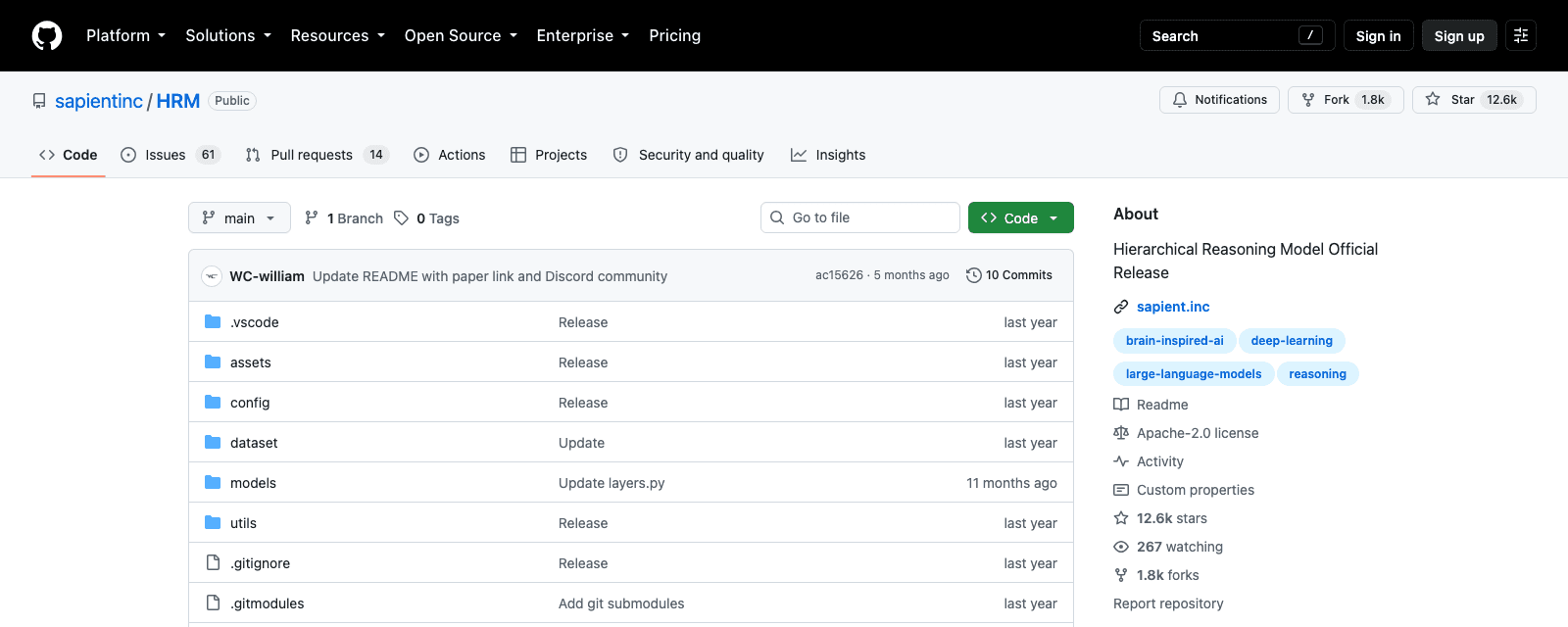
Read that as a signal rather than a betrayal. Research weights and a reference architecture are things you want copied everywhere; a research orchestration platform is a thing you want to sell to the companies large enough to afford it. The million-dollar threshold draws exactly that line, and Sapient wrote a contact address into the licence file for the people on the far side of it.
What 906 stars in a day doesn't tell you
Praxist is one day old. Four commits, five contributors, a single 0.5.0 tag and no published release. There's a real arXiv paper behind it, 2608.25955, Praxist: From Experimental Artifacts to Solution Lineages, with sixteen authors including Sen Song and Guan Wang, so this isn't a weekend project with a landing page. But a paper is not a track record.
The platform support table is honest in a way that's easy to skim past. Linux on CPython 3.11 and 3.12 is continuously release-tested. macOS is listed as a compatibility target, not a qualified host, and Sapient tells you to run praxist doctor before starting research. If your team is on Macs, you're off the tested path from the first command, which is another argument for doing the run on a hosted Linux box like MoClaw and keeping your laptop for reading the results.
Sapient also states plainly that Praxist guarantees no metric improvement. What a failed run gives you is a negative-result evidence package, an audit report and a recommendation on whether to stop or redirect. That's an honest product claim and a genuinely useful artefact, and it's also the thing to quote back at whoever in your organisation heard "autonomous research system" and started imagining discoveries.
If you're under a million in revenue, work at a university, or just want to read how a research loop can be made auditable, install it and see. If you're above the line, the useful next step isn't pip install; it's forwarding praxist@sapient.inc to whoever signs your vendor agreements, because nobody below them can agree to the Praxist license on the company's behalf. All figures here are as of 28 August 2026, and on a repo this young they will move.
FAQ
Is Praxist open source?
No. Praxist is source-available under the Fair Source License Agreement 1.0. You can read, download and modify the complete source, but the Praxist license restricts commercial use by company revenue and forbids redistributing Praxist as a standalone product, so it doesn't meet the open source definition. GitHub's API reports NOASSERTION and the repo page shows no licence name, which is why so many summaries of this project will get it wrong.
Can my company use Praxist for free?
If your worldwide gross revenue, aggregated with every affiliate under common control, was under one million US dollars in your last completed fiscal year, yes — for internal use, modification and deployment inside your own organisation. Cross that threshold and the free grant lapses automatically, with thirty days to notify Sapient and ninety days before you must delete your copies.
Who makes Praxist?
Sapient Intelligence Pte Ltd, a Singapore-registered AI research company, the same group behind the Hierarchical Reasoning Model. Their earlier releases are Apache-2.0; Praxist is their first Fair Source project.
Do I need an API key to run Praxist?
Not in Codex-native mode, which uses your existing authenticated Codex session. Sapient also supports provider API keys and suggests open-weight model APIs with a high cache-hit rate for long runs. Model costs are the provider's and scale with peer count, generation count and evaluation runtime; the arithmetic works out much like any other self-hosted AI agent cost question.
What kind of project can Praxist work on?
One that already runs without it, has at least one metric with a clear optimisation direction, and where the best next step is genuinely unknown. Miss any of those and Praxist stops and tells you which one, rather than guessing.
Continue Reading
More Guide
What Is GLM-5.3-Flash? Specs and Price

Tokentab: See What Claude Code Actually Costs

Open Higgsfield: One Prompt Bar, 40 Models

ChatGPT Ads India: Who Sees Them, How to Stop

OpenAI Assistants API Deprecated: What Broke

No Endpoints Found for OpenAI Batch Models

The MoClaw editorial team writes about workflow automation, AI agents, and the tools we build. Default byline for industry overviews, listicles, and collaborative pieces.
Ready to put this into practice?
MoClaw runs browser tasks, research, and schedules automatically. Try it free.
References: https://github.com/sapientinc/PRAXIST · https://github.com/sapientinc/PRAXIST/blob/main/LICENSE.md · https://praxist.sapient.inc/en/docs · https://arxiv.org/abs/2608.25955 · https://github.com/sapientinc/HRM