ChatGPT Ads India: Who Sees Them, How to Stop

ChatGPT ads India rollout: OpenAI now shows sponsored units to Free and Go users. Who sees ads, who stays ad-free, and the two ways to switch them off.
Table of Contents
OpenAI switched on ChatGPT ads India-wide on August 27, 2026, and the change lands on exactly two plans: Free and Go. Pay for Plus, Pro, Business, Enterprise, or Edu and your interface does not change at all. Everyone else starts seeing sponsored units underneath some answers, and there are two documented ways out, each of which costs you something you probably want to keep.
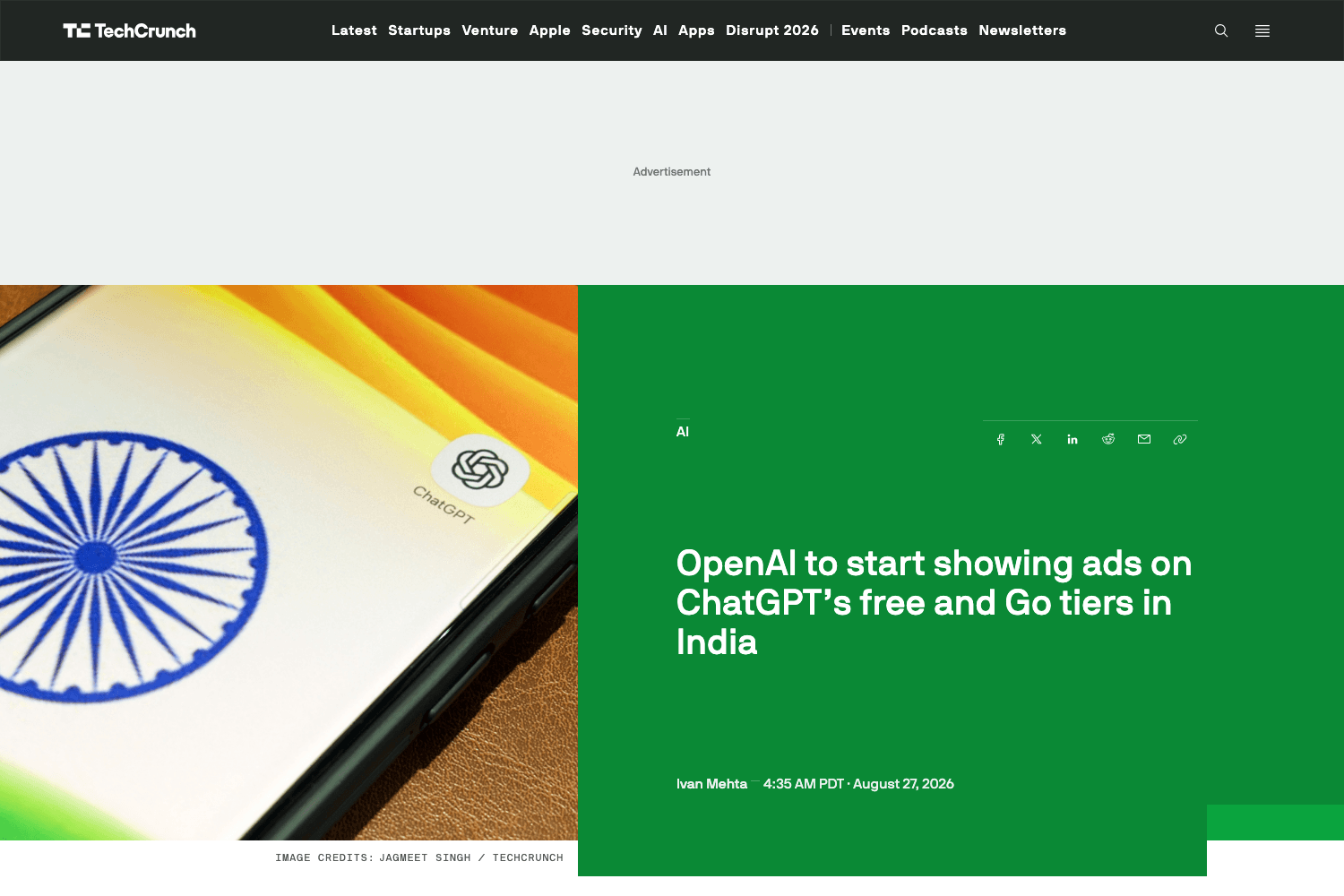
TechCrunch's Ivan Mehta reported the rollout at 4:35 AM PDT that morning, with more than 50 brands going live in the first week and WPP and Omnicom attached as agency partners. OpenAI's own help centre had been rewritten within the previous twelve hours. That page, rather than the press coverage, is where the detail worth acting on sits.
Key Takeaways:
- Ads run on the Free and Go plans only. Plus, Pro, Business, Enterprise, and Edu accounts stay ad-free, and OpenAI says it does not show ads to accounts identified as belonging to people under 18.
- Sponsored units appear below the end of a response, labelled and visually separated, and OpenAI states that advertisers have no ability to shape, rank, or alter ChatGPT's answers.
- Two exits exist: pay for Plus or Pro, or take a free no-ads option that cuts your daily message count and removes access to tools like image generation.
- Switching off ad personalization is not the same as switching off ads; you keep getting ads matched to your current thread.
- Temporary Chats show no ads at all.
What the ChatGPT ads India rollout actually changed
This is not the beginning of advertising inside ChatGPT. OpenAI's help centre puts the start of the test at February 9, 2026, in the United States, describing a deliberate, phased approach that would expand gradually. India is a later stage of that same programme, and it matters because of scale: press coverage of the announcement put India above 100 million weekly ChatGPT users, second only to the US.
What is new for Indian users is the arrival of a paid placement in a product that had none. Dave Dugan, who runs global ads solutions at OpenAI, framed the pitch to advertisers as reaching people "at relevant, high-context moments when decisions are beginning to take shape." An ad manager is due next month with a minimum daily budget of ₹725, roughly $7.60.
Go is the plan most people will be surprised by. It launched in India in August 2025 as a low-cost subscription, ₹399 a month with UPI payment support, and OpenAI's help centre now describes it as available in every supported country. Paying for Go does not buy an ad-free product. That is the single fact most worth internalising here: on this plan you are a paying customer who still sees advertising.
Who sees ads and who stays ad-free
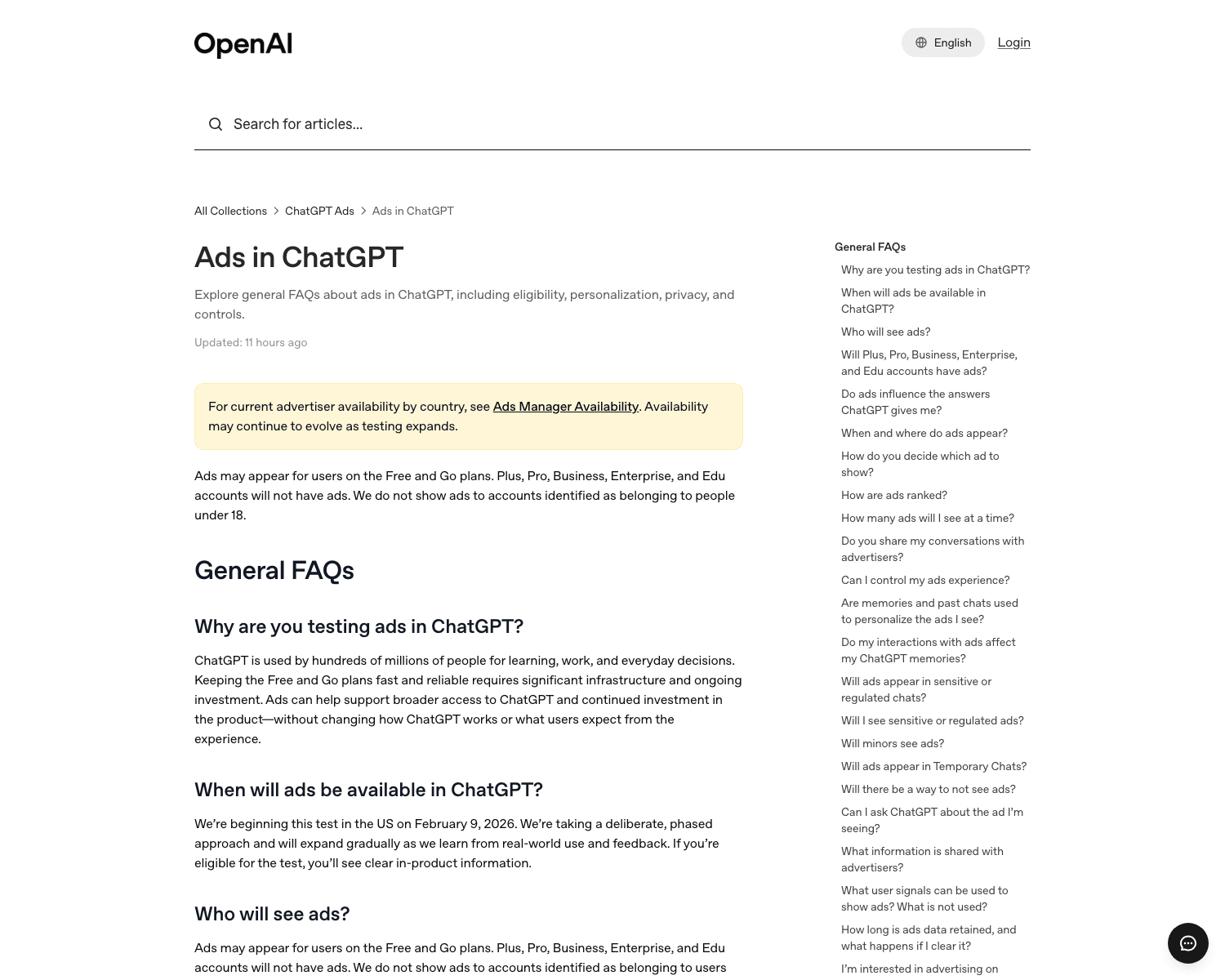
The eligibility rule is one sentence in OpenAI's documentation, and it is unusually blunt: "Ads may appear for users on the Free and Go plans. Plus, Pro, Business, Enterprise, and Edu accounts will not have ads. We do not show ads to accounts identified as belonging to people under 18."
Age is not taken purely on trust. OpenAI describes a model that weighs stated age alongside behavioural and account-level signals, including how long the account has existed, typical times of use, usage patterns over time, and the general topics somebody discusses. If that classifier decides you are a minor, you see no ads regardless of plan.
There are also whole categories of conversation the system will not sell against. Ads are not eligible to appear near sensitive or regulated topics, and OpenAI names personal health, mental health, and politics specifically. Political advertising is not allowed in ChatGPT at all right now. Advertisers in regulated verticals such as health and financial services can qualify under stricter criteria, but even then their ads stay away from personal health conversations.
Where a sponsored unit sits, and whether it touches the answer
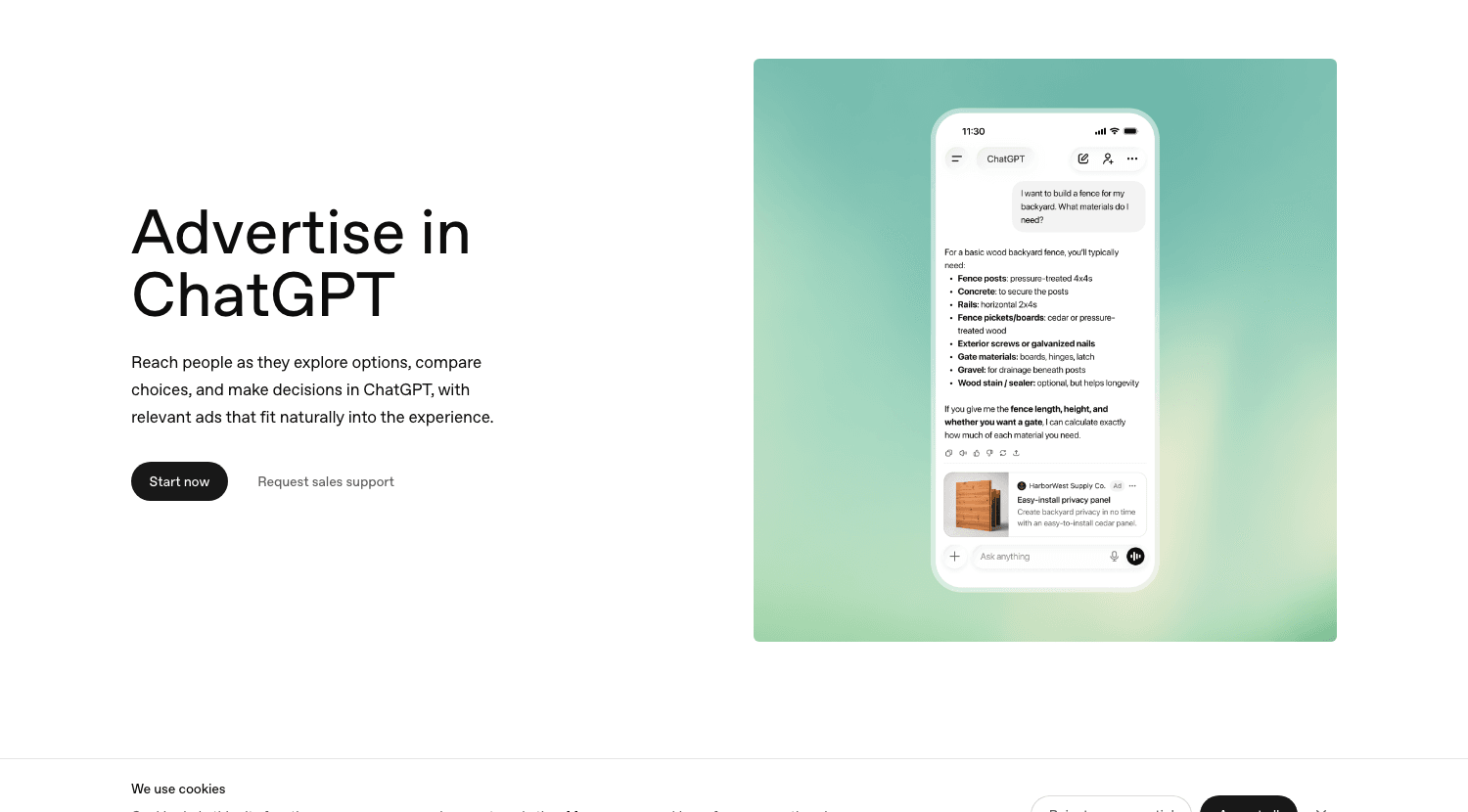
The ChatGPT ads India placement is below the end of a response, tagged as sponsored and visually separated from what ChatGPT wrote. During the test you may see one or more ad units under a response when there is a relevant match, and a single unit can carry items from one advertiser or several. The ChatGPT Atlas browser is excluded from the test entirely.
On the question everybody actually asks, OpenAI's answer leaves no wiggle room: ads do not influence ChatGPT's answers, they run on separate systems from the chat model, and advertisers have no ability to shape, rank, or alter responses. Seeing an ad is not an endorsement.
Ranking works the way ranking usually works. Where several ads are eligible, OpenAI weighs a combination of relevance and advertiser bids to decide which one shows first, and when personalization is on, signals from your wider ChatGPT use help judge relevance. You can tap the three-dot menu on an ad and choose "Ask ChatGPT" to pull it into the conversation; by default the model cannot see the ads you are shown.
The two exits, and the price of each
Here is where the ChatGPT ads India change stops being cosmetic. OpenAI documents two ways to stop seeing ads, and neither is free in the sense people mean.
The first is upgrading to an ad-free subscription plan, Plus or Pro. Straightforward, and it costs money.
The second is the one worth reading twice: a free, no-ads option with additional limits, described as fewer messages per day and no access to tools like images. You reach it through Settings, then Ads controls, then the option to change plan and go ad-free. The prompt spells out the trade before you confirm, because ads are what pay for the larger allowance. Choosing quiet means choosing a smaller ration.
A third control exists and is frequently mistaken for an off switch. In Settings you can turn off ad personalization, dismiss individual ads, see why a particular one was shown, and clear the data used for ads. Turning personalization off does not stop advertising; OpenAI is explicit that you will still see ads based on the context of your current chat thread, only without other threads, ad history, or topics feeding in. Those controls are limited to Free and Go users in regions where ads run or are about to. Personalized ads are not initially available in the European Economic Area or Switzerland.
One more lever, no settings required: Temporary Chats will not show ads.
What the ad system reads, and what advertisers never get
Ad selection draws on what you are discussing in the current thread plus basic context such as general location and language. With Personalized Ads enabled, that widens to your current thread including personalized model responses, how you interact with ads, and past chats and memory. If memory is on, ChatGPT may save and reference recent chats when picking an ad.
The counterweight is what leaves the building, and the list is specific. Advertisers never receive your chats, chat history, memories, name, email, precise location, IP address, or sensitive information. What they get is aggregated reporting such as total views and clicks. If you message an advertiser through an ad, they see only the messages you send them directly. Delete your ads data and it stops being used immediately, though it sits on OpenAI's servers for up to 30 days before removal.
Actions on ads do not pollute your memory either. Hiding, reporting, viewing, or clicking an ad is not written back into what ChatGPT remembers about you.
When the free tier grows a budget, move the work that cannot be interrupted
Take the two exits seriously for a moment. Both of them reprice the same thing: how much uninterrupted machine time you get for nothing. Ads buy you the larger message allowance; refusing ads shrinks it and takes image generation and similar tools with it. Whichever you pick, the ceiling on a free consumer chat plan is now something OpenAI adjusts, in public, on its own schedule. That is a fine deal for asking questions. It is a bad foundation for anything that has to run to completion.
That gap is what MoClaw fills. It is a hosted cloud AI computer, so a long job runs on its machine rather than inside a chat window whose message budget is being renegotiated; you start the task and the allowance that governs your afternoon of questions is not the same allowance governing whether the job finishes.
The always-on part matters more than it sounds. A scheduled report that fires at 6 AM has to land somewhere that is awake, and a laptop with a closed lid is not that somewhere, nor is a chat tab you closed on Tuesday. MoClaw stays up so scheduled and long-running work has a place to land, and you pick it back up from whichever device you are holding.
None of this is a reason to stop using ChatGPT, and it would be silly to pretend otherwise given that most of the people reading this are on Free or Go for good reasons. MoClaw runs alongside the tools you already have rather than instead of them: keep the chat product for the conversation, hand the work that must survive a rate limit to a machine that is not rationing your messages. If you want to see where that line falls for you, our own pricing breakdown walks through it, and the free trial is three days and 1,000 credits, with the $20 plan running 1,000 credits a month.
For a comparison of what the consumer chat tiers do and do not cover, what ChatGPT Work actually includes and how far the free agent tier stretches are the two most useful things we have written on the subject.
Frequently asked questions
Are ChatGPT ads India-only?
No. India is one stage of a phased rollout that OpenAI began testing in the United States on February 9, 2026. OpenAI's help centre points to its Ads Manager availability list for current advertiser coverage by country and notes that availability keeps changing as testing expands.
Does paying for ChatGPT Go remove ads?
No, and this is the most common misreading of the announcement. Go is a paid plan that still shows ads. Only Plus, Pro, Business, Enterprise, and Edu accounts are ad-free.
Can I turn ads off completely on the free plan?
Yes, with a cost. In Settings, under Ads controls, you can change plan to go ad-free, which reduces your daily message limits and removes access to tools such as image generation. Turning off ad personalization on its own does not remove ads.
Do ads change the answers ChatGPT gives me?
OpenAI says no. Ads run on separate systems from the chat model, and advertisers cannot shape, rank, or alter responses. Ads are labelled and sit below the answer rather than inside it.
Will my conversations be shared with advertisers?
No. Advertisers do not receive chats, chat history, memories, name, email, precise location, IP address, or sensitive information, only aggregated performance data such as views and clicks.
What to check in your ChatGPT settings this week
The ChatGPT ads India change is small on screen and large in what it implies. Open Settings and find Ads controls; if the section is missing on mobile, update the app. Decide deliberately between the larger ad-supported allowance and the quieter, smaller one, because the default picks for you. If you are on Go and assumed the subscription bought silence, that assumption is now wrong. And for the work that genuinely cannot stop halfway, put it somewhere the message budget is not a variable.
All plan, placement, and control details above are quoted from OpenAI's Ads in ChatGPT help centre article and its ChatGPT Go documentation as of August 27, 2026; the India rollout timing is from TechCrunch.
Continue Reading
More Guide
Praxist License: Fair Source, Not Open Source

What Is GLM-5.3-Flash? Specs and Price

Tokentab: See What Claude Code Actually Costs
Open Higgsfield: One Prompt Bar, 40 Models
OpenAI Assistants API Deprecated: What Broke
No Endpoints Found for OpenAI Batch Models
The MoClaw editorial team writes about workflow automation, AI agents, and the tools we build. Default byline for industry overviews, listicles, and collaborative pieces.
Ready to put this into practice?
MoClaw runs browser tasks, research, and schedules automatically. Try it free.
References: Ads in ChatGPT - OpenAI Help Center · What is ChatGPT Go? - OpenAI Help Center · OpenAI to start showing ads on ChatGPT's free and Go tiers in India - TechCrunch