Is ChatGPT Agent Free? It Starts at Plus $20

Is ChatGPT agent free? No. Work agent for multi-step tasks first appears on ChatGPT Plus at $20/month. The $8 Go tier does not include it, and Go may show ads.
Table of Contents
ChatGPT agent is not free. The capability OpenAI labels "Work agent for multi-step tasks" first appears on the ChatGPT Plus tier at $20 per month, and it is absent from the feature list of the $8 ChatGPT Go tier entirely.
That is the whole answer, and it is worth stating plainly because the naming has shifted. What people search for as agent mode is presented in the ChatGPT upgrade screen as Work agent, sitting alongside a separate Codex agent for coding. Searching for the old name will not find the current row.
Key Takeaways:
- Work agent for multi-step tasks is listed on ChatGPT Plus at $20/month, not on the $8 Go tier.
- ChatGPT Pro comes in two variants selected by a toggle: $100/month for 5x more usage than Plus, and $200/month for 20x. Both list "Maximum access to Work agent."
- The Go tier carries the footnote "This plan may include ads," which is unusual for a paid consumer subscription.
- ChatGPT Business lists Work agent too, along with connectors for Microsoft 365, Google Drive, Slack, GitHub, Linear and Figma, and "No training on your business data by default."
- Pricing renders in different currencies depending on account and tab. The Business view showed Singapore dollars while the personal view showed US dollars on the same account.
Is ChatGPT Agent Free? Where Work Agent First Appears
Read down the ChatGPT upgrade screen and the feature lists separate cleanly.
Go at $8 lists: core model, more messages and uploads, more image creation, longer memory, expanded voice mode. There is no agent row.
Plus at $20 lists: advanced models, advanced image creation with Thinking, expanded memory across chats, Work agent for multi-step tasks, Codex agent for coding, expanded deep research, projects and custom GPTs.
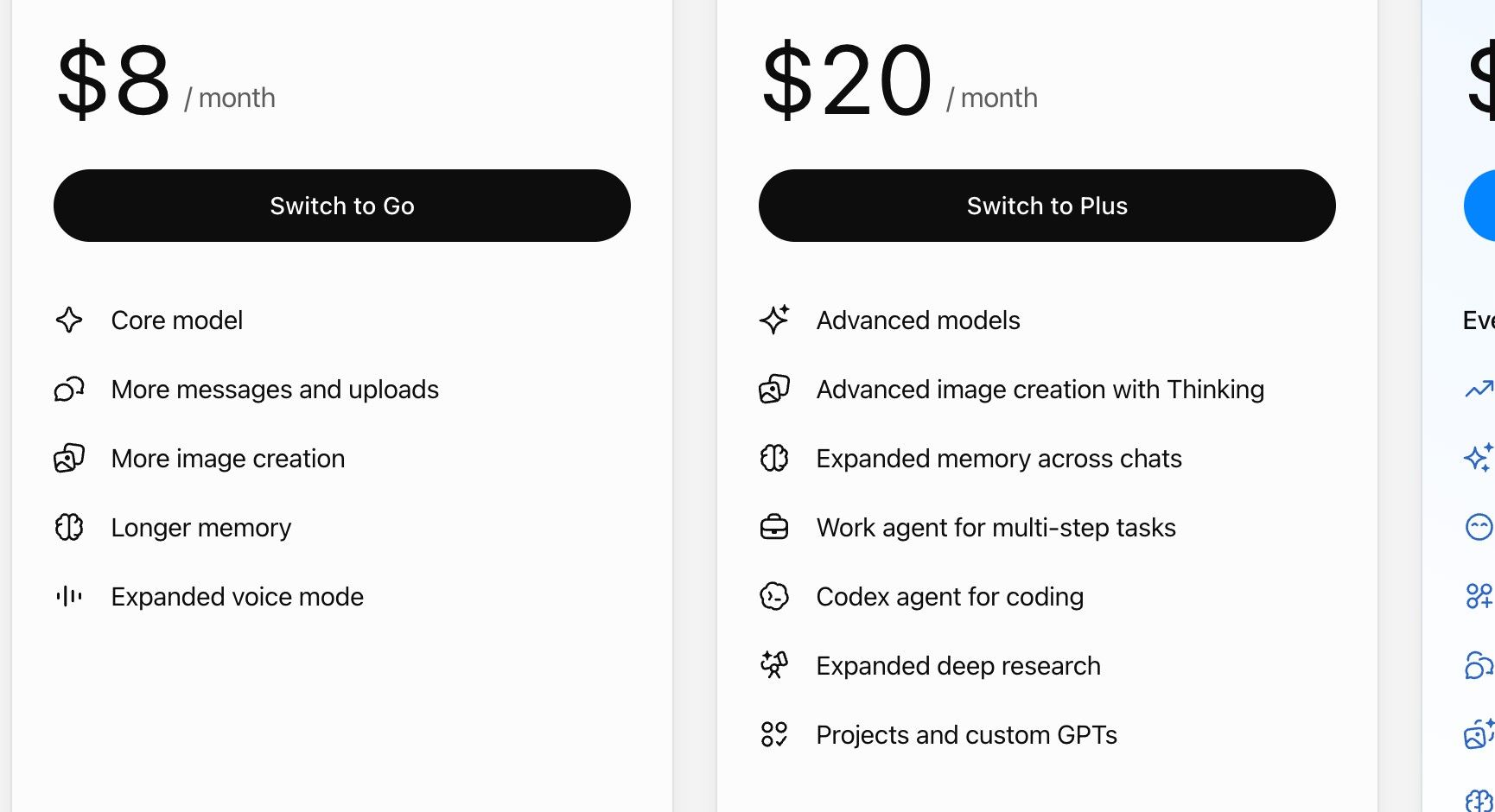
So the agent boundary is between Go and Plus, not between Free and paid. Someone who upgraded to Go specifically to get agent behavior bought the wrong tier, and the feature list is the only place that tells them.
Note also that Plus splits agents into two named products. Work agent handles multi-step tasks. Codex agent handles coding. They are separate rows with separate access levels at higher tiers, which means OpenAI is treating general task automation and code generation as different capabilities rather than one agent with different prompts.
Anthropic draws the same line at a similar price. Claude's pricing page puts Claude Code inside the $20 Pro tier and excludes it from Free, so both vendors have settled on $20 as the point where an agent stops being a demo.
ChatGPT Tiers in Full: Go, Plus and the Two Pro Variants
Read from the in-product upgrade screen on August 11, 2026:
| Tier | Price | Agent access |
|---|---|---|
| Go | $8 / month | No agent row listed |
| Plus | $20 / month | Work agent for multi-step tasks, Codex agent for coding |
| Pro (5x) | $100 / month | Maximum access to Work agent and Codex agent |
| Pro (20x) | $200 / month | Maximum access to Work agent and Codex agent |
The Pro card carries a 5x / 20x toggle that changes the price between $100 and $200 while the feature list stays nearly identical. The only line that changes is the usage multiplier: "5x more usage than Plus" versus "20x more usage than Plus."
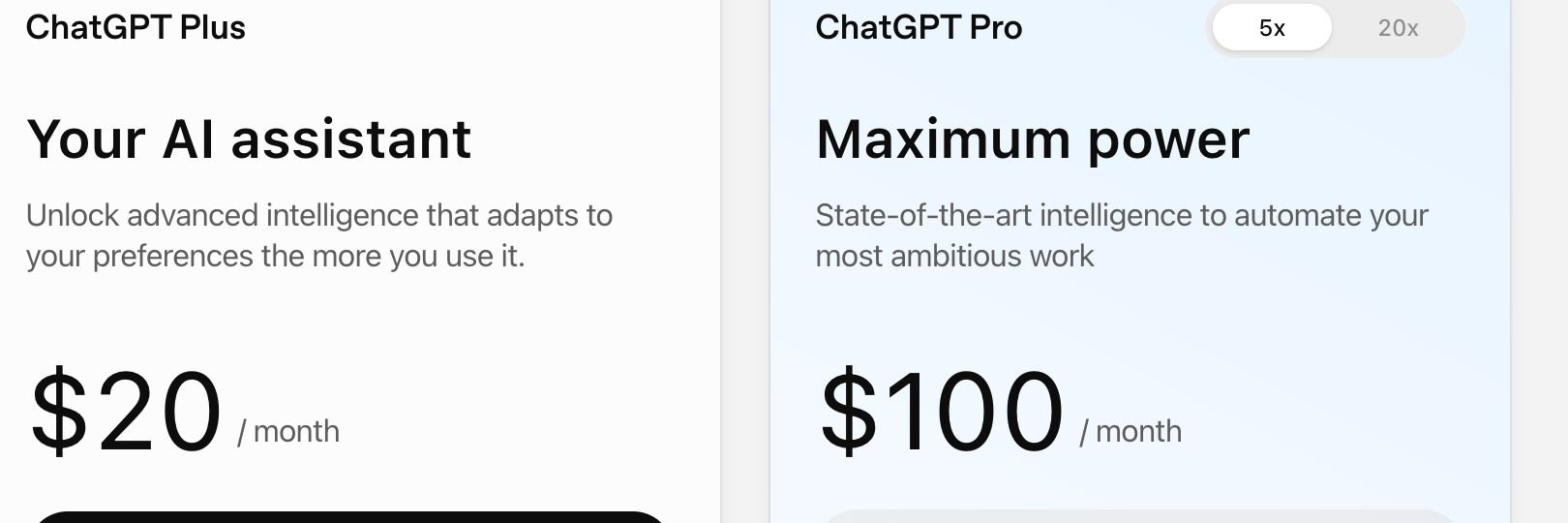
Both Pro variants add: Frontier Pro model, unlimited core chat, unlimited and faster image creation, maximum memory and context, and early access to experimental features. A footnote reads "Unlimited subject to abuse guardrails."
That toggle is the most useful thing on the screen for anyone deciding. You are not choosing between feature sets at the Pro level, you are choosing a multiplier. If your usage is 6x Plus, the $100 tier is the answer and the $200 tier is waste.
The $8 Go Tier Buys Access, Not Agency
Go is positioned as "Expanded access," with the subtitle "Explore topics in depth with longer conversations." Every one of its five listed features is a quantity increase over the free experience: more messages, more image creation, longer memory, expanded voice mode, core model.
None of them is a new capability. That is a coherent product decision, and it makes Go the wrong purchase for anyone whose problem is "I want it to go do something" rather than "I want more of what I already have."
If you are comparing tiers because a task keeps hitting a wall, the question to ask is which kind of wall. A message limit is a Go problem. A task that needs to browse, click through several steps and come back with a result is a Plus problem, and $8 will not solve it.
What Maximum Access to Work Agent Means at Pro
Both Pro variants list "Maximum access to Work agent" rather than a number. Combined with the 5x and 20x multipliers, the reasonable reading is that agent runs draw from the same usage pool as everything else, scaled by the multiplier.
This is the same structural problem every metered agent has. Manus publishes credit allowances of 4,000, 8,000 and 40,000 per month but states that consumption depends on task complexity. Genspark publishes task equivalents of roughly 1 Deep Research per day on free and roughly 625 per month on Pro. OpenAI publishes a multiplier against an unstated baseline.
Of the three, Genspark's is the only one you can plan against without buying first, because it is denominated in tasks rather than in credits or multiples.
For a Pro subscriber the practical consequence is mild, since 20x of anything is usually enough. For a Plus subscriber deciding whether to upgrade, it is the entire question and there is no published answer.
ChatGPT Business and the Currency Trap on the Pricing Screen
The Business tab lists ChatGPT Business at S$25 per user per month, marked RECOMMENDED, with Work agent for multi-step tasks included alongside connectors for Microsoft 365, Google Drive, Slack, GitHub, Linear and Figma, centralized billing, usage analytics, SAML SSO and MFA, and "No training on your business data by default."
One detail deserves flagging because it will bite anyone comparing prices. On the same account, the personal tab rendered prices in US dollars while the Business tab rendered ChatGPT Pro 20x as S$300 per month, in Singapore dollars, against the $200 shown on the personal view.
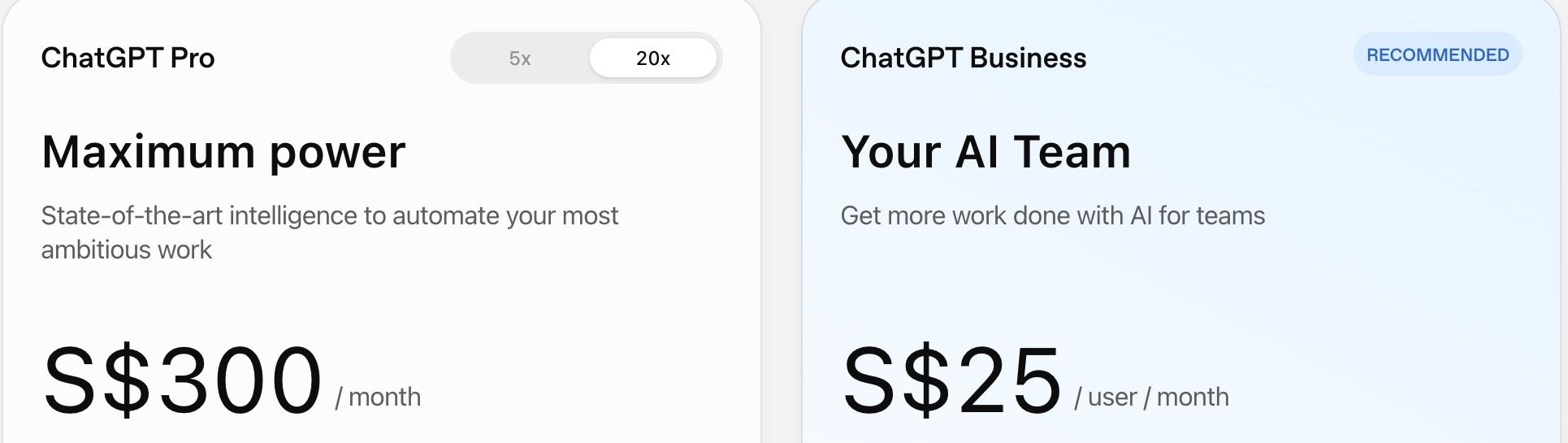
That is the same plan quoted in two currencies on two tabs. If you are building a budget from a screenshot, check the currency symbol rather than the number. Vendor pricing pages routinely localize by region, and the symbol is often the only thing that changes visually.
We have quoted the US dollar figures throughout this article because those were the ones rendered on the personal tier cards. Your own screen may differ.
Ads on a Paid Tier: What the Go Footnote Signals
Under the Go card sits the line "This plan may include ads," with a Learn more link. Neither Plus nor Pro carries that footnote.
This is worth noticing beyond the immediate purchase decision. A paid tier that also carries advertising is a signal about where the entry price is heading. Go exists to convert free users at a price point below Plus, and the ad line suggests $8 alone does not cover the cost of serving them.
For someone choosing a tier, the practical read is simple: if ads in the interface would bother you, Go is not a cheaper Plus, it is a different product. Budget for $20 or stay free.
When ChatGPT Agent Is the Wrong Tool for Scheduled Work
Work agent is built for tasks you ask for. You describe a multi-step job, it goes and does it, you get a result. That shape fits ad hoc work extremely well.
The shape it fits poorly is work that should happen without you asking. A competitor sweep every weekday morning, a report assembled before you open your laptop, a monitor that only speaks up when something changes. Those are not requests, they are schedules, and an assistant that runs inside a chat window is the wrong container for them.
That is the distinction worth holding onto when comparing agent products. It is not which one is smarter. It is whether the thing runs when you are present or when you are not.
MoClaw is a hosted cloud AI computer that runs scheduled agents on a flat monthly subscription. It is not a replacement for ChatGPT and we are not going to pretend the model quality question is settled by billing structure. What it changes is the failure mode: a job that runs every weekday does not consume a usage multiplier that you then have to reason about.
For the wider version of this comparison see Manus AI alternatives and the cost-focused cheaper alternative to Manus AI.

FAQ
Is ChatGPT agent free?
No. "Work agent for multi-step tasks" is listed on the ChatGPT Plus tier at $20 per month. It does not appear in the feature list for the $8 Go tier. Verified from the in-product upgrade screen on August 11, 2026.
Does ChatGPT Go include agent mode?
No. Go lists core model, more messages and uploads, more image creation, longer memory and expanded voice mode. There is no agent row.
How much is ChatGPT Pro?
Pro has a toggle: $100 per month for 5x more usage than Plus, or $200 per month for 20x. The feature lists are otherwise the same.
What is the difference between Work agent and Codex agent?
They are separate rows. Work agent handles multi-step tasks, Codex agent handles coding. Both appear on Plus, and both get "maximum access" at Pro.
Does ChatGPT Go show ads?
The Go card carries the footnote "This plan may include ads." Plus and Pro do not carry it.
How many agent runs do I get on Plus?
OpenAI does not publish a number. Pro tiers are described as 5x and 20x more usage than Plus, but the Plus baseline itself is not quantified on the upgrade screen.
Matching Agent Access to How Often the Work Runs
The boundary that matters in ChatGPT's lineup is between $8 and $20, not between free and paid. Go buys more of the same. Plus buys a different kind of thing.
Above that, the Pro decision is arithmetic rather than judgment: pick 5x at $100 or 20x at $200 based on how far past Plus your usage runs, since nothing else changes between them.
And underneath all of it sits a question the pricing screen cannot answer, which is whether your work is something you ask for or something that should already have happened by the time you look. Agent tiers price the first. Schedules are a different purchase.
All figures here were read from the ChatGPT upgrade screen on August 11, 2026, from the personal tier cards in US dollars. The Business tab on the same account rendered Singapore dollars. Check your own currency and re-verify before budgeting.
Continue Reading
More Guide
What Is ChatGPT Work? Features, Tasks, and Limits

Orca ADE: Parallel AI Agent Fleet Explained

Is Manus AI Free? What You Actually Get

Is Genspark Free? The Free Tier Is 1 a Day

Is Skywork AI Free? The 120-Credit Daily Cap

Paperclip AI: An Org Chart for Your Agents
The MoClaw editorial team writes about workflow automation, AI agents, and the tools we build. Default byline for industry overviews, listicles, and collaborative pieces.
Ready to put this into practice?
MoClaw runs browser tasks, research, and schedules automatically. Try it free.
References: ChatGPT (product) · ChatGPT pricing (OpenAI) · Manus Pricing Plans (metered-agent comparison point) · Genspark Pricing (task-denominated comparison point) · Claude pricing (Claude Code tier comparison point)