Is Genspark Free? The Free Tier Is 1 a Day

Is Genspark AI free? Yes, but the free tier is roughly one Deep Research, one Data Search and one Fact Check per day. Here is what that means in practice.
Table of Contents
Genspark is free to use, with a hard daily ceiling. On the Genspark pricing page, the Free column is quantified as roughly one Deep Research, one Data Search and one Fact Check per day, versus roughly 50 per month on Plus and roughly 625 per month on Pro.
That single line answers most of what people want when they search for Genspark free, and it is more specific than most vendors publish. Genspark labels the table "Equivalent to X times of Interactions," which is an unusually honest attempt to translate an opaque credit system into something you can plan against.
Key Takeaways:
- Genspark's free tier is approximately 1 Deep Research, 1 Data Search and 1 Fact Check per day, per the official pricing page as of August 11, 2026.
- Plus is roughly 50 Deep Research per month, Pro is roughly 625 per month, and a Credits Pack of 7,500 credits equates to roughly 38 Deep Research runs.
- Super Agent has no published per-run figure. Genspark states consumption "varies based on conversation length, tool usage and model complexity."
- The dollar prices for Plus and Pro are not displayed on the public pricing page. The page renders as "Upgrade your plan" and shows the comparison table without a price card.
- A per-day cap and a per-month allowance fail differently. Daily caps block bursts; monthly allowances block sustained use.
Is Genspark Free? What the Free Tier Actually Includes
Yes, and the limit is published. Here is the table exactly as Genspark presents it, read on August 11, 2026:
| Agent | Free | Plus | Pro | Credits Pack (7,500) |
|---|---|---|---|---|
| Super Agent | Varies by conversation length, tool usage and model complexity | Same | Same | Same |
| Deep Research | ≈1 / day | ≈50 / month | ≈625 / month | ≈38 |
| Data Search | ≈1 / day | ≈50 / month | ≈625 / month | ≈38 |
| Fact Check | ≈1 / day | ≈40 / month | ≈500 / month | ≈30 |
Notice the units change between columns. Free is expressed per day. Plus and Pro are expressed per month. That is not a formatting quirk, it reflects two different limiting mechanisms, and it is the most important thing on the page.
On Free you cannot bank yesterday's unused run. If you need three research passes on a Tuesday because that is when the work landed, the free tier gives you one and asks you to come back Wednesday.
Genspark Free vs Plus vs Pro: The Numbers Side by Side
Run the conversion. Roughly 1 per day on Free is about 30 per month if you use it every single day without missing one. Plus at roughly 50 per month is under twice that, but with the crucial difference that you can spend all 50 in one week.
Pro at roughly 625 per month is a different category entirely, about 12 times Plus. That is a jump sized for someone running research continuously rather than occasionally.
The Fact Check row is slightly lower across the board, roughly 40 per month on Plus and 500 on Pro against 50 and 625 for the other two. So Genspark is charging marginally more per fact check than per deep research, which suggests fact checking pulls more tool calls than the name implies.
Genspark Pricing: What the Three Tiers Cost
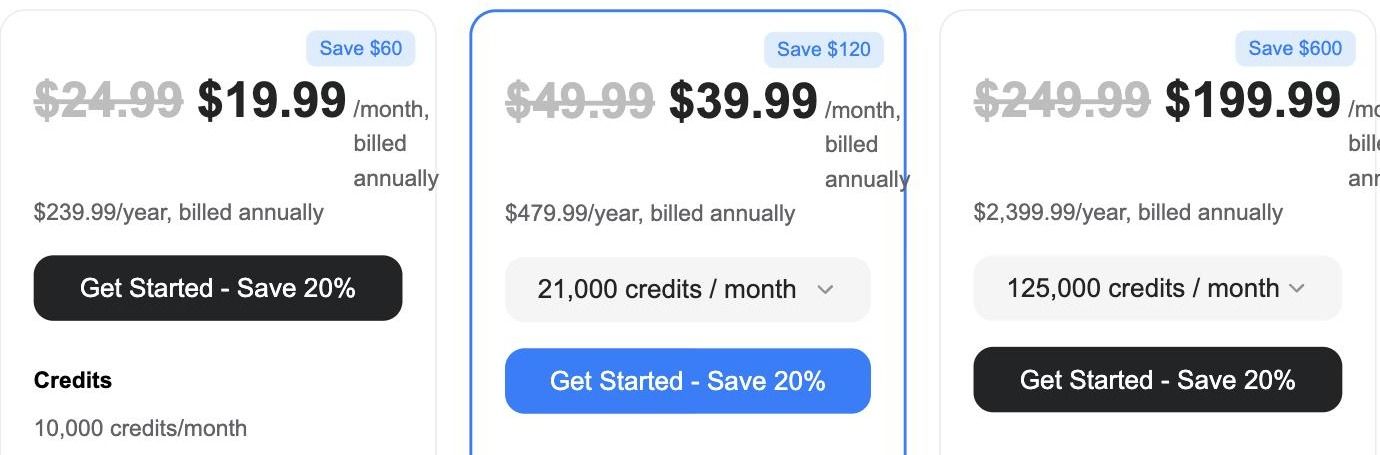
Genspark publishes its prices on the upgrade screen. With the Annually toggle selected on 11 August 2026, marked "SAVE 20%":
| Tier | Billed annually | Per year | Credits / month | Credits per dollar |
|---|---|---|---|---|
| Entry | $19.99 / month | $239.99 | 10,000 | 500 |
| Middle | $39.99 / month | $479.99 | 21,000 | 525 |
| Top | $199.99 / month | $2,399.99 | 125,000 | 625 |
Each card shows a struck-through monthly rate above the annual one: $24.99, $49.99 and $249.99, with savings labelled at $60, $120 and $600.
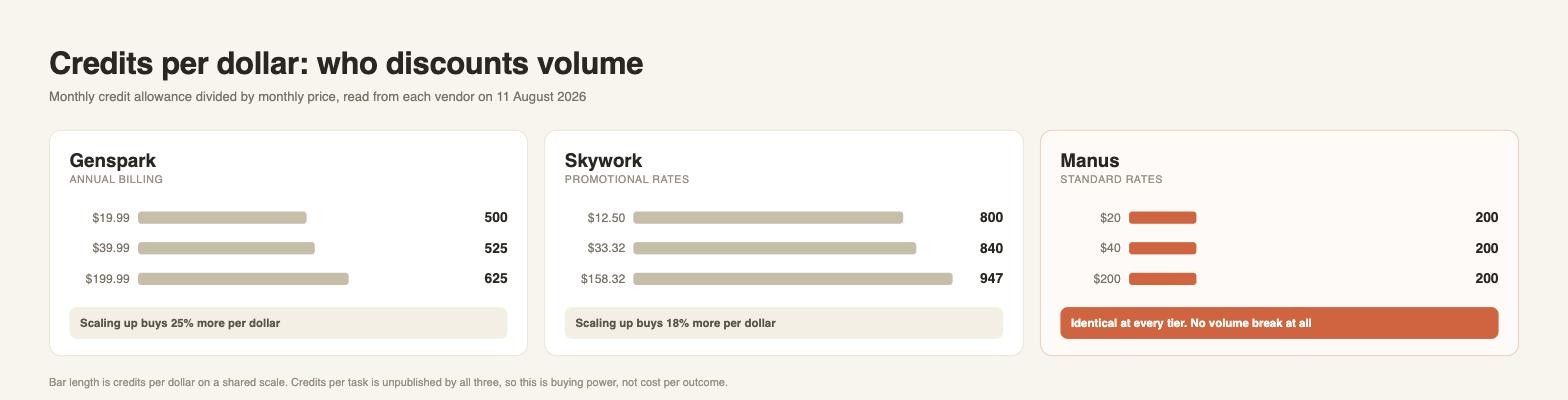
Run the division and Genspark does discount volume, climbing from 500 credits per dollar at the entry tier to 625 at the top, about 25% better. That is a real break for heavy users, and it separates Genspark from Manus, whose three tiers all sit at exactly 200 credits per dollar with no volume break anywhere on the ladder.
So the two products meter the same way and price it differently. Genspark rewards scaling; Manus is indifferent to it.
Genspark Credits: Why Super Agent Has No Published Rate
The Super Agent row spans all four columns with a single sentence: consumption "varies based on conversation length, tool usage and model complexity."
That is honest and unhelpful in equal measure. It is honest because an agent that decides its own tool calls genuinely cannot be priced per invocation. It is unhelpful because Super Agent is the product's headline capability, so the one thing you cannot budget is the one thing you came for.
The practical consequence: your free daily allowance is predictable for the three named agents and unpredictable for the agent that does the interesting work. If you are evaluating Genspark for a recurring workflow, run your actual task on Super Agent and watch the balance, because no published table will tell you.
What One Deep Research per Day Rules Out
A daily cap is fine for exploration and hostile to deadlines. Consider what one run per day means for common patterns:
You are comparing four vendors before a Thursday decision meeting. That is four research passes. On the free tier that is four days, so you needed to start Monday. Most people start Wednesday.
You are running a weekly competitor sweep. One per day is plenty, since you only need one per week. The free tier fits perfectly and you should not upgrade.
You are iterating on a prompt to get the research shape right. Iteration is the pattern daily caps punish hardest, because attempts two through five all live on separate days and you lose the thread between them.
The pattern is not about volume, it is about whether your work arrives evenly. Free tiers metered per day assume it does.
What Genspark Does Not Meter at All
Worth stating plainly, because it cuts against the rest of this article: Genspark does not put everything on the credit meter. Each tier carries an Unlimited Usage block listing core chat, image creation, meeting transcription and voice dictation, all at zero credit cost.
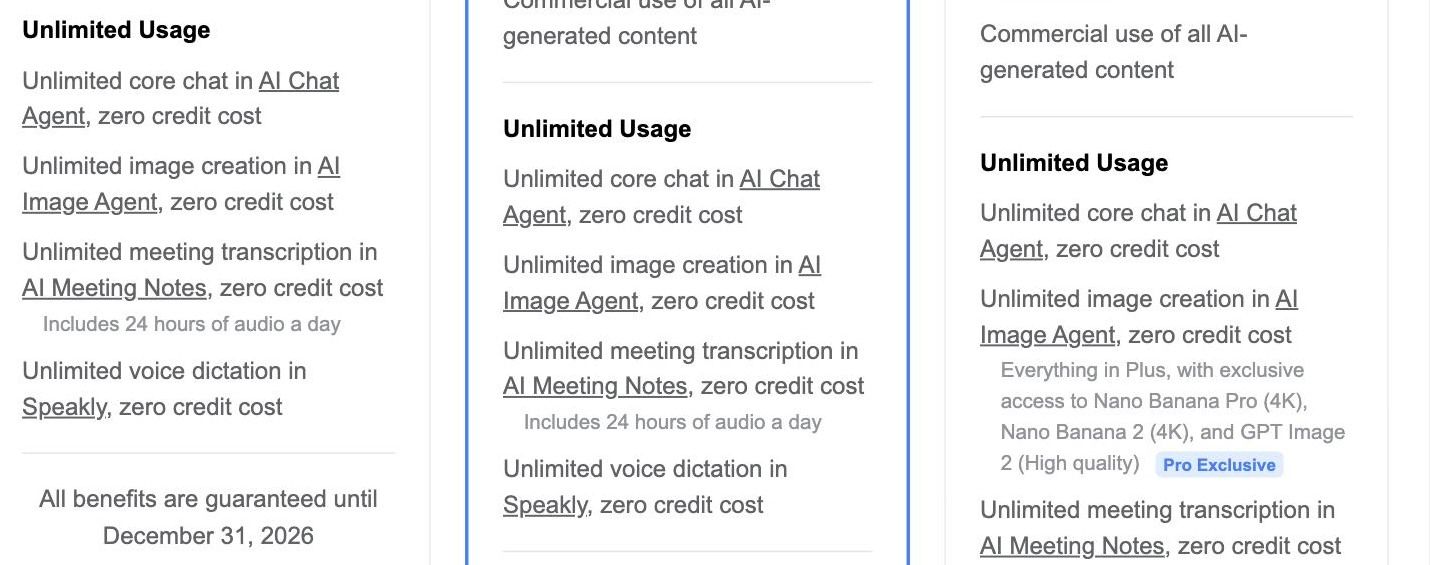
So the metering applies to the named research agents, not to the whole product. If your daily work is chatting, generating images and transcribing calls, the credit balance is close to irrelevant and the free tier question barely matters.
Two caveats sit right under it in Genspark's own words. "Unlimited subject to abuse guardrails," and "All benefits are guaranteed until December 31, 2026." A guarantee with an end date is a repricing notice with a longer fuse, so treat the unlimited tier as a 2026 arrangement rather than a permanent property of the product.
Genspark Credits Pack: The Top-Up Math
The fourth column is a Credits Pack of 7,500 credits, equating to roughly 38 Deep Research runs, roughly 38 Data Searches, or roughly 30 Fact Checks.
Divide it out: 7,500 credits over roughly 38 runs is about 197 credits per Deep Research. For Fact Check, 7,500 over roughly 30 is about 250 credits. That confirms the earlier read that fact checking is the more expensive operation.
This is the most useful number on the whole page, because it is the only place Genspark exposes an implied credit cost per task. If you know your task mix, you can now estimate a credit burn rate before you buy anything.
A pack is also the right instrument for burst work specifically. If your problem is that four research passes need to happen on Thursday, a pack solves it and a subscription does not solve it any better.
When a Daily Cap Is the Wrong Shape for Your Work
There are three shapes of recurring work, and they want different billing:
Occasional and light. One research pass a week, an ad hoc fact check. The Genspark free tier covers this outright. Do not upgrade, do not switch tools.
Bursty. Nothing for two weeks, then twelve runs in three days. Credit packs handle this better than any subscription, because you pay for the burst and not for the quiet fortnight.
Continuous and scheduled. Something runs every weekday whether or not you are watching. This is the shape that daily caps and credit meters both handle badly, because the automation's value grows with frequency and so does its cost.
This distinction is getting more consequential as the category consolidates. VentureBeat's analysis of Meta's Manus acquisition makes the point that teams standardising on a metered agent are also standardising on that vendor's billing model, which is harder to unwind than a feature dependency.
For that third shape, the useful comparison is not Genspark versus another metered agent. It is metered versus flat. MoClaw is a hosted cloud AI computer that runs scheduled agents on a monthly subscription rather than per task, which means a weekday job does not get more expensive as you extend it. It is not free, and for the first two shapes above it would be the wrong purchase.
We have written the broader comparison in Manus AI alternatives and the cost-focused version in a cheaper alternative to Manus AI, both of which cover the same metered-versus-flat decision with a different vendor as the starting point.
FAQ
Is Genspark AI free?
Yes. The Genspark pricing page shows a Free column with roughly 1 Deep Research, 1 Data Search and 1 Fact Check per day, verified August 11, 2026.
How many free searches does Genspark give per day?
Approximately one of each named agent per day. Genspark writes it as "≈1 / day" for Deep Research and Data Search, and "≈1 / day" for Fact Check.
How much does Genspark cost?
With the Annually toggle selected on 11 August 2026, the three tiers showed $19.99, $39.99 and $199.99 a month billed annually, carrying 10,000, 21,000 and 125,000 credits, each against a higher struck-through rate. Genspark runs promotions, so check your own account for the figure that applies to you.
How many credits is a Genspark Deep Research?
Genspark does not state it directly, but its Credits Pack row implies it. A 7,500 credit pack equates to roughly 38 Deep Research runs, which works out to roughly 197 credits each.
Does the Genspark free tier include Super Agent?
The Super Agent row spans all columns with the note that consumption varies by conversation length, tool usage and model complexity. Genspark publishes no per-run figure for it on any tier.
Do unused free runs roll over?
The free tier is expressed per day while paid tiers are expressed per month, which indicates a daily reset rather than an accumulating balance. Confirm against your own account before planning around it.
Picking Between a Daily Allowance and a Flat Monthly Agent
Genspark's free tier is one of the more honest ones on the market, because it tells you the limit in tasks instead of in credits you cannot convert. One research pass a day is a real amount of capability for zero dollars.
It breaks in exactly one place, and it is worth knowing before you build on it: work that arrives in bursts, or work that runs on a schedule and gets more valuable the more often it runs. A daily cap is a floor and a ceiling at the same time.
Before upgrading anything, count how many research passes you actually ran last month and on how many distinct days. If the count is low and the days are spread out, stay on free. If the count clustered into a handful of days, buy a credits pack. If it ran every weekday, the metered model is the wrong instrument and no tier of it will feel right.
All figures in this article were read from genspark.ai on August 11, 2026. Vendor limits change without notice, so re-verify before you budget.
Continue Reading
More Guide
Orca ADE: Parallel AI Agent Fleet Explained

Is ChatGPT Agent Free? It Starts at Plus $20

Is Manus AI Free? What You Actually Get

Is Skywork AI Free? The 120-Credit Daily Cap

Paperclip AI: An Org Chart for Your Agents

AI Optimization Travel Under Human Review
The MoClaw editorial team writes about workflow automation, AI agents, and the tools we build. Default byline for industry overviews, listicles, and collaborative pieces.
Ready to put this into practice?
MoClaw runs browser tasks, research, and schedules automatically. Try it free.
References: Genspark Pricing (official) · Manus Pricing Plans (metered-agent comparison point) · Why Meta bought Manus and what it means for enterprise AI agents (VentureBeat) · Meta acquires AI agent firm Manus (CNBC) · Skywork