What Is CopilotKit OpenTag? Slack Agent Basics

CopilotKit OpenTag is an open-source Slack agent starter. Learn what it is, what it is not, how it differs from Claude Tag, and when a managed agent saves work.
Table of Contents
CopilotKit OpenTag is an open-source Slack agent starter that lets teams run an AI agent inside Slack threads. It is useful if you want to read permitted Slack threads where it is installed/invoked, call tools, render results, and keep the runtime under your control.
Key takeaways:
- CopilotKit OpenTag is about Slack-first agent building, not a finished managed teammate.
- It is open source and MIT licensed, but "free to use" does not mean free to operate.
- OpenTag is not Claude Tag, and it is not an Anthropic product.
- There is another OpenTag project, amplifthq/opentag, focused on routing agent mentions to local coding agents.
- If you do not want to manage Slack apps, model keys, hosting, persistence, and deployment, a managed cloud agent such as MoClaw may be less work.
I understand why the name is getting attention. A Slack agent sounds like the missing piece between "AI can answer this" and "AI can actually deal with this thread while I go do something else." That is also where the confusion starts. Open source gives you control. It does not remove the setup work. I have learned to pause there.
Disclosure: This article was produced by MoClaw. Vera is a MoClaw staff writer. For this piece, I reviewed the public CopilotKit/OpenTag repository, CopilotKit docs, Slack developer docs, and the separate amplifthq/opentag repository on June 30, 2026. I did not deploy OpenTag in a production Slack workspace, so this is a source-based explainer, not a performance test.
What CopilotKit OpenTag Is
CopilotKit OpenTag is a starter project for running an AI agent in Slack. The project describes itself as "an open-source alternative to Claude in Slack," meaning you can run your own agent that responds inside Slack conversations instead of buying a closed managed teammate. As of June 30, 2026, the dependable setup path is to run OpenTag from the CopilotKit monorepo. The standalone npm installation is not yet the recommended production path because several bot SDK packages are still being published and aligned.
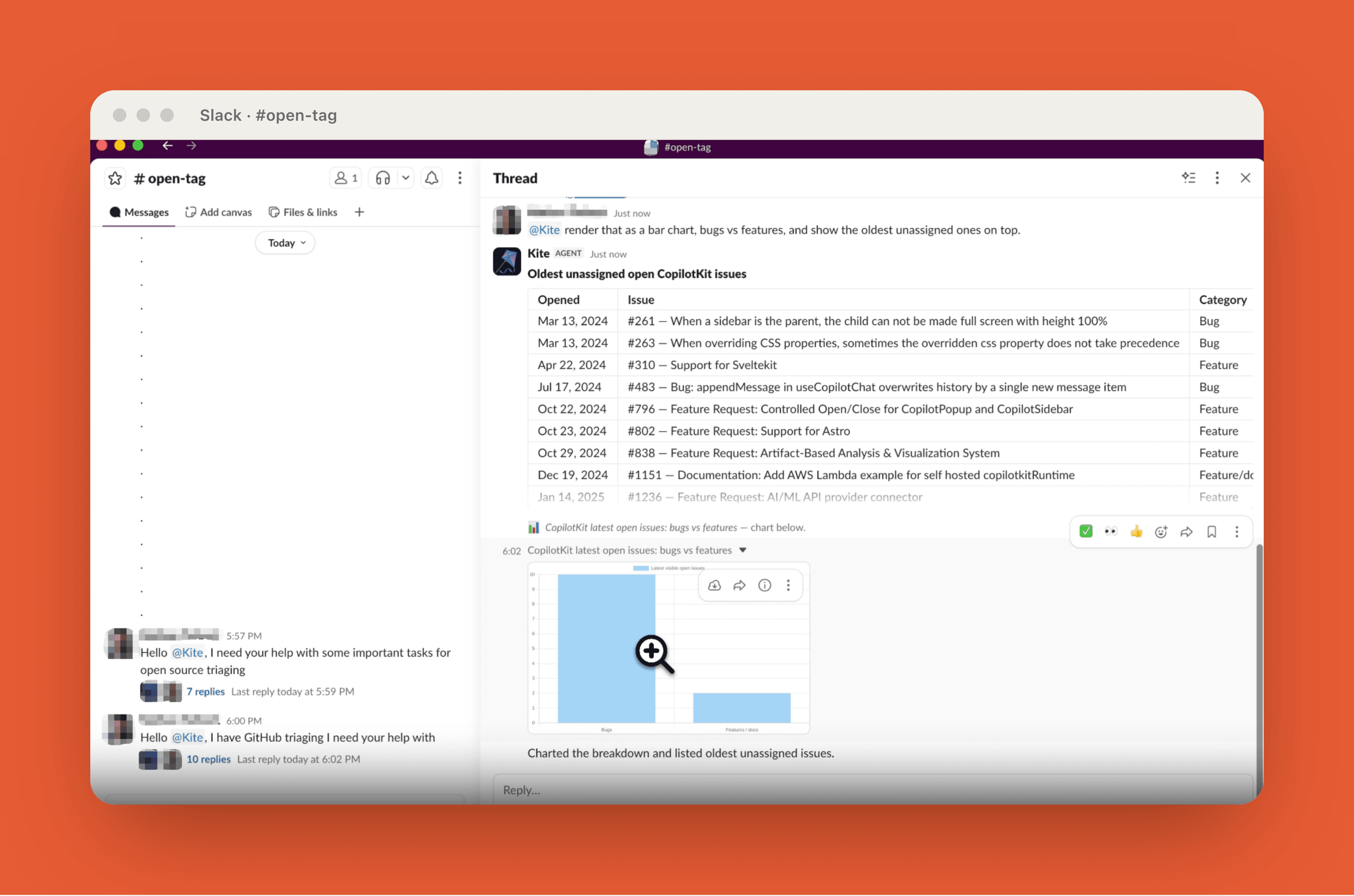
The public CopilotKit/OpenTag GitHub repository says the agent can read Slack threads, answer, call tools, and render rich results in the conversation. It is built on CopilotKit's bot SDK and related packages, including a Slack adapter, runtime, bot UI components, and optional Redis-backed persistence.
The basic flow is simple on paper:
- Create a Slack app.
- Add Slack tokens and a model key.
- Run the CopilotKit agent backend.
- Run the bot process.
- Mention the bot in a Slack thread.
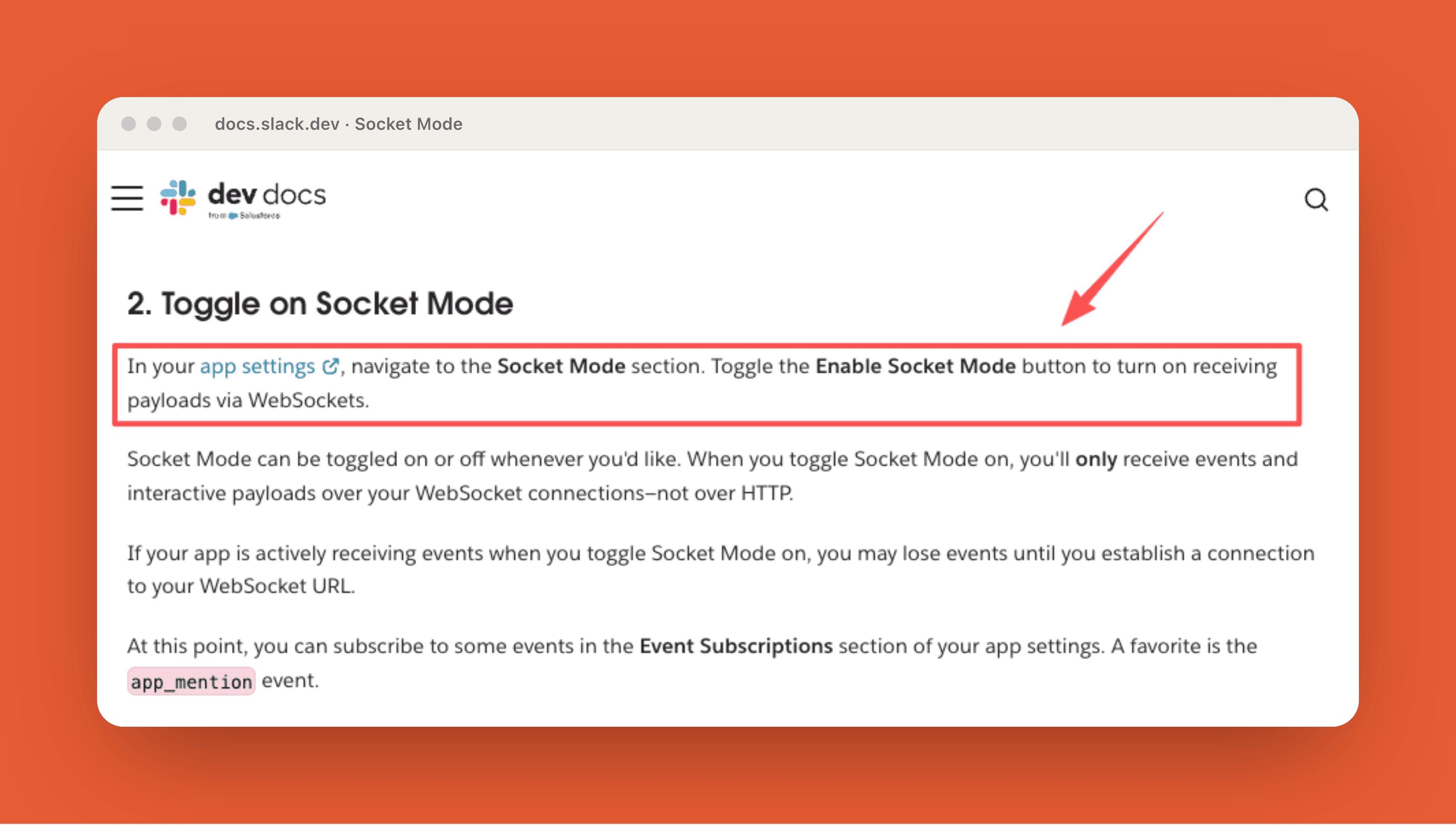
The practical flow is less tiny. You need a Slack app, Socket Mode or event handling, secrets, hosting, model credentials, tool wiring, and some decision about where thread state should persist. Slack's own Socket Mode documentation explains that apps receive events over WebSockets instead of a public HTTP request URL, but the app still has to handle event delivery, acknowledgements, reconnects, and tokens.
That is not criticism. It is the deal. OpenTag gives builders a starting point, not a finished operations layer.
The Two OpenTag Projects People May Confuse
At least two public open-source projects are using the OpenTag name. They are not the same project, and mixing them together makes the whole topic harder than it needs to be.
CopilotKit/OpenTag for Slack-first agents
CopilotKit/OpenTag is the project this article is about. It is Slack-first, built around CopilotKit's agent and bot stack, and aimed at teams that want to run an agent inside a chat platform. The repo also points to CopilotKit's broader agent UI and runtime ecosystem, where CopilotKit describes itself as the frontend stack for agentic user experience.
The important part: this OpenTag is for building a chat-platform agent experience. It can be adapted, but the headline use case is an open-source Slack agent.
amplifthq/opentag for agent-mention routing
The other project, amplifthq/opentag, is also open source and MIT licensed, but it has a different job. Its README describes it as a way to connect Slack, GitHub, or Lark to a local coding agent. It listens for mentions, routes tagged requests to Codex or Claude Code running locally, and replies back in the same platform.
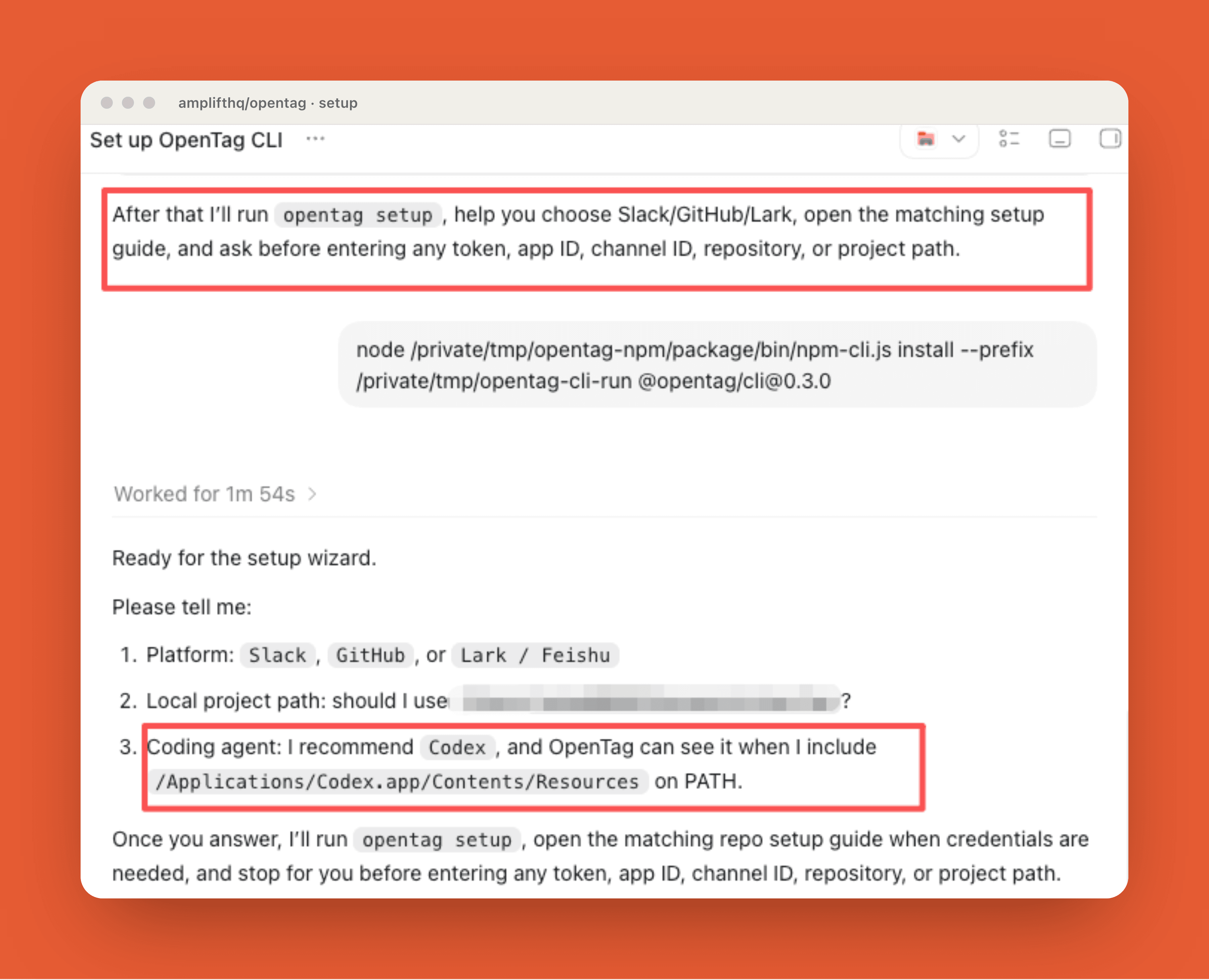
That makes amplifthq/opentag closer to an agent-mention router for coding workflows. It is relevant if your team wants to mention an agent from Slack or GitHub and have it work against a local checkout. It is not the same thing as CopilotKit/OpenTag, even though both use OpenTag and both touch Slack.
What OpenTag Is Not
OpenTag is easiest to understand by drawing a few boundaries.
Not Claude Tag or an Anthropic product
CopilotKit OpenTag is not Claude Tag. It is not owned by Anthropic, and it should not be described as an official Anthropic product.
Claude Tag is Anthropic's official Slack teammate product, launched in beta on June 23, 2026, for Claude Team and Enterprise customers. OpenTag uses "Claude in Slack" as a comparison point, but comparison is not the same as product ownership. If you are writing internal notes or evaluating vendors, keep that line clean.
This also matters for trust. If a team thinks it is installing something backed by Anthropic when it is actually deploying an open-source starter, the security and support expectations will be wrong from day one.
Not a fully managed teammate by default
OpenTag is not a fully managed teammate by default. The CopilotKit repository itself says there are two ways to run it: self-host it with the open-source SDK, or wait for a managed CopilotKit service. It also states that setting up hosting for chat agents is not easy.
That sentence is doing a lot of useful work.
A self-hosted Open Tag setup can give you control over the runtime, tools, model choice, and data path. But somebody still has to own uptime, logs, app tokens, model billing, tool failures, retries, permissions, and updates. If that person is you, the agent has already created a job before it has removed one.
Why Slack Agent Builders Care
Slack is where a lot of work already has context. A project thread may contain the problem, the decision history, the people involved, the file links, and the half-finished action items. A Slack AI agent is appealing because it can start from that context instead of asking you to paste everything into a separate chatbot.
For builders, CopilotKit OpenTag matters for four reasons.
First, it gives you a working pattern for an agent that lives inside Slack threads. You are not starting from a blank app.
Second, it supports tool calls and richer responses. That matters because useful agents often need to do more than produce text.
Third, it keeps the stack open enough for model and tool choices. The repo shows examples using OpenAI or Anthropic model keys, which is useful for teams that already have a preferred provider.
Fourth, it fits the current direction of AI Agent work: conversational entry point, tool execution behind the scenes, and human approval where the action has consequences. That is the part I care about. The agent should not just talk in the place where work happens. It should move the work forward without making the team babysit every small step.
When a Managed Cloud Agent Is Less Work
A managed cloud agent is less work when your actual goal is not "build a Slack agent." Your actual goal is "stop doing this recurring digital work myself."
That distinction sounds small until you are the person holding the deployment checklist.
If your team has engineers, a clear security model, and a reason to control every part of the runtime, CopilotKit OpenTag can be a good starting point. If you are an operator, founder, marketer, researcher, or small team lead, self-hosting can become a second workflow sitting next to the workflow you were trying to automate.
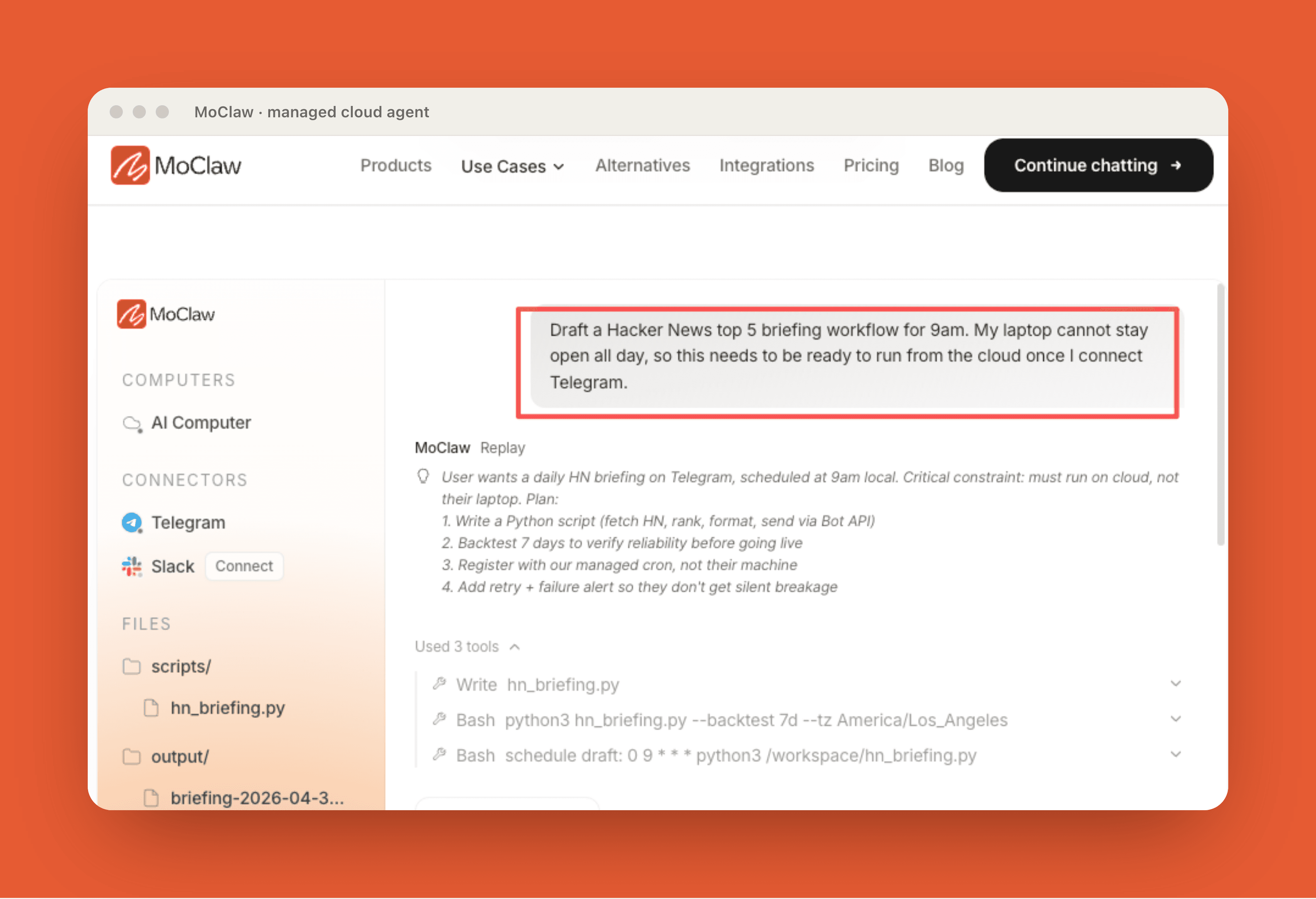
This is where MoClaw's value is different. MoClaw is a managed cloud AI assistant with its own cloud computer. Instead of asking you to deploy a Slack bot, wire tools, and maintain the runtime, it is built for people who want an always-on assistant they can reach through everyday chat channels, including Slack, without turning agent maintenance into part of the job.
FAQ
Is CopilotKit OpenTag free to use?
Yes, CopilotKit OpenTag is fully open-source under MIT license, so the code is free to use, modify, and deploy. However, real-world costs include LLM API calls, server hosting, Redis persistence, and ongoing maintenance. Operating costs vary based on model usage, hosting, persistence, monitoring, and engineering time. The OpenTag repository does not publish a standard monthly operating range.
Are CopilotKit OpenTag and amplifthq/opentag the same project?
No. CopilotKit/OpenTag is a Slack-first agent framework built on CopilotKit's SDK for rich thread interactions and tool calling. In contrast, amplifthq/opentag is a lightweight mention router that forwards @agent tags in Slack, GitHub, or Lark to locally running coding agents like Claude Code. They serve different purposes.
Can non-technical teams use OpenTag without deployment help?
Usually not comfortably. While the concept is easy to grasp, setup requires creating a Slack app, managing tokens, configuring hosting, and handling environment variables. Non-technical teams often need developer support for reliable deployment and maintenance. A managed service is typically more practical for them.
Where does Slack thread data go during an agent run?
CopilotKit OpenTag's provided Slack setup uses Socket Mode. When needed, the bot reads thread content from Slack and passes relevant context through your runtime to the configured model. Interactive approval state is stored in memory by default, with Redis available for durability. Model providers, logs, and connected tools may also process or retain data depending on your configuration.
CopilotKit OpenTag: Control vs Convenience in Slack Agent Design
CopilotKit OpenTag is a useful open-source Slack agent starter for builders who want control over the runtime, model, tools, and deployment path. It is not Claude Tag, not an Anthropic product, and not a fully managed teammate unless someone provides and operates that managed layer.
For technical teams, that control may be the point. For operators and small teams, it may be the cost. If what you really want is an AI Agent that keeps working without making you own the infrastructure, CopilotKit OpenTag is worth understanding, but a managed assistant like MoClaw may be the version that actually leaves your to-do list.
Continue Reading
More Guide
OpenTag Workflow: Slack Threads to Approval Trails

Claude Tag Workflows for Shared Slack Context

What Is GLM-5.3? Specs, Speed, Access

GLM Coding Plan: Why You Hit Rate Limits

GLM-5.3 Is Live. The API Isn't Yet.

MoClaw Pricing: Is $20 a Month Worth It?
MoClaw Research publishes quarterly data studies on the AI tools ecosystem, drawing on public registries (npm, GitHub, Hugging Face, arXiv, Google Trends). All charts and datasets ship under CC-BY 4.0.
Ready to put this into practice?
MoClaw runs browser tasks, research, and schedules automatically. Try it free.